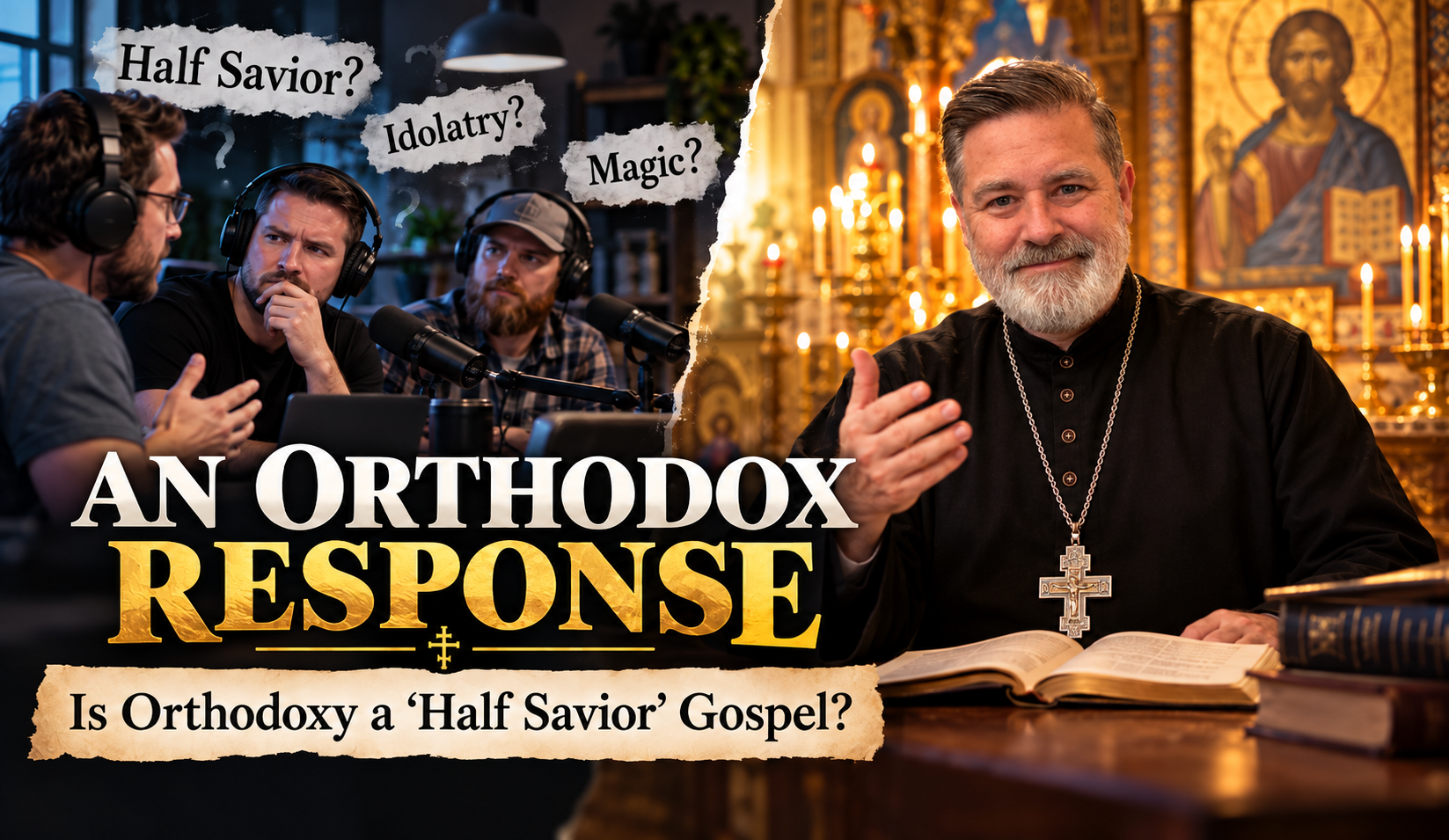
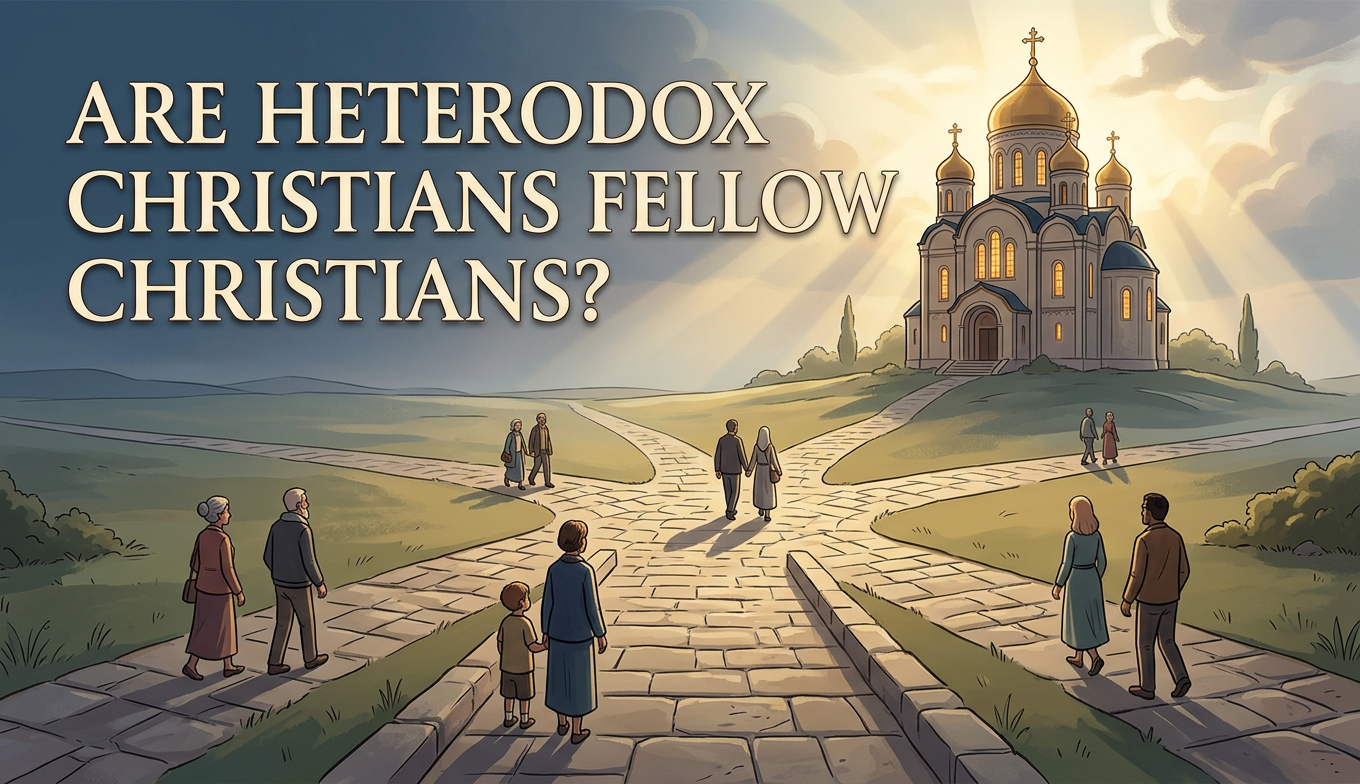
Recently, I listened to a fascinating conversation between Jonathan Pageau and Gavin Ortlund discussing Orthodoxy, salvation, and the nature of the Church. While the discussion itself covered a broad range of subjects, it reminded me of a question that I have heard repeatedly from both Orthodox Christians and those exploring Orthodoxy:
“Do Orthodox Christians consider Roman Catholics and Protestants to be fellow Christians?”
The question sounds simple, but the answer is anything but simple.
Depending on who you ask, you may receive very different answers. Some Orthodox Christians will answer with a straightforward “yes.” Others will answer with an equally confident “no.” Still others will offer a more nuanced response that may seem confusing at first.
Part of the difficulty is that people often use words differently. Before we can answer whether Orthodox Christians consider heterodox believers to be fellow Christians, we first need to understand what the word “heterodox” actually means.
You can Now Listen to Each Article
What Does “Heterodox” Mean?
The word heterodox comes from two Greek words.
“Heteros” means “other” or “different.”
“Doxa” means “teaching,” “belief,” or “opinion.”
Put together, the word literally means “different teaching” or “different belief.”
Within Orthodox Christianity, the term heterodox is generally used to describe Christians who confess Jesus Christ but who do not hold the fullness of the Orthodox faith. In other words, they possess beliefs that differ from the doctrinal teachings preserved by the Orthodox Church.
For example, Orthodox Christians would typically describe Roman Catholics, Protestants, Anglicans, Lutherans, Presbyterians, Baptists, and non-denominational Christians as heterodox Christians.
It is important to understand what the word does not mean.
Heterodox is not the same thing as atheist.
It is not the same thing as pagan.
It is not the same thing as an unbeliever.
Nor is it intended as an insult.
Rather, it is a theological category describing those who profess faith in Christ but who differ from Orthodoxy in matters of doctrine, ecclesiology, worship, or spiritual practice.
This distinction is important because when Orthodox Christians discuss heterodox believers, they are not discussing people who reject Christ altogether. They are discussing people who confess Christ while differing from the Orthodox Church on significant theological questions.
Once we understand that distinction, we can begin asking the larger question: How does the Orthodox Church understand its relationship to those Christians who stand outside her visible communion?
The Orthodox Starting Point: There Is Only One Church
Every discussion about heterodox Christians must begin with the Nicene-Constantinopolitan Creed.
Each Sunday, Orthodox Christians confess:
“I believe in One, Holy, Catholic, and Apostolic Church.”
Notice what the Creed does not say.
It does not say there are many churches.
It does not say there are branches of the Church.
It does not say there are denominations that collectively make up the Church.
The Orthodox understanding is that Christ founded one Church, not many.
The Apostle Paul writes:
“There is one body and one Spirit, just as you were called in one hope of your calling; one Lord, one faith, one baptism.” (Ephesians 4:4-5)
For the Orthodox Christian, this is not merely an abstract theological statement. It is a reality.
The Church is one because Christ is one.
The Body of Christ cannot be divided against itself.
This means that Orthodoxy rejects what is often called “branch theory,” the idea that Roman Catholics, Protestants, Orthodox, and others are simply different branches of the same Church.
Historically speaking, that has never been the Orthodox understanding.
The Orthodox Church identifies herself as the One, Holy, Catholic, and Apostolic Church confessed in the Creed.
That point is not controversial within Orthodoxy.
The controversy begins when we ask what relationship those outside her visible boundaries have to Christ and His Church.
What Did the Early Councils Teach?
Interestingly, none of the Seven Ecumenical Councils directly addressed Roman Catholics or Protestants because those groups did not yet exist.
However, the councils did address heretics and schismatics.
Two texts are especially important.
The first is Canon 7 of the Second Ecumenical Council in Constantinople in 381.
The second is Canon 95 of the Quinisext Council, often called the Council in Trullo, in 692.
Both canons establish different methods for receiving different groups into the Church.
Some groups were received through baptism.
Some groups were received through chrismation.
Others were received simply through a profession of faith and renunciation of their errors.
This distinction is incredibly important.
The Church did not treat every group identically.
The Church recognized varying degrees of separation.
If all heterodox groups were viewed exactly the same way, there would have been no reason for the councils to prescribe different methods of reception.
The existence of these distinctions tells us something significant about how the Church historically understood those outside her visible communion.
The Strict Ecclesiological Position
There is a position within Orthodoxy that emphasizes the absolute distinction between being inside the Church and being outside the Church.
This position argues that because the Church is one, anyone separated from the Church by heresy or schism cannot properly be called a Christian in the fullest theological sense.
Those who hold this position often point to the writings of St. Cyprian of Carthage and emphasize that outside the Church there is no salvation.
They argue that heresy fundamentally severs a person from the life of the Church.
This perspective exists within Orthodoxy and has historical roots.
However, even among those who hold this view, there is often disagreement about how to apply it pastorally.
Some use the language very strictly.
Others use it more carefully.
The challenge is that the historical reception practices of the Church often appear more nuanced than a simple inside-or-outside framework can fully explain.
The Mainstream Orthodox Position
The majority position among contemporary Orthodox bishops, theologians, and jurisdictions is more nuanced.
This position maintains two truths simultaneously.
First, the Orthodox Church is the fullness of the Church established by Christ.
Second, many heterodox believers are genuinely Christians in a real, though incomplete, sense.
This is why Orthodox Christians often speak of “non-Orthodox Christians.”
Notice the wording.
They are not called Orthodox Christians.
Neither are they typically described as pagans or unbelievers.
Instead, they are understood as Christians who are separated from the fullness of the faith and from sacramental communion with the Orthodox Church.
This language has become the dominant approach throughout much of the Orthodox world.
It preserves the uniqueness of the Orthodox Church while acknowledging that many outside her visible boundaries confess Christ, believe in the Holy Trinity, read the Scriptures, and sincerely seek to follow the Lord.
This position does not claim that all doctrinal differences are insignificant.
Quite the opposite.
It recognizes that theological differences matter precisely because truth matters.
At the same time, it recognizes that not every separation is identical.
Why Reception Practices Matter
One of the strongest arguments supporting this mainstream position comes from the Church’s own sacramental practice.
Historically, many Roman Catholics and certain Protestants have been received into Orthodoxy through chrismation rather than baptism.
Why is this significant?
Because the Church’s actions often reveal her theological reasoning.
If the Church viewed every heterodox person as being in exactly the same position as an unbeliever, then one would expect a universal practice of baptism for all converts.
Yet historically, that has not been the case.
Different local churches have applied different practices at different times, but the existence of these distinctions demonstrates that the Orthodox tradition has long recognized degrees of separation.
This does not mean the Church formally recognizes all heterodox sacraments as fully equivalent to Orthodox sacraments.
It does mean the issue has always been more complex than many modern debates suggest.
The Council of Crete and Modern Discussion
The most significant modern conciliar statement came from the Holy and Great Council of 2016.
The council stated that the Orthodox Church accepts the historical name of other non-Orthodox Christian churches and confessions.
Predictably, this generated controversy.
Some Orthodox believed the statement compromised Orthodox ecclesiology.
Others argued that it merely acknowledged historical reality.
After all, Roman Catholics, Lutherans, Anglicans, and others have been called Christian communities for centuries.
The council did not teach that these groups are equal branches of the Church.
Nor did it deny that the Orthodox Church is the One, Holy, Catholic, and Apostolic Church.
Rather, it reflected the language already used by many Orthodox churches throughout the world.
Whether one agrees with every aspect of the council or not, it demonstrates that the question is not nearly as settled as some internet discussions would lead people to believe.
Why Orthodox Christians Disagree
Part of the reason for disagreement is that Orthodoxy has always held together two realities that exist in tension.
On the one hand, the Church must protect the truth.
On the other hand, the Church must acknowledge the mysterious ways God works in the lives of human beings.
Orthodoxy has always been reluctant to place limits on God’s mercy.
The Church knows where the fullness of grace is.
The Church does not always claim to know where grace is absent.
Those are not the same statement.
Many modern Orthodox theologians have emphasized this distinction.
We know where the Church is.
We are less comfortable making absolute pronouncements about every person who exists outside her visible boundaries.
A More Fundamental Question
Perhaps there is an even deeper question beneath all of this.
Why do we ask whether heterodox believers are Christians?
Sometimes the question comes from genuine theological curiosity.
But often it comes from a desire to determine who is in and who is out.
The Orthodox tradition consistently calls us back to a different concern.
Am I in Christ?
Am I walking the path of repentance?
Am I acquiring the Holy Spirit?
Am I becoming transformed into the likeness of Christ?
The Fathers spent remarkably little time worrying about labels compared to the amount of time they spent pursuing holiness.
The purpose of theology is not merely to categorize people.
The purpose of theology is union with God.
As Orthodox Christians, we should never compromise the truth.
At the same time, we should never forget that every human being we encounter bears the image of God and is someone for whom Christ died.
So, Are Heterodox Believers Fellow Christians?
The answer depends on which Orthodox voice you ask.
A minority of Orthodox Christians would answer no.
They would argue that separation from the Church means one cannot properly be called a Christian.
A larger and more mainstream group would answer yes, but with qualifications.
They would say that Roman Catholics, Protestants, and other Trinitarian believers are Christians, though separated from the fullness of the Church and from sacramental communion with Orthodoxy.
This latter position is the most common view found among contemporary Orthodox bishops, theologians, and jurisdictions throughout the world.
Yet both sides agree on one foundational truth.
The Orthodox Church is not merely one denomination among many.
She is the One, Holy, Catholic, and Apostolic Church confessed in the Creed.
The real debate concerns how we understand the relationship between that Church and those who stand outside her visible boundaries.
As with so many things in Orthodoxy, the answer is not found in slogans.
It is found in history, theology, the councils, the Fathers, and above all in the life of the Church herself.
Final Thoughts
One of the things I appreciated about the conversation between Jonathan Pageau and Gavin Ortlund was not that they solved every disagreement between Orthodoxy and Protestantism. They did not. Nor should we expect them to.
Rather, what I appreciated was that they took seriously the questions of salvation, authority, tradition, and the Church itself. These are not secondary issues. They are foundational questions that every Christian should wrestle with honestly.
My hope in writing this article is not to provide ammunition for internet debates or to encourage triumphalism. The goal is to help people understand what the Orthodox Church actually teaches and why faithful Orthodox Christians sometimes answer this question differently.
If nothing else, I hope this article encourages all of us to move beyond caricatures and toward a deeper understanding of the Church, the Fathers, and the faith once delivered to the saints.
And perhaps most importantly, I hope it encourages us to pursue Christ Himself. For in the end, the purpose of theology is not merely to win arguments. The purpose of theology is communion with the living God.
Want the entire article distilled into one clear, printable page?
Download your free summary and keep it with you.
Get the free PDF + join thousands receiving short, practical Orthodox insights in the “Morning Brew with Father Don” to help you grow in Christ each week.