How St. Gregory Palamas and Orthodox Christianity Shaped the Fall of an Empire
What if an entire civilization chose theological conviction over political survival?
What if the fall of one of the greatest cities in Christian history was not simply the result of military defeat, but the consequence of a people refusing to surrender what they believed was the very heart of the Christian faith?
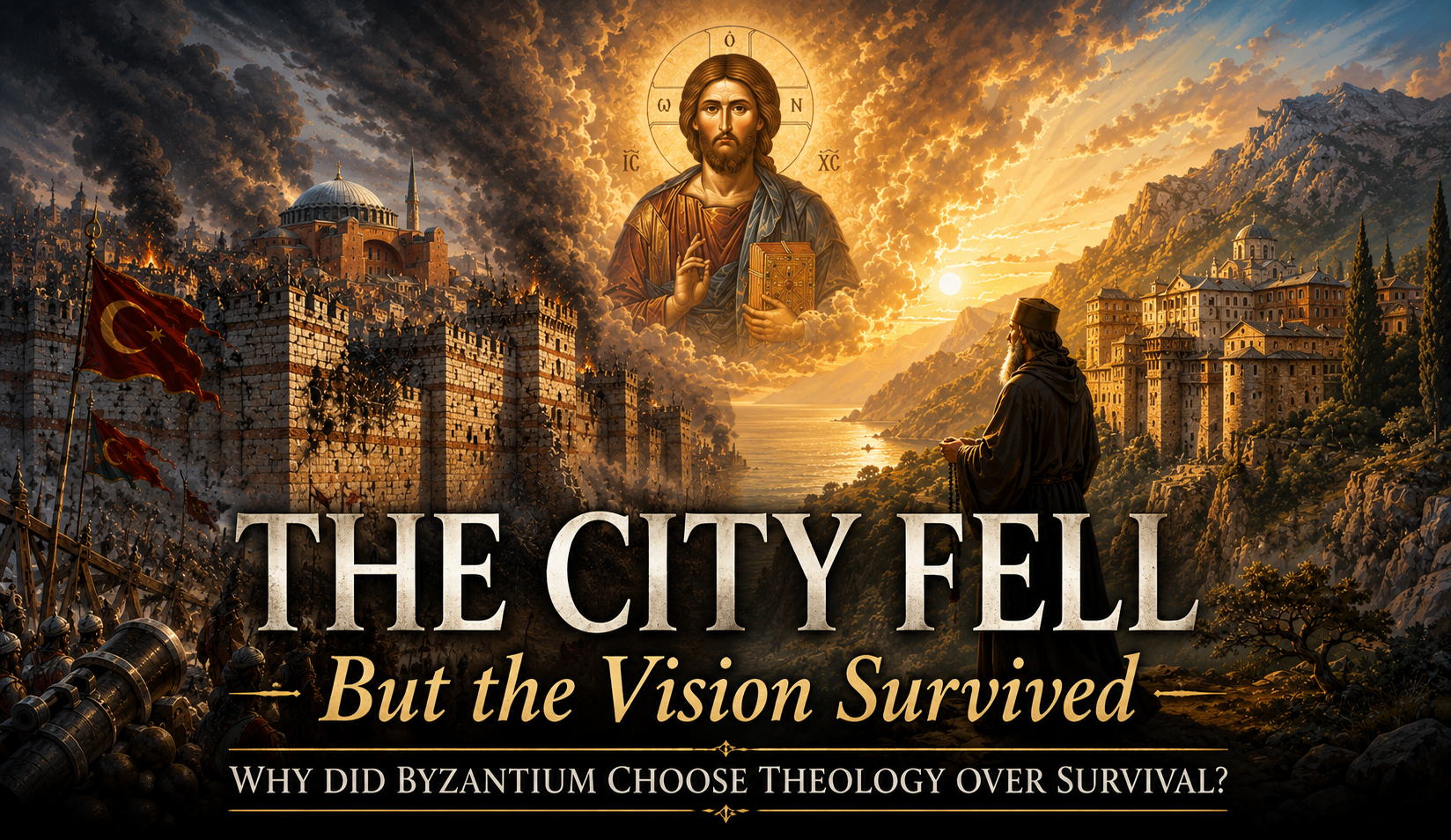
On May 29, 1453, the walls of Constantinople finally gave way. Ottoman soldiers poured into the city. The last Roman Emperor, Constantine XI Palaiologos, cast aside his imperial regalia, drew his sword, and disappeared into the chaos of battle. Within hours, the city that had stood for more than a thousand years as the capital of the Christian Roman Empire was gone.
For many historians, this was the end of Byzantium. For others, it marked the close of the Middle Ages. Yet beneath the military drama lies a far more profound story, one that most Christians have never heard.
The fall of Constantinople was not merely a clash of armies. It was the culmination of centuries of theological conflict, spiritual formation, and competing visions of what it means to know God.
By the fifteenth century, the Byzantine Empire desperately needed military assistance from the Christian West. Yet many Orthodox Christians viewed reunion with Rome as a betrayal of the spiritual inheritance they had received from the Fathers. They were not merely defending political independence. They believed they were defending a vision of salvation itself.
The question confronting Constantinople was therefore not simply whether the city could be saved, but whether survival was worth the price of theological compromise.
How did Christianity reach such a moment?
The answer begins not in imperial palaces or on the battlefield, but in the silence of a monastery.
It begins on Mount Athos, where generations of monks sought communion with God through prayer, repentance, and stillness. It begins with a controversy that would permanently shape Orthodox theology. And it begins with a monk and theologian named Gregory Palamas, whose defense of Hesychasm would help define the spiritual identity of Eastern Orthodoxy for centuries to come.
To understand why Constantinople fell, we must first understand what the Byzantines believed was worth preserving, even at the cost of an empire.
The story begins nearly 250 years before the fall, when Christians first turned their swords against one another.
You can Now Listen to Each Article
The Wounds of 1204
Most Christians know something about the Great Schism of 1054. They know of the disagreements concerning the Filioque, papal authority, and the growing estrangement between Rome and Constantinople.
Yet for generations, those disputes remained largely confined to bishops, theologians, and church leaders. The average Christian in Constantinople was far more concerned with daily life than with the finer points of ecclesiastical politics.
Everything changed in 1204.
The Fourth Crusade had been called to liberate the Holy Land. Instead, Western armies turned toward Constantinople itself. What followed became one of the darkest chapters in Christian history.
Crusaders stormed the greatest city in Eastern Christianity. Churches were looted. Relics were stolen. Sacred vessels disappeared. Priceless treasures accumulated over centuries were carried away by men who bore the same name of Christ as those they conquered.
The damage was not merely political or economic.
It was spiritual.
The sack of Constantinople created a wound that would endure for generations. Before 1204, a Byzantine Christian might view a Latin Christian as mistaken. After 1204, many viewed the West as a betrayer.
Theological disagreements can often be debated. Historical wounds are far more difficult to heal.
When the Byzantines eventually reclaimed their city in 1261, they discovered a hollow shell of its former glory. The treasury had been depleted. Great buildings had fallen into disrepair. Entire sections of the city had been devastated. More importantly, trust had been shattered.
Future proposals for reunion with Rome would no longer be evaluated solely on theological grounds. They would be weighed against memories of desecrated churches, stolen relics, and foreign occupation.
The bitterness ran deep.
Yet while these wounds festered within the empire, another movement was quietly transforming Orthodox Christianity far from the imperial capital.
Its center was not a palace.
It was a mountain.
The Silence of Mount Athos
Stretching into the northern Aegean Sea, Mount Athos had long been a center of Orthodox monastic life. For centuries, monks had withdrawn there in pursuit of a single goal: communion with God.
To modern readers, this may sound simple. To the monks of Athos, however, it represented the very purpose of human existence.
The Christian life was not merely about learning doctrines or obeying commandments. It was about transformation. It was about becoming by grace what humanity was created to become in Christ.
Central to this pursuit was a practice known as Hesychasm.
The word comes from the Greek term hesychia, meaning stillness or inner tranquility. Yet this was not merely external silence. It was the quieting of the passions. It was the gathering of the scattered mind. It was the purification of the heart.
The Hesychast monk sought to descend with the mind into the heart through repentance and prayer. He sought to stand before God with undivided attention.
The primary instrument of this spiritual discipline was the Jesus Prayer:
“Lord Jesus Christ, Son of God, have mercy on me, a sinner.”
The prayer was repeated continuously. Sometimes hundreds of times. Sometimes thousands. Over months, years, and even decades, the prayer became woven into the very fabric of the monk’s existence.
To outsiders, these practices could appear strange.
To the monks themselves, they were simply part of the ancient spiritual inheritance of the Church.
What mattered was not the posture of the body or the rhythm of breathing. Those were merely aids. The goal was something far greater.
The goal was the purification of the heart.
The goal was union with God.
The goal was what the Fathers called theoria, the direct experience of divine reality.
And it was precisely this claim that would spark one of the most significant theological controversies in Orthodox history.
The Controversy That Changed Orthodoxy
In the early fourteenth century, a learned monk and scholar named Barlaam of Calabria arrived in the Byzantine world.
Barlaam was no fool. He was highly educated, intellectually gifted, and well-versed in both Greek philosophy and Western theological thought. In many respects, he represented the growing confidence of scholastic theology, a method of inquiry that sought clarity through logic, careful distinctions, and rigorous argumentation.
When Barlaam encountered the monks of Mount Athos, however, he found something deeply troubling.
The Athonite monks claimed that through prayer, repentance, and purification of the heart, a Christian could experience the same divine light revealed at Christ’s Transfiguration on Mount Tabor.
They spoke of the “Uncreated Light.”
They claimed this light was not merely symbolic. It was not a metaphor. It was not an emotional experience or psychological state.
It was a genuine encounter with the living God.
To Barlaam, such claims bordered on the absurd.
God, he argued, is utterly transcendent. Infinite. Incomprehensible. Beyond all human understanding. No creature can directly experience God as He is in Himself.
If the monks claimed to see divine light, then that light must be something created.
It could not be God.
The controversy quickly intensified.
Barlaam mocked the practices of the Hesychasts. He ridiculed their methods of prayer. Observing monks seated with their heads bowed and their attention directed inward, he derisively referred to them as “navel-gazers.”
The insult spread.
What appeared on the surface to be a dispute about monastic prayer was actually something much deeper.
At stake was one of the most fundamental questions in Christianity:
Can human beings truly know God?
Not merely know facts about Him.
Not merely believe doctrines concerning Him.
Can they genuinely encounter Him?
Can they participate in His life?
Can salvation be understood as more than legal forgiveness or moral improvement?
These questions struck at the heart of Orthodox spirituality.
For centuries, the Church Fathers had taught that the goal of the Christian life was union with God. The saints spoke of illumination, transformation, and participation in divine life. The Scriptures themselves described believers as becoming “partakers of the divine nature.”
If Barlaam was correct, many feared that this entire spiritual tradition would be reduced to symbolism.
The Christian life would become primarily intellectual.
God would remain infinitely distant.
The language of communion and participation would be little more than poetic imagery.
The monks of Athos believed something precious was being threatened.
They needed someone capable of defending the spiritual tradition of the Church while also answering Barlaam on his own intellectual ground.
Providence had already prepared such a man.
His name was Gregory Palamas.
Unlike the caricature sometimes presented by his critics, Palamas was not an anti-intellectual mystic hiding from reason.
He was born into an aristocratic family in Constantinople around 1296. His father served in the imperial court, and Gregory received an exceptional education. He studied grammar, rhetoric, philosophy, logic, and the natural sciences. He was fully familiar with Aristotle and the intellectual methods admired throughout the medieval world.
Had he chosen a different path, he might have risen to prominence within the imperial administration.
Instead, he chose the monastic life.
He eventually settled on Mount Athos, where he immersed himself in prayer, ascetic discipline, and theological study. Unlike many participants in the controversy, Palamas possessed firsthand experience of the spiritual tradition being challenged.
He understood both worlds.
He understood the language of philosophy.
He understood the language of prayer.
When the controversy reached a critical point, Palamas stepped forward to defend the monks.
What followed would permanently shape Orthodox theology.
His response would not merely answer Barlaam’s objections. It would provide one of the most important theological formulations in the history of the Eastern Church.
The debate was no longer simply about prayer.
It was about the possibility of communion with God Himself.
And the answer Gregory Palamas would give continues to shape Orthodox Christianity nearly seven centuries later.
The Essence and Energies of God
Gregory Palamas understood that the controversy was never really about prayer techniques.
It was about God.
More specifically, it was about how God relates to His creation.
Barlaam’s argument seemed logical enough. If God is infinite and human beings are finite, then there must always be an unbridgeable gap between Creator and creature. God can reveal information about Himself. He can act in the world. He can inspire, guide, and illuminate. But human beings can never truly participate in God’s life. Any encounter with God must always be indirect.
At first glance, this may sound reasonable.
In fact, Palamas agreed with part of Barlaam’s argument.
God is indeed transcendent.
God is indeed beyond all human comprehension.
No created mind can fully understand the divine essence.
No saint, no angel, no human being can penetrate the inner reality of God Himself.
On this point, Palamas and Barlaam stood together.
The disagreement began when the question shifted from what God is in Himself to how God makes Himself known.
For centuries, the Church Fathers had taught two truths simultaneously.
First, God is utterly transcendent.
Second, God genuinely reveals Himself to His creation.
The challenge was explaining how both statements could be true at the same time.
Palamas’ answer became one of the defining theological contributions of Orthodox Christianity.
He distinguished between God’s essence and God’s energies.
God’s essence refers to His inner being, His unknowable reality, the mystery of who God is in Himself.
This essence remains forever beyond the reach of creation.
The divine essence cannot be comprehended, analyzed, or possessed.
It is inaccessible.
But God’s energies are different.
His energies are His life, His grace, His power, His presence, His action in the world.
They are not created effects.
They are not symbols.
They are not merely gifts that God sends from a distance.
They are God Himself as He freely communicates Himself to His creation.
This distinction preserved both divine transcendence and genuine communion.
The essence remains inaccessible.
The energies are participable.
The essence remains beyond comprehension.
The energies are experienced.
The essence remains hidden.
The energies are revealed.
To understand why this mattered, consider the Transfiguration of Christ.
When Christ stood upon Mount Tabor, His face shone like the sun and His garments became dazzling white. Peter, James, and John beheld a glory unlike anything they had ever seen.
What exactly were they seeing?
Were they merely witnessing a created light?
A temporary miracle?
A supernatural spectacle designed to impress them?
Palamas answered no.
The light of Tabor was the uncreated glory of God.
It was the same divine light that would later be experienced by the saints.
Not God’s essence.
But God’s uncreated energies.
This was why the Hesychasts spoke so confidently about encountering God through prayer.
They were not claiming to comprehend God’s essence.
They were not claiming to become equal with God.
They were not claiming to possess secret knowledge.
They were claiming something far more profound.
They were claiming that God genuinely gives Himself to those who seek Him.
The Christian life is therefore not merely a matter of believing certain propositions about God.
It is not simply moral improvement.
It is not merely external religious observance.
It is participation.
Communion.
Transformation.
Union.
Palamas believed that the entire witness of Scripture pointed toward this reality.
Why does Christ command His followers to abide in Him?
Why does St. Peter speak of becoming “partakers of the divine nature”?
Why does St. Paul describe believers being transformed from glory to glory?
Why do the saints throughout Christian history consistently speak of illumination, communion, and union with God?
Because salvation is not merely forensic.
It is relational.
God does not simply forgive humanity from afar.
He draws humanity into His life.
This understanding became the foundation of Orthodox spirituality.
Prayer was no longer viewed as merely speaking to God.
Prayer became participation in God’s life.
Grace was no longer viewed merely as divine favor.
Grace became the uncreated energy of God working within the believer.
Salvation was no longer reduced to a legal declaration.
Salvation became transformation.
This is why the debate mattered so deeply.
If Barlaam was correct, then the language of union with God had to be understood metaphorically.
If Palamas was correct, then the saints truly experienced God.
Not as an idea.
Not as an abstraction.
Not as a distant object of study.
But as a living reality.
The councils that followed ultimately vindicated Palamas. Throughout the fourteenth century, a series of synods affirmed his teaching and established it as the Orthodox understanding of the relationship between God and humanity.
Yet the victory of Palamas did more than settle a theological controversy.
It gave Orthodoxy something it desperately needed.
A clear articulation of its spiritual vision.
A vision that would eventually shape not only Orthodox theology, but Orthodox identity itself.
And that identity would play a crucial role in the final century before the fall of Constantinople.
Theosis: The Heart of Orthodox Christianity
To modern Christians, the debate between Gregory Palamas and Barlaam can initially seem abstract.
Essence.
Energies.
Uncreated light.
Divine participation.
At first glance, these concepts may appear to belong exclusively to theologians and scholars.
For the Church Fathers, however, this debate concerned something far more practical.
It concerned the purpose of human existence.
Why did Christ become man?
Why did He suffer, die, and rise again?
Why does the Church exist?
What is salvation ultimately meant to accomplish?
The answer given by the Orthodox tradition is both profound and startling.
The goal of salvation is union with God.
This teaching is often summarized by the famous words of St. Athanasius:
“God became man so that man might become god.”
To modern ears, such language can sound shocking, even dangerous. Yet Athanasius was not suggesting that human beings become divine by nature. The creature never becomes the Creator. Humanity never merges into God’s essence.
Rather, Athanasius was expressing what the Fathers consistently taught: through Christ, human beings are invited to participate in the life of God.
By grace, they become what Christ is by nature.
This is the doctrine of theosis.
Theosis is not an optional aspect of Orthodox spirituality.
It is not an advanced teaching reserved for monks.
It is not a mystical add-on for particularly devout Christians.
It is the very purpose of salvation.
From the beginning of creation, humanity was made for communion with God. Adam and Eve were created to live in fellowship with their Creator. Sin disrupted that communion, introducing death, corruption, and alienation into the human condition.
The story of salvation is therefore not merely the story of guilt being forgiven.
It is the story of communion being restored.
Christ did not come merely to cancel a debt.
He came to heal human nature.
He came to restore what had been broken.
He came to unite humanity to God.
This theme appears throughout the writings of the Fathers.
St. Basil the Great taught that the Holy Spirit enables believers to participate in divine life.
St. Gregory the Theologian described salvation as humanity’s restoration to communion with God.
St. Maximus the Confessor envisioned the entire cosmos being united in Christ.
Again and again, the Fathers described salvation not primarily in legal terms, but in relational and transformational terms.
Human beings are called to become by grace what they were always intended to be.
This is where Palamas’ distinction between essence and energies becomes indispensable.
Without it, theosis becomes difficult to explain.
If God remains completely inaccessible, then participation in divine life becomes impossible.
At best, salvation could be understood as moral imitation.
Human beings might learn about God.
They might obey His commandments.
They might admire His holiness.
But they could never truly share in His life.
Palamas insisted that the Gospel promises something far greater.
Because God communicates Himself through His uncreated energies, genuine participation becomes possible.
The Christian does not merely think about God.
The Christian encounters God.
The Christian does not merely receive information about divine life.
The Christian is drawn into divine life.
This participation begins now.
It begins in prayer.
It begins in repentance.
It begins in worship.
It begins in the sacraments.
Every aspect of the Church’s life is directed toward this transformation.
Baptism is not merely a symbol.
It is entrance into Christ.
The Eucharist is not merely a memorial.
It is communion with Christ.
Prayer is not merely conversation.
It is participation.
The spiritual life is therefore not about acquiring religious knowledge alone.
One can know theology and still remain spiritually unchanged.
One can master doctrines and still remain captive to pride, anger, envy, and fear.
The goal of Orthodoxy has never been information.
The goal is transformation.
This was precisely what the Hesychasts sought on Mount Athos.
Their long hours of prayer were not attempts to escape the world. They were attempts to become fully alive in God.
The Jesus Prayer was not a technique.
It was a means of purification.
The struggle against the passions was not self-improvement.
It was preparation for communion.
Everything pointed toward union with God.
This understanding gave Orthodox Christianity a distinct spiritual identity.
By the fourteenth century, Palamas’ theology had become far more than a successful defense of monastic prayer.
It had become a comprehensive vision of the Christian life.
A vision centered on transformation rather than mere information.
A vision centered on participation rather than observation.
A vision centered on communion rather than distance.
And as this vision became increasingly central to Orthodox self-understanding, it would profoundly influence how many Byzantines viewed the growing pressure to reunite with the Christian West.
The debate was no longer simply about ecclesiastical authority or theological formulas.
It was about preserving a particular understanding of salvation itself.
And that conviction would shape the final century of the Byzantine Empire.
Why Palamas Mattered to Constantinople
It is tempting to view the controversy surrounding Gregory Palamas as a theological dispute confined to monasteries, bishops, and scholars.
After all, empires rise and fall because of armies, economies, and political decisions. What difference could a debate about divine energies possibly make to the fate of a civilization?
The answer is far more than most modern readers realize.
The victory of Palamas did not simply settle a theological argument. It helped define how Orthodox Christians understood themselves.
By the middle of the fourteenth century, the Byzantine Empire was already in decline. Civil wars had weakened the state. Economic resources were shrinking. Former territories had been lost. New enemies pressed against the empire’s borders from every direction.
At precisely the moment when Byzantium was becoming politically weaker, it was becoming spiritually more self-conscious.
The theology of Palamas gave many Orthodox Christians a renewed confidence in the distinctiveness of their spiritual tradition. The Church was not merely preserving a collection of doctrines inherited from the past. It was preserving a way of life rooted in prayer, asceticism, communion with God, and the pursuit of theosis.
Increasingly, many Byzantines came to see this vision as one of Orthodoxy’s greatest treasures.
This development profoundly affected how they viewed the Christian West.
For centuries, theological disagreements between East and West had revolved around issues such as papal authority, the Filioque, liturgical practices, and ecclesiastical jurisdiction. Important as these issues were, they often appeared technical to ordinary believers.
The Palamite controversy shifted the conversation.
Now the differences seemed to concern the very nature of salvation itself.
Many Byzantine Christians increasingly viewed Orthodoxy as preserving a distinct spiritual inheritance, one rooted in the experiential theology of the Fathers. The Christian life was understood as a journey of purification, illumination, and union with God. Theology was inseparable from prayer. Doctrine was inseparable from transformation.
To many Orthodox believers, this vision represented the heart of Christianity.
Whether this perception of East and West was entirely accurate is not the central issue.
What matters is that many Byzantines believed it.
And beliefs shape history.
As the empire weakened, the conviction grew stronger that Orthodoxy possessed something unique, something precious, something worth defending.
This conviction can be seen in the growing prominence of Palamas himself.
Within a generation of his death, he was widely venerated as a saint. His writings spread throughout the Orthodox world. The Second Sunday of Great Lent became dedicated to his memory, almost as an extension of the Church’s celebration of the triumph of Orthodoxy on the previous Sunday.
This was not accidental.
The Church recognized that Palamas had articulated something fundamental about the Orthodox understanding of salvation.
The implications extended far beyond theology.
By the fifteenth century, Byzantine leaders found themselves facing an impossible dilemma.
The Ottoman Turks were expanding relentlessly.
Former Byzantine territories had fallen one after another. Cities that had once belonged to the empire now existed under Ottoman rule. Constantinople itself remained standing, but increasingly it resembled an island surrounded by hostile seas.
Everyone understood the danger.
Everyone knew that the empire lacked the military resources necessary to defend itself indefinitely.
Help would have to come from somewhere else.
There was only one realistic source of assistance.
The Christian West.
Yet Western aid came with conditions.
Popes and Western rulers repeatedly linked military support to ecclesiastical reunion. If Byzantium wanted substantial help, it would need to heal the schism with Rome.
From a purely political perspective, the solution seemed obvious.
The empire needed soldiers.
The empire needed money.
The empire needed allies.
Yet for many Orthodox Christians, the question was not that simple.
The issue was never simply whether Constantinople could survive.
The issue was what kind of Christianity would survive if it did.
The memory of 1204 still lingered.
The wounds inflicted by the Fourth Crusade had not healed.
And now, after more than a century of Palamite theology, many Orthodox believers had become deeply convinced that they were preserving a spiritual vision that could not be compromised without grave consequences.
To them, reunion was not merely an administrative matter.
It was not merely a diplomatic agreement.
It touched the very identity of the Church.
As a result, the empire entered its final century deeply divided.
Some believed reunion with Rome offered the only realistic hope for survival.
Others believed that survival purchased through theological compromise would ultimately be a greater defeat than political conquest.
These tensions would reach their climax in the years leading up to 1453.
The walls of Constantinople still stood.
The churches still celebrated the Divine Liturgy.
The emperor still occupied his throne.
But time was running out.
The empire that had once ruled the Mediterranean world now faced a question no civilization ever wishes to answer:
What are you willing to sacrifice in order to survive?
And for many Byzantines, another question stood beside it:
What truths are too precious to surrender, even if the alternative is destruction?
An Empire Running Out of Time
By the middle of the fifteenth century, the question was no longer whether the Byzantine Empire was declining.
The question was whether it could survive at all.
The empire that had once stretched across three continents had been reduced to little more than Constantinople and a handful of scattered territories. The great cities of the eastern Mediterranean were gone. Former provinces had fallen into the hands of foreign powers. The wealth that had once filled imperial treasuries had long since vanished.
What remained was a magnificent capital surrounded by memories.
The walls of Constantinople still inspired awe. Hagia Sophia still dominated the skyline. The Divine Liturgy still echoed through churches built by emperors centuries before.
Yet appearances could not conceal reality.
The empire was dying.
The population had dwindled dramatically. Entire districts within the city stood sparsely inhabited. Economic resources were scarce. Military manpower was dangerously limited. The Byzantines possessed courage, history, and faith, but they no longer possessed the strength that had once allowed them to dominate the known world.
Across the Bosporus, however, a new power was rising.
In 1451, a nineteen-year-old sultan named Mehmed II ascended the Ottoman throne.
Unlike some of his predecessors, Mehmed was not content merely to expand Ottoman territory. He possessed a grander ambition.
He intended to take Constantinople.
For centuries, the city had resisted countless sieges. Arabs, Persians, Bulgarians, Rus, and others had attempted to breach its defenses. Again and again, the walls had held.
Mehmed believed his generation would succeed where others had failed.
He immediately began preparing for the conquest.
Massive fortifications were constructed along the Bosporus. Armies were assembled. Resources were gathered from across the Ottoman realm. Most ominously, enormous cannons were commissioned, weapons unlike anything the city had previously faced.
The ancient walls that had protected Constantinople for a thousand years would soon confront the realities of a changing age.
Within the city, Emperor Constantine XI Palaiologos understood the danger.
History would remember him as the last Roman Emperor.
He inherited neither the wealth of Justinian nor the military power of Basil II. What he inherited instead was a nearly impossible task: preserving an empire that existed largely in memory.
Yet Constantine was no dreamer.
He understood the situation with painful clarity.
Without substantial assistance from the West, Constantinople could not withstand a determined Ottoman assault indefinitely.
This reality pushed the empire toward a decision that had divided Byzantines for generations.
Could reunion with Rome save the city?
Years earlier, Byzantine representatives had traveled to the Council of Florence in hopes of securing Western support. There, under enormous political pressure, agreements had been reached regarding reunion between the Eastern and Western Churches.
On paper, the union appeared promising.
In practice, it proved deeply controversial.
Many Orthodox Christians rejected it outright.
Some objected to the theological concessions involved. Others distrusted the promises of Western rulers. Still others simply could not forget the wounds of 1204.
For many, the issue was no longer merely theological.
It was existential.
The proposed union seemed to require acceptance of claims and authorities that many believed contradicted the spiritual inheritance of Orthodoxy. After generations shaped by the theology of Gregory Palamas and the spirituality of Mount Athos, the prospect of submission to Rome appeared to some not as reconciliation, but as surrender.
As a result, the empire became divided between those who favored union and those who opposed it.
Both sides loved Constantinople.
Both sides feared the Ottoman threat.
Both sides desired the preservation of the Christian empire.
Yet they disagreed profoundly on the path forward.
The unionists argued that survival required compromise. Without Western aid, they warned, the city would fall.
The anti-unionists responded that survival purchased through theological compromise would come at too high a price. What would be gained if the empire survived but Orthodoxy lost its integrity?
The debate became increasingly urgent as the Ottoman threat grew.
Each year brought new reports of Turkish victories.
Each year the empire grew weaker.
Each year the walls of Constantinople seemed less certain.
The tragedy facing Byzantium was that both sides recognized the danger.
The disagreement centered on what should be done about it.
As the fifteenth century progressed, time began to run out.
The empire lacked the strength to save itself.
The West lacked the unity and determination to provide the assistance Byzantium desperately needed.
And Mehmed II was preparing for war.
The question that had lingered for generations was now becoming unavoidable.
Would Constantinople preserve its political existence through compromise?
Or would it preserve its spiritual identity at the risk of destruction?
Soon, the city would no longer have the luxury of debating the answer.
The armies of the Ottoman Empire were already on the march.
The Last Liturgy in Hagia Sophia
By the spring of 1453, the end was approaching.
On April 6, Mehmed II’s army arrived before the walls of Constantinople. Tens of thousands of Ottoman soldiers surrounded the city. Massive cannons thundered day after day, hurling stone projectiles against fortifications that had protected the empire for nearly a thousand years.
Inside the city, the defenders fought with remarkable courage.
Yet they understood the reality of their situation.
There would be no great relief army.
There would be no miraculous coalition of Christian kingdoms arriving to break the siege.
The city stood largely alone.
Each passing day brought fresh casualties. Each passing day weakened the walls. Each passing day narrowed the distance between survival and catastrophe.
As the siege continued, something remarkable began to happen.
The arguments that had divided Christians for generations suddenly seemed less important than they once had.
For centuries, the relationship between East and West had been defined by suspicion, theological disagreement, and painful memories. The wounds of the schism remained. The bitterness of 1204 remained. The disputes surrounding reunion remained.
Yet now an enemy stood at the gates.
And death stood nearby.
When human beings are confronted with mortality, they often see things more clearly.
The evening of May 28, 1453, became one of the most moving moments in Christian history.
As darkness settled over Constantinople, people began making their way toward Hagia Sophia.
For nearly a thousand years, the great cathedral had stood at the heart of the Christian world. Emperors had been crowned beneath its dome. Patriarchs had celebrated the Divine Liturgy at its altar. Generations of believers had lifted their prayers toward heaven within its walls.
Now it would host what many suspected would be its final Christian service.
The cathedral filled with worshippers.
Soldiers came.
Monks came.
Nobles came.
Merchants came.
Ordinary citizens came.
Some arrived burdened by fear.
Others arrived burdened by grief.
Many arrived knowing they would likely be dead within twenty-four hours.
Among them stood men who had spent years arguing about theology.
Men who had debated reunion.
Men who had disagreed about the future of the Church.
Yet on that evening, many of those divisions gave way to something deeper.
Greek and Latin Christians stood together.
Prayers were offered.
Confessions were made.
Forgiveness was sought.
The Eucharist was celebrated.
The city that had spent centuries divided by ecclesiastical conflict found itself united by the reality of impending judgment.
No one knew exactly what the following day would bring.
But everyone understood that they stood before God.
Contemporary accounts describe an atmosphere of solemnity and reverence. The service was not marked by triumphalism. There were no illusions that victory was certain. There was instead a profound awareness of mortality, repentance, and hope.
For all their disagreements, the worshippers gathered in Hagia Sophia shared something greater than their divisions.
They shared a belief that Christ had conquered death.
They shared a belief that history itself rested in God’s hands.
And they shared a belief that earthly kingdoms, no matter how glorious, were temporary.
Among those present was Emperor Constantine XI.
History remembers him as the last Roman Emperor.
Yet on that evening, he stood not primarily as a ruler, but as a Christian preparing to meet whatever providence had ordained.
After participating in the service, he reportedly sought forgiveness from those around him. He thanked the defenders who had remained faithful. He prepared himself for the battle to come.
There is something profoundly moving about the image.
The final emperor of a thousand-year-old empire standing beneath the dome of Hagia Sophia, receiving the Holy Mysteries while knowing that both his city and his life might soon be lost.
By the time the service concluded, the fate of Constantinople had likely already been decided.
The walls were damaged.
The defenders were exhausted.
The Ottoman army remained relentless.
Yet within the cathedral, another reality had been affirmed.
Empires rise and fall.
Cities flourish and disappear.
Political power comes and goes.
But the Kingdom of God endures.
The following morning, the people of Constantinople would awaken to the final assault.
Many who prayed in Hagia Sophia that evening would never see another sunset.
The last Christian service in the great cathedral had ended.
The final chapter of Byzantine history was about to begin.
The Fall of Constantinople
Before dawn on May 29, 1453, the final assault began.
For nearly two months, the defenders of Constantinople had endured relentless bombardment. Day after day, Ottoman cannons battered the ancient walls. Repairs were made under cover of darkness. Breaches were filled. Exhausted soldiers returned to their posts.
But the strain was becoming unbearable.
The defenders numbered only a few thousand. Many had fought without rest for weeks. Every casualty mattered. Every gap in the walls became increasingly difficult to defend.
Mehmed II understood this.
The young sultan had no intention of allowing the city another day to recover.
In the darkness before sunrise, waves of Ottoman troops surged toward the walls.
The attack came in stages.
First came irregular forces, sent to exhaust the defenders and expose weaknesses in the defenses. Behind them came more disciplined units. Then came the elite Janissaries, among the finest soldiers in the Ottoman Empire.
The fighting was fierce.
Arrows filled the air.
Cannons roared.
Steel clashed against steel.
Across the battered walls, men fought knowing that the fate of a civilization hung in the balance.
For a time, the defenders held.
Again and again, Ottoman assaults were repelled. The walls that had protected Constantinople for centuries continued to resist.
Then disaster struck.
One of the key leaders of the defense, Giovanni Giustiniani, was seriously wounded during the fighting. A skilled commander from Genoa, Giustiniani had become indispensable to the city’s defense. His courage and leadership had inspired those around him throughout the siege.
When he was carried from the battlefield, panic began to spread.
Defenders who had relied upon his leadership suddenly found themselves uncertain and disorganized.
At nearly the same time, Ottoman forces discovered or gained access through a small opening near the walls. Historians continue to debate the precise details, but the result was unmistakable.
Ottoman soldiers penetrated the defenses.
Once enemy banners appeared within the city, morale began to collapse.
The unthinkable had happened.
Constantinople had been breached.
Emperor Constantine XI understood immediately what it meant.
There would be no recovery.
There would be no second line of defense.
There would be no miraculous rescue.
The city was lost.
What happened next secured his place in history.
According to the most widely accepted accounts, Constantine removed the imperial insignia that identified him as emperor. No longer standing apart from his soldiers, he joined the fighting as an ordinary defender.
His reported final words have been preserved in various forms, though historians debate their exact wording. What remains consistent is the sentiment.
The emperor refused to flee.
He refused to surrender.
He chose to die with his people.
Then he disappeared into the battle.
His body was never conclusively identified.
The last Roman Emperor vanished amid the chaos of a collapsing city.
With his death, an empire that traced its origins to ancient Rome came to an end.
For more than a thousand years, the Byzantine Empire had preserved Roman law, Christian civilization, classical learning, and Orthodox Christianity. It had survived invasions, civil wars, religious controversies, and countless external threats.
Now it was gone.
As Ottoman forces poured through the city, panic spread among the population. Many civilians fled toward churches, monasteries, and public buildings, seeking refuge from the violence unfolding around them.
Some made their way to Hagia Sophia.
The great cathedral that had witnessed the final Christian service only hours earlier now became a place of desperate hope.
Inside, crowds gathered beneath the vast dome.
Prayers were offered.
Tears were shed.
Many believed divine intervention might still save the city.
No intervention came.
By afternoon, Constantinople belonged to Mehmed II.
The young sultan entered the city that had been the dream of conquerors for centuries.
Eventually, he made his way to Hagia Sophia.
The cathedral that had stood for nearly a millennium as the spiritual heart of Eastern Christianity would soon be converted into a mosque.
For many contemporaries, the symbolism was overwhelming.
The city had fallen.
The empire had ended.
The Christian capital of the East was no more.
Yet even in that moment of catastrophe, something important must be remembered.
The Ottoman conquest destroyed a political order.
It did not destroy the faith that had animated it.
The walls had fallen.
The throne had disappeared.
The empire had perished.
But the spiritual vision that had shaped generations of Orthodox Christians remained alive.
In many ways, the most enduring legacy of Byzantium was not its military power, its wealth, or its political institutions.
It was the understanding of God, salvation, prayer, and communion that men like Gregory Palamas had defended.
And that legacy would outlive the empire itself.
The Legacy of a Fallen Empire
When Constantinople fell on May 29, 1453, many believed they were witnessing the end of a world.
In one sense, they were.
The Byzantine Empire vanished from history. The line of Roman emperors stretching back to antiquity came to an end. Institutions that had endured for centuries disappeared almost overnight. The political order that had shaped Eastern Christianity for more than a millennium was gone.
Yet history has a way of surprising us.
Political powers often appear permanent until they collapse. Spiritual realities often appear fragile until they endure.
This was the paradox of Byzantium.
The empire died.
The vision survived.
In the years following the conquest, Orthodox Christians faced enormous challenges. Many lived under Ottoman rule. Churches operated under restrictions. Political influence diminished dramatically. The cultural and intellectual centers that had once flourished in Constantinople no longer enjoyed the protection of Christian emperors.
Yet the spiritual life of the Church continued.
The Divine Liturgy continued.
The sacraments continued.
Monasteries continued.
The Jesus Prayer continued.
The theology defended by Gregory Palamas continued.
The Ottoman conquest could seize territory.
It could not erase the spiritual inheritance of Orthodoxy.
In fact, one could argue that the collapse of the empire revealed where the true strength of the Church had always resided.
For centuries, Byzantium had enjoyed magnificent cathedrals, powerful rulers, and substantial political influence. These blessings often gave the impression that Orthodoxy’s strength was tied to imperial institutions.
The fall of Constantinople demonstrated otherwise.
The Church survived because its foundation was never ultimately political.
Its foundation was Christ.
This truth becomes especially clear when we consider the enduring influence of Gregory Palamas.
The emperor who ruled Constantinople in 1453 is remembered primarily by historians.
Palamas continues to shape the spiritual lives of millions of Orthodox Christians.
The walls that once defended the city now exist largely as historical monuments.
The Jesus Prayer remains a living reality.
The empire’s armies disappeared centuries ago.
The pursuit of theosis continues.
This is not to minimize the tragedy of Constantinople’s fall.
The loss was immense.
A great Christian civilization was destroyed. Priceless cultural treasures were lost. Countless lives were shattered. The Christian world was permanently altered.
The grief was real.
Yet from an Orthodox perspective, history cannot be evaluated solely according to political outcomes.
The Church has always understood that earthly success and spiritual success are not necessarily the same thing.
The early Christians possessed no empire.
The apostles held no political office.
The martyrs often appeared defeated in the eyes of the world.
Yet the Church remembers them not because they conquered nations, but because they remained faithful.
The same principle helps explain why the story of Palamas became so significant after 1453.
His theology reminded Orthodox Christians that the goal of life was never political dominance.
The goal was communion with God.
The purpose of the Church was not the preservation of an empire.
The purpose of the Church was the transformation of human beings.
The purpose of the Church was theosis.
This understanding gave Orthodoxy remarkable resilience.
Empires rise and fall.
Nations are born and disappear.
Borders change.
Governments collapse.
Yet the call to union with God remains.
A peasant living under Ottoman rule could pursue theosis just as surely as an emperor ruling from Constantinople.
A monk praying on Mount Athos could participate in divine life regardless of who controlled the surrounding territories.
The Kingdom of God could not be reduced to geography.
Nor could it be destroyed by conquest.
This is why the legacy of Gregory Palamas proved so enduring.
He gave Orthodoxy more than a theological formula.
He articulated a vision of the Christian life that transcended political circumstances.
A vision in which prayer mattered more than power.
A vision in which holiness mattered more than influence.
A vision in which communion with God mattered more than earthly success.
That vision had helped shape the spiritual identity of Byzantium before its fall.
After the fall, it became even more important.
The empire was gone.
The Church remained.
The throne had vanished.
The altar remained.
The political order had collapsed.
The path of repentance, prayer, and communion with God remained open.
And in the centuries that followed, it would be this spiritual inheritance, rather than the memory of imperial power, that carried Orthodoxy forward.
The greatest legacy of Byzantium was not ultimately its architecture, its military achievements, or even its political institutions.
Its greatest legacy was the vision of salvation it preserved.
A vision in which human beings are called not merely to believe in God, but to participate in His life.
A vision in which prayer becomes communion.
A vision in which grace becomes transformation.
A vision in which the ultimate purpose of existence is union with the living God.
The city had fallen.
But the vision endured.
What Is Worth Preserving?
At the beginning of this article, we asked a question.
What if an entire civilization chose theological conviction over political survival?
The history of Constantinople does not provide an easy answer.
Historians continue to debate whether different political decisions could have saved the city. Some argue that stronger cooperation with the West might have altered the outcome. Others believe the empire’s fate had already been sealed by forces beyond its control.
Those debates will likely continue for generations.
Yet beneath the historical arguments lies a deeper question.
What did the Byzantines believe was worth preserving?
The answer, at least for many of them, was not simply a political system.
It was not merely a culture.
It was not even a city.
It was a vision of the Christian life.
A vision shaped by the Fathers.
A vision nurtured in monasteries.
A vision defended by Gregory Palamas.
A vision centered on communion with God.
For many Byzantines, the issue was never simply whether Constantinople could survive.
The issue was what kind of Christianity would survive if it did.
Whether one agrees with every decision they made is ultimately beside the point.
What matters is the seriousness with which they approached the question.
Modern Christians often live in a world obsessed with survival.
Institutions seek survival.
Organizations seek survival.
Political movements seek survival.
Even churches can become consumed with preserving influence, maintaining relevance, and protecting their place within society.
None of these concerns are entirely wrong.
Yet the story of Constantinople reminds us that survival is not the highest good.
Faithfulness is.
The Christians of Byzantium understood something that modern believers can easily forget.
A church can possess wealth and lose its soul.
A nation can possess power and lose its identity.
A Christian can possess knowledge and still fail to know God.
The ultimate purpose of the Christian life has never been institutional success.
It has never been cultural influence.
It has never been political victory.
The purpose of the Christian life is union with God.
This was the truth Gregory Palamas defended.
This was the truth the Hesychasts sought through prayer.
This was the truth that survived long after emperors, armies, and governments disappeared.
More than five centuries have passed since the walls of Constantinople fell.
The empire vanished.
The throne of the emperors disappeared.
The political order that once dominated the eastern Mediterranean became a subject for historians.
Yet the vision that animated Orthodox Christianity remains alive.
Christians still pray the Jesus Prayer.
Monks still pursue hesychia on Mount Athos.
Believers still seek purification of heart.
The writings of Gregory Palamas continue to be studied.
The doctrine of theosis continues to shape Orthodox spirituality.
The call to communion with God remains as urgent today as it was in the fourteenth century.
That is why the story of Constantinople still matters.
Not because it teaches us how empires fall.
History is full of fallen empires.
It matters because it forces us to ask what we ourselves are trying to preserve.
What truths are we tempted to compromise for comfort?
What convictions are we willing to sacrifice for acceptance?
What aspects of the faith do we treat as negotiable when they become inconvenient?
These questions are no less relevant today than they were in 1453.
Every generation of Christians must answer them.
Every generation must decide whether the faith is merely something to be inherited or something worth preserving.
The men and women who gathered in Hagia Sophia on the evening of May 28, 1453, knew they might lose everything by the following day.
Many of them did.
Yet they also believed that there were realities more enduring than walls, armies, and kingdoms.
They believed that communion with God was one of them.
History proved them right.
The city fell.
But the vision survived.
Want the entire article distilled into one clear, printable page?
Download your free summary and keep it with you.
Get the free PDF + join thousands receiving short, practical Orthodox insights in the “Morning Brew with Father Don” to help you grow in Christ each week.