One of the great tragedies of modern Christianity is that we have forgotten what the word mystery actually means.
When most people hear the word mystery, they immediately think of a puzzle. A riddle. A crime to be investigated. A problem that exists solely so that one day it can be solved. In the modern Western mind, a mystery is temporary. It is something hidden until enough information is gathered to uncover the answer.
But that is not how the Orthodox Church has ever understood the word.
The Greek word used throughout the life of the early Church is mysterion. A mystery is not something hidden because God is playing games with us. It is not divine information locked away behind a heavenly curtain that God refuses to reveal. Rather, a mystery is a reality so profound, so infinite, and so transcendent that it can never be exhausted by human reasoning.
A mystery is not a problem to solve.
It is a reality into which we enter.
That distinction changes everything.
You can Now Listen to Each Article
The Modern Obsession with Explanation
We live in an age obsessed with explanation.
We measure. We categorize. We analyze. We dissect. We create systems and frameworks for everything. We have become convinced that if something cannot be explained, then it cannot be trusted.
This way of thinking has deeply influenced much of modern Christianity.
For many Christians today, faith has become a collection of theological equations. Every doctrine must be reduced to a formula. Every biblical text must fit neatly into a system. Every mystery must be explained away until nothing remains except intellectual certainty.
We often imagine that if we can define God correctly, defend Him effectively, categorize His attributes, and answer every objection, then somehow we have mastered theology.
The problem is that theology was never intended to be about mastering God.
God is not an object to be mastered.
He is the Living God.
The God who created the stars by His word cannot be contained within the limits of human logic. The God who spoke the universe into existence cannot be reduced to a set of intellectual propositions. The God who became man, trampled down death by death, and opened Paradise to humanity will always remain infinitely greater than our ability to comprehend Him.
The question is not whether God can be understood.
The question is whether we are willing to stand before Him in humility and worship when our understanding reaches its limits.
The Difference Between Knowing About God and Knowing God
There is a profound difference between speaking about God and knowing God.
Theology is not merely the accumulation of facts about divine realities. Theology is participation in divine realities. Christianity was first called The Way because it was never intended to be merely a set of beliefs. It is a path. It is a life. It is a journey of communion with Christ.
A person may know every doctrine of the Church and still not know God.
A person may be able to win every theological debate and still be spiritually immature.
The demons themselves possess accurate theology.
What they lack is communion.
The goal of Christianity is not information.
The goal is union.
The goal is participation in the life of God.
Why the Church Calls Them Mysteries
This is why the Orthodox Church speaks of the Holy Mysteries.
Baptism is a Mystery.
Chrismation is a Mystery.
The Eucharist is a Mystery.
Confession is a Mystery.
Marriage is a Mystery.
Ordination is a Mystery.
Holy Unction is a Mystery.
Even the Church herself is described as a Mystery.
Why?
Because in every one of these realities, heaven and earth intersect.
The visible and invisible meet.
The finite participates in the infinite.
Can we explain Baptism?
Certainly.
We can describe what the Church teaches concerning Baptism. We can discuss repentance, forgiveness, regeneration, union with Christ, and entrance into the Body of Christ.
But can we fully explain every dimension of what God accomplishes through Baptism?
No.
Can we explain the Eucharist?
Absolutely.
We can proclaim what the Church has always proclaimed: that the bread and wine truly become communion with the Body and Blood of Christ.
But can we explain how this occurs?
No.
And the Church has never attempted to dissect the mystery as though it were a laboratory experiment.
The Eucharist is not reduced to a formula.
It is received with faith.
The same is true of Marriage.
Marriage is not merely a legal contract.
It is not simply a social arrangement.
Marriage is a mystery because two distinct persons become one flesh while remaining two persons. Through the grace of God, husband and wife become living icons of Christ and His Church.
We can describe that reality.
We can teach it.
We can defend it.
But no human being can fully exhaust its depths.
Mystery and the Transformation of Being
There is another dimension of mystery that modern Christians often overlook, and it is perhaps one of the most important.
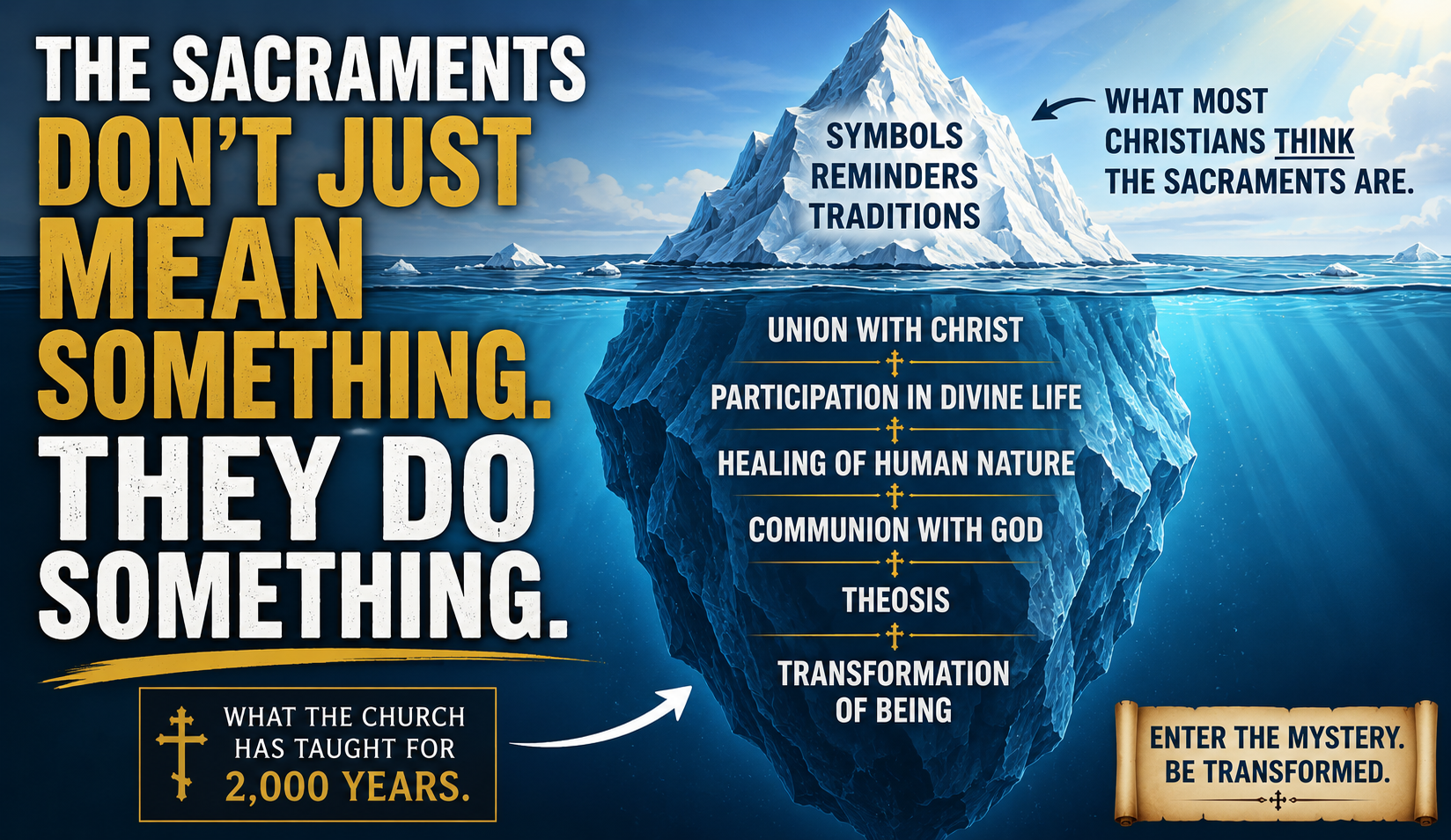
The Mysteries of the Church are not merely ceremonies. They are not simply symbolic acts meant to remind us of spiritual truths. Nor are they merely legal transactions that alter our standing before God.
The Mysteries are ontological.
Ontology concerns the nature of being itself. It asks the question: What is a thing? Not merely what does it represent, or what does it signify, but what is it in its very existence?
When the Orthodox Church speaks of the Mysteries, she is speaking about realities that change what we are.
In Baptism, a person does not merely make a public profession of faith. He is united to Christ. He dies and rises with Christ. He becomes a member of Christ’s Body.
In Chrismation, a person does not simply receive a blessing. He receives the seal of the Holy Spirit.
In the Eucharist, we do not merely remember Christ.
We participate in Him.
In Marriage, two people do not merely sign a covenant before witnesses. Through the grace of God, they become one flesh and are united in a way that reflects the union of Christ and His Church.
These are not merely changes in status.
They are changes in being.
The Fathers understood salvation itself in ontological terms. Christ did not come merely to improve our behavior or provide a legal acquittal before a divine courtroom. He came to heal human nature, to restore what was broken in Adam, and to unite humanity once again with God.
As St. Athanasius famously declared, “God became man so that man might become god by grace.”
That statement only makes sense if salvation is ontological.
Something real happens.
Something changes.
Human beings are transformed through participation in divine life.
How This Differs from Roman Catholicism and Protestantism
This is where Orthodoxy differs from both Roman Catholicism and Protestantism, though in different ways.
Following the rise of Scholasticism in the medieval West, Roman Catholic theology increasingly sought to explain the Mysteries through philosophical categories and precise definitions. Questions arose concerning substance and accidents, causation, merit, satisfaction, and numerous other technical distinctions. While many of these efforts were sincere attempts to defend the faith, they often reflected a desire to explain the mechanism of the mystery.
Orthodoxy never felt compelled to explain every mechanism.
The Church proclaims what is true without claiming to understand exhaustively how God accomplishes it.
We know Christ is truly present in the Eucharist.
We know Baptism truly unites us to Christ.
We know grace truly transforms the human person.
How God accomplishes these things remains within the mystery of His divine action.
Protestantism reacted strongly against medieval Roman Catholicism. In doing so, many Protestant traditions moved in the opposite direction. The sacraments often became understood primarily as symbols, memorials, ordinances, public testimonies, or outward expressions of inward realities.
The focus shifted from what God objectively accomplishes through the Mystery to what the believer subjectively experiences or declares.
Orthodoxy rejects both extremes.
The Mysteries are neither philosophical puzzles to be dissected nor mere symbols that point to something absent.
They are encounters with divine reality.
They are the places where heaven and earth meet.
They are the means through which God communicates His uncreated grace and transforms human beings from glory to glory.
The Orthodox Christian therefore approaches the Mysteries neither as a skeptic demanding explanations nor as a spectator observing symbols.
He approaches them as one entering into the very life of God.
Because the Mystery is not merely teaching us about Christ.
The Mystery is uniting us to Christ.
The Error of Treating God Like a Science Project
One of the unfortunate consequences of modern thinking is that we often approach God the same way we approach science.
Science has tremendous value. It helps us understand many things about the created world. But the mistake comes when we assume that God Himself can be approached in exactly the same way.
The Enlightenment taught us to trust only what can be measured, quantified, observed, and explained. Over time, many Christians unconsciously adopted that framework. The result is that we often attempt to fit God into categories that were designed for studying creation rather than encountering the Creator.
But God is not a specimen under a microscope.
God is not an equation.
God is not an academic theory.
He is a Person.
And persons are not known through analysis alone.
They are known through relationship.
No husband truly knows his wife merely because he has collected information about her.
No wife truly knows her husband simply because she has studied his habits.
Real knowledge comes through communion, intimacy, sacrifice, trust, and shared life.
The same is true of God.
Why the Saints Become More Humble
One of the most fascinating things about the saints is that the closer they draw to God, the more humble they become.
Modern people imagine that spiritual maturity means arriving at a place where all questions are answered and every mystery is resolved.
The saints tell a different story.
The closer they drew to Christ, the more they became aware of the infinite depth of His glory.
The closer they came to the Light, the more they recognized their own limitations.
The more they experienced God, the less interested they became in proving how much they knew.
Instead, they were filled with wonder.
They stood before God not with arrogance but with awe.
Not because they knew less than others.
But because they had seen more.
A man standing on the shore may think he understands the ocean.
A man standing in the middle of it realizes how vast it truly is.
The saints stood in the depths of the ocean of God’s glory.
And it left them speechless.
Entering the Mystery
This is where modern man and the Orthodox Christian often part ways.
Modern man stands outside the mystery demanding explanations.
The Orthodox Christian steps inside the mystery and encounters Christ.
The modern approach asks, “Can you explain everything?”
The Orthodox approach asks, “Can you enter into communion with the One who transcends explanation?”
Those are very different questions.
Christianity is not ultimately about solving God.
It is about being transformed by God.
It is about becoming by grace what Christ is by nature.
It is about purification of the heart.
It is about participation in divine life.
It is about union with Christ.
And that journey never ends.
The Endless Wonder of Eternity
Perhaps one of the most beautiful truths in all of Orthodoxy is that eternity itself will never exhaust the glory of God.
If God is truly infinite, then no amount of time—not even endless ages—will ever bring us to the end of His beauty, His wisdom, His love, or His majesty.
The life of the age to come is not spiritual boredom.
It is not an eternal existence where we eventually run out of things to discover.
It is an everlasting journey deeper and deeper into the inexhaustible life of God.
For all eternity, the saints will continue growing in their experience of His glory.
For all eternity, they will continue discovering new depths of His goodness.
For all eternity, they will stand in awe of the One who can never be fully comprehended because He is infinitely greater than all created things.
That is what mystery means.
The mystery is not evidence that God has failed to reveal Himself.
The mystery is evidence that God is greater than our capacity to comprehend Him.
The mystery is not something to be solved.
The mystery is something to be lived.
And the deeper we enter into Christ, the more we discover that eternity itself is an endless journey into the inexhaustible beauty, majesty, and glory of the Living God.
Want the entire article distilled into one clear, printable page?
Download your free summary and keep it with you.
Get the free PDF + join thousands of people receiving short, practical Orthodox insights in the “Morning Brew with Father Don” to help you grow in Christ each week.