Every generation has its defining theological challenge. In the fourth century, the Church defended the divinity of Christ against Arianism. In the eighth century, she defended the holy icons against iconoclasm. Today, one of the greatest challenges confronting Christians is the attempt to reinterpret the Scriptures through the lens of modern feminism.
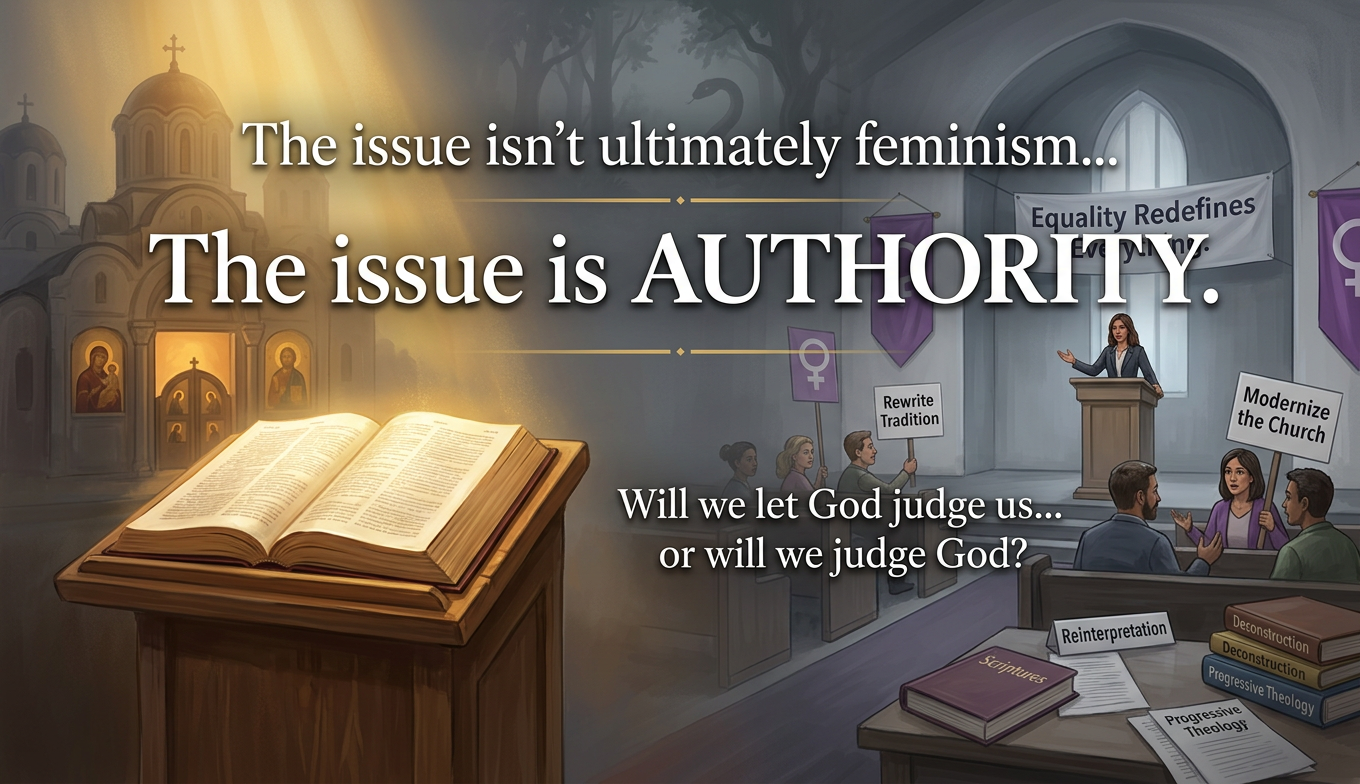
This is not simply a political discussion. It is not about voting, economics, or equal opportunity. It is about something far deeper. It is about authority.
The question before the Church is the very same question the serpent asked Eve:
“Did God really say…?” (Genesis 3:1)
Every theological revolution begins by questioning divine revelation. Every spiritual rebellion begins by placing human judgment above God’s wisdom. That is precisely why the Orthodox Church has never measured truth by cultural acceptance, but by what has been “believed everywhere, always, and by all,” as St. Vincent of Lérins famously observed.
Feminism Did Not Begin as a Theological Movement—But It Became One
The earliest advocates of women’s civil rights were not necessarily attacking Christianity itself. Many sought legitimate legal reforms concerning education, property ownership, and civic participation. Those historical realities deserve to be acknowledged honestly.
Yet as the nineteenth century progressed, an increasingly influential stream within the movement recognized that lasting social change could not occur without first dismantling the biblical foundations upon which Western civilization had been built.
Few figures illustrate this more clearly than Elizabeth Cady Stanton.
Following the Seneca Falls Convention of 1848, Stanton gradually became convinced that the Scriptures themselves—not merely their interpretation—stood in the way of the liberation she envisioned. In 1895 she published The Woman’s Bible, arguing that many biblical texts reflected patriarchal oppression rather than divine revelation. Her famous declaration was unequivocal:
“The Bible and the Church have been the greatest stumbling blocks in the way of woman’s emancipation.”
Whether or not one agrees with every conclusion she reached, her significance lies elsewhere. Stanton made explicit what later feminist theologians would develop much more systematically: if biblical teaching on man and woman cannot be accepted, then Scripture itself must be reinterpreted—or its authority rejected altogether.
Over the next century this approach increasingly influenced academic biblical scholarship. Many passages once understood as universally authoritative came to be described as merely “culturally conditioned.” The question shifted from, “What has the Church always believed?” to “What is acceptable to contemporary society?”
That is a profound theological shift.
The Orthodox Beginning: Creation Is Not Oppression
Orthodoxy begins where Scripture begins—with creation.
“So God created man in His own image; in the image of God He created him; male and female He created them.” (Genesis 1:27)
The Fathers consistently teach that both man and woman equally bear the image of God. There is no hierarchy of dignity.
St. Gregory the Theologian writes that both man and woman possess the same human nature and therefore share equally in salvation.
Likewise, St. John Chrysostom, in reference to Ephesians 5, repeatedly reminds husbands that they are never to rule their wives as tyrants but to imitate Christ’s sacrificial love.
Christianity transformed the ancient world because it elevated women in a culture that often treated them as property. The Church honored the Virgin Mary above every human being. Women became martyrs, ascetics, teachers of holiness, benefactors, and saints.
The Orthodox Church has never taught that women are spiritually inferior.
Yet equality before God does not erase distinction.
Modern thought assumes that equality requires sameness. Scripture never makes that assumption.
The Father, Son, and Holy Spirit are perfectly equal in essence while remaining distinct in Person.
Likewise, husband and wife possess equal dignity while receiving different vocations within God’s created order.
Difference is not inequality.
It is harmony.
St. Paul and the Created Order
Few passages are attacked more frequently than St. Paul’s teaching on marriage.
“The head of every man is Christ, the head of a wife is her husband, and the head of Christ is God.” (1 Corinthians 11:3)
Modern readers often hear domination.
The Fathers heard responsibility.
St. John Chrysostom explains that headship never grants license for tyranny. Rather, it places upon the husband the greater burden of sacrificial service.
Paul himself defines that headship:
“Husbands, love your wives, just as Christ also loved the Church and gave Himself up for her.” (Ephesians 5:25)
Christ’s authority is revealed not by demanding privilege but by embracing the Cross.
That completely transforms the discussion.
Biblical authority is cruciform.
It dies before it demands.
It serves before it leads.
The husband who uses Scripture to justify selfishness has already abandoned the very passage he claims to defend.
The Fathers Speak with Remarkable Unity
One of the distinctive strengths of Orthodoxy is that we do not interpret difficult passages in isolation.
We ask instead:
How did those taught by the Apostles understand these texts?
Across centuries and across continents, the Fathers display extraordinary consistency.
St. Irenaeus sees Adam and Eve as partners in humanity’s fall and Christ and the Virgin Mary as partners in humanity’s restoration.
St. Basil the Great speaks of the household as a place of mutual sanctification.
St. John Chrysostom commands husbands to honor their wives with tenderness, patience, and self-sacrifice.
None of the Fathers teach domination.
Neither do they erase the distinctions established in creation.
Their vision is profoundly different from both ancient pagan patriarchy and modern egalitarian individualism.
It is communion.
The Real Question Is Authority
Ultimately, feminism is not the deepest issue.
Authority is.
Will Scripture interpret our culture?
Or will culture reinterpret Scripture?
Every age attempts to reshape Christianity according to its own assumptions.
The Gnostics did it.
The Arians did it.
The iconoclasts did it.
Modern secular ideology does the same.
The temptation remains unchanged.
Rather than conforming ourselves to Christ, we invite Christ to conform Himself to us.
St. Paul warns us:
“Do not be conformed to this world, but be transformed by the renewing of your mind.” (Romans 12:2)
Transformation always begins with humility.
It begins by allowing God’s Word to judge us rather than insisting that we judge God’s Word.
Returning to the Mind of the Church
The Orthodox Church does not oppose women.
She never has.
She venerates the greatest woman who has ever lived—the Most Holy Theotokos.
She honors countless female martyrs, ascetics, confessors, missionaries, mothers, and queens whose lives continue to illuminate the Church.
What Orthodoxy rejects is every ideology that asks us to reinterpret divine revelation according to the spirit of the age.
The Church is not called to mirror the culture.
She is called to transfigure it.
Every generation faces the same choice.
Will we receive the faith once delivered to the saints (Jude 3), or will we reshape it until it reflects ourselves?
The answer to that question will determine not only what we believe about men and women, but whether Christ remains Lord over our theology at all.
For if the authority of Scripture can be set aside wherever it confronts our desires, then the issue is no longer feminism.
The issue is whether Jesus Christ truly speaks with divine authority through His Church.
That is the question every Christian must answer.
Would You Like to Learn the Fuller Story?
Would you like to go deeper to understand the fuller history and theology behind the feminist movement?
I’m working on an eBook that takes this blog article to help us understand how the feminist movement evolved from something much needed to an abandonment of God’s intended plan. I’ll share how feminism molded mainline Protestant churches to their detriment and led to their collapse, and how the family has been tremendously harmed. More importantly, I’ll offer an Orthodox view of how we can lead the way in restoring the hope of the Church and our culture in America.
Want the entire article distilled into one clear, printable page?
Download your free summary and keep it with you.
Get the free PDF + join thousands of people receiving short, practical Orthodox insights in the “Morning Brew with Father Don” to help you grow in Christ each week.