One of the statements Jesus makes that often gets overlooked is found near the end of what we call the Olivet Discourse. It is a simple sentence, only a few words, but hidden within it is one of the clearest declarations of Christ’s divinity and one of the greatest sources of hope for every Christian.
Jesus says,
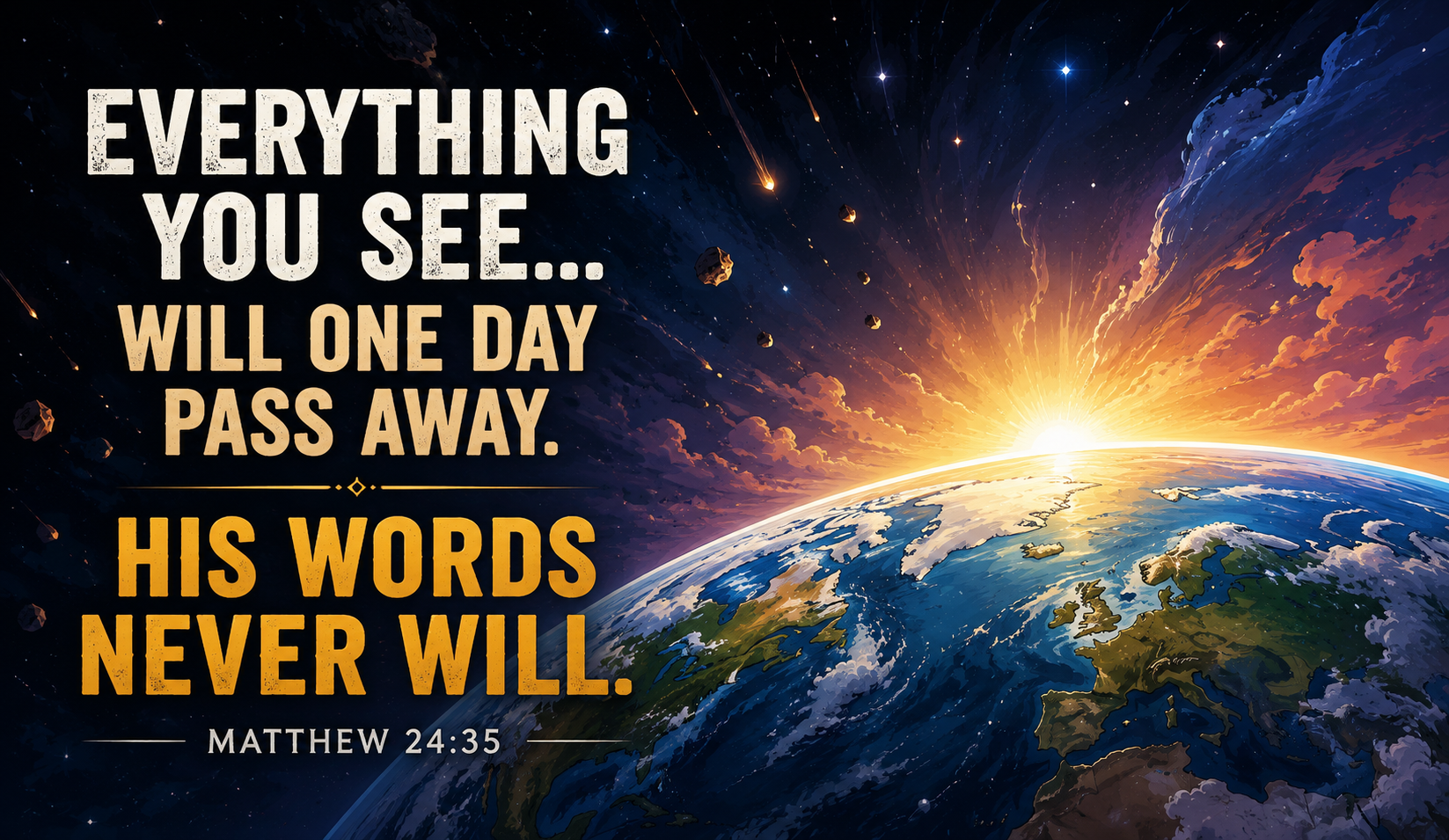
“Heaven and earth will pass away, but My words will by no means pass away.”
(Matthew 24:35)
At first glance, this sounds like a beautiful promise about the reliability of Scripture. It certainly includes that. But if we stop there, we miss the breathtaking magnitude of what Jesus is actually saying.
To understand these words, we have to understand the context in which He spoke them.
The World Is Shaking
Matthew 24 is not a comfortable chapter.
Jesus has just described wars, famines, persecution, deception, the destruction of Jerusalem, cosmic disturbances, and finally His glorious return. He speaks of the sun being darkened, the moon no longer giving its light, and the very powers of heaven being shaken.
Everything humanity considers permanent is suddenly revealed to be temporary.
Kingdoms fall.
Empires collapse.
Cities are destroyed.
Civilizations disappear.
Even heaven and earth themselves will one day give way to something greater.
Then Jesus says something astonishing.
“Heaven and earth will pass away, but My words will not pass away.”
Notice the contrast.
He does not compare His words to the writings of Moses.
He does not compare them to the prophets.
He does not even compare them to the Law.
He compares them to the entire created universe.
The stars will not last forever.
Galaxies will not last forever.
The heavens themselves will not last forever.
Yet the words spoken by Christ endure eternally.
That should cause us to stop and ask a question:
Who can possibly make a statement like that?
Only God Can Say This
To a first-century Jew, this statement would have been nothing short of extraordinary.
The prophet Isaiah had already declared,
“The grass withers, the flower fades, but the word of our God stands forever.”
(Isaiah 40:8)
Notice carefully what Isaiah says.
Not the words of a prophet.
Not the words of a king.
The Word of God stands forever.
Now Jesus takes that very language and applies it to Himself.
He does not say,
“God’s words will never pass away.”
He says,
“My words will never pass away.”
That is not merely a statement about truth.
It is a declaration about His identity.
Jesus is quietly claiming something only God Himself could claim.
Isaiah 40:8 and the Divine Identity of Christ
To fully appreciate what Jesus is saying, we need to look more closely at the prophet Isaiah.
Isaiah writes,
“The grass withers, the flower fades, but the word of our God stands forever.”
(Isaiah 40:8)
The contrast is unmistakable.
Everything in creation is fleeting.
Grass withers.
Flowers fade.
Human life is brief.
Nations rise and fall.
Empires come and go.
Only one thing remains forever.
The Word of God.
For the Jewish people, this was not merely a statement about the Scriptures. It was a declaration about God’s eternal nature. Everything God speaks is as everlasting as God Himself. His Word cannot fail because He cannot fail.
Now listen again to Jesus’ words:
“Heaven and earth will pass away, but My words will by no means pass away.”
This is far more than a promise that His teachings will be preserved.
Jesus deliberately places His own words where Isaiah placed the Word of God.
Had Jesus merely been a prophet, such a statement would have been blasphemous. The prophets never claimed that their words would endure forever. They consistently declared, “Thus says the Lord,” pointing beyond themselves to the One who had sent them.
Jesus does something entirely different.
He speaks with His own authority.
“My words.”
That distinction changes everything.
Jesus is not simply delivering God’s message. He is revealing Himself as the eternal Logos, the very Word through whom the Father created all things.
This is one of the beautiful ways the New Testament reveals Christ’s divinity. Often, it is not through dramatic declarations but through subtle moments where Jesus quietly takes upon Himself what the Old Testament attributes to God alone.
The more we read the Scriptures as a unified whole, the more these connections become impossible to ignore.
The One speaking on the Mount of Olives is the same eternal Word spoken of by Isaiah.
His words endure forever because He Himself is eternal.
Christ Is the Eternal Logos
John opens his Gospel with these familiar words:
“In the beginning was the Word, and the Word was with God, and the Word was God.”
The Greek word is Logos.
Christ is not merely One who speaks God’s Word.
He is the eternal Word through whom all things were made.
Everything that exists owes its existence to Him.
The mountains exist because He spoke.
The oceans exist because He spoke.
The stars exist because He spoke.
Time itself exists because He spoke.
If creation came into existence through the Logos, it should not surprise us that creation may pass away while the Logos remains forever.
The Creator always outlives His creation.
Will Heaven and Earth Be Destroyed?
This is where Orthodox Christianity offers an important distinction.
Many Christians picture the end of the world as though God intends to throw creation away and begin again from nothing.
That is not how the Fathers understood these passages.
Creation is not discarded.
It is transformed.
Consider the pattern God has already given us.
A grain of wheat falls into the earth and dies before producing new life.
Christ entered death and rose again in glory.
Our own bodies die, yet they are raised incorruptible.
St. Paul tells us in Romans 8 that creation itself longs to be set free from corruption.
The present heavens and earth are passing, not because God has abandoned them, but because He intends to renew them.
The entire cosmos awaits resurrection.
What the Church Fathers Teach
St. John Chrysostom writes,
“He shows His power by declaring that His words are more abiding than heaven and earth. For it is easier for those things to perish than for anything He has spoken to fail.”
Think about that.
According to Chrysostom, it is easier for the universe itself to disappear than for one promise of Christ to fail.
St. Cyril of Alexandria explains,
“The words of the Savior are not like ours, but are divine and life-giving. Therefore they remain forever, because they proceed from Him who is by nature Life.”
Human words fade.
We forget them.
Books decay.
Languages change.
But Christ’s words remain because they proceed from the One who is eternal Life Himself.
St. Bede beautifully summarizes the passage:
“The elements of this world shall pass into a better state, but the truth of the Lord shall never fail.”
Notice that phrase:
a better state.
The Fathers consistently understood the passing of heaven and earth as transformation rather than annihilation.
Even St. Augustine writes,
“Heaven and earth shall pass away by changing, not by utterly perishing; but the words of Christ remain because they are eternal.”
Where Are We Placing Our Confidence?
Perhaps the greatest lesson of this passage is not simply about the future.
It is about the present.
Every generation is tempted to place its confidence in things that appear permanent.
Governments.
Economies.
Military power.
Technology.
Financial security.
Our health.
Even our own plans for tomorrow.
History has repeatedly shown how quickly all these things can disappear.
Jesus reminds us that everything belonging to this created order is temporary.
Only the uncreated is eternal.
Only Christ remains unchanged.
Only His Kingdom cannot be shaken.
Only His promises cannot fail.
The Word That Will Never Fade
There is one final observation that should leave us in awe.
Jesus does not merely promise that His teachings will be remembered.
He promises that His words will outlast the universe itself.
That is an astonishing claim.
No prophet ever spoke this way.
No apostle ever spoke this way.
No saint ever spoke this way.
Only Christ.
Because only Christ is the eternal Son of God.
The same voice that said, “Let there be light,” is the voice that now says,
“Heaven and earth will pass away, but My words will by no means pass away.”
Everything you see today will one day be transformed.
The kingdoms of this world will fade.
The monuments of men will crumble.
The stars themselves will grow dim.
But every promise Christ has ever made will still stand.
That is why the Christian builds his life, not upon the shifting foundations of this passing world, but upon the eternal Word who became flesh and dwelt among us.
For if His words will endure long after heaven and earth have passed away, there is no safer place to anchor our lives than in Him.
Want the entire article distilled into one clear, printable page?
Download your free summary and keep it with you.
Get the free PDF + join thousands of people receiving short, practical Orthodox insights in the “Morning Brew with Father Don” to help you grow in Christ each week.