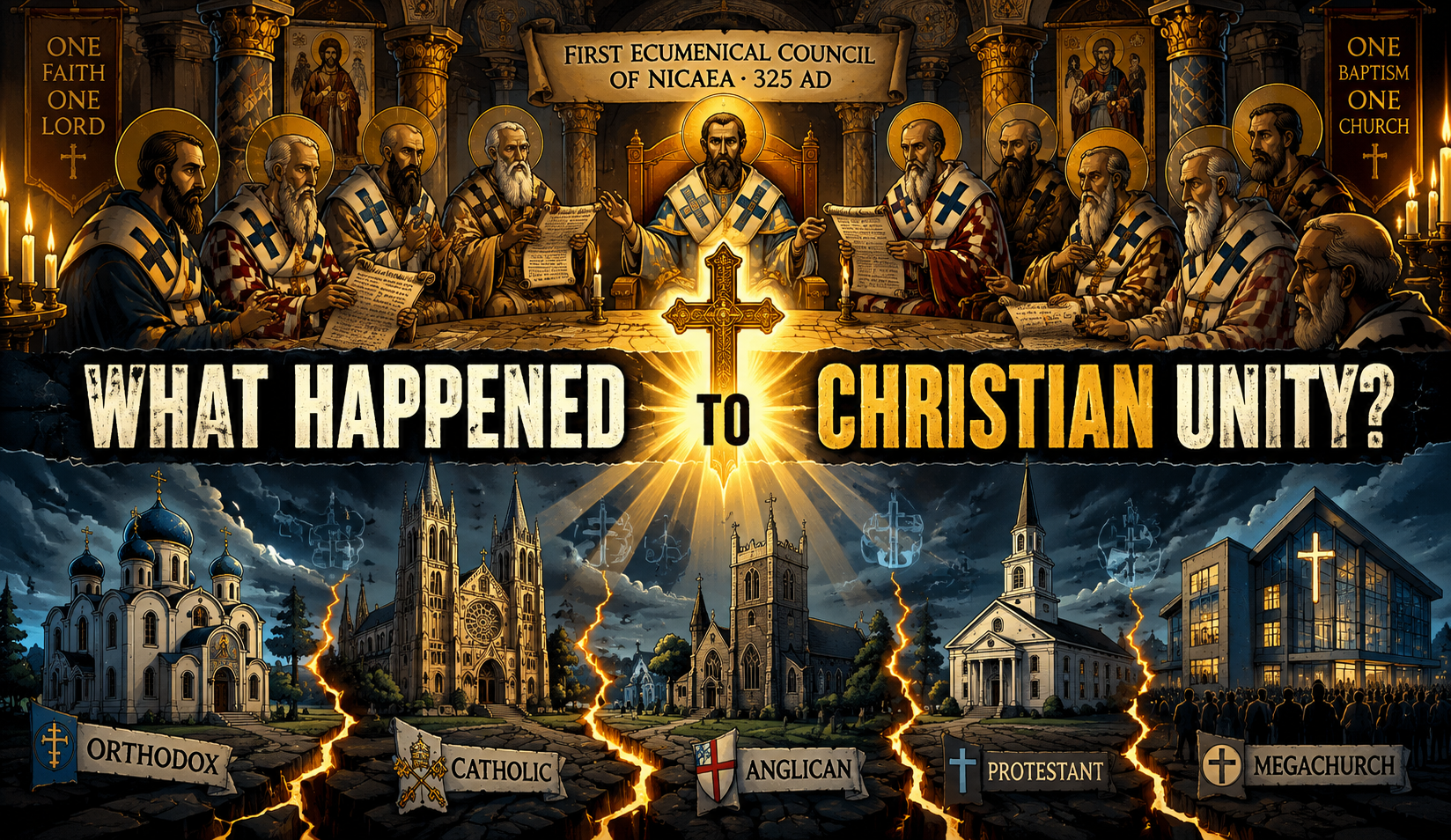
We live in a strange moment in Christian history. Every Sunday, millions of Christians across countless denominations stand and confess belief in “one, holy, catholic, and apostolic Church,” while existing in a landscape fractured by schism, jurisdictional disputes, doctrinal disagreements, historical wounds, and mutual suspicion. The question is no longer merely whether Christianity is fragmented — that much is obvious — but whether genuine unity can still be found in the midst of that fragmentation without sacrificing truth itself.
A reader recently asked me the following thoughtful and heartfelt question:
“My question is about Christian unity. Most Orthodox say there is no Christian unity outside of the Orthodox Church (and many say no salvation outside it). As a priest who belongs to an Orthodox Church without formal recognition from mainstream orthodoxy (at least that’s my limited understanding), how do you approach the topic of Christian unity? I ask as an Anglican priest in the Episcopal church who deeply desires Christian unity but whose tradition is not recognized by Orthodox and Romans as valid, though we recognize ourselves as part of the one, holy, Catholic, and apostolic church in line with apostolic succession and the creeds.”
You can Now Listen to Each Article
This is an honest and important question because it touches not only ecclesiology, but the very heart of Christian longing: How can the Church confess “one, holy, catholic, and apostolic Church” while Christians remain visibly divided?
As an Orthodox priest serving within the American Orthodox Catholic Church (AOCC), I approach this question both pastorally and historically, with humility and realism. I also approach it with hope.
First, I want to acknowledge plainly what many people already understand: the fourteen mainstream Orthodox jurisdictions do not presently recognize the AOCC as being in full canonical communion with them. That reality cannot be ignored or minimized.
At the same time, it is important to define what Orthodox Christians mean when they use the word canonical and the present day struggle with this issue.
What Does “Canonical” Mean?
In Orthodoxy, the term canonical refers to whether a church body, bishop, or clergy are recognized as operating according to the canons of the Church. The canons are the historic ecclesiastical rules and governing principles established by the early Ecumenical Councils, the Church Fathers, and the historic life of the Orthodox Church. They address matters such as doctrine, church order, episcopal authority, sacramental life, discipline, and communion between churches.
When a church is described as “canonical,” it generally means that it is formally recognized and in sacramental communion with the larger body of historically recognized Orthodox Churches.
Conversely, when a church is called “non-canonical,” it does not necessarily mean that its clergy are insincere, heretical, or devoid of sacramental intent. Rather, it means that there is currently a dispute or break in formal ecclesiastical recognition and communion.
That distinction matters because many people hear the term “non-canonical” and assume it means “fake,” “invalid,” or “outside Christianity altogether.” Historically speaking, the reality is often far more complex.
The history behind the AOCC’s separation is rooted in ecclesiastical conflicts that emerged nearly a century ago after the Russian Orthodox Church established what became the AOCC in 1927.
The division was not originally born out of doctrinal innovation or a rejection of Orthodoxy’s dogmatic faith. Rather, it arose during a turbulent period in American Orthodoxy when overlapping ethnic jurisdictions were themselves struggling with questions of canonical order, authority, immigration, nationalism, and ecclesial identity. In many respects, the fragmentation of Orthodoxy in America already represented a violation of the ancient canonical principle of one bishop in one city according to Apostolic Canon 34 and Canon 8 of the 1st Ecumenical Council at Nicaea, as well as Canon 28 of the 4th Ecumenical Council at Chalcedon.
Other issues also arose that impact the modern Orthodox landscape in America today.
Ethnophyletism, organizing the Church along ethnic or national lines rather than territorial/ecclesial ones, was determined a heresy at the Council of Constantinople in 1872. Yet, it’s prevalent in American Orthodoxy today as Orthodox Churches are defined by Greek, Russian, Serbian, and other forms of ethnic and national identities. This created a complete breakdown of Aposotic Canona 34 at the 1st Council of Nicea that stated bishops must act conciliatory. Yet, American bishops ultimately answer to synods overseas (Constantinople, Moscow, etc.).
This created overlapping and competing jurisdictions.
The AOCC emerged in the midst of that instability.
That historical reality does not solve the present problem, nor does it remove the pain of non-recognition. But it does matter because it reminds us that ecclesiastical divisions are often more historically and politically complex than simple narratives of “inside” and “outside” suggest.
And perhaps it is worth noting with sobriety that even today the Orthodox world itself experiences fractures. The rupture between Constantinople and Moscow has demonstrated painfully that full communion among canonical Orthodox Churches is itself presently wounded. That fact should humble all of us and caution us against triumphalism.
So how, then, do I think about Christian unity?
The Orthodox Claim About Unity
Classical Orthodoxy has always maintained that the fullness of the Church subsists within the Orthodox Church. That is not merely denominational pride; it is rooted in Orthodoxy’s understanding of continuity with the apostolic faith, sacramental life, conciliarity, and holy tradition.
But there is an important distinction that often gets lost in modern conversations.
To say that Orthodoxy possesses the fullness of the faith is not the same thing as saying that God is absent everywhere else.
Nor is it the same thing as claiming certainty about the eternal destiny of every non-Orthodox Christian.
Many Orthodox Christians, unfortunately, speak in overly simplistic formulas such as “there is no salvation outside the Orthodox Church,” without carefully explaining what the Church Fathers actually meant.
Historically, the Fathers emphasized that salvation comes through Christ and His Body — not through autonomous individual spirituality detached from the Church. They were not granting us permission to declare who is or is not finally saved.
Unity Is More Than Institutional Alignment
As an Anglican priest in the Episcopal tradition, you already understand something profoundly important: apostolic continuity is not merely about institutional claims. It is also about fidelity to Christ, the creeds, sacramental worship, repentance, holiness, and participation in the life of God.
Now, Orthodoxy and Anglicanism certainly disagree on serious theological matters. Those disagreements are not imaginary. They involve ecclesiology, sacramental theology, moral theology, authority, and the nature of Holy Tradition itself. Real unity cannot be built by pretending those differences do not exist.
But neither should we ignore the genuine work of grace that has existed within Anglican Christianity.
I have known Anglican clergy and faithful believers whose love for Christ, reverence for Scripture, devotion to liturgy, and pursuit of holiness would rival Orthodox Christians.
The Holy Spirit is not mocked by our denominational arrogance.
From an Orthodox perspective, the fullness of sacramental and doctrinal unity remains unresolved. Yet I do not believe that means we should speak of one another as enemies.
Rather, we should speak truthfully, honestly, and charitably.
The Tragedy of Christian Fragmentation
One of the great tragedies of Christian history is that we often define unity juridically instead of spiritually.
Christ prayed in John 17 “that they all may be one.” That unity was never intended to be mere organizational cooperation. It was participation in the divine life itself — unity in truth, love, holiness, and communion with God.
Modern Christianity frequently substitutes institutional branding for spiritual transformation.
Orthodoxy is not immune from this temptation.
In many places, Orthodoxy became entangled with nationalism and ethnicity. Greek, Russian, Serbian, Antiochian, Romanian — these identities preserved treasures of faith, but they also sometimes obscured the catholicity (universality) of the Church. In America, especially, overlapping jurisdictions created canonical contradictions that continue to affect Orthodox witness today.
That context is important when discussing bodies like the AOCC because the broader Orthodox landscape in America has itself struggled to embody the canonical unity it proclaims.
Again, this is not an attack on Orthodoxy. I remain deeply Orthodox in theology and conviction. It is simply an honest acknowledgment that the visible life of the Church has often fallen short of its own ideals.
How I Personally Approach Christian Unity
I approach Christian unity sacramentally, spiritually, and eschatologically.
Sacramentally
I believe the Church is not merely an invisible collection of believers. The Church is tangible, embodied, historical, liturgical, and sacramental. Apostolic succession matters. Doctrine matters. Eucharistic communion matters.
Unity without truth is sentimentality.
Spiritually
At the same time, I cannot ignore Christ wherever I genuinely encounter Him.
When I see Christians praying faithfully, loving sacrificially, repenting sincerely, serving the poor, honoring Scripture, and seeking holiness, I do not believe my first response should be condemnation.
My first response should be gratitude to God.
The early Christians were first called “The Way,” emphasizing not merely institutional membership, but a lived path of communion with God.
Orthodoxy at its best understands theology not merely as information about God, but as participation in the life of God Himself.
Eschatologically
Ultimately, perfect unity is fulfilled in the Kingdom of God.
Every earthly jurisdiction, synod, patriarchate, denomination, and communion remains historically conditioned and imperfect in this age. The Church is holy because Christ is holy — not because Christians have flawlessly maintained unity.
That realization should produce humility in all of us.
The Path Forward
So what do we do?
We pursue unity without sacrificing truth.
We repent of pride.
We study one another honestly instead of caricaturing one another.
We recover the Church Fathers instead of weaponizing them.
We seek holiness more than tribal victory.
And perhaps most importantly, we remember that the purpose of the Church is not self-preservation, but union with Christ.
As someone within the AOCC, I genuinely desire reconciliation with our sister Orthodox Churches. I pray for a future in which old historical wounds, jurisdictional conflicts, and canonical irregularities might be healed through humility, honesty, and charity.
At the same time, I also believe conversations like this one matter deeply because they remind us that many Christians across traditions are sincerely longing for the same thing: fidelity to Christ and communion in His Body.
That longing itself is not the enemy.
It may, in fact, be the beginning of healing.
Want the entire article distilled into one clear, printable page?
Download your free summary and keep it with you.
Get the free PDF + join thousands receiving short, practical Orthodox insights in the “Morning Brew with Father Don” to help you grow in Christ each week.