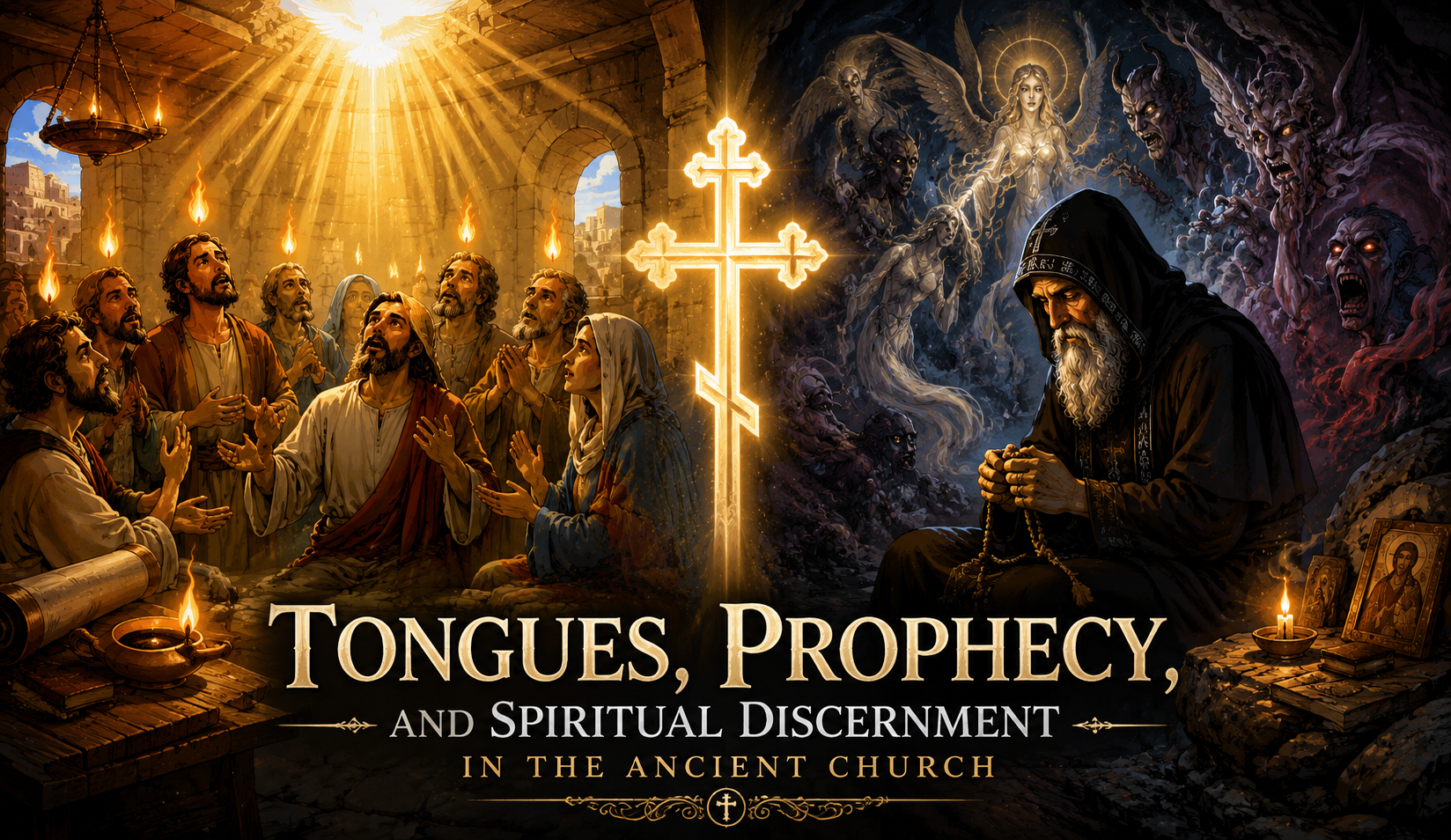
One of the most hotly debated questions in modern Christianity concerns the continuation and operation of the charismatic gifts, especially speaking in tongues, prophecy, and words of knowledge. Entire movements within Protestant Christianity, particularly the Pentecostal and broader charismatic traditions, have built much of their spirituality around these experiences. Yet the question remains: How did these gifts actually function in the ancient Church?
The question is important because the New Testament undeniably speaks about these phenomena. St. Paul discusses tongues, prophecy, healings, discernment, and spiritual gifts extensively in 1 Corinthians 12–14. The Book of Acts records miraculous events, prophetic utterances, visions, healings, and inspired speech. Therefore, any serious theological treatment must avoid two extremes:
- Denying outright that such gifts ever existed in the Church.
- Assuming that every modern charismatic practice is identical to what the Apostles experienced.
I approach this issue neither with rationalistic skepticism nor emotional sensationalism, but through the lens of Holy Tradition, the Fathers, ascetical theology, and discernment.
Christianity is not merely intellectual assent to propositions, but “the way,” a path of union with God through purification, illumination, and communion. The Orthodox understanding of spiritual gifts must therefore be understood within the larger context of theosis and spiritual warfare, not individual spiritual excitement.
You can Now Listen to Each Article
The Apostolic Church Clearly Experienced Charismatic Gifts
The New Testament leaves no doubt that the early Church experienced supernatural manifestations of the Holy Spirit.
St. Paul writes:
“To one is given the word of wisdom through the Spirit, to another the word of knowledge through the same Spirit… to another various kinds of tongues, to another the interpretation of tongues.”
—1 Corinthians 12:8–10
Likewise, Acts 2 records the Apostles speaking in tongues at Pentecost. Prophets such as Agabus appear in Acts 11 and Acts 21. Visions, dreams, healings, and miracles permeate the apostolic age.
The critical issue is not whether these gifts existed. They did.
The real issue is:
- What were these gifts?
- How were they understood?
- What role did they play in the Church?
- And are modern charismatic manifestations the same thing?
What Were “Tongues” in the Ancient Church?
The modern charismatic movement often defines tongues as ecstatic, non-rational utterances or “prayer languages.” However, the earliest evidence from Scripture and the Fathers suggests something more nuanced.
Pentecost Was Intelligible Language
In Acts 2, the miracle of tongues was explicitly understood by listeners:
“We hear them speaking in our own tongues the wonderful works of God.”
The Greek word glossa can mean language. The miracle at Pentecost appears to involve intelligible speech understood by people from many nations.
This is profoundly important because the first manifestation of tongues in the Church was missionary and ecclesial, not private and ecstatic.
The purpose was revelation and proclamation.
St. Paul’s Concern About Disorder
When Paul discusses tongues in Corinth, his tone is corrective rather than celebratory.
The Corinthian church was spiritually immature, emotionally chaotic, and fascinated with displays of spiritual power. Paul repeatedly warns them that spiritual gifts without love become dangerous.
In fact, 1 Corinthians 13, the famous “love chapter,” sits directly between Paul’s teaching on gifts.
This is not accidental.
Paul is subordinating charisma to holiness.
He explicitly warns:
- tongues without interpretation create confusion,
- prophecy must be tested,
- and spiritual manifestations are not proof of sanctity.
This is remarkably close to later Orthodox spirituality, which consistently warns believers not to equate spiritual experiences with genuine holiness.
I have often emphasized in discussions about spiritual warfare and discernment that many modern Christians seek supernatural experiences without understanding the spiritual realities behind them. The Fathers would strongly agree.
The Ancient Church Was Deeply Suspicious of Spiritual Delusion
One of the most important differences between Orthodoxy and many charismatic traditions is the Orthodox doctrine of prelest, spiritual delusion.
The Desert Fathers repeatedly warned that demons can counterfeit spiritual experiences.
Visions, voices, revelations, ecstatic feelings, and supernatural phenomena were never automatically trusted.
St. Anthony the Great famously taught that if a vision truly comes from God, peace and humility follow. Demonic manifestations, by contrast, produce confusion, pride, fear, or spiritual self-exaltation.
This caution became foundational to Orthodox spirituality.
Thus, the question in Orthodoxy is never merely:
“Did something supernatural happen?”
The question is:
“What spirit is behind it?”
This distinction is essential because modern charismatic theology often assumes that powerful emotional or supernatural experiences are inherently from the Holy Spirit. The Fathers would reject that assumption outright.
Did Prophecy Continue in the Ancient Church?
Yes, but not in the modern charismatic sense of casual “personal prophecy.”
The ancient Church absolutely believed that God revealed things to holy people.
The lives of the saints are filled with examples:
- discerning hearts,
- foreseeing events,
- prophetic warnings,
- miraculous healings,
- and supernatural knowledge.
But there is a critical distinction.
Prophecy Was Rooted in Holiness
In Orthodoxy, prophecy emerged from:
- purification of the passions,
- humility,
- ascetic struggle,
- repentance,
- prayer,
- and union with God.
It was not treated as a spontaneous talent available to anyone who desired it.
The Desert Fathers even warned that desiring supernatural gifts could itself become a doorway to pride and deception.
This is radically different from much of modern charismatic culture, where “words from the Lord” may be delivered casually, frequently, and without deep ecclesial discernment.
What About “Words of Knowledge”?
Modern charismatics often describe “words of knowledge” as supernatural impressions or revelations about another person.
Something similar certainly existed in the ancient Church.
Many saints demonstrated extraordinary discernment:
- St. Seraphim of Sarov,
- St. Paisios,
- St. John of Kronstadt,
- and countless elders of the desert.
But again, these experiences emerged from profound sanctity, not spiritual technique.
The Orthodox tradition would never reduce spiritual gifts to methods, formulas, conferences, or emotional environments.
Rather, gifts were seen as the byproduct of communion with God.
I have repeatedly emphasized that theology is not merely information about God but experiential union with God. That distinction lies at the heart of Orthodox spirituality.
Why the Fathers Rarely Emphasized Tongues
One striking reality is that as Church history progresses, tongues become less central in orthodox Christian life.
Why?
Because the Church matured.
The extraordinary signs accompanying the apostolic age served a missionary and foundational purpose. As Christianity spread and the sacramental-liturgical life of the Church deepened, the emphasis shifted:
- from spectacle to sanctification,
- from manifestation to transformation,
- from charisma to holiness.
This does not mean miracles ceased.
The Orthodox Church has always believed in miracles.
But miracles were never treated as the center of spiritual life.
Repentance was.
Humility was.
Union with Christ was.
The Problem With Modern Charismatic Individualism
Perhaps the greatest divergence between Orthodoxy and modern charismaticism is ecclesiology.
Modern charismatic culture often centers spiritual authority in:
- the individual experience,
- the emotionally powerful preacher,
- or the “anointed” personality.
Orthodoxy locates discernment within:
- the Church,
- the bishops,
- the sacramental life,
- Holy Tradition,
- and the consensus of the Fathers.
This is critically important because spiritual experiences detached from ecclesial accountability become extremely dangerous.
History repeatedly demonstrates that movements obsessed with revelation often drift into:
- emotionalism,
- doctrinal instability,
- personality cults,
- or spiritual manipulation.
The ancient Church understood this danger well.
Did the Gifts Cease?
Orthodoxy does not teach strict cessationism.
The Holy Spirit still acts.
Miracles still occur.
Saints still manifest extraordinary discernment.
Healings still happen.
God still speaks.
But Orthodoxy also rejects the idea that the normative Christian life should revolve around seeking supernatural manifestations.
The central miracle of Christianity is not ecstatic speech.
It is the transformation of the human person into the likeness of Christ.
The Orthodox Perspective on True Spiritual Power
The Fathers consistently taught that the greatest spiritual gifts are:
- humility,
- repentance,
- love,
- self-control,
- purity of heart,
- and discernment.
Not tongues.
Not visions.
Not emotional ecstasy.
In fact, many saints intentionally concealed supernatural gifts to avoid pride.
This is profoundly different from modern religious culture, which often platformizes charisma itself.
I have often noted in discussions about fear, stress, discouragement, and spiritual warfare that the Christian life is fundamentally about learning to walk in communion with God amid suffering and temptation, not chasing spiritual experiences.
Final Thoughts
The ancient Church unquestionably experienced charismatic gifts.
Tongues, prophecy, healings, discernment, and supernatural knowledge were all realities within apostolic Christianity.
However, the historical evidence suggests several important truths:
- These gifts operated within the life of the Church, not apart from it.
- They were subordinate to holiness and love.
- They required discernment and testing.
- They were never treated as proof of spiritual superiority.
- The Fathers consistently warned against spiritual deception.
- The highest goal of Christianity was never ecstatic experience, but union with God.
Modern charismatic movements often preserve a genuine hunger for the reality of the Holy Spirit. That hunger should not be mocked or dismissed.
Yet Orthodoxy asks a deeper question:
Is the goal spiritual excitement, or sanctification?
The saints teach us that the true evidence of the Holy Spirit is not merely supernatural manifestation, but the crucified and resurrected life of Christ formed within the human soul.
Want the entire article distilled into one clear, printable page?
Download your free summary and keep it with you.
Get the free PDF + join thousands receiving short, practical Orthodox insights in the “Morning Brew with Father Don” to help you grow in Christ each week.