In our modern world, particularly in Western Christianity, we often inherit a simplified, almost mechanical view of what happens when we die. You will hear it said, “When you die, you either go to Heaven or Hell,” as if the matter is immediate, final, and neatly resolved.
But when we step into the depth of the Orthodox Christian tradition, when we begin to think not merely in categories but in mystery, we discover that the reality is far more profound and far more sobering.
This is not just a theological exercise. This is about you. About me. About what we are becoming even now.
The Problem with Our Assumptions
Many people operate with an assumption like this:
When I die, I go somewhere temporary, maybe Paradise or something like it, and then at the end of time, I am judged and sent to Heaven or Hell.
Now, while there is a kernel of truth in that idea, it is incomplete and in some ways misleading.
The Orthodox Church does not reduce the afterlife to a waiting room followed by a courtroom verdict. Instead, it presents a continuous, living reality of the soul in relation to God.
And that changes everything.
Sheol (Hades): The Realm of the Dead
In the Old Testament, the place of the dead is called Sheol. In the New Testament, it is referred to as Hades. These are not the final Hell that many people imagine.
Rather, Hades is the state of the soul after death, a real, conscious condition in which every person finds themselves once they depart from this life.
But here is where we must be careful.
Hades is not uniform.
It is not one experience for all.
Within this state, there are radically different experiences depending on the condition of the soul.
Paradise: Communion with God
Christ Himself gives us the clearest insight when He speaks to the thief on the cross:
“Today you will be with Me in Paradise.”
Paradise is not simply a poetic term. It is the state of blessedness experienced by those who, even imperfectly, have oriented their lives toward God.
It is communion.
It is peace.
It is light.
But it is important to understand that this is not yet the final, resurrected Heaven. It is real, it is immediate, but it is still awaiting its fullness.
The Experience of Separation
On the other side, there are those who enter into a state of alienation, a condition of suffering, not because God has withdrawn, but because the soul is not prepared to receive Him.
This is what Scripture begins to reveal in images of torment, darkness, and anguish.
But again, we must be precise.
This is not yet the final Hell, but rather a foretaste of what separation from God feels like when the soul stands exposed in His presence.
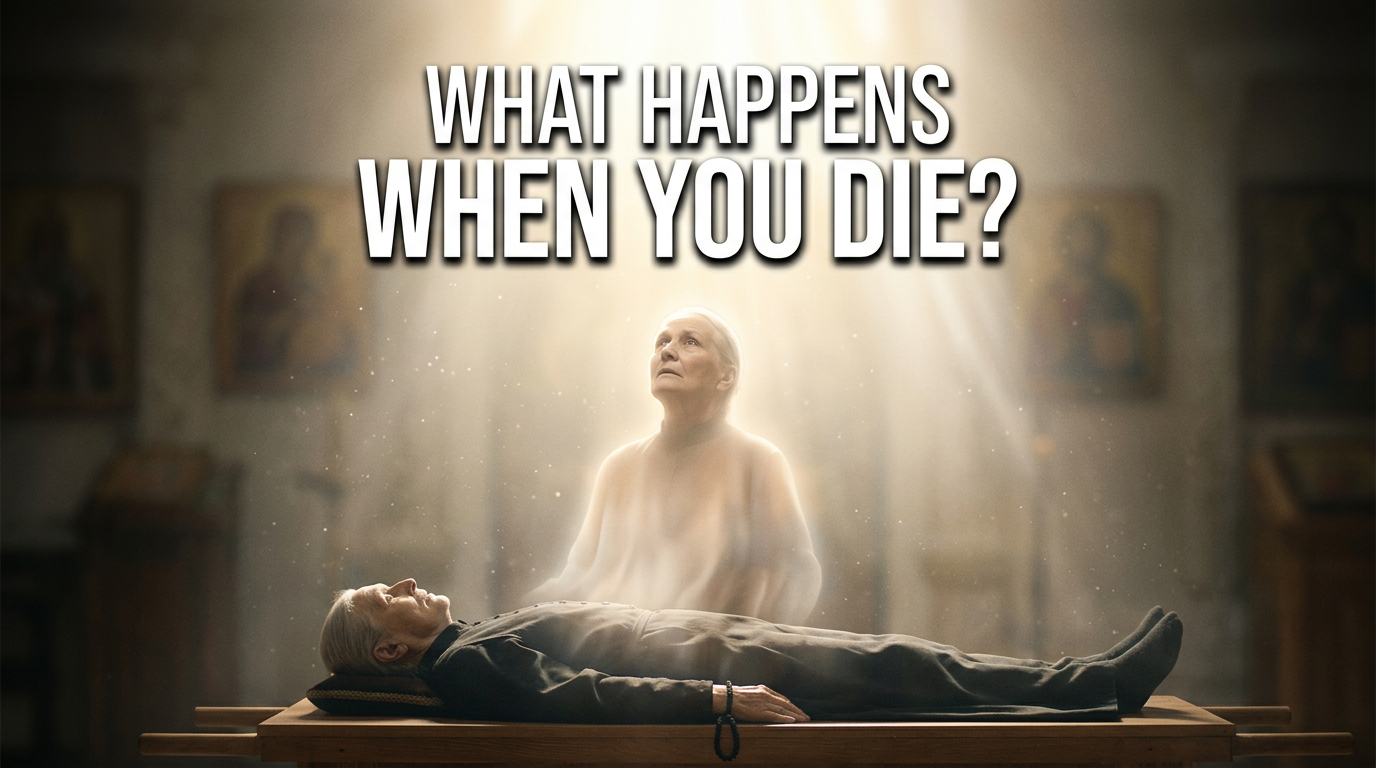
What Happens When You Die?
Let’s bring clarity to this.
When you die:
- You do not cease to exist.
- You do not fall into unconscious “sleep.”
- You do not enter a neutral waiting zone.
Instead, you become fully aware. You encounter reality as it truly is.
And you undergo what the Church calls a particular judgment, not a final sentencing, but a real unveiling of your condition before God.
From that moment, you begin to experience either communion, which we call Paradise, or alienation, which is the suffering aspect of Hades.
This is not theoretical. This is existential.
The Final Judgment and the Resurrection
At the end of time, Christ will return.
The dead will be raised.
Body and soul will be reunited.
And then comes what we call the Final Judgment.
But here is where Orthodox theology departs sharply from many common assumptions.
God is not deciding something arbitrary in that moment.
He is revealing what already is.
Heaven and Hell: Not Places, But Presence
One of the most misunderstood aspects of Christian theology is this.
Heaven and Hell are not primarily different locations.
They are different experiences of the same God.
God is not absent from Hell.
God is everywhere present.
The difference is this.
- For the one who has been purified, humbled, and united to Christ, God is light, joy, and life.
- For the one who has hardened themselves, clung to pride, and rejected Him, God is experienced as fire, torment, and judgment.
The same sun that melts wax hardens clay.
The same presence that saves also judges.
Why This Matters Right Now
This is not just about what happens after you die.
This is about what is happening right now.
Because the Orthodox understanding insists on something deeply uncomfortable.
You are already becoming the person who will experience eternity in a particular way.
Every thought you entertain.
Every habit you form.
Every act of repentance or refusal to repent.
You are being shaped.
Your heart is being conditioned.
And what you become will determine how you experience God, not only then, but even now.
A Final Word
We live in a culture that wants clarity, simplicity, and control. We want to map out eternity like a timeline with neat categories.
But the Orthodox Church invites us into something deeper.
Mystery.
Not confusion, but depth beyond reduction.
You will stand before God.
Not someday in the abstract, but truly, personally, and fully.
And the question is not merely where will I go.
The question is what have I become.
Because in the end, Heaven and Hell are not about distance from God.
They are about whether His presence is your joy or your sorrow.