If there were no priests in the early Church, then one of the foundational structures of Orthodox, Catholic, and even ancient Christian worship collapses entirely. If the apostles never established a sacramental priesthood, then the Eucharist becomes merely symbolic, apostolic succession becomes meaningless, and nearly the entire witness of early Christianity stands in contradiction to modern Protestant assumptions.
Yet when we actually examine the New Testament, the Greek language of Scripture, and the writings of the earliest Christians, a very different picture emerges. The early Church was not a loose collection of independent believers without sacramental authority or ordained ministry. It was deeply liturgical, hierarchical, sacramental, and structured around bishops, presbyters, and deacons.
What makes this discussion even more fascinating is that much of the modern confusion comes not from the Bible itself, but from translation choices made during and after the Protestant Reformation. In many cases, theological assumptions shaped how certain Greek words were rendered into English — particularly the word presbyteros.
The historical and biblical evidence is far more compelling than most modern Christians realize.
You can Now Listen to Each Article
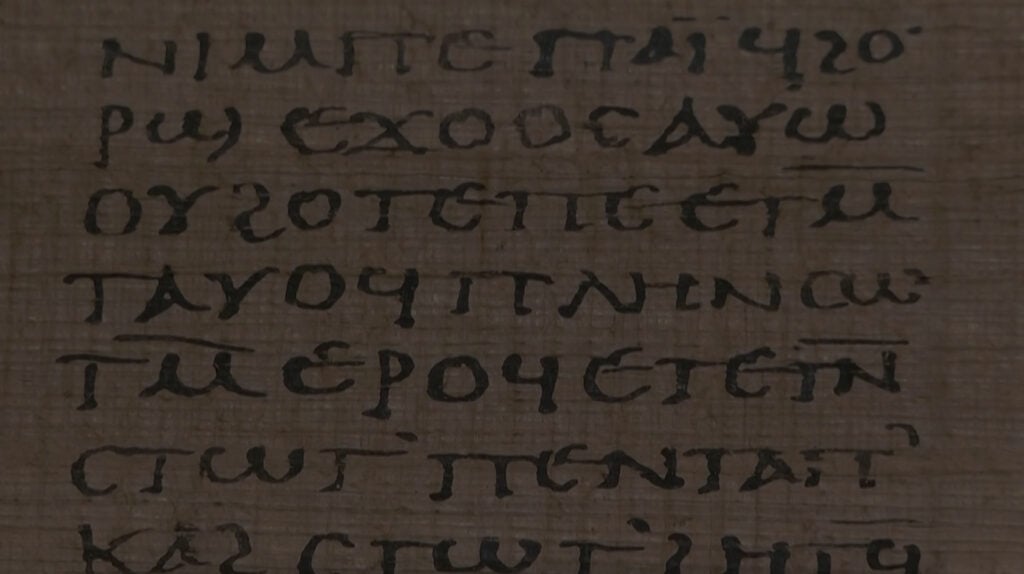
The Word “Presbyter” (πρεσβύτερος)
The English word priest ultimately derives from the Greek word πρεσβύτερος (presbyteros), meaning “elder.”
Over time, the word evolved linguistically:
- Greek: presbyteros
- Late Latin: presbyter
- Old English: preost
- Modern English: priest
This is important because many modern readers assume “elder” and “priest” are entirely different concepts. Historically and linguistically, they are not.
The New Testament uses the word presbyteros numerous times to describe ordained leaders within the Church.
Presbyter in the New Testament
One of the major controversies surrounding this discussion is the way many Protestant Bible translations render the Greek word presbyteros as “elder” instead of “priest.” While presbyteros literally can mean “elder,” the issue is far more theological than merely linguistic.
During the Protestant Reformation, reformers strongly rejected the sacrificial and sacramental understanding of priesthood that had existed historically within the Church. Because of this, translators often preferred the term “elder” in order to distance New Testament ministry from the concept of an ordained sacramental priesthood.
The irony is that the English word priest itself is historically derived from presbyter. The two words are not opposites. Rather, “priest” developed linguistically from the very Greek word used throughout the New Testament.
In other words, modern readers are often led to assume that “elder” refers to a simple church administrator while “priest” refers to something later and more ceremonial. But the early Christians never understood the offices this way. The presbyters of the New Testament exercised sacramental, liturgical, and pastoral authority.
This becomes clear when we examine the biblical evidence itself.
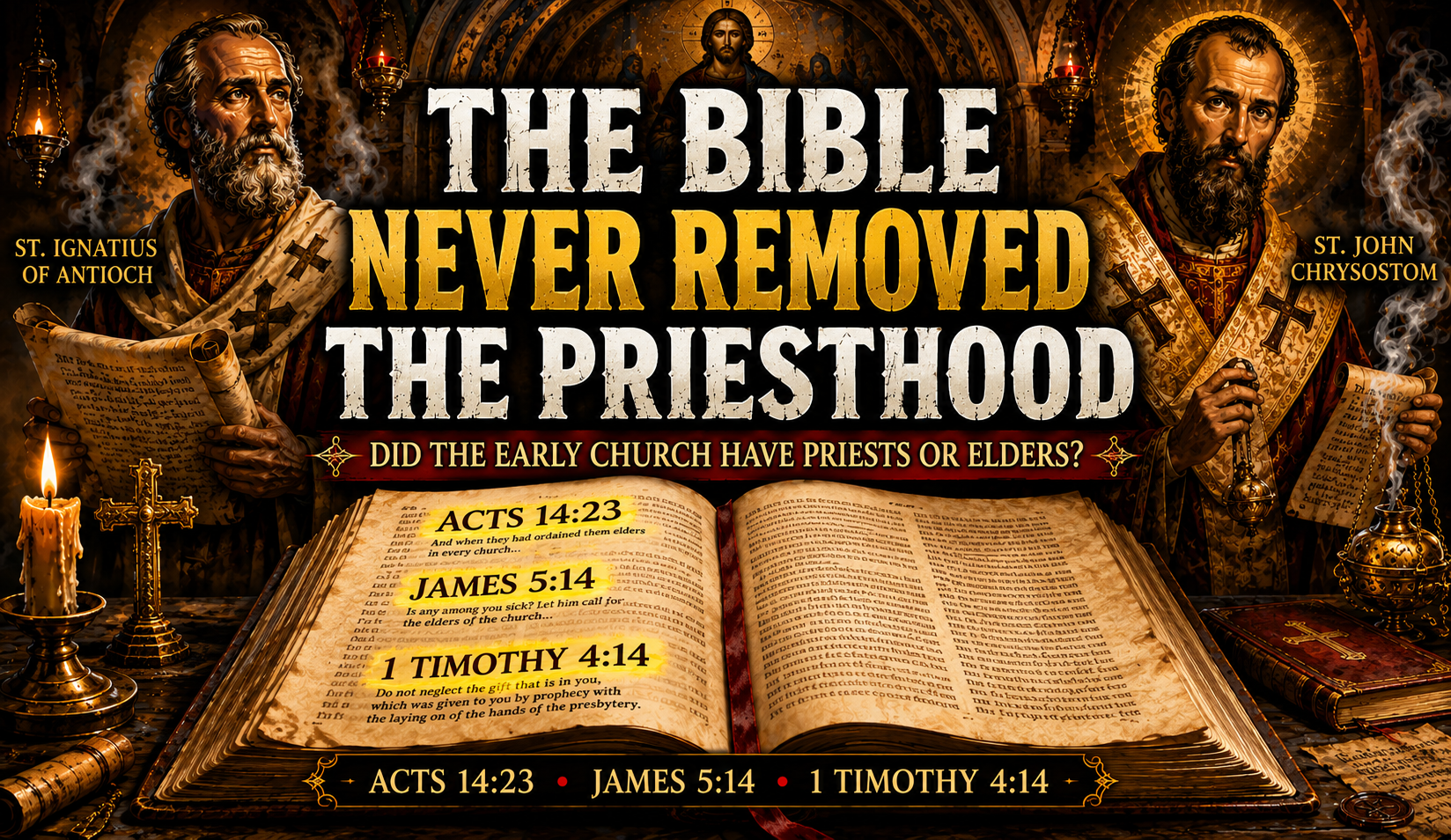
Acts 14:23
Paul and Barnabas appoint presbyters in every church:
“And when they had appointed elders for them in every church, with prayer and fasting they committed them to the Lord…”
This was not informal leadership. These men were appointed through prayer and fasting in an ecclesiastical act.
James 5:14
The presbyters are entrusted with sacramental ministry:
“Is anyone among you sick? Let him call for the elders of the church, and let them pray over him, anointing him with oil…”
Here the presbyters administer healing through prayer and oil — an early form of sacramental anointing.
1 Timothy 4:14
Ordination occurs through the laying on of hands:
“Do not neglect the gift you have, which was given you by prophecy with the laying on of the hands of the presbytery.”
The priesthood was not self-appointed. Grace was imparted through ordination.
Titus 1:5
Paul instructs Titus:
“This is why I left you in Crete, that you might amend what was defective, and appoint elders in every town as I directed you.”
Again, the apostolic Church establishes a visible and ordered clergy.
Were These Merely “Elders” or Actual Priests?
Many Protestants argue that these “elders” were simply mature believers who taught Scripture and managed congregations. But the New Testament presents them as something much more.
The presbyters:
- exercised spiritual authority,
- administered sacraments,
- governed the Church,
- preached doctrine,
- forgave sins in Christ’s name,
- and were ordained through apostolic succession.
This ministry reflects continuity with the Old Testament priesthood, though transformed and fulfilled in Christ.
The early Church never understood ordained ministry as merely administrative. It was sacramental.
Christ as the Fulfillment of the Priesthood
Orthodoxy teaches that Jesus Christ is the eternal High Priest.
The Epistle to the Hebrews repeatedly emphasizes this:
“We have a great high priest who has passed through the heavens, Jesus, the Son of God…” (Hebrews 4:14)
Christ fulfills and perfects the Old Covenant priesthood. But His fulfillment did not abolish ministerial priesthood altogether. Rather, He established a new covenant priesthood that participates in His own ministry.
This is exactly what we see at the Last Supper.
Luke 22:19
Christ tells the apostles:
“Do this in remembrance of Me.”
The apostles are commissioned to continue the Eucharistic offering.
This Eucharistic ministry becomes central to the identity of the priesthood in the early Church.
The Priesthood in the Early Church Fathers
The historical evidence from the Church Fathers is overwhelming.
St. Ignatius of Antioch (c. AD 107)
St. Ignatius was a disciple of the Apostle John. His writings reveal a Church already possessing bishops, presbyters, and deacons in clearly defined sacramental roles.
He writes:
“Let no one do anything pertaining to the Church apart from the bishop.”
And elsewhere:
“Where the bishop is, there let the multitude of believers be.”
Ignatius consistently describes the Eucharist as something offered under the authority of the bishop and presbyters.
This is astonishingly early evidence — within living memory of the apostles.
St. Irenaeus of Lyons (2nd Century)
St. Irenaeus defended apostolic succession against heretics by pointing to the ordained bishops who preserved the faith handed down from the apostles.
For Irenaeus, true doctrine was inseparable from sacramental continuity and ordained ministry.
St. Cyprian of Carthage (3rd Century)
Cyprian spoke explicitly of priests offering sacrifice at the altar.
He writes:
“The priest truly acts in the place of Christ.”
This is unmistakably sacramental language.
St. John Chrysostom and On the Priesthood
Perhaps no early Christian writing demonstrates the sacred character of the priesthood more powerfully than St. John Chrysostom’s work On the Priesthood (Click Here if you would like to download and read it).
Written in the 4th century, the text reveals that the Church already viewed priesthood as a holy mystery (sacrament) requiring divine grace.
Chrysostom describes the priesthood as a ministry that belongs simultaneously to heaven and earth.
He writes:
“The priestly office is indeed discharged on earth, but it ranks among heavenly ordinances.”
He further explains that priests are entrusted with mysteries that even angels stand in awe of.
Most importantly, Chrysostom explicitly connects the priesthood to sacramental ministry:
- offering the Eucharist,
- absolving sins,
- baptizing,
- shepherding souls,
- and administering divine grace.
For Chrysostom, the priest does not merely teach or lead. He participates in the ministry of Christ Himself.
This is profoundly important because it demonstrates that by the 4th century the universal Church already understood priesthood sacramentally — not as a medieval innovation, but as apostolic inheritance.
When Did the Priesthood Become a Sacrament?
Some ask when the Church officially defined priesthood as a sacrament.
The answer depends partly on terminology.
The early Church often used the Greek word mysterion (“mystery”) rather than the later Latin term sacramentum. The Church did not initially produce rigid scholastic lists of sacraments as later Western theology would.
However, from the earliest centuries:
- ordination involved laying on of hands,
- invocation of the Holy Spirit,
- transmission of grace,
- and entrance into sacred ministry.
In other words, the Church practiced sacramental ordination long before later theological systems formally categorized it.
Orthodoxy still prefers the language of “Holy Mystery” because the priesthood is not merely a legal office — it is participation in divine grace.
The Sacramental Role of the Priest
What exactly does a priest do sacramentally?
The Orthodox priest does not replace Christ. Rather, he serves as an icon and instrument of Christ’s ministry within the Church.
His sacramental functions include:
- Celebrating the Eucharist
- Hearing confessions
- Pronouncing absolution
- Baptizing
- Chrismating
- Anointing the sick
- Blessing marriages
- Teaching the faith
- Shepherding the flock
The priest acts within the life of the Church as a steward of the mysteries of God.
As St. Paul writes:
“This is how one should regard us, as servants of Christ and stewards of the mysteries of God.” (1 Corinthians 4:1)
The language of “mysteries” here is deeply sacramental.
The Protestant Objection: “The Priesthood of All Believers”
One of the most common Protestant objections comes from the doctrine known as “the priesthood of all believers.”
This teaching usually appeals to passages such as:
1 Peter 2:9
“You are a chosen race, a royal priesthood…”
Orthodox Christians fully affirm this verse.
Every baptized Christian participates in the royal priesthood of Christ in a general sense:
- offering prayers,
- worship,
- repentance,
- praise,
- and self-sacrifice to God.
But this universal priesthood is not identical to ordained priesthood.
Ironically, the Old Testament followed this exact same pattern.
Israel as a whole was called to be a priestly people:
Exodus 19:6
“You shall be to Me a kingdom of priests and a holy nation.”
Yet despite all Israel being called a “kingdom of priests,” God still established a distinct ordained priesthood through Aaron and the Levites.
So there was:
- a universal priesthood belonging to the people of God generally,
- and a ministerial priesthood set apart for sacrificial and liturgical service.
The New Testament mirrors this same structure.
All Christians participate spiritually in Christ’s priesthood, but certain men are still ordained and set apart for sacramental ministry through the laying on of hands.
The New Testament clearly distinguishes between the two.
If every believer possessed identical priestly authority:
- why did the apostles ordain presbyters?
- why was laying on of hands necessary?
- why were some entrusted specifically with Eucharistic ministry?
- why did James instruct believers to call the elders for sacramental anointing?
- why did Paul warn Timothy not to ordain hastily?
The existence of a universal priesthood does not eliminate ordained ministry any more than the universal call to evangelism eliminates pastors or bishops.
In Orthodoxy:
- all Christians are priests in the sense of offering spiritual sacrifice,
- but ordained priests are sacramentally set apart for liturgical and ecclesial ministry.
This distinction existed from the beginning.
Apostolic Succession and Continuity
The early Church understood priesthood through apostolic succession.
The apostles ordained bishops and presbyters.
Those bishops ordained others.
This continuity preserved:
- doctrine,
- sacramental grace,
- and ecclesial unity.
Christianity was never envisioned as an invisible collection of self-appointed interpreters. It was a visible, sacramental, worshipping communion.
The Orthodox priesthood today stands in continuity with that apostolic structure.
Conclusion
Were there priests in the early Church?
Absolutely.
The New Testament speaks repeatedly of ordained presbyters exercising sacramental ministry. The Church Fathers universally affirm bishops, priests, and deacons as divinely instituted offices. The Eucharistic life of the Church depended upon ordained clergy from the apostolic era forward.
Much of the modern confusion stems from post-Reformation attempts to separate the word presbyter from the concept of priesthood itself. By translating presbyteros merely as “elder,” many readers are unintentionally led to believe that the early Church possessed only administrators or teachers rather than sacramental clergy. Yet historically, linguistically, and theologically, the word priest developed directly from presbyter.
The early Christians never saw a contradiction between the two.
Likewise, the Protestant doctrine of the “priesthood of all believers” contains a partial truth, but not the whole picture. Both the Old Testament and New Testament reveal the same biblical pattern:
- the people of God as a whole share in a royal priesthood,
- while ordained ministers are uniquely set apart for sacramental service.
This distinction existed under Moses, continued through the apostles, and remains present in the Orthodox Church today.
Far from being a later corruption, the sacramental priesthood emerges directly from:
- Christ’s commissioning of the apostles,
- apostolic ordination through laying on of hands,
- and the uninterrupted witness of the early Church.
As St. John Chrysostom understood so profoundly, the priesthood is not merely administrative or symbolic. It is a holy mystery — a participation in the very ministry of Christ Himself.
Want the entire article distilled into one clear, printable page?
Download your free summary and keep it with you.
Get the free PDF + join thousands receiving short, practical Orthodox insights in the “Morning Brew with Father Don” to help you grow in Christ each week.