
The 16th century stands as one of the most disruptive periods in Christian history. In Western Europe, the Protestant Reformation fractured the unity of Christendom, challenged the authority of Rome, and unleashed waves of theological, political, and social upheaval. From the posting of the Ninety-Five Theses in 1517 to the wars of religion that followed, the Western Church entered a period of profound instability and redefinition.
Yet, during this same period, the Orthodox Christian world did not undergo a comparable rupture. There was no equivalent to Wittenberg, no cascade of competing confessions, and no continent-wide religious wars born from doctrinal division. This absence becomes even more striking when we recognize that the Orthodox Church, like the West, was not immune to internal tensions and corruption.
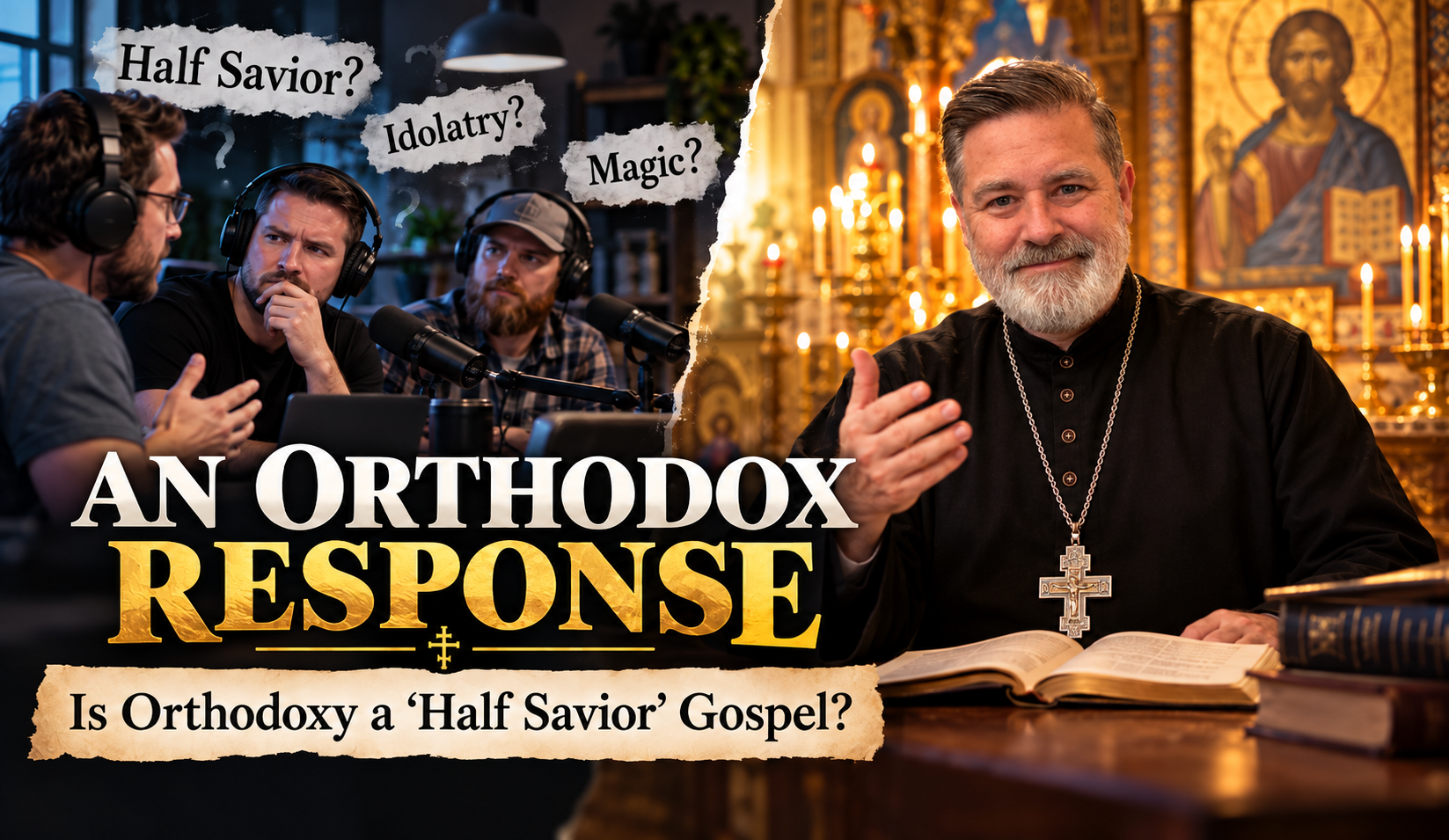
So the question must be approached with greater depth: Why did the Orthodox Church not experience a Reformation, even while sharing some of the same external problems?
Corruption Was Present but Revolution Did Not Follow
By the late medieval and early modern periods, the Orthodox world was not free from institutional strain. Bishops were sometimes entangled in political concerns. Monasteries accumulated land and wealth. Complaints about ecclesiastical abuses were not entirely absent.
However, unlike in Western Europe, these issues did not culminate in a theological revolt. There was no mass movement to redefine doctrine or restructure ecclesiastical authority. This suggests that the roots of the Protestant Reformation cannot be reduced simply to corruption. The deeper issue was how corruption itself was interpreted.
In the West, corruption was increasingly seen as evidence that the system itself was broken. In the East, corruption was more often understood as a spiritual failure within persons, not a failure of the Church’s nature.
Early Protestant Optimism Toward Orthodoxy
At the dawn of the Reformation, Protestant reformers were not immediately hostile toward the Orthodox Church. In fact, there was a period of curiosity and even cautious optimism.
Martin Luther, in his early disputes with Roman Catholic authorities, pointed to the Greek Church as an example of Christianity existing without papal supremacy. This gave Protestants a historical precedent for rejecting Rome’s claims.
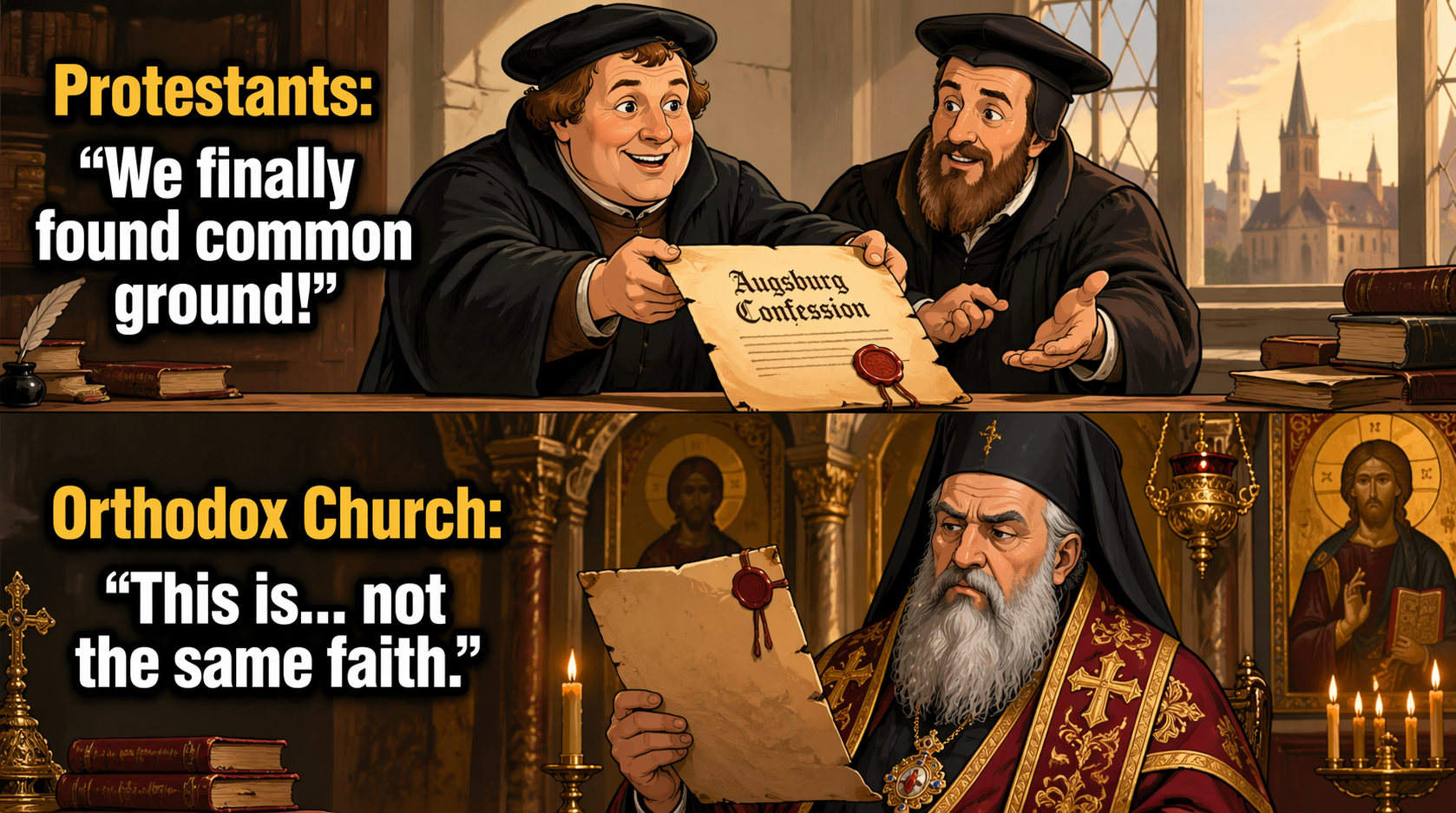
Philip Melanchthon, a key figure in the Lutheran movement, took this interest further. As a scholar of Greek and an academic deeply invested in the recovery of early Christian sources, he reached out to the Patriarch of Constantinople. The Augsburg Confession, drafted in 1530 as a formal statement of Lutheran belief, was translated into Greek and sent to the East in 1559 as an invitation to dialogue and potential unity.
This moment is historically significant. It represents one of the earliest serious attempts at theological reconciliation between Protestantism and Orthodoxy.
The Patriarchal Response and the End of Dialogue
The Orthodox response unfolded over several decades. A second major attempt at engagement occurred in the 1570s when Lutheran theologians from Tübingen sent another Greek translation of the Augsburg Confession.
In 1576, Patriarch Jeremias II of Constantinople issued a detailed reply. This was not a dismissive rejection but a careful theological engagement. He systematically addressed each of the Confession’s articles, affirming certain general truths while rejecting others as incompatible with Orthodox teaching.
Over the next several years, additional letters were exchanged. These writings form one of the most important theological dialogues of the 16th century. Yet, despite the depth of engagement, the outcome was decisive. By 1581, Jeremias II asked the Lutherans to cease correspondence, recognizing that the differences were too significant to overcome.
This exchange reveals something critical. The divide was not rooted in misunderstanding alone but in fundamentally different theological frameworks.
The Fall of Constantinople and Its Lasting Impact
To understand the Orthodox position in the 16th century, one must look back to 1453 and the fall of Constantinople to the Ottoman Empire. This event reshaped the entire Orthodox world.
The Patriarch of Constantinople became not only a religious leader but also a civil representative of Orthodox Christians within the Ottoman system. The Church was tasked with preserving identity, cohesion, and continuity under foreign rule.
This context cannot be overstated. While Western Europe experienced fragmentation that allowed reform movements to flourish, the Orthodox world operated under conditions where unity was essential for survival. A theological rupture on the scale of the Reformation could have destabilized entire communities already living under political pressure.
The Council of Florence and the Memory of Failed Union
Another crucial historical moment shaping Orthodox resistance to reformist ideas was the Council of Florence in 1438 to 1439. This council attempted to reunite the Eastern and Western Churches.
Under significant political pressure, some Orthodox leaders agreed to union with Rome. However, this union was overwhelmingly rejected by the broader Orthodox population upon their return.
This rejection left a deep imprint on Orthodox consciousness. It reinforced a suspicion toward Western theological initiatives and a conviction that doctrinal compromise, even under political necessity, was unacceptable.
By the time the Protestant Reformation emerged, the Orthodox Church had already experienced and rejected one major attempt at theological realignment with the West. This history shaped how Protestant overtures were received.
Authority: A Different Crisis Entirely
The Protestant Reformation was driven by a crisis of authority centered on the papacy. Reformers rejected the Pope’s claim to universal jurisdiction and sought to relocate authority in Scripture alone.
Orthodoxy never faced this same crisis. Authority was not centralized in a single figure but distributed through councils, bishops, and the living tradition of the Church.
Because the structure of authority differed, the pressure points that triggered the Reformation in the West simply did not exist in the same way in the East.
Theology as Experience Rather Than System
Another decisive factor lies in the nature of theology itself.
In the West, especially following the Scholastic period, theology developed into a highly systematic discipline. The Reformation intensified this trend, producing confessions, catechisms, and precise doctrinal formulations.
In Orthodoxy, theology remained rooted in experience. It was not merely about defining God but about encountering Him. This is reflected in the understanding that the spiritual and physical realms are inseparably linked, and that what occurs in the spiritual realm directly shapes human life.
This perspective shifts the focus from doctrinal correction to spiritual transformation.
The Hesychast Controversy as an Internal “Non-Reformation”
Interestingly, the Orthodox Church did experience internal theological conflict in the 14th century during the Hesychast controversy. This debate centered on the nature of divine experience and the practice of contemplative prayer.
St. Gregory Palamas defended the experience of the uncreated light against critics who emphasized a more rational approach to theology. The Church ultimately affirmed Palamas’ teaching.
This moment is instructive. It shows that Orthodoxy was capable of addressing theological disputes. However, the resolution came not through fragmentation or reform movements, but through conciliar affirmation and deeper articulation of tradition.
The Role of the Spiritual Worldview
A recurring theme in the source material is the inseparability of the spiritual and physical realms. The Orthodox perspective sees human problems as rooted in spiritual realities rather than merely institutional structures.
This fundamentally alters the response to corruption and disorder. If the root issue is spiritual, then the solution is not structural revolution but repentance, ascetic struggle, and renewal of the heart.
Continuity Rather Than Reinvention
The Orthodox Church understood itself as the living continuation of the apostolic faith. This continuity was not merely historical but sacramental and experiential.
To introduce a Reformation in the Protestant sense would have required rejecting this continuity. From the Orthodox perspective, such a move would not be reform but rupture.
A Different Kind of Renewal
Renewal in the Orthodox world did occur, but it took a different form. It emerged through:
Monastic revivals such as those on Mount Athos
Spiritual renewal movements within local communities
The guidance of elders and saints
A deepening of liturgical and sacramental life
The emphasis remained on inner transformation rather than institutional restructuring.
The absence of an Orthodox Reformation is not an anomaly but a reflection of a fundamentally different vision of the Church.
While Western Christianity responded to crisis with reform and redefinition, Orthodoxy responded with preservation and spiritual renewal.
Understanding this difference requires more than historical analysis. It requires a recognition that the East and West were operating from different theological assumptions about authority, salvation, and the very nature of the Church itself.
In the end, the question is not simply why the Orthodox Church did not reform, but whether it believed that such a reform, as conceived in the West, was ever necessary or even possible.