There are few theological subjects today that generate more confusion, more emotional reaction, and more misunderstanding than the question of Israel and the Church. Much of this confusion comes from categories that are foreign to the historic life of the Church but have become dominant in modern religious discourse. Terms like “replacement theology” are often used as if they are self-evident, but in reality they obscure more than they clarify.
So the question before us is this. How does the Orthodox Church understand Israel, the Church, and the continuity of God’s covenantal work in history?
To answer that, we must step out of modern frameworks and return to the mind of the early Church, to the Scriptures, and to the lived theological experience of the faith.
The Problem with the Question Itself
Before we can answer the question, we need to recognize something important. The phrase “replacement theology” assumes a very specific framework. It assumes that God had one people, then rejected them, and then chose a completely different people to take their place.
That framework is not how the Orthodox Church has historically understood salvation.
In Orthodoxy, God’s work in history is not a series of disconnected programs. It is one continuous, unfolding reality that reaches its fulfillment in Christ. What we are dealing with is not replacement, but fulfillment. Not abandonment, but transformation.
The Abrahamic Covenant: What Was Actually Promised?
If we are going to speak honestly about Israel, we must go all the way back to Abraham. Because everything begins there.
God makes a covenant with Abraham that includes three primary elements:
- A people
- A land
- A blessing to the nations
Now here is where much of the modern confusion begins. Many interpret the Abrahamic covenant almost exclusively in terms of land and ethnicity. But that is not how the Scriptures ultimately unfold the meaning of that covenant.
The promise was never merely about geography. It was never merely about biological descent.
The promise was always moving toward something greater.
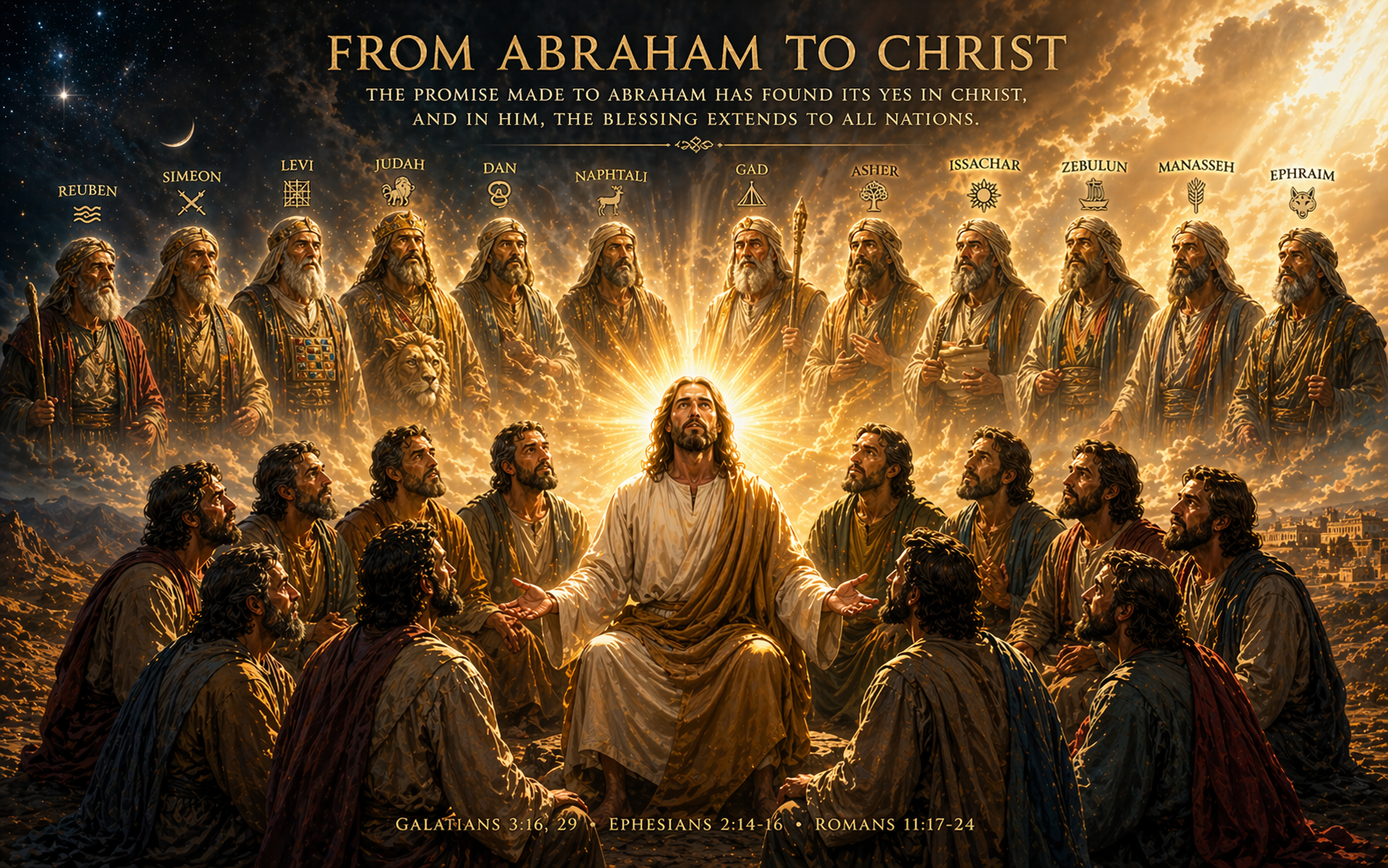
God says to Abraham that through his seed, all the nations of the earth will be blessed. That is not a national promise. That is a universal one.
So the question becomes, who is the true seed of Abraham?
Christ as the Seed and Fulfillment of the Covenant
The New Testament answers this very directly.
The seed of Abraham is not ultimately a nation. The seed is Christ.
This is where everything comes into focus.
The covenant with Abraham is fulfilled not in the preservation of an ethnic line for its own sake, but in the coming of Christ through that line. And in Christ, the blessing promised to Abraham is extended to the entire world.
This means that the Abrahamic covenant was always Christological in its deepest meaning.
It was pointing forward.
It was preparatory.
It was never meant to terminate in itself.
Who Are the Children of Abraham?
This leads to another critical question.
Who, then, are the children of Abraham?
From an Orthodox perspective, the answer is not limited to biology. It is defined by participation.
Those who are in Christ are the true children of Abraham. Not because ethnicity is irrelevant in history, but because it is no longer the defining boundary of the covenant.
Faith, obedience, and union with Christ are now the defining realities.
This is exactly what we see in the life of the Church. Jew and Gentile alike are brought into one body. Not by replacing one with the other, but by fulfilling what both were called into.
The Land Promise Reconsidered
One of the most sensitive aspects of the Abrahamic covenant is the promise of land.
In modern discussions, this is often interpreted in strictly geopolitical terms. But the Orthodox Church approaches this differently.
The land was real. It mattered. It was part of God’s historical work.
But like so many elements of the Old Covenant, it was also typological. It pointed beyond itself.
The ultimate inheritance is not a strip of territory. It is the Kingdom of God.
The movement of Scripture is always from the particular to the universal, from the shadow to the fullness. What begins in a specific place expands into a reality that encompasses all creation.
If we reduce the promise to land alone, we risk missing the fullness of what God was doing.
Want to go deeper?
Check out my video on this issue…

Israel’s True Vocation
To understand Israel rightly, we must return to why Israel existed at all.
Israel was not chosen as an end in itself. Israel was chosen as a vessel. A people set apart through whom God would reveal Himself to the world and ultimately bring forth the Messiah.
This is crucial.
If we misunderstand Israel as primarily an ethnic or political identity, then everything that follows will be distorted. Israel’s identity is theological before it is anything else. It is rooted in covenant, in calling, and in communion with God.
The promises given to Israel were never meant to terminate in Israel. They were always meant to open outward to the entire world.
Christ as the Fulfillment of Israel
Everything changes in the coming of Christ.
In Him, the promises made to Abraham, Isaac, and Jacob reach their fulfillment. Not their cancellation. Not their rejection. Their fulfillment.
The covenant is not broken. It is completed.
This is why the New Testament consistently reframes what it means to be the people of God. No longer is the defining boundary ethnic lineage. The defining reality is union with Christ.
This is not an innovation. It is the completion of what was always intended.
The Church as the Fulfilled Israel
So what is the Church?
The Church is not a separate entity that replaces Israel. The Church is Israel fulfilled.
This is a deeply important distinction.
The Church is the continuation of the people of God, now revealed in its fullness. What was once partial is now complete. What was once preparatory is now realized.
In the Church, the calling of Israel expands to include all nations. The dividing wall is broken down. The covenant is not discarded. It is opened.
What Orthodoxy Rejects
Because the Orthodox Church maintains this continuity, it rejects two extremes.
The idea that God has completely rejected the Jewish people
This contradicts the witness of Scripture. God’s covenantal faithfulness is not so fragile. There remains mystery, and there remains hope.
The idea that the Abrahamic covenant guarantees a perpetual geopolitical entitlement
This is equally problematic.
When the covenant is reduced to land and ethnicity, it is severed from its fulfillment in Christ. It becomes something smaller than what God intended.
Orthodoxy does not interpret the Abrahamic covenant as a blank check for modern political claims. It interprets it through Christ, where its true meaning is revealed.
The Spiritual Reality Behind the Visible
One of the recurring themes in Orthodox theology is that we cannot separate the visible from the invisible.
What we see externally is often the manifestation of deeper spiritual realities.
This applies directly to how we understand Israel and the covenant.
If we look only at outward markers such as land, ethnicity, or political identity, we miss the deeper truth. The covenant is ultimately about communion with God.
The Mystery of Israel’s Future
There remains, however, a mystery.
Scripture speaks of a future reality involving Israel that is not fully revealed. The Church does not attempt to force this into rigid systems.
Instead, it holds this tension with humility.
God is not finished. His mercy is not exhausted. His purposes continue to unfold.
Final Thoughts
So how should we think about Israel and the Abrahamic covenant?
Not as a story of replacement.
Not as a story of political entitlement.
But as a story of fulfillment.
The covenant with Abraham finds its meaning in Christ. The promises are completed, not canceled. The people of God are expanded, not discarded.
The Church is Israel fulfilled in Christ, open now to all humanity.
And when we see it this way, the confusion begins to clear. What remains is the profound beauty of a God who is faithful to His promises, who brings them to completion, and who invites the entire world into the blessing that began with Abraham.