
If we are honest, much of modern Christianity feels thin.
It often becomes about information instead of transformation. About attendance instead of struggle. About comfort instead of repentance. We reduce the spiritual life to something manageable. Say a few prayers. Attend when we can. Try to be a decent person.
And then we wonder why we feel unchanged.
Why the same patterns persist.
Why the same sins return.
Why there is so little inner peace.
The problem is not that Christianity has lost its power.
The problem is that we have forgotten how it actually works.
The early Church did not speak about the spiritual life in casual terms.
It spoke about purification. Illumination. Union.
It spoke about the heart as something that must be healed, not just informed.
It spoke about the inner life as a battlefield, not a self-improvement project.
This is where John Climacus becomes so important.
In The Ladder of Divine Ascent, he presents a vision of Christianity that is deeply mystical, intensely practical, and completely uncompromising.
He reminds us that the spiritual life is not passive. It is war. Not against other people, but against the disordered passions within us that distort how we see, think, and live.
This is the language we have largely lost.
And yet it is exactly the language we need.
Because what St. John describes is not an ancient problem. It is our problem.
Fragmentation. Distraction. Emotional instability. Conflicted desires. A divided heart.
The Ladder does not flatter us. It exposes us.
But it also gives us something far more valuable than comfort.
It gives us a path.
And if we are willing to listen, we may discover that the wisdom of St. John Climacus speaks more directly to our modern condition than anything we have been offered in its place.
Why Did St. John Climacus Write the Ladder of Divine Ascent?
In the. 7th century, St. John Climacus was a monk at Saint Catherine’s Monastery on Mount Sinai, and later became its abbot. He lived a life of deep ascetic struggle, long before he ever wrote a word.
He did not write this book to impress anyone. He wrote it because another abbot asked him a very simple question.
How do I guide my monks toward salvation?
That is the origin of the Ladder.
It was written as a pastoral guide.
A spiritual handbook.
Something practical and direct.
Not theoretical. Not abstract.
The structure is simple, but powerful.
Thirty steps.
Each one represents a movement of the soul. Either away from disorder or toward God.
Why thirty?
Because it mirrors the hidden years of Christ before His public ministry.
The implication is clear.
Before anything is revealed outwardly, something must be formed inwardly.
Why This Work Matters Historically
Very quickly, the Church recognized something about this work.
This was not just for monks.
This was for anyone serious about the spiritual life.
For centuries, the Ladder has been read every year during Great Lent. Not as a tradition for tradition’s sake, but because it does something very few writings can do.
It tells the truth about the human condition.
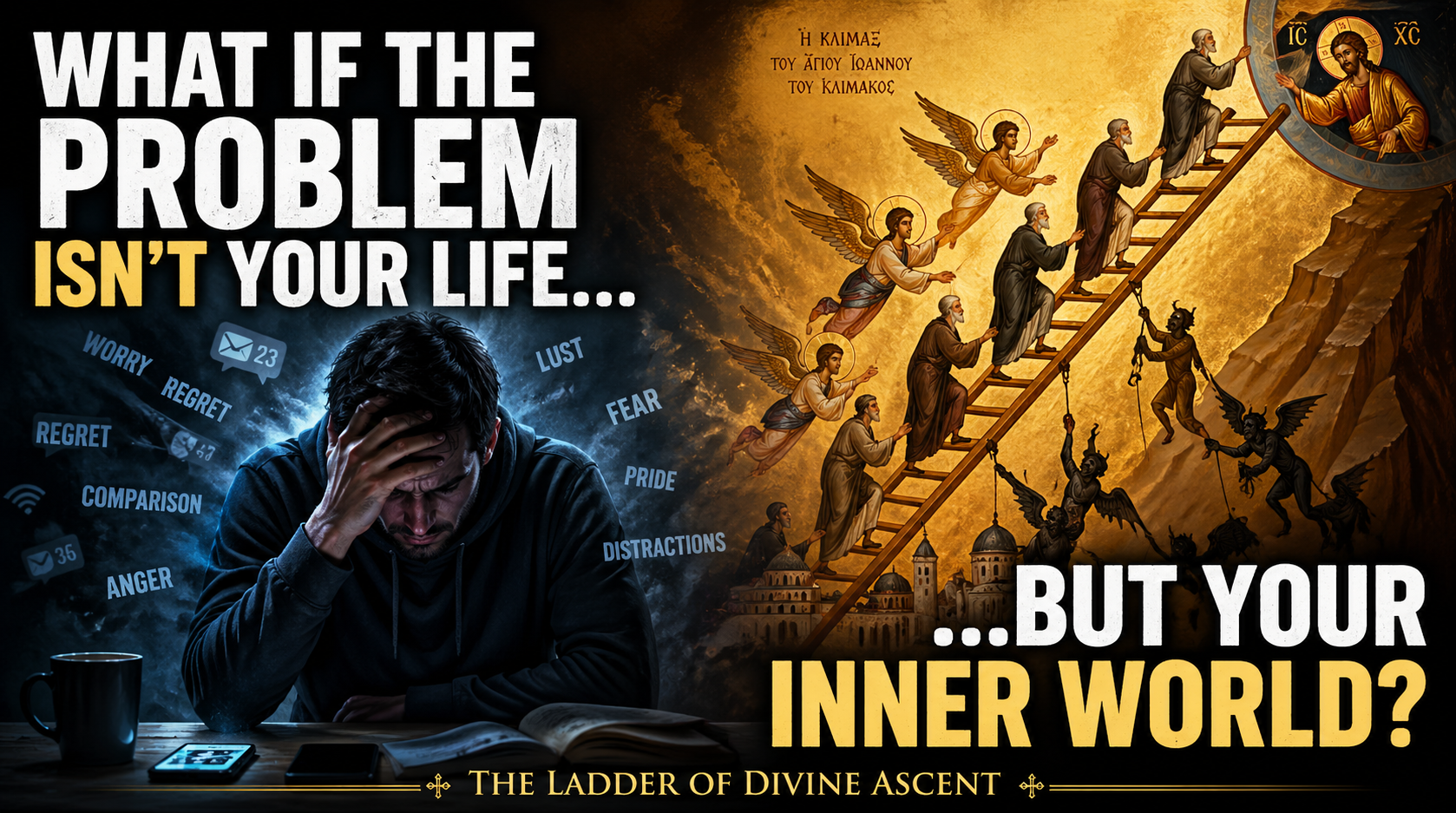
The famous icon of the Ladder shows monks climbing toward Christ while demons attempt to pull them down. Some are ascending. Some are falling.
That image is not dramatic exaggeration.
It is reality.
The Church preserved this work because it is accurate.
What the Ladder Teaches
At its core, the Ladder teaches that the spiritual life is not casual.
It is intentional. It is demanding. It is transformative.
St. John lays out the journey in three movements.
First, breaking from disordered attachment.
This is where most people misunderstand the spiritual life. They think renunciation means losing something. In reality, it means being freed from what is controlling you.
Second, the healing of the passions.
Anger. Lust. Pride. Envy. Despondency.
These are not just bad habits. They are distortions of the soul. They shape how you see reality. They influence how you respond to everything.
If they are left unchecked, they do not stay still.
They grow.
Third, union with God.
This is where the Ladder is heading from the very beginning. Not behavior modification. Not moral improvement.
Union.
Stillness. Prayer. Dispassion. And finally, love.
Because the goal is not simply to become better.
The goal is to become whole.
Spiritual Warfare Is Not What You Think
This is where St. John becomes very clear.
The spiritual life is warfare.
But not in the way most people imagine.
It is not about external enemies. It is not about dramatic confrontations.
It is interior.
It is the battle over your thoughts. Your desires. Your attention.
St. John speaks about what the Fathers call logismoi. These are thoughts that present themselves to you. Not all of them are neutral. Some are invitations.
To anger. To pride. To despair. To distraction.
Spiritual warfare is learning to recognize these thoughts before they take root.
It is choosing, moment by moment, what you will agree with.
This is why someone can be in the exact same situation as another person and experience something completely different.
One sees offense.
Another sees an opportunity for humility.
Another sees nothing at all.
Same moment. Different inner world.
That is the battlefield.
And here is the part most people do not want to hear.
If you are not actively engaging in this struggle, you are not standing still.
You are drifting.
Toward comfort. Toward distraction. Toward forgetfulness.
The Ladder is not describing an extreme spiritual path.
It is describing reality.
Why the Orthodox Church Still Reveres It
The reason the Orthodox Church continues to hold The Ladder of Divine Ascent in such high regard is very simple.
It works.
It speaks to the same human condition we are experiencing right now. Different culture. Same soul.
It does not offer vague inspiration. It offers clarity.
It does not reduce the spiritual life to ideas. It integrates theology with lived experience.
It aligns with everything the Church gives us. Prayer. Fasting. Confession. The sacraments.
Not as burdens.
As medicine.
The Ladder endures because it tells the truth and because it leads to healing.
The Invitation to Climb
The Ladder is not meant to be admired from a distance.
It is meant to be climbed.
And that is where this becomes personal.
Because the question is no longer about St. John.
It is about you.
Where are you divided?
What thoughts are shaping your inner world?
What desires are quietly directing your life?
This is why we are beginning this series.
Not as an academic exercise.
But as an invitation.
An invitation to examine the inner life honestly.
An invitation to begin the work of integration in Christ.
If you are ready to go deeper, to move beyond surface level Christianity and actually engage the spiritual life as the Fathers describe it, I want to invite you to learn more or join the full catechetical series:
👉 Click Here to Learn More or Join the lecture series on the Ladder of Divine Ascent
This is where theology becomes life.
And where the climb begins.
Grace and Peace,
Fr. Don