Most people don’t begin asking theological questions because they’re curious.
They begin because something in their life doesn’t make sense.
Why do I keep reacting this way?
Why do I fall into the same patterns?
Why does peace feel so unnatural, and chaos feel so easy?
If we’re honest, that’s where this conversation really starts.
And that’s exactly why discussions about “original sin” keep showing up in modern culture. People are trying to understand their experience. They’re trying to answer a deeply personal question:
Is something wrong with me… or is something wrong with us?
Defining the Terms: What Is “Original Sin”?
In Western Christianity, particularly following the influence of Augustine of Hippo, original sin is typically defined this way:
Humanity inherits both the guilt and the consequences of Adam’s sin.
In this framework:
- Adam sinned
- Humanity fell “in him”
- Therefore, every person is born already guilty before God
This is often expressed in legal terms:
- Sin equals violation of divine law
- Humanity equals guilty
- Salvation equals forgiveness or acquittal
So the primary problem becomes legal standing before God.
And the solution becomes being declared righteous.
The Orthodox Distinction: What Is “Ancestral Sin”?
The Orthodox Church has always approached this differently.
We do not use the term “original sin” in the same way.
Instead, we speak of ancestral sin.
Here’s the key distinction:
- We do not inherit Adam’s guilt.
- We inherit the condition that resulted from his fall.
So what do we actually inherit?
Mortality
Corruption
A disordered human nature
A world fractured from communion with God
In other words, we are not born guilty.
We are born sick.
The Order Matters: Death First, Then Sin
One of the most important differences between these two views is what comes first.
In the Western model:
Sin leads to death.
In the Orthodox understanding:
Death enters first, and sin follows because of it.
This is critical.
Because once death enters the human experience, everything changes:
- Fear becomes central
- Self-preservation becomes instinctive
- Relationships become fractured
- The human heart becomes divided
And from that environment, sin multiplies.
This is why Scripture and the Fathers emphasize that the human condition is not merely moral failure.
It is existential brokenness.
And as we see even in lived experience, trauma, stress, and internal fragmentation are not anomalies. They are part of the human condition itself.
Why This Distinction Matters
At first glance, this might feel like theological nuance.
It’s not.
It changes everything.
1. It Changes How You See Yourself
If original sin is primarily about guilt:
You start your life already condemned.
If ancestral sin is about condition:
You start your life wounded and in need of healing.
That is a very different starting point.
2. It Changes How You Understand Sin
In a legal framework:
Sin is breaking rules.
In the Orthodox framework:
Sin is the symptom of a deeper sickness.
That’s why we don’t just struggle occasionally.
We struggle consistently.
Not because we are trying to be evil.
But because something within us is disordered.
3. It Changes What Salvation Means
If the problem is legal:
Salvation equals forgiveness.
If the problem is ontological:
Salvation equals healing, restoration, and transformation.
This is why the Orthodox Church speaks so much about:
- Healing of the soul
- Purification of the heart
- Union with God
Christianity is not simply about getting out of trouble.
It is about becoming whole again.
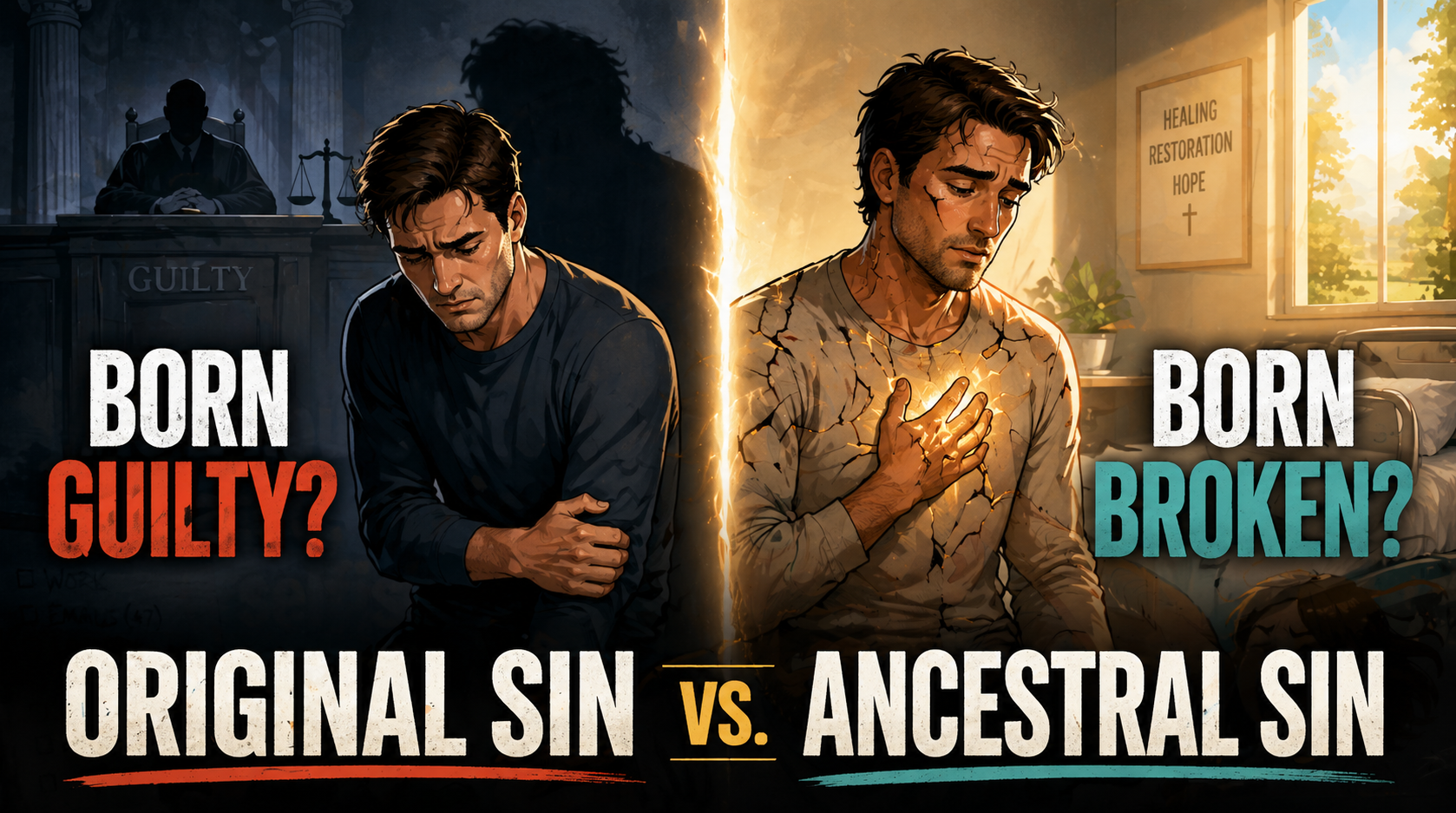
A More Accurate Analogy: Courtroom vs. Hospital
This contrast might help clarify things.
- Western emphasis: Courtroom
- You are guilty
- God is judge
- Christ pays the penalty
- You are declared innocent
- Orthodox emphasis: Hospital
- You are sick
- God is physician
- Christ heals your nature
- You are restored to life
Now, to be clear, Orthodoxy does not deny guilt entirely.
We do commit personal sins.
But guilt is not the starting point.
Brokenness is.
Why This Explains Your Daily Struggle
This is where it becomes practical.
Because if you’ve ever said:
“I’m going to be patient today.”
And then two hours later you’re frustrated, anxious, and short-tempered…
That’s not just a failure of effort.
That’s a revelation of condition.
The struggle you experience is not random.
It is the lived reality of ancestral sin.
So What Has God Done About It?
This is where everything turns.
Because Christianity is not primarily a diagnosis.
It is a cure.
Christ does not come merely to forgive sins.
He comes to heal human nature itself.
- He takes on our mortality
- He enters into our condition
- He conquers death through His resurrection
What was corrupted in Adam is renewed in Christ.
This is why the Incarnation matters.
This is why the Cross matters.
This is why the Resurrection matters.
Final Thought
When people argue online about original sin, they are often debating fairness.
But the deeper question is not:
Is this fair?
The deeper question is:
What has happened to us, and how is it healed?
Orthodoxy answers that question with clarity.
You are not born condemned.
You are born into a broken world, with a broken nature.
And Christ has come not simply to forgive you.
But to restore you.
And that changes everything.
Grace and Peace,
Father Don