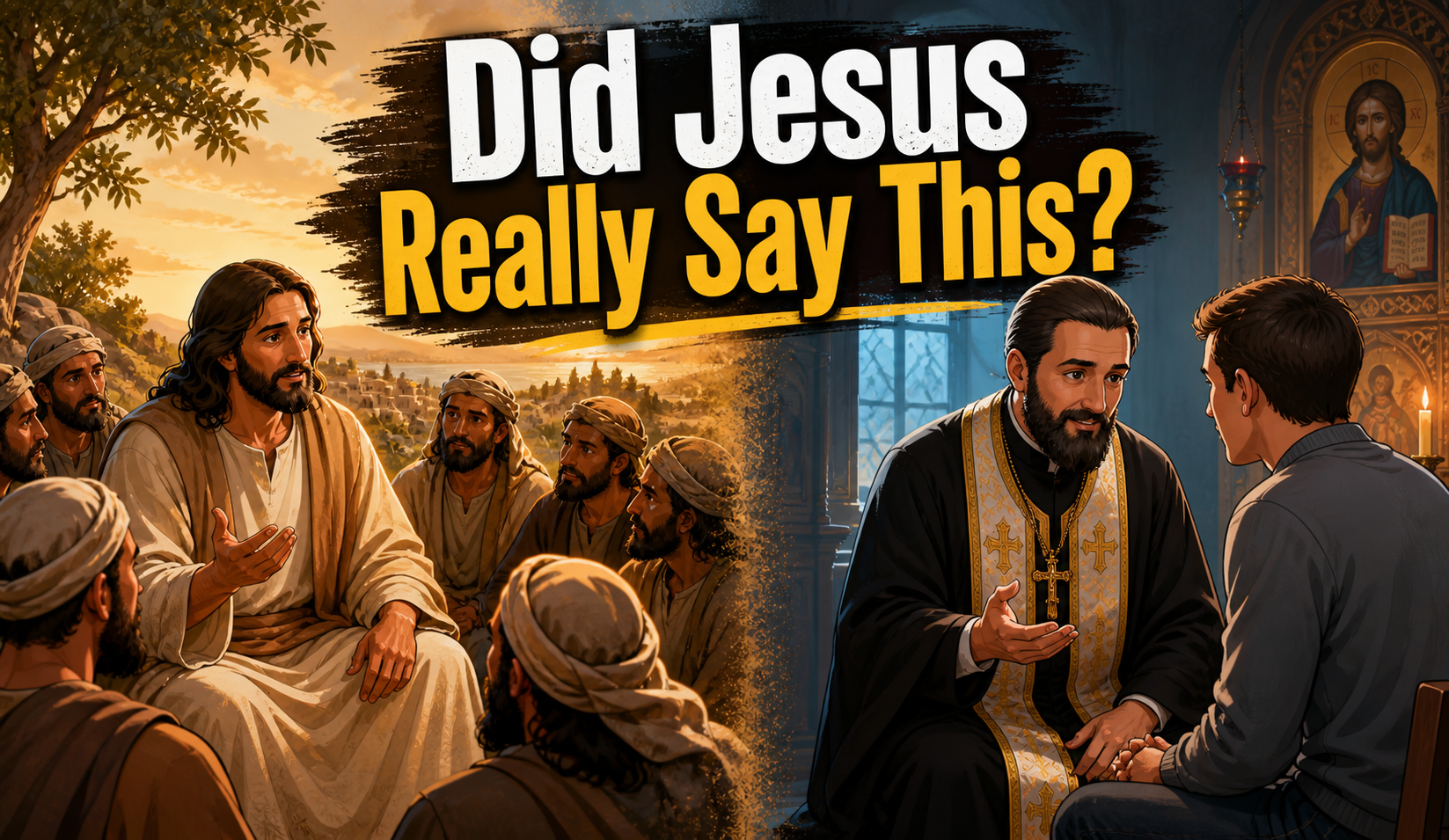
There are few things more frustrating than watching the Word of God be weaponized against the very Body of Christ it was given to build.
You have probably seen it. A post. A comment. A quick jab meant to sound biblical and decisive. “Jesus said call no man father.” And just like that, centuries of Christian life are dismissed in a single line, ripped out of context and stripped of meaning.
But here is the deeper question that we must wrestle with if we are serious about truth.
Did Jesus actually forbid the use of the word “father”? Or are we missing something far more profound, far more penetrating, and frankly, far more convicting?
Because if we misunderstand Christ here, we are not just misusing a word. We are misunderstanding His teaching on authority, humility, and the very nature of spiritual life.
You can Now Listen to Each Article
What Was Christ Actually Confronting?
The statement comes from the Gospel of Matthew, chapter 23. But we cannot isolate verse 9 from what comes before it.
Christ begins by exposing the religious leaders:
“They do all their deeds to be seen by others… they love the place of honor… and to be called rabbi by others.”
This is the context.
So when He says, “Call no man your father on earth, for you have one Father, who is in heaven,” He is not regulating vocabulary. He is confronting something much deeper.
It is the love of recognition.
It is the grasping for identity.
It is the desire to occupy a place that belongs to God alone.
Christ is addressing pride disguised as religion.
If Taken Literally, the Command Collapses
If this were a strict, literal prohibition, then Scripture would contradict itself.
The entire Old Testament uses the word “father.” Christ Himself uses it in His parables. The language is not the problem.
The problem is the heart.
Christ is speaking in a way that cuts through surface-level thinking and exposes interior disposition.
The Apostle Paul Forces the Question
In the First Epistle to the Corinthians, Paul writes:
“I became your father in Christ Jesus through the gospel.”
And in the First Epistle to Timothy:
“To Timothy, my true child in the faith.”
So we must ask the unavoidable question.
Did Paul disobey Christ?
Of course not.
Paul understood exactly what Christ meant.
The Difference Between Replacement and Participation
Christ is not denying that there are fathers. He is denying that any man can be the Father in the ultimate sense.
There is a difference between:
- Claiming authority as your own
- Participating in authority that comes from God
Paul’s fatherhood exists “in Christ Jesus.” That means it is not independent. It is not competitive. It is derived.
God is Father by nature.
Man becomes a father by grace.
Where Did the Term “Father” for Clergy Come From?
This is where history becomes incredibly important.
The word itself comes from the Greek patēr, meaning father, which is used throughout the New Testament. The concept of spiritual fatherhood is already present in the apostolic writings.
But what about its use as a title?
Apostolic Foundation
From the very beginning, spiritual life was understood as something that is generated, not merely taught. Paul does not say he instructed the Corinthians. He says he became their father through the Gospel.
This places the origin of the concept firmly in the first century.
Early Church Development
By the time of Ignatius of Antioch around 107 AD, the Church already has a clear understanding of spiritual authority rooted in relational and sacramental life, even if the formal title “father” is still developing.
Soon after, figures like Irenaeus of Lyons and Clement of Alexandria begin using paternal language for those who transmit the faith and form believers in Christ.
The Desert Fathers and Formal Usage
By the third and fourth centuries, the term becomes unmistakably clear and widely used.
In the Egyptian desert, monks began calling their spiritual elders “Abba,” meaning father.
This is not a minor detail.
This is the same word used by Christ in addressing the Father.
Figures like Anthony the Great became known as spiritual fathers, not because they replaced God, but because they participated in God’s work of forming souls.
The Oldest Recorded Usage
So we can say with confidence:
- The concept of spiritual fatherhood originates in the first century with the Apostles
- The explicit use of “father” as a title appears clearly by the late second century
- It becomes widespread and normalized by the third and fourth centuries
This is not a corruption.
It is continuity.
The Historical Root of the Objection
Now we need to say something that many people will not say out loud, but must be said if we are going to be honest.
This particular objection does not arise from the early Church. It does not arise from the Apostles. It does not arise from the Fathers.
It arises out of the Protestant Reformation.
And more specifically, it emerges from a reactionary posture against Rome that, over time, developed into something deeper. Not just theological disagreement, but what can only be described as a kind of Romanphobia.
In that environment, anything that appeared “too Catholic” was rejected, often without careful examination of its historical roots.
The problem is this.
In rejecting certain abuses, entire categories of authentic Christian life were also discarded. Titles, sacramental language, apostolic continuity, all of these became suspect, not because they were unbiblical, but because they were associated with Rome.
And over time, that reaction became disconnected from the actual history of the Church.
The Real Issue Behind the Objection
What we often see today is not a careful reading of Scripture, but a fragmented one.
Verses are isolated. Context is ignored. Theological continuity is dismissed.
And ironically, this can lead to the very thing Christ condemned.
A kind of confidence that says, “I alone have the correct interpretation.”
That is the spirit of Matthew 23.
What Christ Was Actually Teaching
Christ is establishing a principle that governs the entire life of the Church.
No man is the source of truth.
No man is the origin of life.
No man possesses authority in himself.
Everything is received.
So when the Church uses the word “father,” it is not elevating a man to God’s place. It is recognizing that God works through human relationships to bring about spiritual life.
Bringing This Into Our Lives
And now we have to turn the mirror on ourselves.
Because this is not ultimately about a title.
It is about the condition of the heart.
Do we seek recognition?
Do we build identity around position?
Do we subtly take for ourselves what belongs to God?
Because here is the truth.
The real issue is not external form. It is internal disposition. Are we living according to the flesh or according to the Spirit?
You can reject the word “father” and still be consumed with pride.
And you can use the word “father” and walk in deep humility before God.
Final Thought
When Christ said, “Call no man father,” He was not simplifying the Christian life.
He was purifying it.
He was tearing down the illusion that we can construct identity, authority, and meaning apart from God.
So the next time that verse is thrown out as a critique, do not just respond with an argument.
Respond with understanding.
Because when you see what Christ was actually doing, it does not dismantle the life of the Church.
It reveals the pride that threatens it from within.
Want the entire article distilled into one clear, printable page?
Download your free summary and keep it with you.
Get the free PDF + join thousands receiving short, practical Orthodox insights in the “Morning Brew with Father Don” to help you grow in Christ each week.