Among all human beings who have ever lived, no person occupies a more exalted place in Orthodox Christian theology and devotion than the Virgin Mary, whom the Church calls Theotokos (“God-bearer” or “the one who gave birth to God”). To many outside the Orthodox Church, this reverence can appear excessive or misunderstood, as though Orthodoxy places Mary on equal footing with Christ. But this is not the case.
The Orthodox Church worships God alone: Father, Son, and Holy Spirit. The honor given to the Theotokos arises precisely because of who Jesus Christ is.
The Orthodox understanding of Mary is inseparable from the mystery of the Incarnation. She is not revered independently of Christ, but because through her, God took flesh and entered human history. In the Orthodox mind, to diminish Mary is ultimately to diminish the reality of the Incarnation itself.
You can Now Listen to Each Article
The Meaning of “Theotokos”
The title Theotokos became the defining theological term for Mary in the early Church. The word does not merely mean “mother of Christ” in a biological sense. Rather, it is a Christological declaration. It affirms that the child born of Mary was not merely a holy man or prophet, but God Himself incarnate.
When the Church calls Mary Theotokos, it proclaims that Jesus Christ is fully God and fully man from the very moment of His conception.
This title was formally defended at the Third Ecumenical Council in Ephesus in AD 431 against the teachings of Nestorius, who objected to calling Mary Theotokos and preferred Christotokos (“Christ-bearer”). The Church recognized that this was not simply a debate about Mary. It was a debate about Christ. If Mary did not give birth to God incarnate, then Christ was divided into two persons, one divine and one human. Orthodoxy rejected this entirely.
Thus, devotion to the Theotokos is fundamentally about preserving the truth that “the Word became flesh and dwelt among us” (John 1:14).
What Sets the Theotokos Apart?
1. Her Unique Role in Salvation History
Orthodoxy sees the Theotokos as the culmination of the entire Old Testament story. From Eve onward, humanity awaited the one through whom the Messiah would come.
The Church Fathers frequently contrast Eve and Mary:
- Eve’s disobedience contributed to the Fall.
- Mary’s obedience opened the door to the Incarnation.
St. Irenaeus of Lyons in the 2nd century famously wrote that “the knot of Eve’s disobedience was untied by Mary’s obedience.”
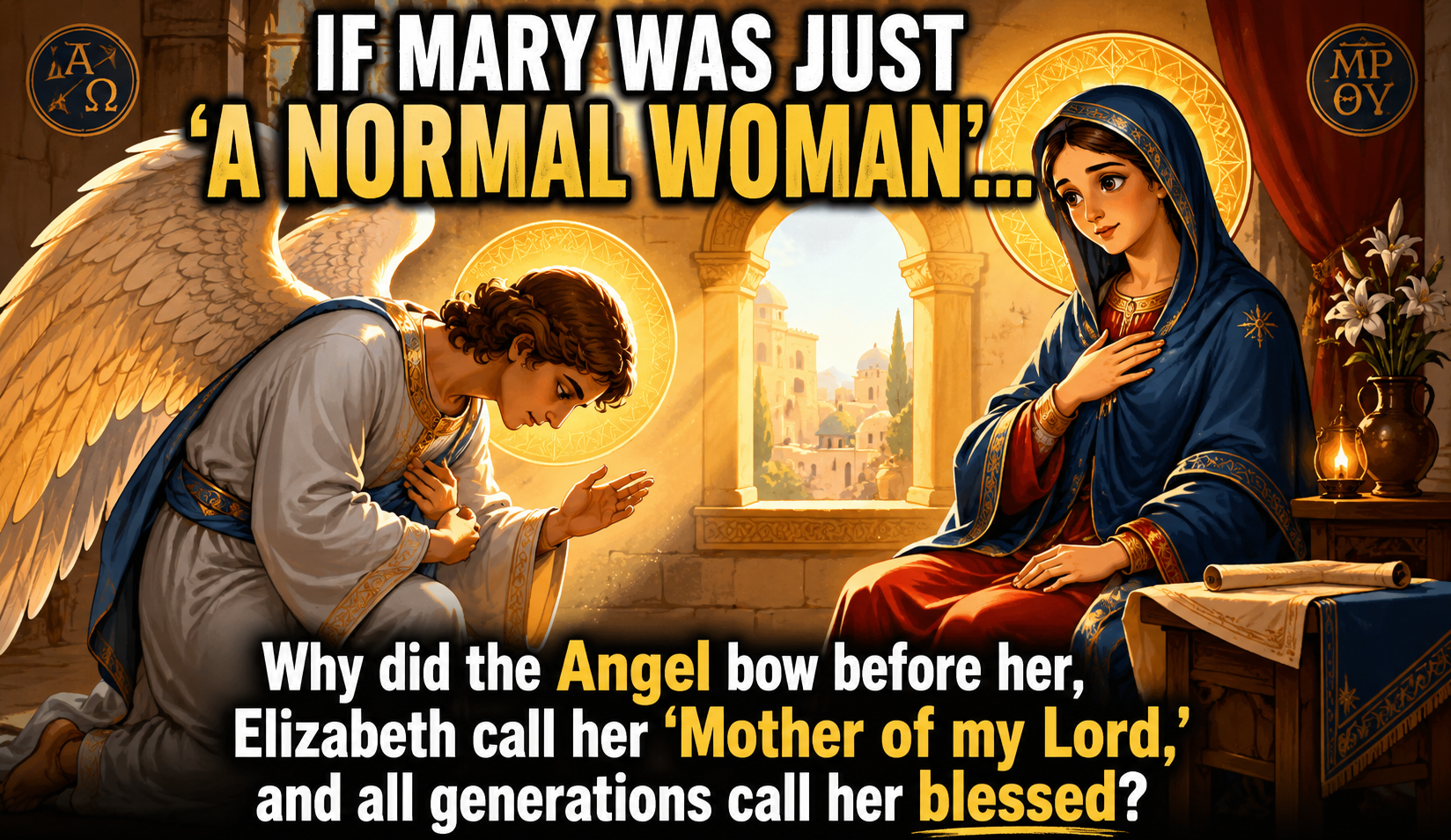
When the Archangel Gabriel announced that she would conceive the Son of God, Mary freely responded:
“Behold the maidservant of the Lord! Let it be to me according to your word.”
Luke 1:38
Orthodoxy emphasizes that salvation was not imposed mechanically upon humanity. God invited human cooperation (synergia). Mary becomes the supreme example of humanity freely saying “yes” to God.
2. Her Purity and Holiness
The Orthodox Church does not teach the Roman Catholic doctrine of the Immaculate Conception in the same manner, yet Orthodoxy still regards Mary as the holiest of all human beings.
In every Divine Liturgy, the Church proclaims her to be:
“More honorable than the Cherubim and beyond compare more glorious than the Seraphim.”
Why?
Because no angel bore God in the flesh. No prophet carried the Creator within his own body. Mary became the living Ark of the New Covenant.
The imagery is deeply biblical.
In the Old Testament:
- The Ark carried the tablets of the Law, manna, and Aaron’s rod.
- Mary carried Christ, who is the fulfillment of the Law, the Bread of Life, and the eternal High Priest.
The Church therefore sees her as the fulfillment of the Ark itself.
3. Her Model of Perfect Discipleship
The Theotokos is not honored merely because she gave birth to Christ biologically. Orthodoxy honors her because she lived in radical humility, purity, obedience, contemplation, and unwavering faithfulness.
She remained with Christ:
- at His birth,
- during His ministry,
- at the Cross,
- at His burial,
- and with the Apostles at Pentecost.
She is the image of what every Christian is called to become: one who bears Christ within.
The Orthodox spiritual life is deeply shaped by this vision. The Theotokos represents humanity fully alive in communion with God.
The Theotokos in the 1st Century Church
The earliest Christians held Mary in profound esteem from the beginning.
The Gospel of Luke preserves some of the Church’s earliest Marian devotion:
- Elizabeth calls her “the mother of my Lord.”
- Mary prophesies: “All generations will call me blessed.”
This last statement is particularly significant. Orthodoxy sees the veneration of Mary not as a later corruption, but as the fulfillment of Scripture itself.
After Christ’s Ascension, the Theotokos remained among the Apostles. Acts 1:14 explicitly mentions her presence in prayer with the early Church.
Ancient Christian tradition holds that the Apostle John cared for her after Christ entrusted her to him from the Cross (John 19:26-27).
The 2nd and 3rd Centuries: Early Christian Devotion
Contrary to modern assumptions, reverence for Mary did not suddenly appear centuries later.
By the 2nd century:
- St. Ignatius of Antioch emphasized the reality of Christ’s birth from Mary.
- St. Justin Martyr and St. Irenaeus developed the Eve-Mary parallel.
- Early Christian hymns and prayers invoking her intercession already existed.
One of the oldest known Christian prayers to the Virgin Mary, Sub Tuum Praesidium, dates to approximately the 3rd century:
“Under your compassion we take refuge, O Theotokos…”
This demonstrates that devotion to Mary was already deeply embedded in Christian worship long before later theological controversies emerged.
The 4th and 5th Centuries: Theological Clarification
The 4th century saw explosive theological development as the Church defended the divinity of Christ against various heresies.
During this period:
- St. Athanasius
- St. Gregory the Theologian
- St. Ephraim the Syrian
- St. John Chrysostom
all spoke extensively about the Theotokos.
St. Ephraim in particular composed profound poetic hymns honoring her role in the mystery of salvation.
Then came the watershed moment in AD 431 at the Council of Ephesus.
When the bishops affirmed the title Theotokos, the people of Ephesus reportedly celebrated through the streets with torches and hymns. This was not mere emotionalism. It reflected the Church’s conviction that the truth about Mary protected the truth about Christ.
The Byzantine Era and the Expansion of Marian Devotion
As Christianity spread throughout the Byzantine world, devotion to the Theotokos became deeply woven into Orthodox spirituality, liturgy, architecture, and iconography.
Churches were dedicated in her honor across the empire, especially in Constantinople.
Some of the most beloved Orthodox feasts emerged:
- The Nativity of the Theotokos
- The Entrance into the Temple
- The Annunciation
- The Dormition
The Dormition (“falling asleep”) became especially central. Orthodoxy teaches that after her earthly life, Mary experienced death as all humans do, but Christ received her into glory. The feast emphasizes resurrection and victory over death.
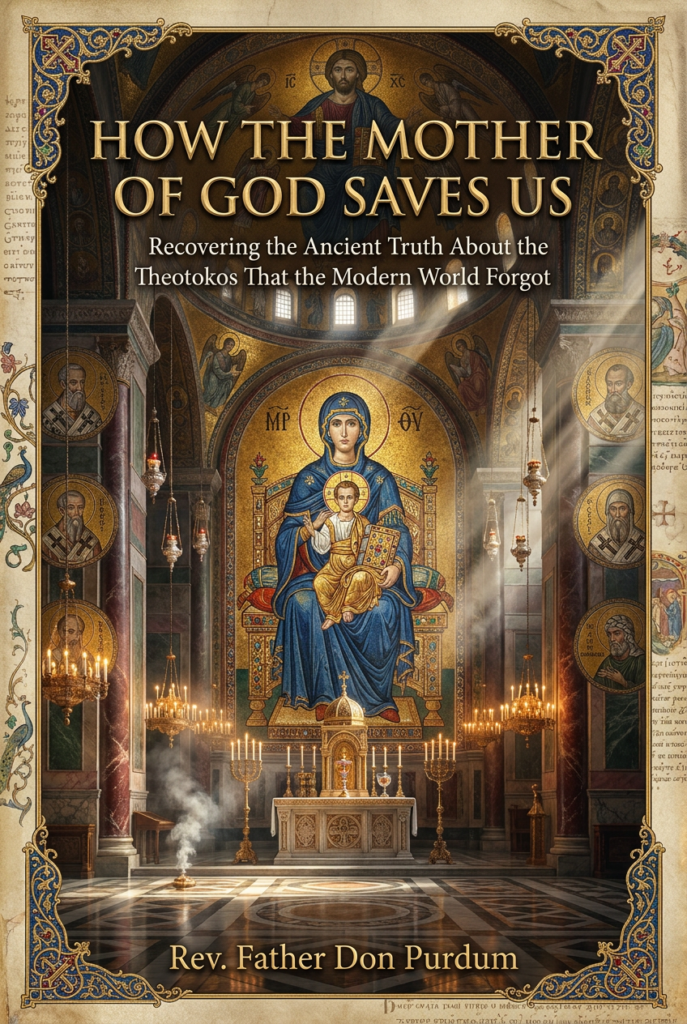
Icons of the Theotokos became central in Orthodox worship:
- The Hodegetria (“She who shows the Way”)
- The Eleusa (“Tenderness”)
- The Orans (“Prayer”)
These icons are never merely decorative. They are theological proclamations in color and form.
The Orthodox Church and the Immaculate Conception
One important distinction between Orthodox Christianity and Roman Catholicism concerns the doctrine of the Immaculate Conception. While Orthodox Christians hold the Theotokos in the highest possible honor among all human beings, the Orthodox Church does not accept the Roman Catholic dogmatic formulation of the Immaculate Conception as defined by Rome in 1854.
This often surprises people because Orthodoxy speaks so highly of Mary’s purity and holiness. However, the disagreement is not about whether the Theotokos was holy. The disagreement concerns how sin is understood and why such a doctrine became necessary in the West.
What the Roman Catholic Doctrine Teaches
The Roman Catholic Church teaches that Mary was conceived free from “original sin” from the very first moment of her existence. According to the doctrine, God preserved her from inheriting the stain or guilt of Adam’s sin in anticipation of Christ’s future redemptive work.
In Roman Catholic theology, this preservation was considered necessary so that Christ could be born from a perfectly sinless vessel.
Why Orthodoxy Rejects the Doctrine
Orthodoxy does not reject the holiness of Mary. It rejects the theological framework that produced the doctrine.
The key issue is that Orthodoxy and Roman Catholicism historically developed different understandings of original sin.
In much of Western theology after St. Augustine, original sin came to be understood primarily in terms of inherited guilt. Humanity inherits both corruption and culpability from Adam.
Orthodoxy, however, traditionally understands ancestral sin differently.
The Orthodox Church teaches that humanity inherits:
- mortality
- corruption
- a propensity toward sin
- and separation from God’s life
but not inherited personal guilt for Adam’s transgression.
In other words, Orthodox Christians believe human beings suffer the consequences of the Fall, but are not personally guilty of Adam’s sin merely by being born.
Because Orthodoxy does not see original sin primarily as inherited guilt, there is no theological necessity for Mary to be conceived outside the fallen human condition.
Instead, Orthodoxy teaches that the Theotokos was born fully human into the same fallen world as the rest of us. She inherited mortality and lived within humanity’s broken condition, yet through her profound humility, obedience, purity, and cooperation with God’s grace, she did not personally fall into sin in the way humanity ordinarily does.
Thus, the Orthodox Church sees her holiness not as the result of an exemption from human nature, but as the supreme example of what humanity can become through union with God.
The Orthodox Emphasis: Purification Through Grace
Orthodoxy places far greater emphasis on theosis (“participation in the divine life”) than on legal categories of guilt and exemption.
The holiness of the Theotokos is therefore understood dynamically:
- she grew in holiness
- surrendered continually to God
- purified herself through obedience and grace
- and became the living temple of God
The Annunciation itself is often viewed in Orthodox theology as a profound moment of sanctification through the Holy Spirit.
This preserves two essential Orthodox convictions:
- Christ truly assumed the same human nature we possess.
- Mary’s greatness came through her free cooperation with God, not through an automatic exemption from humanity.
Was the Theotokos Sinless?
Orthodox Christians generally affirm that the Theotokos lived a life of extraordinary holiness and purity. The liturgical tradition frequently calls her:
- “All-Holy” (Panagia)
- “Most Pure”
- and “Spotless”
However, Orthodoxy is usually careful not to define this in the same absolute juridical categories found in later Western theology.
The Church prefers mystery and reverent restraint where Scripture itself is restrained.
What Orthodoxy proclaims with certainty is this:
- Mary is the holiest of all human beings
- the greatest among the saints
- and the pure vessel through whom God became man
But her holiness magnifies the transformative power of divine grace acting within authentic human freedom, not an exemption from being truly human.
Why Orthodox Christians Ask for Her Intercessions
One of the most misunderstood Orthodox practices is asking the Theotokos for prayers.
Orthodoxy does not teach that Mary replaces Christ as mediator. Christ alone reconciles humanity to the Father through His death and resurrection.
However, Orthodoxy also believes that death does not sever the unity of the Church. The saints are alive in Christ. Just as Christians ask one another for prayers on earth, the Church asks the saints in heaven, including the Theotokos, to pray with and for us.
The Theotokos is viewed as the foremost intercessor because of her closeness to Christ.
This is reflected in the wedding at Cana (John 2), where Mary intercedes before Jesus performs His first public miracle.
The Orthodox Emotional and Spiritual Connection to the Theotokos
For Orthodox Christians, devotion to the Theotokos is not merely intellectual theology. It is profoundly pastoral and experiential.
She is seen as:
- protector of the suffering
- comforter of the grieving
- defender of the oppressed
- and mother of the faithful
In Orthodox history, entire cities prayed for her protection during invasions, wars, plagues, and persecutions.
The famous hymn:
“It is truly meet to bless thee, O Theotokos…”
is not simply admiration. It is the language of love from a Church that sees in her the image of redeemed humanity.
The Theotokos and the Orthodox Vision of Humanity
Ultimately, the Theotokos matters because she reveals what humanity was always intended to become.
Modern culture often sees humanity in fragmented terms:
- biological
- psychological
- political
- economic
Orthodoxy sees humanity theologically.
Mary becomes the image of humanity fully united to God through grace.
She demonstrates:
- humility over pride
- obedience over rebellion
- purity over corruption
- contemplation over distraction
- surrender over self-will
In her, the Orthodox Church sees the first and greatest fruit of Christ’s redeeming work.
Conclusion
The profound reverence Orthodox Christians have for the Theotokos is not accidental sentimentality, nor is it a later medieval invention. It flows directly from the Church’s understanding of Jesus Christ and the mystery of the Incarnation.
From the 1st century onward, Christians recognized her unique place in salvation history:
- as the Mother of God incarnate
- the New Eve
- the Ark of the New Covenant
- the model disciple
- and the foremost among the saints
To honor the Theotokos is ultimately to honor the God who became man through her.
As Orthodox Christians often say:
“If you want to understand what the Church believes about Christ, look at what the Church says about His mother.”
The reverence shown to the Theotokos is therefore not a distraction from Christ. Properly understood, it is one of the clearest windows into Him.
Want the entire article distilled into one clear, printable page? Download your free summary and keep it with you.
Get the free PDF + join thousands receiving short, practical Orthodox insights in the “Morning Brew with Father Don” to help you grow in Christ each week.