Few teachings create more confusion among modern Christians than the Orthodox belief that the Virgin Mary remained perpetually virgin before, during, and after the birth of Jesus Christ.
For many Protestants, the doctrine sounds unnecessary at best and unbiblical at worst. Others assume this teaching emerged later out of Roman Catholic excess or medieval superstition. Still others dismiss it entirely because they believe it distracts from Christ.
But what if the exact opposite is true?
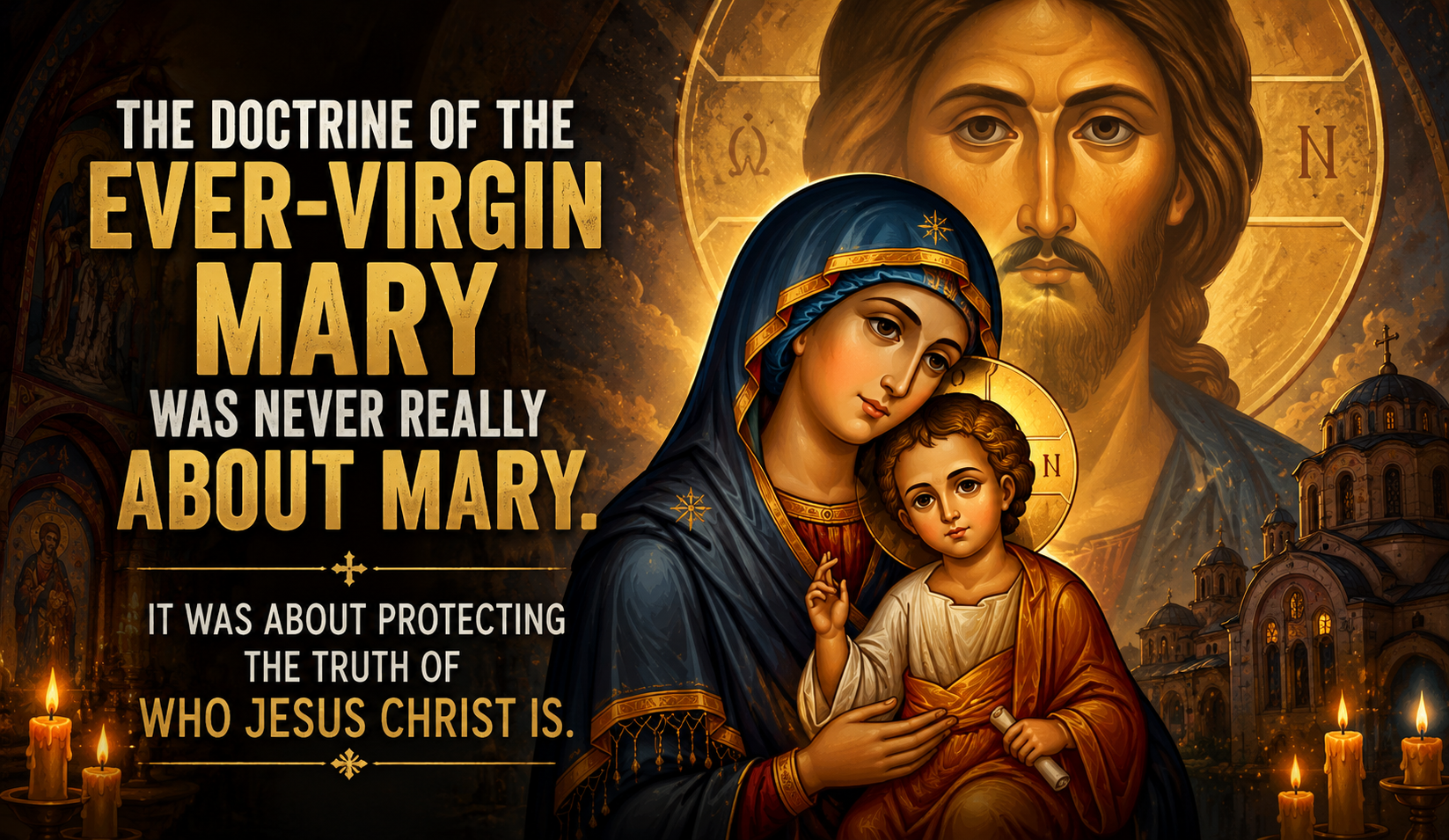
What if the doctrine of the Ever-Virgin Mary is actually about protecting the truth of the Incarnation itself?
What if this ancient teaching has less to do with elevating Mary and everything to do with preserving a right understanding of who Jesus Christ truly is?
One of the great tragedies of modern Christianity is that we have inherited a way of thinking about theology that is often disconnected from mystery, disconnected from the Church Fathers, and disconnected from the lived experience of the ancient Church. We have become so conditioned to approach theology like lawyers arguing cases or scientists dissecting formulas that we sometimes forget Christianity is first and foremost about union with the living God.
As I often say in my teaching, theology is not merely about knowing facts about God. Theology is about experiencing God.
That matters tremendously when we begin talking about the Mother of God.
The Orthodox Church does not arrive at the Ever-Virgin Mary through sentimentality or emotional devotion. The Church arrives there through the mystery of Christ Himself. The Church Fathers understood that what we say about Mary ultimately reveals what we believe about Jesus.
And once you begin to understand that, this doctrine begins to make much more sense.
What Does “Ever-Virgin” Mean?
When the Orthodox Church refers to Mary as “Ever-Virgin” or Aeiparthenos, we mean that she remained perpetually virgin:
- Before the birth of Christ
- During the miraculous birth of Christ
- After the birth of Christ for the rest of her earthly life
This is not some fringe Orthodox belief. This language is embedded deeply into the worship and liturgical life of the Church. Every Divine Liturgy, every feast day, every cycle of Orthodox prayer consistently refers to Mary as:
“Our most holy, pure, blessed and glorious Lady, the Theotokos and Ever-Virgin Mary.”
That language matters because in Orthodoxy, worship and theology are inseparable. The Church prays what the Church believes.
And importantly, this doctrine did not appear centuries later as some medieval innovation. The perpetual virginity of Mary was universally affirmed throughout the ancient Church long before the divisions between East and West and long before the Protestant Reformation.
Why This Doctrine Exists At All
One of the biggest mistakes modern Christians make is assuming that doctrines exist in isolation.
They do not.
The doctrine of the Ever-Virgin Mary exists because the Church was trying to protect something much larger than Mary herself. The Church was protecting the mystery of the Incarnation.
The early Christians understood something modern Christianity often forgets. Holy things are set apart for God.
In the Old Testament, the Ark of the Covenant was treated with immense reverence because it contained the presence of God. It was holy because God sanctified it unto Himself.
The Church Fathers saw Mary as the fulfillment of the Ark of the Covenant.
Think about the parallels:
- The Holy Spirit overshadows Mary in Luke 1:35 just as the glory cloud overshadowed the Ark in Exodus.
- David cries out, “How can the ark of the Lord come to me?” while Elizabeth cries, “Why is this granted to me, that the mother of my Lord should come to me?”
- The Ark remained in the hill country for three months. Mary remains with Elizabeth for three months.
None of this is accidental.
The Gospel writers were deliberately showing us that Mary is the living Ark who carried God Himself in her womb.
And if the Old Covenant Ark was treated as holy and untouchable, how much more would the womb that bore the Incarnate Christ be uniquely consecrated unto God?
This is how the ancient Church thought.
Modern Christianity often wants to reduce everything down to mechanics, biology, and material categories. But the ancient Christian mind saw reality sacramentally. The physical and spiritual worlds were always interconnected.
That is one reason many modern Christians struggle with this doctrine. We no longer think the way the ancient Church thought.
The Biblical Objections Protestants Raise
The most common Protestant objection is straightforward:
“If Mary remained perpetually virgin, why does Scripture mention the brothers of Jesus?”
Passages like Matthew 13:55 are commonly cited:
“Is not this the carpenter’s son? Is not His mother called Mary? And are not His brothers James and Joseph and Simon and Judas?”
At first glance, many assume this settles the issue.
But the problem is that modern readers often impose modern Western assumptions onto ancient Semitic language.
In the ancient world, the term “brother” was frequently used broadly for cousins, relatives, kin, or close familial relations. Scripture itself repeatedly uses family language this way.
The early Church overwhelmingly understood these “brothers” either as Joseph’s children from a previous marriage or as extended relatives of Jesus.
What is fascinating historically is that the burden of proof actually falls more heavily on the Protestant reinterpretation than it does on Orthodoxy. For over 1,500 years, Christians across East and West affirmed Mary’s perpetual virginity.
Even many of the Protestant Reformers themselves believed it.
- Martin Luther affirmed it.
- John Calvin affirmed it.
- Huldrych Zwingli affirmed it.
The rejection of the Ever-Virgin Mary became much more common later within certain strands of Protestantism.
The Earlier Article on the Theotokos Matters Here
In my previous article on the Theotokos, I explained why the Orthodox Church insists on calling Mary the “Mother of God.” That title was never about glorifying Mary above Christ. It was about protecting the truth that Jesus Christ is fully God and fully man.
You can read that article here:
The Theotokos: Why the Orthodox Church Holds the Virgin Mary in Such Profound Reverence
The doctrine of the Ever-Virgin Mary flows naturally out of that same theological reality.
If Mary truly bore God incarnate in her womb, then her role in salvation history cannot be treated casually or reduced merely to biological functionality.
Again, this is not about worshipping Mary. Orthodoxy worships God alone.
But Orthodoxy does recognize that when God sanctifies something for His divine purpose, it becomes holy in a unique way.
The Early Church Fathers and the Ever-Virgin Mary
The perpetual virginity of Mary appears astonishingly early in Christian history.
One of the earliest Christian writings outside the New Testament, the Protoevangelium of James, already reflects widespread belief in Mary’s perpetual virginity by the second century.
Later Church Fathers spoke openly and consistently about it:
- St. Athanasius
- St. Basil the Great
- St. Gregory of Nyssa
- St. John Chrysostom
- St. Jerome
All affirmed this doctrine in one way or another.
And this is critically important to understand.
Orthodoxy does not invent doctrine through private interpretation detached from history. The Church preserves what has been handed down through the Apostles, the Fathers, the liturgical life of the Church, and the consensus of the saints.
This is one of the major differences between Orthodoxy and much of Protestantism.
Why Orthodoxy and Protestantism Often Think Differently
The real disagreement here is not simply about Mary.
The deeper disagreement is about how theology itself is understood.
Many Protestants approach theology through sola scriptura, the idea that doctrines must be explicitly stated in Scripture alone.
Orthodoxy rejects that framework because Scripture itself came out of the life of the Church. The Church existed before the New Testament canon was formally established.
The Apostles preached, baptized, worshipped, ordained bishops, and passed down Holy Tradition before the New Testament was ever fully compiled.
Orthodoxy therefore sees Scripture and Holy Tradition as inseparable realities flowing from the same Apostolic source.
This is why the Orthodox Church asks a different question.
Not merely:
“Can I find one verse?”
But rather:
“How has the Church understood this from the beginning?”
That is a profoundly different approach to theology.
How Orthodoxy Differs from Roman Catholicism
Now at this point, many people assume Orthodoxy simply agrees with Roman Catholicism about Mary.
There are similarities, but there are also very important differences.
Both Orthodox and Roman Catholics affirm Mary’s perpetual virginity.
But Orthodoxy does not accept later Roman Catholic Marian dogmas such as the Immaculate Conception.
The Roman Catholic Church teaches that Mary was conceived without original sin.
Orthodoxy does not teach this because Orthodoxy understands ancestral sin differently than the West.
In much of Western theology, especially after St. Augustine, original sin became heavily associated with inherited guilt.
Orthodoxy teaches instead that humanity inherits mortality, corruption, and the consequences of the Fall, but not inherited personal guilt.
Mary was fully human like the rest of us.
What made her extraordinary was not exemption from humanity but her complete surrender to God.
Her greatness is found in her obedience.
Her “yes” to God reversed Eve’s rebellion.
Orthodoxy also tends to resist over-defining mysteries in the way Western Christianity often does. The Orthodox Church is comfortable allowing mystery to remain mystery.
As I have often taught, not everything about God can be reduced into perfectly organized systems and formulas. The mysteries of God transcend our categories.
That does not mean theology is irrational. It means theology is larger than human reason alone.
Why the Ever-Virgin Mary Still Matters
Some Christians may still ask:
“Why does any of this matter?”
It matters because modern Christianity is suffering from a crisis of holiness.
We live in a culture that desacralizes everything. Nothing is holy anymore. Nothing is set apart. Everything becomes common, disposable, and centered around the self.
But the Ever-Virgin Mary stands as a witness against all of that.
She reminds us:
- that the body can be holy
- that human beings can be consecrated unto God
- that salvation is transformational
- that purity still matters
- that surrender to God is not weakness but true strength
Mary ultimately reveals what humanity looks like when fully united to Christ.
Her life proclaims the words:
“Behold the maidservant of the Lord! Let it be to me according to your word.”
And in many ways, that is the entire Christian life.
The Ever-Virgin Mary is not simply a doctrine about the past. She is an icon of what every Christian is called to become through union with Jesus Christ.
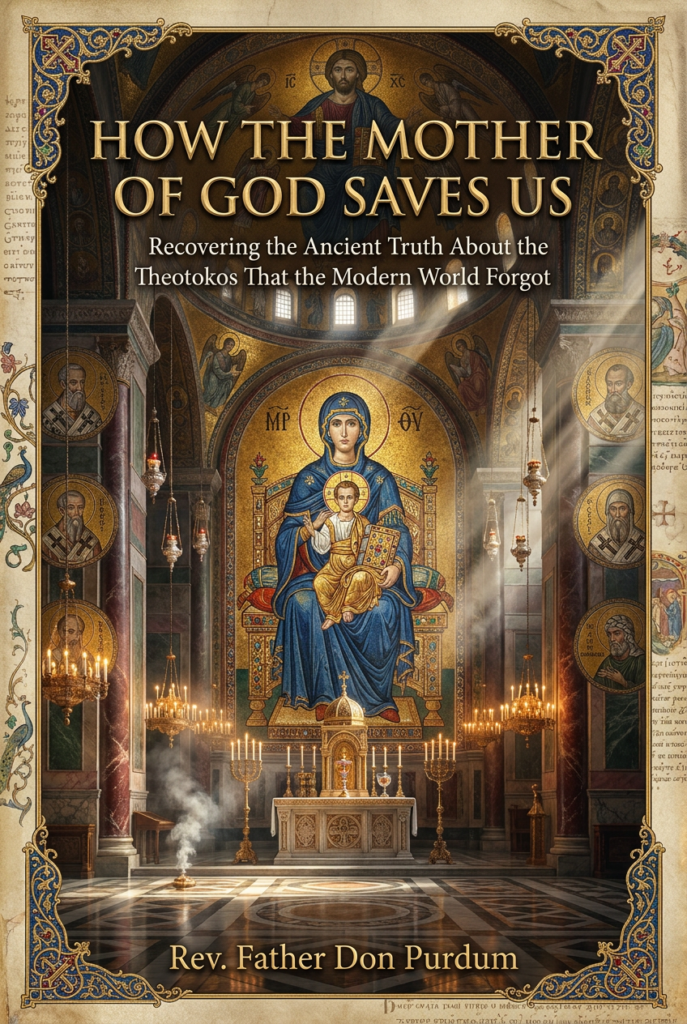
If the perpetual virginity of Mary raises questions for you, I explore this teaching more deeply in my eBook, How the Mother of God Saves Us. In it, we look at Scripture, the early Church, and the Fathers to understand why Christians have called Mary the Ever-Virgin, why this matters to Orthodox theology, and how everything the Church teaches about the Theotokos ultimately points us back to Jesus Christ.
Click Here to Get Your Copy Today
Want the entire article distilled into one clear, printable page?
Download your free summary and keep it with you.
Get the free PDF + join thousands receiving short, practical Orthodox insights in the “Morning Brew with Father Don” to help you grow in Christ each week.