What if every secret thought you’ve ever had was suddenly displayed for the world to see?
Not just your actions.
Not just the mistakes people already know about.
But every hidden resentment.
Every selfish motive.
Every lustful thought.
Every jealous impulse.
Every bitterness you’ve carefully concealed behind a smile.
How many of us would volunteer for that kind of exposure?
None of us.
And yet Scripture confronts us with a sobering reality. In Romans 2:16, St. Paul declares that God “judges the secrets of men by Christ Jesus.”
The secrets.
Not merely the public failures.
Not merely the visible sins.
The secrets.
Those words strike directly at the heart of modern culture. We live in a world obsessed with appearances. We carefully curate our lives on social media. We project images of success, happiness, spirituality, and confidence. We spend enormous amounts of energy managing what others think about us.
But God is not looking at the image.
He is looking at the reality.
And while that truth may initially feel terrifying, it is also one of the greatest expressions of God’s mercy.
Because Christ did not come merely to forgive what everyone else can see.
He came to heal what is hidden.

You can Now Listen to Each Article
The Great Illusion of Modern Man
One of the defining beliefs of our age is that human beings are fundamentally good.
Many modern philosophies teach that people are naturally moral and that evil originates primarily from external forces such as politics, economics, social structures, or upbringing.
Certainly those influences matter.
The Orthodox Church has never denied that.
But Orthodoxy says something deeper.
The problem is not merely outside of us.
The problem is inside of us as well.
The Holy Fathers consistently describe humanity as spiritually wounded.
Our passions are disordered.
Our desires are distorted.
Our minds are darkened.
Our wills are weakened.
Every one of us knows this through experience.
You know you should forgive.
Yet you cling to the resentment.
You know you should remain silent.
Yet you speak the hurtful words.
You know you should resist temptation.
Yet you return to it.
Why?
Because the problem is not information.
The problem is transformation.
The problem is not that we do not know what is right.
The problem is that our hearts require healing.
This is precisely why Christ came.
He did not come simply to provide better information.
He came to restore fallen humanity.

Hearing Truth Is Not Enough
St. Paul writes:
“It is not the hearers of the law who are righteous before God, but the doers of the law who will be justified.”
Those words would have shocked many of his listeners.
The Jewish people possessed the Law of Moses.
They had the Scriptures.
They had the prophets.
They had the Temple.
Yet Paul warns them that possessing truth is not the same as living truth.
The same warning applies to Christians today.
It is possible to know the Creed and not know Christ.
It is possible to defend Orthodoxy online while failing to practice Orthodoxy at home.
It is possible to attend every service while refusing genuine repentance.
It is possible to know the teachings of the Fathers while ignoring their call to holiness.
St. John Chrysostom wrote:
“The Jew is not justified by hearing the Law, but by fulfilling it. For what advantage is there in hearing, if the hearing is not followed by obedience?”
Orthodoxy has never taught that salvation is merely intellectual agreement.
Christianity is not about passing a theological examination.
Christianity is union with God.
It is transformation.
It is healing.
It is becoming by grace what Christ is by nature.
That transformation must penetrate beyond our public image and into the deepest parts of the soul.
The Law Written on the Heart
One of the most remarkable statements in Romans chapter two is Paul’s teaching about the Gentiles.
These were people who had never received the Mosaic Law.
Yet Paul says they sometimes do what the Law requires because God’s law is written upon their hearts.
This challenges one of the most common assumptions of modern secular thought.
Many people today believe morality is entirely subjective.
They argue that right and wrong are merely social constructs that evolve over time.
St. Paul disagrees.
The Orthodox Church disagrees.
Every human being is created in the image of God.
That image may be wounded.
It may be obscured.
But it is never erased.
This is why cultures separated by geography, language, and history often recognize similar moral truths.
People instinctively admire courage.
They honor sacrifice.
They condemn murder.
They recognize justice.
Why?
Because God’s fingerprints remain upon humanity.
The conscience bears witness.
As St. Justin Martyr taught, every truth ultimately belongs to Christ because Christ is the eternal Logos who enlightens every human being.
Why Conscience Alone Is Not Enough
Many people today say, “Just follow your conscience.”
Orthodoxy offers a more careful response.
A healthy conscience is valuable.
A damaged conscience is dangerous.
The conscience can be enlightened.
But it can also become distorted.
It can become numb.
It can become silent.
St. Dorotheos of Gaza described conscience as a divine spark placed within every human soul.
Yet he also warned that each time we ignore conscience, we weaken its voice.
Spiritual blindness rarely arrives suddenly.
It happens gradually.
One compromise at a time.
One justification at a time.
One secret sin at a time.
Eventually we become comfortable with things that once troubled us deeply.
This is why repentance is so essential.
Repentance restores spiritual sight.
Prayer restores spiritual sight.
Confession restores spiritual sight.
Fasting restores spiritual sight.
The Eucharist restores spiritual sight.
The Christian life is not a collection of religious activities.
It is the healing of the heart.
And Christ tells us exactly what that healing produces:
“Blessed are the pure in heart, for they shall see God.”
Notice He does not say blessed are the informed.
Blessed are the educated.
Blessed are the intelligent.
He says blessed are the pure.
The Identity Crisis of Our Age
Perhaps no question dominates modern culture more than this:
Who am I?
The world increasingly answers that question through feelings, desires, attractions, achievements, politics, or personal preferences.
Orthodoxy offers a radically different answer.
You are who God created you to be.
That sounds simple.
Yet it stands in direct opposition to much of contemporary thinking.
The modern world often treats feelings as infallible.
Orthodoxy teaches discernment.
Not every thought comes from God.
Not every feeling reveals truth.
Not every desire should be followed.
Spiritual maturity involves learning to examine our thoughts rather than automatically obey them.
St. Maximus the Confessor taught that the purpose of the Christian life is to align the human will with the divine will.
That changes everything.
The modern world asks:
“What do I want?”
Orthodoxy asks:
“What does God desire for me?”
One approach makes the self the center.
The other makes Christ the center.
One leads toward self-definition.
The other leads toward transfiguration.
God Shows No Partiality
St. Paul also reminds us that God shows no partiality.
That truth should humble every one of us.
God is not impressed by wealth.
He is not impressed by titles.
He is not impressed by social status.
Kings stand before Him.
Presidents stand before Him.
Bishops stand before Him.
Priests stand before Him.
The rich stand before Him.
The poor stand before Him.
Everyone.
Modern society constantly sorts people into categories and tribes.
God sees something deeper.
He sees souls.
St. Cyril of Alexandria taught that God’s judgment is impartial because He looks beyond external distinctions and sees the reality of the heart.
The world is captivated by appearances.
God is concerned with truth.
That reality should both comfort and challenge us.
We cannot fool Him.
But we also do not need to impress Him.
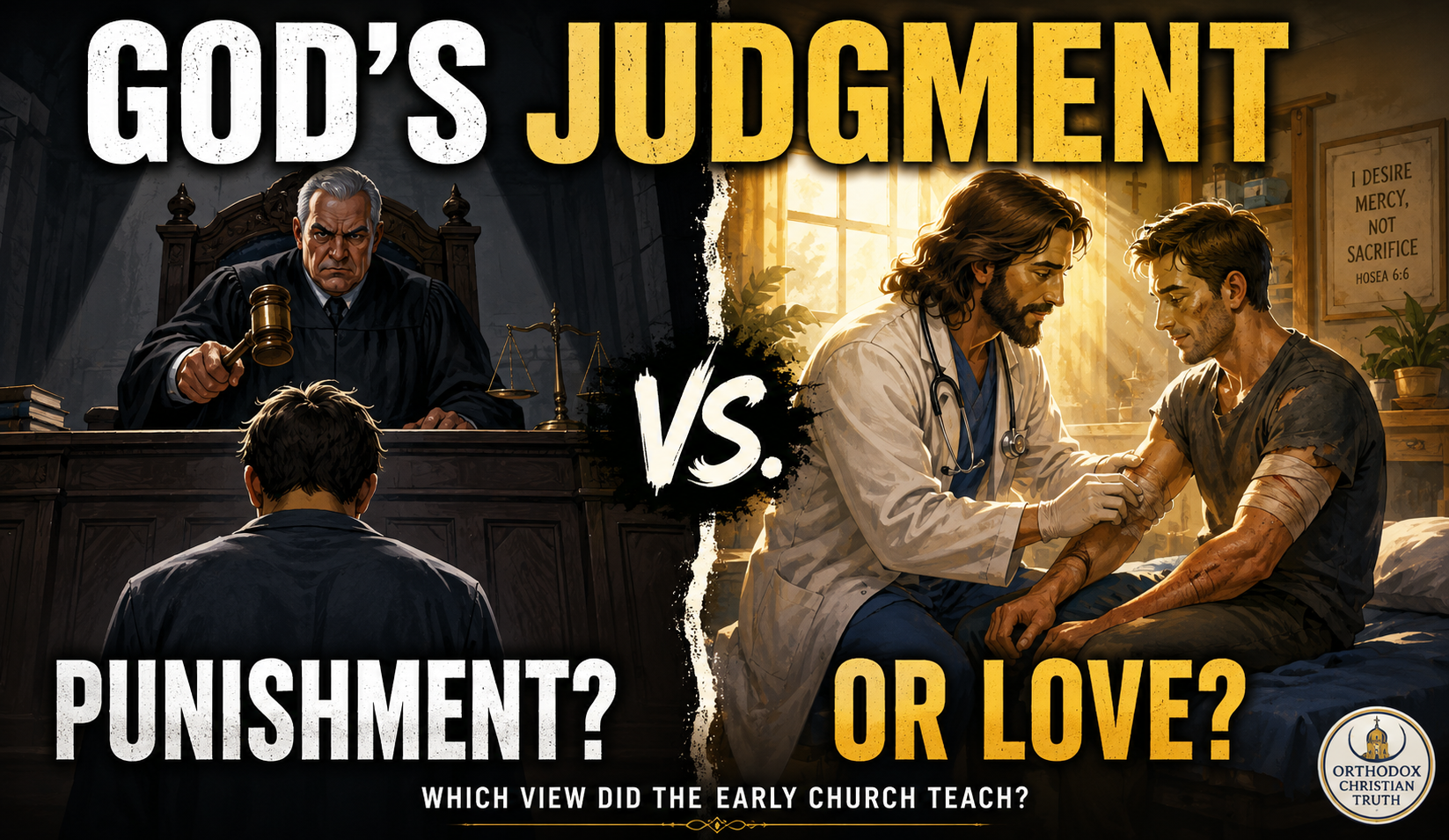
Judgment Is Revelation
Many people hear the word judgment and immediately think of punishment.
The Fathers often describe it differently.
Judgment is revelation.
Imagine a room flooded with brilliant light.
Everything hidden suddenly becomes visible.
Every motive.
Every thought.
Every secret.
The terrifying aspect of judgment is not that God finally discovers who we are.
He already knows.
The terrifying aspect is that we finally see ourselves as we truly are.
All excuses disappear.
All self-deception ends.
The masks come off.
And we stand before Christ.
The One who knows us completely.
The One who loves us completely.
The One who cannot be deceived.
St. Isaac the Syrian famously wrote:
“Those who are punished in Gehenna are punished by the scourge of love.”
God’s love never changes.
The same divine presence experienced by the saints as joy is experienced by the unrepentant as torment.
The difference is not God.
The difference is us.
Judgment reveals what we have become.
The Good News Hidden in the Warning
At first glance, Romans 2 may seem frightening.
But look carefully.
The passage begins with glory.
Honor.
Peace.
The purpose of God’s judgment is not destruction.
It is restoration.
God reveals darkness because He wants to heal it.
God exposes sin because He wants to destroy sin.
God uncovers wounds because He wants to restore what has been broken.
The physician must diagnose the disease before healing can begin.
This is why repentance is not punishment.
Repentance is mercy.
Confession is mercy.
Correction is mercy.
The Cross is mercy.
Everything God does is aimed toward our salvation.
As St. John Climacus beautifully wrote:
“Repentance is the daughter of hope and the renunciation of despair.”
Repentance is not hopelessness.
Repentance is hope.
It is God’s invitation to come closer.
What Is Happening in Your Secret Place?
So let me leave you with the same question I asked my parish yesterday.
What is happening in your secret place?
Not your public life.
Not your reputation.
Not the version of yourself that others see.
What is happening in your heart?
What thoughts are you entertaining?
What resentments are you nurturing?
What sins are you excusing?
What wounds are you refusing to surrender to Christ?
Because that hidden place is where salvation is worked out.
That hidden place is where transformation begins.
That hidden place is where Christ waits for you.
And if you surrender that place to Him today, the judgment you fear becomes the healing you long for.
For the same Christ who will judge the world is the Christ who stretched out His hands upon the Cross for the life of the world.
The One who knows every secret is also the One who loves sinners enough to die for them.
Including you.
Including me.
And that means Romans 2 is not merely a warning.
It is an invitation.
Bring the hidden places into the light.
Bring the secret wounds into the light.
Bring the secret sins into the light.
Because the same Christ who will one day sit upon the Judgment Seat stands before us today with open arms, offering forgiveness, healing, and communion.
The question is not whether He knows what is hidden.
He already does.
The question is whether we will allow Him to heal it.