There are few Christian doctrines that have produced more fear, confusion, caricature, and bad theology than the doctrine of hell.
For some Christians, hell is imagined as an underground torture chamber where God sends sinners to suffer forever because they broke His rules.
For others, the entire concept is dismissed as a medieval invention that has little to do with Jesus or the Bible.
Both approaches create serious problems.
The Bible absolutely speaks about judgment. Jesus warns about Gehenna. Scripture speaks of Hades, fire, condemnation, exclusion, the second death, resurrection, and final judgment.
Orthodox Christianity does not deny any of this.
But Orthodoxy also refuses to reduce all of these biblical ideas into the simplistic image many of us inherited.
The problem begins with the word itself.
Our English word hell frequently compresses several different biblical words and concepts into a single term. Scripture distinguishes between Sheol, Hades, Gehenna, Tartarus, and the lake of fire. Revelation even tells us that Hades itself will eventually be cast into the lake of fire.
If we want to understand what the Bible teaches about hell, we have to begin by allowing Scripture to speak in its own language.
And if we want to understand the Orthodox perspective, we must place all of these passages within the larger story of Christ’s death, descent into Hades, resurrection, final judgment, and humanity’s calling to communion with God.
The Orthodox question is not simply:
“How do I avoid going to hell?”
The deeper question is:
“What is Christ saving humanity from, what is He saving us for, and what kind of person am I becoming in His presence?”
One English Word, Several Biblical Realities
When many Christians hear the word hell, they imagine one single place.
But the Bible uses several different words.
They are related, but they are not identical.
Sheol
In the Old Testament, the Hebrew word Sheol commonly refers to the realm of the dead.
The righteous and unrighteous alike are described as descending into Sheol.
Psalm 16, for example, declares:
“For You will not leave my soul in Sheol, nor will You allow Your Holy One to see corruption.”
When St. Peter quotes this passage in Acts 2 and applies it to Christ, the Greek word used is Hades.
Already we see something important.
Sheol and Hades are associated with death and the realm of the departed. They should not automatically be equated with the final eternal judgment.
Hades
The Greek New Testament frequently uses the word Hades for the realm of the dead.
This becomes especially important in the Book of Revelation.
Revelation 20 tells us that Death and Hades surrender the dead who are within them.
Then something interesting happens.
Death and Hades themselves are thrown into the lake of fire.
Think carefully about that.
If Hades is thrown into the lake of fire, then Hades and the lake of fire cannot simply be two names for exactly the same thing.
This is one reason we have to be careful when reading an English Bible that translates several different biblical realities with the single word hell. The source material rightly emphasizes that Scripture itself distinguishes these concepts.
Gehenna
Then there is Gehenna.
This is the word frequently used by Jesus when He warns about judgment.
And we should not soften those warnings.
Jesus speaks seriously about judgment, exclusion, destruction, fire, accountability, and the consequences of refusing God.
Orthodoxy does not say, “Jesus did not really mean that.”
He did.
The warnings are real.
The judgment is real.
The danger is real.
But we must still ask what Jesus means within the whole biblical revelation of God.
Tartarus
There is also Tartarus, a word appearing in 2 Peter 2:4 in reference to fallen angels.
Again, this is another example of why biblical language should not simply be flattened into one English category.
The Bible’s teaching about death, judgment, the demonic powers, and final condemnation is more complex than simply saying, “Everyone who dies goes either to heaven or hell.”
Sheol and Hades Are Not the Final Judgment
One of the clearest biblical distinctions is that Hades is not itself the final state.
Revelation 20 makes this explicit.
The dead are raised.
They stand before God.
Judgment occurs.
Death and Hades surrender their dead.
Then Death and Hades are destroyed in the lake of fire.
This is enormously important for Orthodox theology.
Christian salvation is not merely about relocating disembodied souls after death.
The Christian hope is resurrection.
God’s answer to death is not simply heaven.
God’s answer to death is the Resurrection of Jesus Christ and ultimately the resurrection of humanity.
This is why the Orthodox Church constantly proclaims at Pascha:
Christ is risen from the dead, trampling down death by death.
Christianity is about the defeat of death itself.
The Forgotten Doctrine: Christ Descended Into Hades
This is where Orthodox Christianity approaches the subject very differently from much of modern Western Christianity.
What happened between the Cross and the Resurrection?
Christ descended into Hades.
First Peter 3 speaks of Christ proclaiming to the spirits in prison.
The Orthodox Church has never treated Christ’s descent into Hades as a minor theological footnote.
It stands at the center of Holy Saturday.
And it stands at the center of the Orthodox icon of the Resurrection.
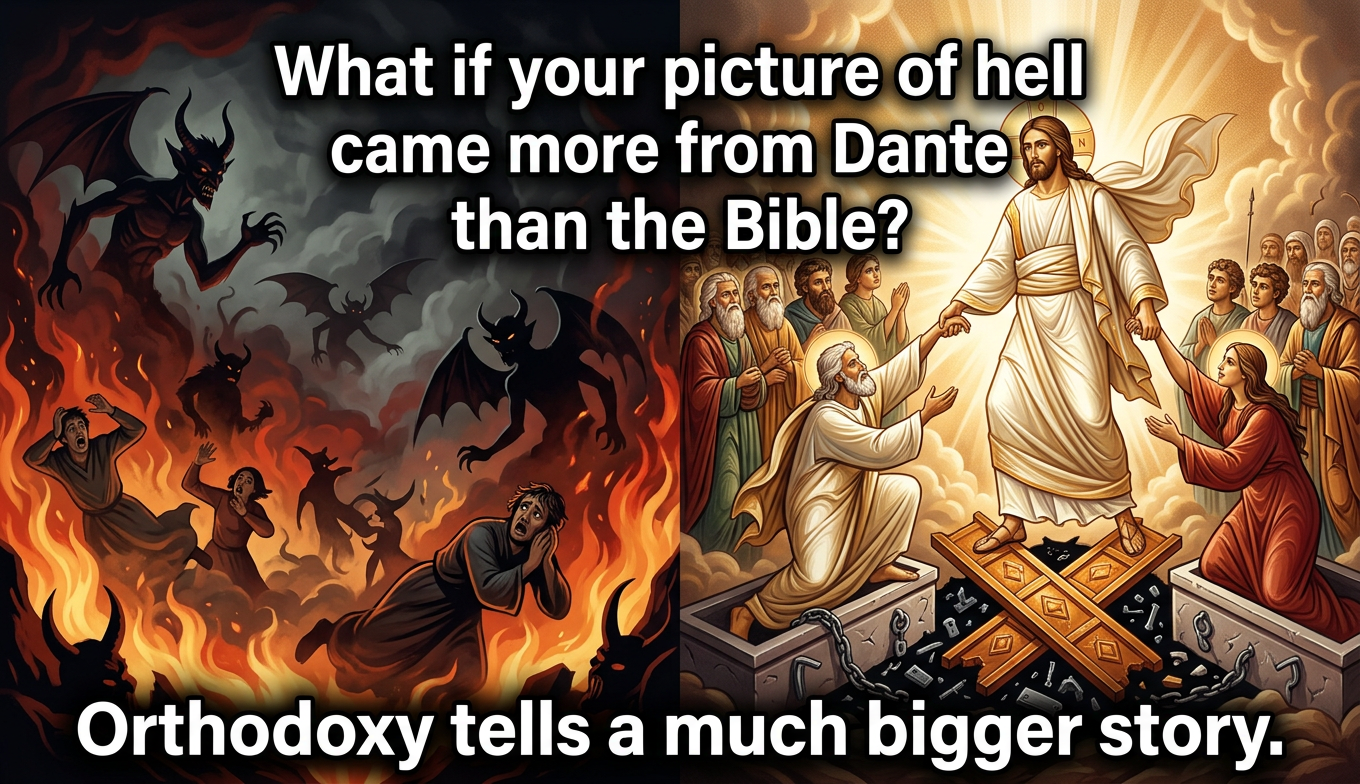
Interestingly, the traditional Orthodox Resurrection icon does not primarily depict Jesus walking out of the tomb.
It depicts Christ standing upon the shattered gates of Hades.
The locks and chains of death lie broken beneath His feet.
And Christ reaches down and takes Adam and Eve by the wrists, pulling humanity from the grave.
That image tells us something profound about salvation.
For Orthodoxy, the dominant picture of salvation is not an angry Father looking for someone to punish and finally deciding to punish Jesus instead of us.
The dominant image is the victorious Christ invading the kingdom of death and breaking its power.
The source material puts this beautifully: the Orthodox vision of salvation is the risen Christ standing upon the shattered gates of Hades and pulling humanity from the grave.
That is Pascha.
That is the Gospel.
Christianity Proclaims Both Hell and the Defeat of Hell
At first, this can sound contradictory.
Jesus warns about Gehenna.
Scripture teaches judgment.
Revelation speaks about the lake of fire.
Yet Pascha proclaims that Christ has destroyed death and shattered Hades.
Which is it?
The Orthodox answer is:
Both truths must be held together.
We do not remove judgment in order to emphasize God’s love.
And we do not turn God into a cosmic torturer in order to emphasize judgment.
We hold together divine love and human freedom.
We hold together judgment and mercy.
We hold together Gehenna and Pascha.
We hold together the seriousness of sin and the victory of Christ.
This tension cannot be solved by simply deleting whichever side makes us uncomfortable.
Jesus Really Does Warn About Judgment
Sometimes Christians discover the Orthodox understanding of God’s love and immediately swing too far in the opposite direction.
They begin saying things like:
“Hell is not real.”
“Judgment is symbolic.”
“Everyone will automatically be saved.”
That is not Orthodox Christianity.
Jesus’ warnings should frighten us enough to take repentance seriously.
He warns that our choices matter.
He warns that hypocrisy matters.
He warns that hatred matters.
He warns that what we do to the poor, hungry, naked, imprisoned, and forgotten matters.
He warns religious people who look holy outwardly while remaining corrupt inwardly.
Christ does not treat judgment casually.
Neither should we.
St. John Chrysostom repeatedly preached about both the love of God and the reality of Gehenna.
Those truths were not contradictory to him.
God is love.
And human beings are accountable for what we do with that love.
God Does Not Become Someone Different at the Last Judgment
Here we arrive at one of the most important distinctions in Orthodox theology.
God does not become loving toward the righteous and hateful toward the condemned.
God does not change.
God is not loving today and wrathful tomorrow.
God is not merciful during our earthly lives and then transformed into a completely different being at the Last Judgment.
God remains God.
The Scriptures declare:
“God is love.”
That does not stop being true at the judgment.
So what changes?
Not God.
We do.
And that leads to a profound Orthodox question:
What if the difference between heaven and hell is not a difference in God, but a difference in what we have become in His presence?
That question changes the entire conversation.
St. Isaac the Syrian and the Scourge of Love
One of the most powerful descriptions of judgment in the Orthodox tradition comes from St. Isaac the Syrian.
St. Isaac speaks of the suffering of those who have rejected God as suffering caused by love itself.
Think about what that means.
Imagine standing before perfect love while realizing that you spent your life refusing love.
Imagine standing before perfect mercy while realizing how often you refused mercy to others.
Imagine encountering perfect beauty when you have deliberately trained your heart to prefer darkness.
Imagine experiencing the truth about yourself with every excuse stripped away.
The love of God has not disappeared.
But the human heart has become unable to experience that love as joy.
This does not mean hell is imaginary.
It means hell may be far more terrible than the crude picture of God inflicting external pain upon people.
The tragedy is relational.
The tragedy is spiritual.
The tragedy is that the very presence that fills the saints with indescribable joy may become agony to a heart that has spent a lifetime refusing communion with God.
The Same Sun Can Melt Wax and Harden Clay
The Fathers often give us ways of thinking about divine realities that are more helpful than legal abstractions.
Consider the sun.
The sun shines.
Its nature does not change depending upon what it touches.
Yet wax melts beneath its warmth while clay hardens.
The difference is not in the sun.
The difference is in what receives it.
In a similar sense, God is eternally God.
God is eternally holy.
God is eternally truth.
God is eternally love.
The question is what kind of heart stands before Him.
A heart that desires God experiences His presence as life.
A heart that hates God experiences that same unchanging holiness very differently.
This is why salvation cannot merely mean getting our name placed on the correct legal document before we die.
We are being transformed into people capable of communion with God.
Theosis Changes the Entire Question
This is where the Orthodox doctrine of theosis becomes essential.
Second Peter tells us that we are called to become:
“Partakers of the divine nature.”
That is an extraordinary statement.
The goal of Christianity is not simply escaping punishment.
The goal is participation in the life of God.
We are being healed.
Purified.
Transformed.
Sanctified.
United to Christ.
According to St. Athanasius, we are becoming by grace what Christ is by nature.
That is theosis.
So the opposite of salvation cannot simply be described as failing to receive admission into heaven.
The deeper tragedy of damnation is the refusal of communion with God.
If salvation is theosis, then damnation must be understood against the tragedy of refusing theosis.
That gives us a much richer way to describe salvation:
Salvation is communion, healing, transformation, resurrection, and theosis.
And damnation is the tragic refusal of that communion and transformation.
Hell Is Not God’s Temper Tantrum
This is why I struggle deeply with presentations of Christianity that make God sound like a furious ruler whose primary problem is that human beings violated His legal code.
Sin is certainly disobedience.
But sin is much more than disobedience.
Sin wounds us.
Sin corrupts us.
Sin enslaves us.
Sin darkens the nous.
Sin distorts desire.
Sin damages our relationships.
Sin destroys communion.
We do not merely need a judge to change our legal status.
We need a Physician to heal us.
We need a Savior to rescue us.
We need death to be conquered.
We need our humanity restored.
We need to be united to Christ.
This is why Christ calls the Church a hospital for sinners rather than a courtroom for defendants.
The Gospel is not merely that God found a legal loophole allowing guilty people to avoid punishment.
The Gospel is that the Son of God entered our fallen condition, defeated sin and death, entered Hades, rose bodily from the grave, and opened the way for humanity to participate in divine life.
Judgment Is Still Judgment
None of this eliminates judgment.
Every human being will stand before Christ.
The dead will be raised.
Secrets will be revealed.
Our lives will be exposed.
Christ Himself speaks repeatedly of judgment according to what we have done.
Matthew 25 is difficult to explain away.
Christ does not ask the nations whether they correctly filled out a theological questionnaire.
He speaks of feeding the hungry.
Giving drink to the thirsty.
Welcoming the stranger.
Clothing the naked.
Visiting the sick.
Caring for the imprisoned.
Our deeds reveal what our hearts have become.
This does not mean we earn salvation by accumulating enough charitable acts.
It means genuine union with Christ produces a transformed life.
If Christ is in us, His love begins appearing through us.
Salvation Is Not Fire Insurance
This is why reducing evangelism to:
“Accept Jesus so you don’t go to hell”
is profoundly incomplete.
Fear can awaken us.
Fear may even begin repentance.
If someone suddenly recognizes the destructive path they are traveling, fear may be the very thing that causes them to turn around.
But fear is not the destination of Christianity.
Love is.
St. John tells us:
“Perfect love casts out fear.”
Christ did not come merely to keep us out of hell.
Christ came to bring us into Himself.
He came that we might have life.
He came to restore the image of God within humanity.
He came to heal what sin has wounded.
He came to destroy death.
He came to make us sons and daughters of God by grace.
Repent because hell is real.
But do not stop there.
Repent because Christ is life.
Judgment Begins Now
We sometimes think of judgment as something completely disconnected from our present lives.
We imagine living however we want and then suddenly standing before God after death for an unrelated evaluation.
But Jesus speaks differently.
John 3 says:
“And this is the condemnation, that the light has come into the world, and men loved darkness rather than light.”
Notice the language.
Judgment begins with the arrival of the Light.
Christ appears.
And His presence reveals what we love.
Do we love light?
Or darkness?
Do we desire truth?
Or do we hide from it?
Do we want communion with God?
Or do we merely want God to approve whatever we have already chosen?
The Last Judgment ultimately reveals what has been forming within us all along.
Every act of repentance trains the heart toward God.
Every act of forgiveness trains the heart toward mercy.
Every act of prayer trains the heart toward communion.
Every reception of the Eucharist calls us deeper into the life of Christ.
Every deliberate embrace of hatred, bitterness, pride, lust, greed, or cruelty trains the heart in the opposite direction.
We are becoming something.
That is the frightening reality of freedom.
Does God Send People to Hell?
This question comes up constantly.
And the common Christian answers are often too simple.
Some say:
“Yes. God sends people there as punishment.”
Others respond:
“No. God never sends anyone to hell. People send themselves.”
Both statements can become misleading if pushed too far.
Scripture clearly presents Christ as Judge.
Judgment is objective.
Human beings are accountable.
We cannot reduce final judgment to a purely subjective psychological state.
At the same time, Orthodox Christianity refuses to suggest that God stops loving His creation or suddenly becomes vindictive.
So the deeper issue is one of synergy.
What have we done with grace?
What have we done with freedom?
What have we done with repentance?
What have we done with the opportunities God gave us to love?
What have we done with Christ?
God calls.
God acts.
God gives grace.
But He does not annihilate human freedom.
Love cannot be forced.
Communion cannot exist without freedom.
Why Human Freedom Matters
God could have created machines.
He did not.
He created persons.
And persons can love.
But the ability to love necessarily includes the possibility of refusing love.
That possibility is terrifying.
God takes our freedom seriously.
Much more seriously, perhaps, than we do.
Every time we choose pride over humility, vengeance over forgiveness, lust over purity, greed over generosity, or hatred over mercy, we are shaping the heart.
Likewise, every time we repent, forgive, pray, give, confess, fast, receive the Eucharist, show mercy, and turn again toward Christ, we are being transformed.
This is why Orthodox Christianity speaks of salvation as a way of life.
Christianity is the Way.
It is not merely agreement with certain propositions.
It is participation in Christ.
The Lake of Fire and the Second Death
Revelation’s imagery should also prevent us from turning theology into crude geography.
Revelation speaks of a lake of fire.
It calls this the second death.
But Revelation is also a deeply symbolic and liturgical book filled with apocalyptic imagery.
We must take the reality seriously without pretending that every image functions as a literal photograph of the afterlife.
Something real is being described.
Final judgment is real.
The second death is real.
Separation from the life of God is catastrophic.
But Scripture’s own imagery pushes us beyond the cartoon image of devils with pitchforks operating torture chambers beneath the earth.
The Bible is giving us theological realities far greater and far more frightening than those medieval caricatures.
Pascha Should Shape Our Theology More Than Dante
Many Christians received their picture of hell more from Western art, medieval literature, revival preaching, movies, and popular culture than from the liturgical life of the Church.
Dante’s Inferno has probably shaped the Western imagination more than many passages of Scripture.
But Christians should not allow Dante to become our unofficial fifth Gospel.
If you want to understand the Orthodox perspective on death and hell, come to Holy Saturday.
Look at the icon.
Listen to the hymns.
Watch what Christ is doing.
He enters death.
Death cannot contain Him.
He enters Hades.
Hades cannot imprison Him.
He breaks the gates.
He crushes death.
He raises fallen humanity.
Pascha does not teach us that judgment does not exist.
Pascha teaches us that death does not get the final word.
The Great Paschal Paradox
So Christianity proclaims something astonishing.
Hell is real.
Judgment is real.
Human freedom is real.
Sin is deadly.
And yet Christ has conquered Hades.
Christ has destroyed death.
Christ has risen.
These truths belong together.
Orthodoxy refuses to eliminate divine love in order to preserve judgment.
And Orthodoxy refuses to eliminate judgment in order to preserve divine love.
The mystery is greater than either extreme.
God loves.
God judges.
Christ saves.
Human beings respond.
Death is defeated.
And every human being will ultimately stand in the unveiled presence of God.
The Question We Should Really Be Asking
When Christians discuss hell, the conversation often becomes speculative.
“Who is there?”
“How hot is it?”
“Where is it?”
“Can anyone escape?”
“What exactly happens?”
Some of those questions have theological value.
But they can also become distractions.
Jesus repeatedly turns judgment back toward us.
Not:
“Who else is condemned?”
But:
“What are you doing with the life I gave you?”
So perhaps the most important question is not:
“Who is going to hell?”
Perhaps the question is:
“Would the unveiled presence of God be heaven to me?”
Do I love Him?
Do I want communion with Him?
Do I desire holiness?
Am I learning mercy?
Am I becoming capable of forgiveness?
Am I repenting?
Am I becoming more like Christ?
Or do I merely want a version of Christianity that guarantees me a pleasant afterlife while requiring very little transformation now?
That question should disturb us.
It disturbs me.
Because Christianity is not merely about where we go.
It is about what we are becoming.
So, Is Hell in the Bible?
Yes.
Absolutely.
Jesus warns about judgment.
Scripture speaks about Gehenna.
It speaks about Hades.
It speaks about Tartarus.
It speaks about fire.
It speaks about condemnation.
It speaks about the lake of fire.
It speaks about the second death.
It speaks about resurrection and final judgment.
But the English word hell does not neatly correspond to one single Hebrew or Greek word covering every modern assumption Christians attach to it.
The Bible gives us a more complex picture.
And Orthodox Christianity receives that biblical teaching with complete seriousness while placing it within the larger revelation of Jesus Christ.
God is love.
Christ entered death.
Christ descended into Hades.
Christ shattered its gates.
Christ rose bodily from the grave.
All humanity will be raised.
Judgment is real.
Human freedom matters.
And humanity’s ultimate calling is not simply to escape punishment.
It is communion with God.
That is where I believe the conversation about hell must finally lead.
The deepest question is larger than:
“Is hell real?”
The deeper questions are:
What has Christ done to death?
What is humanity being saved for?
What am I becoming through my response to God’s grace?
And perhaps most importantly:
What will it mean for me to stand completely unveiled before the God who is eternally and unchangeably love?
That is not merely a question about the afterlife.
It is a question about how we live today.
Want the entire article distilled into one clear, printable page?
Download your free summary and keep it with you.
Get the free PDF + join thousands of people receiving short, practical Orthodox insights in the “Morning Brew with Father Don” to help you grow in Christ each week.