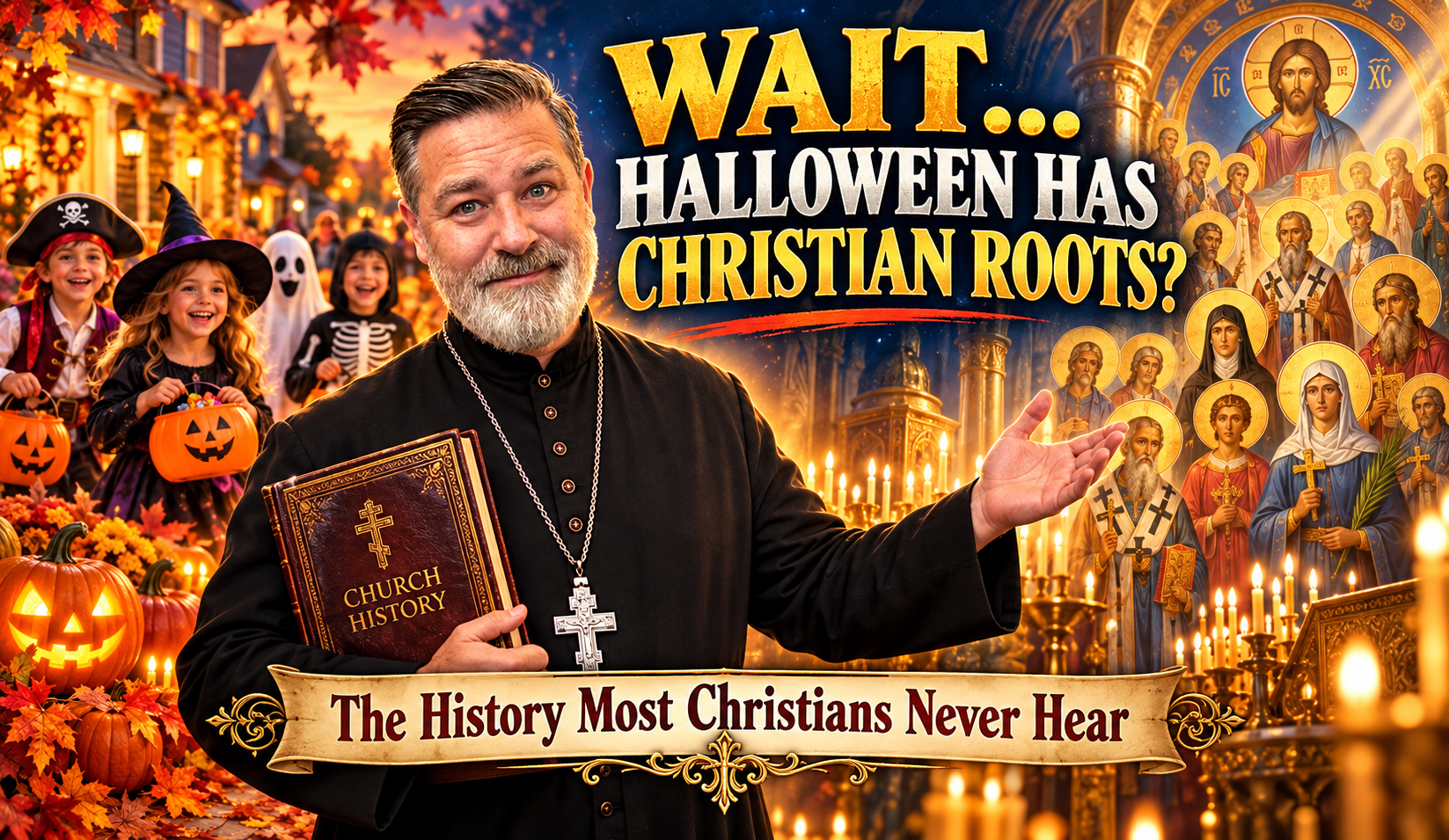
Before Halloween became a celebration of ghosts, monsters, and fear, Christians were remembering the saints, confronting the reality of death, and proclaiming the victory of Jesus Christ.
Every October, Christians find themselves asking the same question:
Should Christians celebrate Halloween?
Check the bottom of this page for an in-depth free eBook for families struggling with this question.
Some believe it is harmless fun. Children dress up, collect candy, and enjoy an evening with their families.
Others are deeply troubled by its associations with witchcraft, demons, death, and the occult. They wonder whether participating in Halloween compromises their Christian faith.
And somewhere in the middle are parents who simply want to raise faithful Christian children without turning every cultural holiday into an argument.
But what if we have been asking the wrong question?
What if, instead of beginning with what Christians should avoid on October 31, we began by asking what the Church has historically taught about death, the saints, and the world to come?
Because there is something remarkable hidden in the very name Halloween.
Before the costumes, the candy, the haunted houses, and the commercial spectacle, there was All Hallows’ Eve.
And All Hallows’ Eve pointed Christians toward something far more powerful than anything frightening in the darkness.
It pointed them toward the saints, the Resurrection, and the promise that death does not have the final word.
1. Halloween Was Not Always What It Is Today
The word Halloween is a shortened form of All Hallows’ Eve.
The word hallow is an older English word meaning holy or saintly. It is the same word preserved in the Lord’s Prayer when we pray:
“Hallowed be Thy name.”
All Hallows’ Eve was the evening before All Saints’ Day, observed on November 1 in the Western Christian calendar.
And November 2 became All Souls’ Day, a day devoted particularly to remembering and praying for the faithful departed.
Together, these observances formed a season of Christian remembrance, honoring the saints and confronting the mystery of death in the light of Christ.
But how did these days develop?
The practice of commemorating the saints did not begin in medieval Europe.
It reaches back into the earliest centuries of Christianity.
The first Christians gathered at the tombs of the martyrs, remembered the anniversaries of their deaths, and celebrated the Eucharist in remembrance of those who had given their lives for Christ.
To the pagan world, death was often a cause of terror or despair.
For Christians, the death of a martyr was understood as a witness to the victory of the risen Christ.
The martyrs were not forgotten. They remained members of the Body of Christ.
As Christianity spread, the number of recognized martyrs and saints grew. Eventually, Christians developed common commemorations honoring all the saints, including those whose names were known only to God.
In Rome, Pope Gregory III, during the eighth century, established a November 1 commemoration of the saints associated with a chapel in St. Peter’s Basilica. During the ninth century, observance of the feast spread more broadly through Western Christianity.
The Christian name of Halloween comes directly from this tradition.
However, there is an important historical distinction.
Halloween as we know it did not develop exclusively from Christian practices.
The ancient Celtic festival of Samhain, associated with the transition from harvest into winter, also influenced customs surrounding the season. Later European traditions involving disguises, fires, stories about wandering spirits, and community celebrations contributed to the modern holiday.
Historians debate exactly how these different traditions interacted. It would be too simplistic to claim that Halloween is entirely pagan or that every modern custom originated with the Church.
The history is more complicated, but the Christian meaning of All Hallows’ Eve is undeniable.
And that meaning deserves to be recovered.
2. What Does the Orthodox Church Teach About All Saints?
Here we need to make an important distinction between Eastern and Western Christian traditions.
In the Orthodox Church, the principal Feast of All Saints is celebrated on the first Sunday after Pentecost, not November 1.
This is deeply theological.
Pentecost celebrates the descent of the Holy Spirit upon the Church. The following Sunday celebrates the fruit of the Holy Spirit working in human lives.
The saints are the evidence of what God intends for humanity.
They are men and women who, through repentance, grace, struggle, and communion with Christ, have been transformed by the Holy Spirit.
They include martyrs, bishops, monastics, mothers, fathers, ordinary laborers, and countless Christians whose holiness was known to God alone.
The Orthodox Church has preserved this celebration in its liturgical calendar, while the November observance of All Saints developed in the Western tradition.
Therefore, we should not pretend that October 31 has historically been a universal Orthodox vigil of All Saints.
It has not.
But the deeper truths expressed by the Christian observances surrounding Halloween are profoundly Orthodox.
The saints are alive in Christ.
The Church is not divided into two unrelated communities, one living and another dead.
And those who have departed this earthly life have not simply vanished from the communion of the Church.
As Christ declared:
“He is not God of the dead, but of the living; for all live to him.” (Luke 20:38)
To understand the saints is to understand that death cannot destroy the Church.
3. The Church Has Always Remembered Her Departed
One of the beautiful aspects of ancient Christianity is the way the Church remembers those who have fallen asleep in the Lord.
Today, our culture often treats death in one of two ways.
We either avoid thinking about it altogether, or we turn it into entertainment.
We surround ourselves with imaginary ghosts, frightening figures, and stories about the dead, yet often struggle to sit quietly with the reality that someone we love has died.
The Orthodox Church offers another way.
We pray.
We remember.
We grieve with hope.
We light candles.
We offer memorial services.
We continue to love those who have departed.
The Orthodox Church appoints particular Saturdays for the commemoration of the departed. These are often called Soul Saturdays.
She also offers memorial services, known in various traditions as the Panikhida, Parastas, or Mnemosyno.
In many Orthodox communities, the departed are especially remembered on the third, ninth, and fortieth days after death and on the anniversary of their repose.
And at the Divine Liturgy, the faithful departed are remembered in the prayers of the Church.
Why?
Because our love for one another does not suddenly end at the grave.
When someone dies, we can no longer embrace them physically.
We can no longer sit across the table and have a conversation.
But we can still love them.
And one of the greatest expressions of Christian love is prayer.
We entrust them to the mercy of Christ.
We ask God to forgive their sins, grant them rest, and remember them in His Kingdom.
This is not an attempt to manipulate the spiritual world.
It is not necromancy.
We are not attempting to contact the dead or summon their spirits.
We are praying to the living God on behalf of those whom we love.
And that is an entirely different thing.
4. Why Do Orthodox Christians Pray for the Dead?
For many Christians raised in Protestant traditions, this practice may seem unfamiliar.
I understand that.
For much of my Christian life, prayer for the departed was not part of the theological framework I had inherited.
But when we examine Scripture alongside the worship and tradition of the ancient Church, we discover that this practice has deep roots.
Consider 2 Maccabees 12:43–45.
This passage describes Judas Maccabeus making provision for prayers and an offering on behalf of fallen soldiers.
The passage explicitly connects prayer for the departed to faith in the resurrection.
The reasoning is straightforward.
If the dead will rise again, death is not the end of their story.
Now, many Protestant Christians do not include 2 Maccabees in their biblical canon.
But the Orthodox Church receives this book as Scripture, and it provides an important witness to Jewish practices of prayer for the departed before the coming of Christ.
We also find an intriguing passage in the New Testament.
In 2 Timothy 1:18, St. Paul prays concerning Onesiphorus:
“May the Lord grant him to find mercy from the Lord on that Day!”
Some Christian interpreters understand this as a prayer for Onesiphorus after his death, although the passage does not explicitly establish that he had died.
The earliest Christian communities continued a tradition of remembering and praying for those who had departed, as reflected in early Christian inscriptions and the Church’s worship. Orthodox Church in America+1
But perhaps the strongest theological foundation is found in Romans 8:38–39, where St. Paul declares that neither death nor life can separate us from the love of God in Christ Jesus.
Consider what that means.
If death cannot separate us from Christ, and we are united to one another in Christ, why would we imagine that death completely destroys the bonds of Christian love?
Of course, we must also acknowledge that Orthodoxy does not claim to explain every mystery of the departed soul.
We do not control the judgment of God.
We do not presume to know the eternal condition of every person who has died.
We trust in the mercy, goodness, justice, and love of Jesus Christ.
And so we pray.
Not because we know everything about eternity.
But because we know the One who holds eternity in His hands.
5. The Saints Remind Us That Death Has Been Defeated
There is another reason why Halloween provides an opportunity for Christians to recover something beautiful.
Modern Halloween frequently uses death to frighten people.
Skeletons hang from porches.
Gravestones fill front yards.
Images of demons, monsters, and the undead appear everywhere.
Much of this is intended as entertainment rather than serious spiritual belief.
But Christianity approaches death from an entirely different perspective.
The Church does not deny that death is terrible.
Death is an enemy.
It separates families, brings grief, and reminds us of the brokenness of the fallen world.
Yet we also proclaim that death has been confronted and defeated by Jesus Christ.
In Hebrews 2:14–15, we read that Christ took part in our flesh and blood so that through death He might destroy the devil’s power over death and deliver those held in bondage by the fear of death.
And in the Paschal hymn, Orthodox Christians sing:
“Christ is risen from the dead, trampling down death by death, and upon those in the tombs bestowing life!”
This is the Christian answer to the darkness.
Not pretending that evil does not exist.
Not denying the reality of demons.
Not celebrating the occult as harmless spirituality.
But proclaiming that Jesus Christ, through His Incarnation, Cross, descent into Hades, and glorious Resurrection, has conquered death.
Think about the traditional Orthodox icon of the Resurrection.
Christ stands upon the shattered gates of Hades.
He grasps Adam and Eve by the wrists, pulling humanity from the tomb.
The broken locks and chains lie beneath His feet.
The message is unmistakable.
Death does not reign. Christ reigns.
That is a far greater story to tell our children than any ghost story.
6. What Should Orthodox Families Do on Halloween?
I believe we sometimes make a mistake when we approach cultural questions exclusively by listing prohibitions.
Don’t watch this.
Don’t wear that.
Don’t participate in this activity.
Certainly, Christians must exercise discernment.
We should not expose ourselves or our children to occult practices, the glorification of evil, or activities that trivialize demonic realities.
There is a significant difference between a child dressing as a firefighter and someone deliberately participating in rituals associated with witchcraft or spirit communication.
But Christian formation must offer more than a list of things to avoid.
We must teach our children what is good, holy, beautiful, and true.
Rather than allowing the culture to define the entire evening, families can intentionally bring Christian practices into their homes.
Here are five possibilities.
First, tell the story of a saint.
Choose a saint whose courage, love, faithfulness, or sacrifice speaks to your family.
Perhaps St. George, St. Maria of Paris, St. Nektarios, St. Mary of Egypt, or St. Nicholas.
Explain that the saints were real human beings who struggled, suffered, repented, and followed Christ.
They remind us that holiness is possible because the Holy Spirit is at work in the Church.
Second, remember someone who has died.
Sit together as a family and share a memory of a beloved parent, grandparent, friend, or relative who has departed.
Tell your children what you loved about that person.
Then pray for them.
Teach your children that Christian remembrance is more than nostalgia.
It is an act of love.
Third, light a candle and pray.
If your family has an icon corner, gather there for a few moments.
Light a candle safely, under adult supervision, and offer a prayer for the departed.
Explain that the candle is not magic.
It is a visible expression of our prayer, our hope in Christ, and our desire to remember those we love.
Fourth, practice generosity.
In medieval Western Europe, a custom called souling developed in connection with All Souls’ Day.
People, especially the poor, sometimes visited homes seeking food or charitable gifts, and prayers for departed family members became associated with these exchanges.
These customs were among the many historical influences that eventually contributed to Halloween traditions. English Heritage+1
Why not recover the spirit of generosity?
Prepare a meal for someone struggling.
Give to a local food pantry.
Teach your children that the Christian response to suffering and mortality should include acts of mercy.
Fifth, celebrate the victory of Christ.
Read John 11:17–27 together, where Jesus encounters Martha after the death of Lazarus.
Then reflect on His words:
“I am the resurrection and the life; he who believes in me, though he die, yet shall he live.”
Let the evening end not with fear, but with thanksgiving.
None of these practices requires us to pretend that October 31 is an Orthodox feast day.
They simply allow us to respond to a cultural moment with the timeless faith of the Church.
7. A Simple Prayer for Those Who Have Died
For those unfamiliar with Orthodox prayers for the departed, I encourage you to begin with something simple.
You do not need an elaborate ceremony.
You do not need to know every theological detail concerning the intermediate state or the final judgment.
You can begin by bringing someone you love before the Lord in prayer.
Here is a brief prayer adapted from the themes of traditional Orthodox memorial prayers:
O Lord Jesus Christ, our God,
You are the Resurrection and the Life, the One who has trampled down death by death.
Remember in Your Kingdom Your departed servant (name).
Forgive every sin committed in word, deed, or thought, whether knowingly or unknowingly.
Grant rest in a place of light, peace, and refreshment, where sorrow and suffering have passed away.
Comfort those of us who remain, strengthen our hope in the Resurrection, and teach us to live each day in preparation for Your Kingdom.
For You are a merciful God who loves mankind, and to You we give glory, together with Your Father and Your all-holy, good, and life-giving Spirit, now and ever and unto ages of ages.
Amen.
For those who desire to go deeper, ask your priest about having departed loved ones commemorated during the Divine Liturgy or requesting a memorial service according to the practice of your parish.
The Church has preserved these prayers because she understands something our modern world has largely forgotten.
Love does not end simply because someone has died.
8. Perhaps It Is Time to Recover What We Have Forgotten
As Halloween approaches, I am not interested in creating another argument among Christians over costumes, candy, and neighborhood celebrations.
Families should make thoughtful decisions guided by their faith, conscience, and pastoral counsel.
But I do want us to recognize something much more important.
We live in a culture fascinated by death yet often frightened to discuss it seriously.
We spend enormous amounts of money celebrating imaginary horrors while avoiding conversations about our own mortality.
We enjoy stories about ghosts but rarely consider what it means that the human soul is created for communion with God.
And we remember fictional monsters while frequently forgetting the extraordinary lives of real Christian saints.
Perhaps this October 31 can be different.
Perhaps parents can introduce their children to the lives of the saints.
Perhaps families can remember loved ones who have fallen asleep.
Perhaps someone grieving a death can discover the beauty of praying for a departed spouse, parent, child, or friend.
Perhaps we can remind our communities that the Christian faith does not approach death with hopeless terror.
We approach death through the Cross and Resurrection of Jesus Christ.
And perhaps that is the greatest lesson All Hallows’ Eve can teach us.
The darkness is real, but it is not sovereign.
Death is real, but it is not victorious.
The saints are not merely figures from the past. They are witnesses to the life that Christ has promised us.
We do not need to fear the darkness when we belong to the One who has overcome it.
So this Halloween, whatever your family’s traditions may be, take a moment to remember the saints.
Pray for someone who has died.
Teach your children why Christians believe in the Resurrection.
And remind yourself of the words of our Lord:
“Because I live, you will live also.” (John 14:19)
All Hallows’ Eve may have become a night associated with death and fear. But the Christian story that gave it its name points beyond the grave to the victory of Jesus Christ.
And that is a story worth recovering.
Christ is risen! Truly He is risen!
At the beginning of this article I promised you a free eBook…
What if the scariest part of Halloween isn’t the costumes, the decorations, or even the darkness, but the fear that you might be making the wrong decision for your children?
Every October, Christian parents face the same uncomfortable questions.
Should we allow our children to trick-or-treat?
Are we unknowingly opening the door to something spiritually dangerous?
Is Halloween harmless fun, or are we compromising our Christian faith?
And perhaps the most difficult question of all: How do we protect our children’s souls without raising them to be afraid of the world around them?
As an Orthodox priest, I believe these questions deserve something better than fear, condemnation, or the dismissive response that it’s all just innocent fun.
They deserve thoughtful, historically informed, spiritually grounded answers.
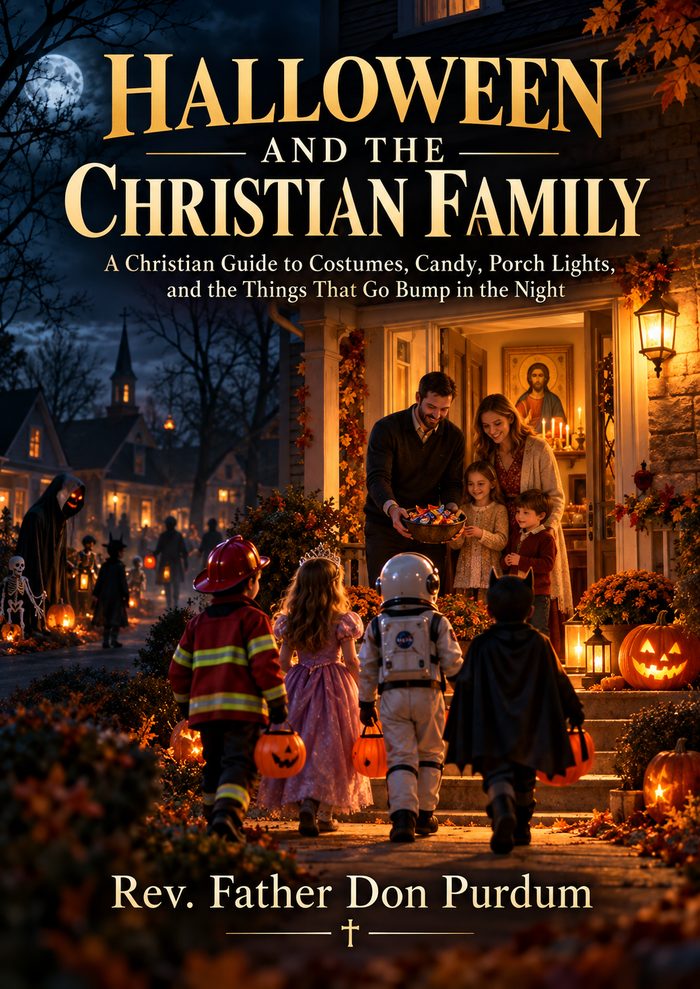
That’s why I’ve written a new ebook, “Halloween and the Christian Family,” and I’m offering it to you absolutely FREE.
In this book, we’ll explore:
✅ The real history of Halloween, from ancient customs to All Hallows’ Eve.
✅ What Orthodox, Catholic, and Protestant Christianity actually teach about Halloween.
✅ How to discern which costumes, activities, and traditions are appropriate for Christian families.
✅ Why hospitality, love of neighbor, and Christian witness matter, even on Halloween.
✅ How to help children who are frightened by the darker aspects of the holiday.
✅ Practical prayers, family discussions, and a simple plan for October 31.
But here’s what I really want you to understand.
The goal of Christian parenting isn’t simply to keep our children away from darkness.
It’s to raise children who know the Light so intimately that they learn to recognize darkness without being consumed by fear.
Jesus Christ has conquered death. He has defeated the powers of darkness. And our families should approach difficult cultural questions with the confidence that comes from belonging to Him.
I’m not going to tell you that every Christian family must celebrate Halloween. Nor am I going to insist that every family must avoid it.
Instead, I want to help you make a faithful, informed decision with a clear conscience.
And whether you’re Orthodox, Catholic, Protestant, or simply a parent trying to raise your children in the Christian faith, I wrote this for you.
🎁 DOWNLOAD YOUR FREE EBOOK TODAY!
Halloween is just around the corner. Before making your family’s decisions this year, I invite you to read Halloween and the Christian Family.
May Christ fill your home with His peace, your heart with discernment, and your family with the confidence that His Light is greater than any darkness.