What Scripture, the Early Church, and Orthodox Tradition Teach Us About Praying for Those We Love
There is something about standing beside the grave of someone you love that changes you.
Perhaps it was your mother or father. Your husband or wife. A child, a sibling, or a dear friend.
You remember their voice. You remember their laughter. Sometimes, without thinking, you reach for the phone to call them, only to remember that they are no longer there.
And in those quiet moments, when the grief seems almost unbearable, a question rises from somewhere deep within your heart:
“Is there anything I can still do for them?”
Can I pray for them? Does God hear those prayers? Can my prayers make any difference now that they have died?
For many Christians, particularly those raised in Protestant traditions, these questions can be confusing. We have been taught to pray for the sick, the struggling, the lost, and those who are suffering. But when someone dies, we are often told that there is nothing more we can do.
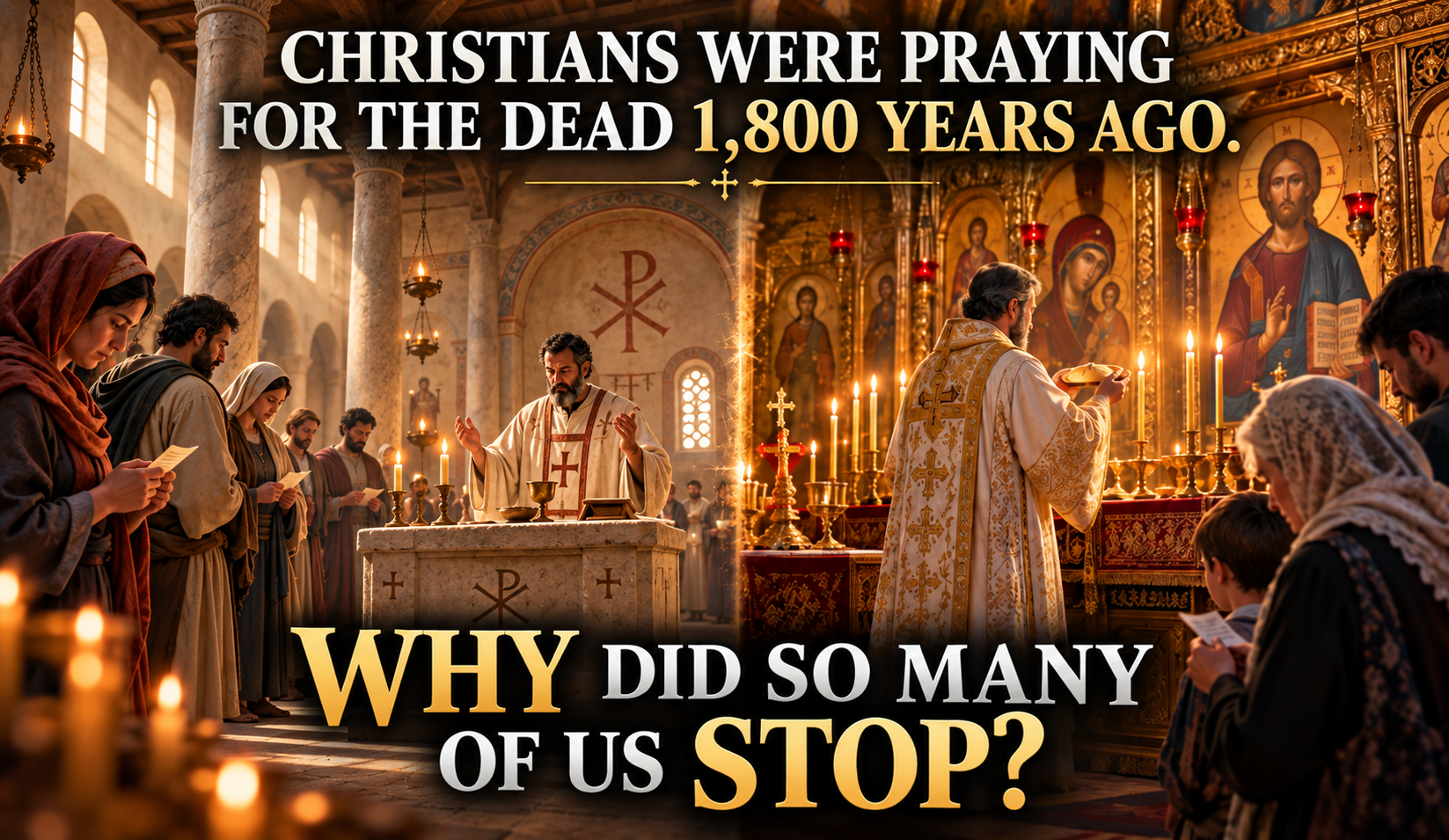
The Orthodox Church offers a different perspective, one rooted in Scripture, practiced by the earliest Christians, and preserved in the worship of the Church for nearly two thousand years.
Death does not mean that love has ended. And because love has not ended, neither must our prayers.
1. Death Does Not Separate Us from the Love of Christ
Before we can understand why Orthodox Christians pray for the departed, we must first understand what the Church believes about death.
Christianity does not teach that death is natural in the sense that God intended humanity to die. Death entered the world through sin, and Christ came to defeat it.
St. Paul writes:
“For as in Adam all die, even so in Christ shall all be made alive.” (1 Corinthians 15:22)
Through His death and Resurrection, Jesus Christ shattered the power of death. This is why, during the Paschal celebration, Orthodox Christians joyfully proclaim that Christ has trampled down death by death.
Our hope is not simply that the soul survives the grave. Our hope is the Resurrection, when Christ will raise the dead and restore creation.
And because Christ has conquered death, our relationship with those who have departed is transformed, not simply erased.
St. Paul asks:
“Who shall separate us from the love of Christ?” (Romans 8:35)
He then declares that neither death nor life can separate us from the love of God in Christ Jesus (Romans 8:38-39).
Notice something important.
Paul does not say that death is stronger than our union with Christ.
If a Christian dies in Christ, that person has not ceased to belong to Him.
Jesus Himself declared:
“For he is not a God of the dead, but of the living: for all live unto him.” (Luke 20:38)
This is foundational to the Orthodox understanding of the Church.
The Church is not merely an earthly institution composed of those who happen to be alive today. It is the Body of Christ, embracing those who struggle here on earth and those who have departed this life in faith.
We remain united in Christ.
And this brings us to an important question.
If we pray for those we love while they are alive, why would our love suddenly become silent when they die?
2. Does the Bible Actually Teach Us to Pray for the Dead?
One of the most common objections I hear is straightforward:
“Father Don, where does the Bible tell us to pray for someone who has died?”
It is an understandable question, especially for Christians who have never encountered the Orthodox Old Testament.
The clearest biblical example is found in 2 Maccabees 12:38-46.
Following a battle, Judas Maccabeus discovered that some of the fallen Jewish soldiers had been carrying objects associated with idolatry. Recognizing their sin, Judas and his men prayed that their wrongdoing might be forgiven.
Judas also arranged for an offering to be made on their behalf.
Scripture explains that he acted with the resurrection in mind. Had he not believed the dead would rise, the passage says, praying for them would have been pointless.
The passage concludes by describing this intercession as holy and pious (2 Maccabees 12:44-46).
Think about what this means.
Long before the earthly ministry of Jesus Christ, faithful Jews were already praying for those who had died.
The early Christians did not invent this practice. They inherited a religious world in which prayer for the departed was already known.
Now, some of my Protestant readers may object that 2 Maccabees does not appear in their Bibles.
That is true of most Protestant editions today. However, 2 Maccabees has been preserved in the Orthodox biblical tradition and was received within the broader ancient Christian scriptural inheritance.
Even for someone who does not accept the book as Scripture, its historical testimony remains significant.
It demonstrates that prayer for the dead existed among Jews before Christianity.
What about the New Testament?
The New Testament does not contain a direct command saying, “You must pray for the dead.”
We should be honest about that.
However, there are passages that fit naturally with this ancient practice.
Consider St. Paul’s prayer for Onesiphorus in 2 Timothy 1:16-18.
Paul asks the Lord to show mercy to the household of Onesiphorus and then offers this particular petition concerning Onesiphorus himself:
“The Lord grant unto him that he may find mercy of the Lord in that day.” (2 Timothy 1:18)
Some early and later Christian interpreters understood Onesiphorus to have already died. Others disagree, and the passage does not explicitly state that he was deceased.
We should therefore avoid pretending this is conclusive proof.
Nevertheless, it is striking that Paul asks for God’s mercy toward Onesiphorus on the day of judgment.
And the larger biblical principle is unmistakable: Christians are called to intercede for one another, trusting in God’s mercy.
The Orthodox Church understands this intercession within the greater reality of Christ’s victory over death.
3. What Did the Earliest Christians Actually Do?
Sometimes Christians assume that praying for the dead was a medieval development or a tradition invented centuries after the Apostles.
Church history tells a very different story.
Tertullian and the Early Christian Community
Writing in the early third century, Tertullian described Christians making commemorative offerings for the departed on the anniversaries of their deaths.
In De Corona, chapter 3, he mentions this practice among the established customs of Christians.
In On Monogamy, chapter 10, he also describes a widow offering prayers and commemorations for her departed husband.
Tertullian’s testimony does not mean every Christian practice he defended must be accepted without question. But it establishes something historically significant.
Christians were praying for the departed long before the medieval period.
The practice was already part of the Church’s life.
St. Cyril of Jerusalem: Prayer During the Divine Liturgy
In the fourth century, St. Cyril of Jerusalem explained the worship of the Church to newly baptized Christians.
In his fifth Mystagogical Catechesis, he describes the Church remembering those who have fallen asleep during the Eucharistic offering.
He teaches that these prayers bring great benefit to those for whom they are offered.
Notice where this was happening.
Not in some secret ritual. Not in an obscure religious movement.
It was taking place during the ordinary worship of the Christian Church.
The faithful were gathering around the altar, offering thanksgiving to God, receiving the Holy Eucharist, and remembering those who had departed.
The practice was woven into the Church’s sacramental life.
St. John Chrysostom: We Can Still Help Those Who Have Departed
St. John Chrysostom, one of the greatest preachers of the fourth century, spoke directly about this subject.
In his third homily on Philippians, he encouraged Christians to pray for the departed and give to the poor in their memory.
He also explained that commemorating the departed during the Holy Mysteries was not meaningless.
Chrysostom believed these prayers could bring genuine spiritual benefit.
But notice that he did not instruct Christians to attempt communication with the dead, summon spirits, or seek hidden information from the departed.
He directed them toward prayer, the Eucharist, and acts of mercy.
This distinction is crucial.
Orthodox Christianity teaches us to entrust the departed to Christ, not to attempt to establish supernatural contact with them.
St. Monica’s Last Request
One of the most moving accounts comes from St. Augustine’s Confessions.
As his mother, St. Monica, approached death in the fourth century, she expressed little concern about where her body would be buried.
Instead, she asked her sons to remember her at the Lord’s altar.
Think about that.
This godly Christian mother, whose prayers had played such a powerful role in Augustine’s conversion, wanted to be remembered in the Eucharistic prayers of the Church.
And Augustine honored her request.
For Monica, death was not the end of the Church’s care for her.
Her final earthly request was not for an elaborate funeral or an impressive monument.
It was for prayer.
What a beautiful testimony to the faith of the ancient Church.
4. If Someone Has Already Died, What Good Can My Prayers Do?
This is where we must approach the subject with humility.
Christians sometimes want precise explanations of everything that happens after death.
We want to know exactly where our loved ones are, what they are experiencing, and how our prayers affect them.
But the Orthodox Church does not claim to possess a detailed map of the unseen world.
There are mysteries God has not fully revealed.
Scripture tells us:
“And as it is appointed unto men once to die, but after this the judgment.” (Hebrews 9:27)
The Church takes judgment seriously.
We do not teach that everyone automatically enters heaven, nor do we believe our prayers give us the power to overturn God’s judgment.
We also do not teach the developed Roman Catholic doctrine of purgatory as a required framework for understanding prayer for the departed.
Instead, we entrust those who have died to the mercy and justice of God.
We pray because God is merciful.
We pray because the Church has always prayed.
We pray because love continues beyond the grave.
And we pray because, as St. James reminds us:
“The effectual fervent prayer of a righteous man availeth much.” (James 5:16)
We should be careful not to turn this verse into a mechanical promise about the departed. James is teaching the power of prayer, not providing an explanation of the intermediate state.
But the principle still matters.
Prayer is not meaningless.
God hears the prayers of His people.
Exactly how He applies those prayers to those who have departed remains in His hands.
And that is precisely where we should want our loved ones to be: in the hands of a God who is infinitely more loving and merciful than we could ever be.
5. How Orthodox Christians Pray for the Departed
You do not need an elaborate ceremony to pray for someone who has died.
You do not need to find the perfect words.
And you certainly do not need to know exactly what is happening to that person’s soul.
What you need is faith, love, and a willingness to place them before Christ.
The Orthodox Church gives us several beautiful ways to do this.
Remember Them in Your Daily Prayers
One of the simplest traditional Orthodox prayers is:
“Lord, grant rest to the soul of Your departed servant [Name], and forgive every sin, voluntary and involuntary. Grant them rest where there is no pain, sorrow, or sighing, but life everlasting. Amen.”
You can pray this in the morning, before bed, or whenever the person comes to mind.
Perhaps you are driving to work and remember your father.
Perhaps you hear a song that reminds you of your mother.
Perhaps you walk into a room and suddenly feel the absence of your husband or wife.
Instead of allowing that moment to become only an experience of sorrow, turn it into prayer.
“Lord Jesus Christ, remember Your servant.”
It does not have to be complicated.
Sometimes the simplest prayers are the most heartfelt.
Have Their Name Remembered During the Divine Liturgy
One of the most beautiful expressions of Orthodox Christianity is the commemoration of the departed during the Divine Liturgy.
In the traditional preparation of the Eucharistic gifts, the priest remembers members of the Church, both living and departed.
Their names are offered in prayer before God as the Church prepares to celebrate the Holy Mysteries.
During the Liturgy, we again remember those who have fallen asleep in the hope of the Resurrection.
This is more than a sentimental remembrance.
The Eucharist is our participation in the sacrificial self-offering of Jesus Christ.
We bring our love, our grief, our thanksgiving, and the names of those who have departed into the worship of the Church.
For Orthodox Christians, this is among the most meaningful ways to remember the faithful departed.
If you have lost someone, speak with your priest about having that person’s name commemorated, according to the discipline and practice of your parish.
Request a Memorial Service
The Orthodox Church has special prayers for the departed, commonly offered in a memorial service called a Panikhida, Parastas, or Mnemosyno, depending on the tradition.
These services are often held on the third, ninth, and fortieth days following death, as well as on anniversaries.
The Church also observes particular days dedicated to remembering the departed.
These are not magical dates.
We should never imagine that our prayers only work on certain days or that God is somehow bound to a religious calendar.
Rather, these traditions give structure to our love and grief.
They remind us that the Church does not forget her children simply because they have departed this world.
Give to the Poor in Their Memory
St. John Chrysostom connected prayer for the departed with acts of charity.
Imagine that your mother spent her life feeding people who were hungry.
What a beautiful way to honor her memory by providing food to a family in need, while asking God to remember her soul.
Perhaps your husband was generous to the poor.
Continue that generosity in his memory.
Perhaps your friend loved helping children.
Support a ministry that serves them.
These acts do not purchase forgiveness or earn salvation for the departed.
They are expressions of Christian love offered to God.
And they allow the memory of someone we love to continue bearing good fruit in the world.
6. What If the Person Who Died Was Not Orthodox, or Did Not Believe?
This is one of the most difficult questions I receive as a priest.
Sometimes the person we love was a Protestant, a Roman Catholic, or a Christian who had stopped attending church.
Sometimes the person had never professed Christian faith at all.
And sometimes we simply do not know what was happening in their heart when they died.
What should we do?
First, we must distinguish between the Church’s public liturgical commemorations and our private prayers.
Orthodox jurisdictions have particular disciplines concerning whose names may be commemorated during the Divine Liturgy or included in certain funeral and memorial services.
Those disciplines should be respected, and a priest can explain what is appropriate.
But private prayer is a different matter.
When we pray privately for someone who has died outside the Orthodox Church, we are not declaring that person saved.
Neither are we demanding that God ignore His own judgment.
We are asking for mercy.
And we are entrusting that person to the One who knows every hidden struggle, every unspoken sorrow, every opportunity for repentance, and every movement of the human heart.
God knows far more about that person’s life than we do.
We should neither pronounce their condemnation nor claim certainty about their salvation.
We should pray humbly and trust in the righteousness and compassion of Christ.
A simple prayer might be:
“Lord Jesus Christ, You know the heart of Your servant [Name]. You know what I cannot know, and You love more perfectly than I ever could. I entrust this soul to Your righteous judgment and Your boundless mercy. May Your holy will be done. Amen.”
That is not presumption.
That is humility.
7. What Prayer for the Departed Is Not
Because I have written previously about ghosts, departed souls, and the communion of saints, I want to make one distinction especially clear.
Praying for someone who has died is not the same as praying to that person or attempting to communicate with them.
Orthodox Christians do not seek contact with the departed through mediums, séances, occult practices, or supposed messages from spirits.
Scripture explicitly warns against practices that attempt to consult the dead (Deuteronomy 18:10-12).
When we pray for the departed, our prayers are addressed to God.
We are not asking the deceased to appear to us.
We are not trying to receive a message from the other side.
We are not attempting to manipulate the spiritual world.
We are simply placing someone we love into the merciful hands of Jesus Christ.
That is a profound difference.
The Christian life is not about seeking supernatural experiences. It is about communion with God.
And genuine prayer always leads us toward Christ.
8. Prayer Does Not Eliminate Grief, but It Gives Grief Somewhere to Go
I have spent many years in ministry, and one thing I have learned is that grief rarely follows the timetable we expect.
Someone may lose a spouse and appear remarkably strong during the funeral.
Then, six months later, the loneliness becomes almost unbearable.
Another person may grieve a parent for years, experiencing the loss again every time a birthday, anniversary, or holiday comes around.
And sometimes grief is complicated by regret.
We remember the words we wish we had said.
The forgiveness we should have offered.
The visit we kept postponing.
The last conversation that never happened.
Perhaps that describes you.
And perhaps you are wondering whether it is too late to express your love.
Here is something I want you to understand.
You cannot go back and rewrite the past. But you can still bring your love, your sorrow, and your regrets before Christ.
If you failed someone while they were alive, confess that failure to God.
If you need forgiveness, seek His mercy.
If you still carry bitterness, ask Him to soften your heart.
And if you simply miss someone terribly, tell God.
Then pray for them.
There is a beautiful simplicity in saying:
“Lord, I love them. I miss them. Please remember them in Your Kingdom.”
You are not speaking into an empty universe.
You are praying to the God who entered death Himself and emerged victorious.
The God who stood before the tomb of Lazarus and wept.
The God who promised:
“I am the resurrection, and the life: he that believeth in me, though he were dead, yet shall he live.” (John 11:25)
The same Christ who wept at the grave is the Christ who conquered the grave.
And He understands your sorrow.
9. A Prayer for Someone You Love Who Has Died
If you have never prayed for the departed before, I want to invite you to begin with this prayer.
You can pray it for a parent, spouse, child, relative, or friend.
You might even write their name on a small piece of paper and place it near your prayer corner as a reminder.
An Orthodox Prayer for a Departed Loved One
O Lord Jesus Christ, Son of the Living God, conqueror of death and giver of eternal life,
I come before You today carrying the memory of someone I dearly love.
You know their name. You know their life. You know their joys and sorrows, their struggles and their victories, their faith and their failures.
Nothing about them is hidden from You.
Lord, I ask You to remember Your departed servant, [Name].
Forgive every sin committed knowingly or unknowingly, willingly or unwillingly.
Where there was weakness, show mercy.
Where there was sorrow, bring comfort.
Where there was darkness, let the light of Your countenance shine.
Grant rest, O Lord, in a place of brightness, a place of refreshment, a place of peace, where sickness, sorrow, and sighing have fled away.
I entrust this beloved soul to Your perfect justice and Your immeasurable compassion.
And Lord, comfort my heart as well.
When grief overwhelms me, remind me of Your Resurrection.
When loneliness surrounds me, remind me that You have not abandoned me.
When I am troubled by things left unsaid, teach me to surrender them to Your mercy.
Help me to live the days You have given me in repentance, faithfulness, and love, looking forward to the resurrection of the dead and the life of the age to come.
For You are the Resurrection and the Life, and to You I give glory, together with Your eternal Father and Your all-holy, good, and life-giving Spirit, now and ever and unto ages of ages.
Amen.
10. Love Does Not End at the Grave
There is a reason Orthodox Christians pray for the departed.
It is not because we deny the reality of death.
It is because we believe in the reality of the Resurrection.
We know that death is an enemy. We know that grief is painful. We know that the grave represents a terrible separation.
But we also know that the grave does not have the final word.
Jesus Christ does.
When we stand at a graveside and pray, we proclaim something the world desperately needs to hear.
Death has not defeated Christ.
And those who belong to Christ have not been forgotten by Him.
Perhaps you are reading this article because you recently lost someone.
Or perhaps decades have passed, and you still carry their memory in your heart.
You may not know exactly where they are or how God receives your prayers.
But you can know the character of the One to whom you are praying.
He is the Good Shepherd.
He is the righteous Judge.
He is the One who desires that all should come to repentance (2 Peter 3:9).
And He is the One who loved the world so much that He gave His only-begotten Son (John 3:16).
So do not allow your grief to become hopelessness.
Remember the person you love.
Thank God for the gift of their life.
Pray for their repose.
Offer acts of mercy in their memory.
And entrust them, again and again, to Jesus Christ.
Because in the Orthodox Christian faith, the last word is not death.
The last word belongs to the risen Christ.
May the memory of our departed loved ones be eternal. And may Christ our God grant them rest among the righteous.
Memory eternal.
Want the entire article distilled into one clear, printable page?
Download your free summary and keep it with you.
Get the free PDF + join thousands of people receiving short, practical Orthodox insights in the “Morning Brew with Father Don” to help you grow in Christ each week.