
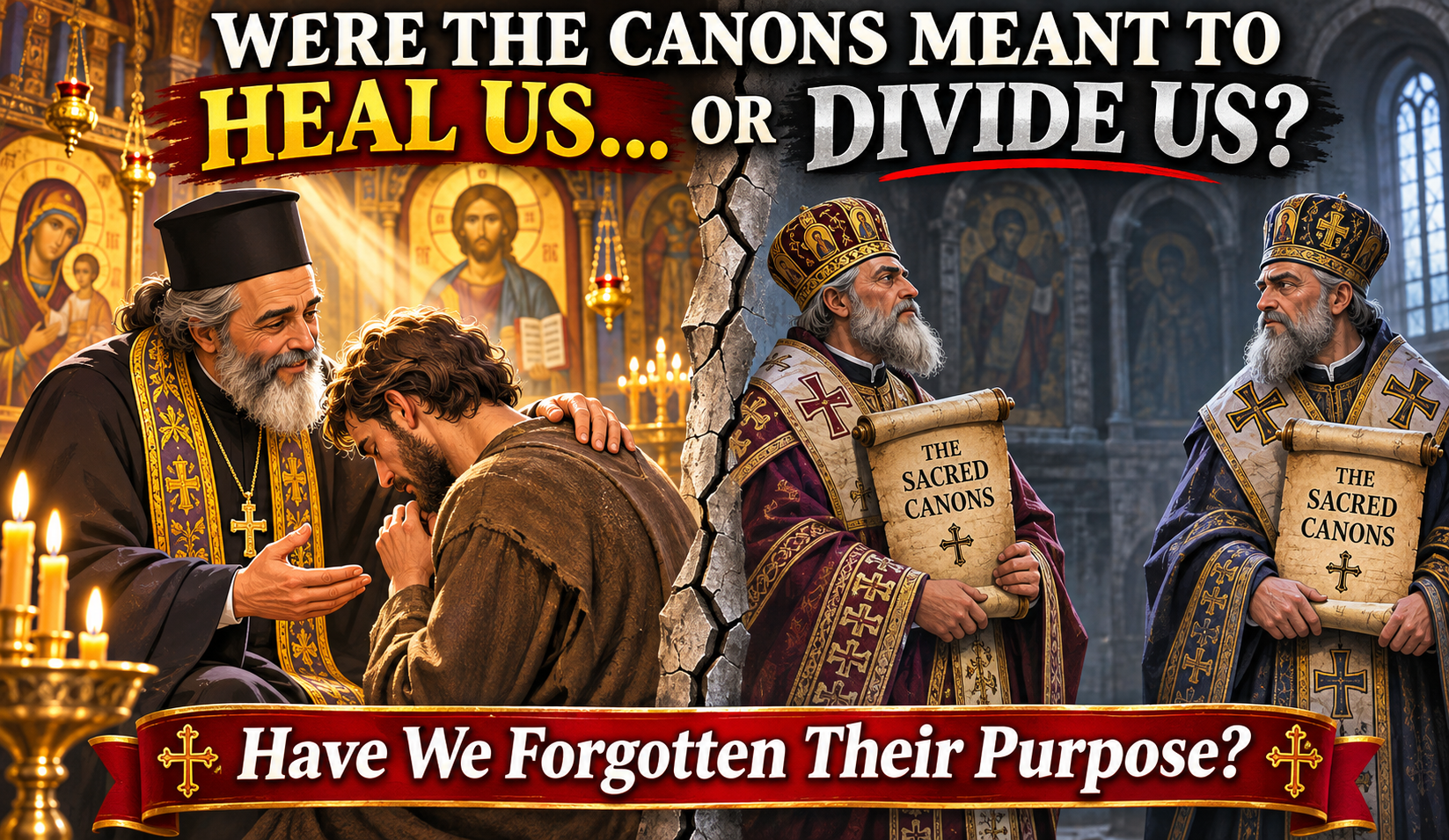
If canonical obedience is a measure of faithfulness, are we willing to examine the ways our own practices have changed?
Published with the blessing of His Eminence, Archbishop Titus, of the American Orthodox Catholic Church (AOCC).
If canonical obedience is a measure of faithfulness to the Orthodox Church, then all of us should be willing to examine the areas in which our own practices have changed.
I believe this is a conversation we need to have, not because the Orthodox Church has somehow failed to preserve the apostolic faith, but because we must be careful about how we use the canons of the Church.
Are they instruments of spiritual healing, ecclesiastical order, and unity? Or do we sometimes turn them into weapons against other Orthodox Christians while overlooking inconsistencies within our own jurisdictions?
I recently reviewed a study identifying 65 areas where contemporary American Orthodox practices differ from ancient canonical prescriptions. Some are significant. Others are relatively minor, historically conditioned, or subject to legitimate differences of interpretation.
Not all are violations. But the examples raise an important question.
If we appeal to the ancient canons as evidence of our faithfulness to apostolic Christianity, shouldn’t we approach their application with consistency, humility, and an understanding of why they were established?
This is not an argument against the canons. Quite the opposite.
It is an invitation to recover their original purpose.
Why Did the Ancient Church Establish Canons?
The word canon comes from the Greek kanōn, meaning a rule or measuring rod.
The canons emerged as the Church confronted practical questions about worship, ordination, morality, ecclesiastical authority, and the discipline of Christians.
They were intended to preserve the apostolic faith, protect the unity of the Church, and guide believers toward holiness.
But we must remember something fundamental.
The Church did not exist because of the canons. The canons existed because of the Church.
The Apostles were already preaching the Gospel, celebrating the Eucharist, baptizing converts, and establishing Christian communities long before most of the canonical regulations were written.
Consider the Council of Jerusalem in Acts 15.
The Apostles confronted a difficult question about whether Gentile Christians should be required to observe the Mosaic Law. After deliberation, they declared:
“For it has seemed good to the Holy Spirit and to us to lay upon you no greater burden than these necessary things.” (Acts 15:28)
Notice those words: No greater burden than these necessary things.
The Apostles were not indifferent to obedience. But they understood that religious regulations must serve God’s saving work rather than become unnecessary obstacles to it.
The same principle should guide our understanding of the Church’s canons.
In Orthodox theology, the Church is frequently described as a spiritual hospital. Christ is the Divine Physician, and we are the patients in need of healing.
The canons are among the medicinal instruments of that hospital.
Their purpose is not simply to identify violations and prescribe punishments. Their purpose is to restore spiritual health, preserve the Church’s order, and lead us toward communion with God.
The Canons We Follow, and Those We Don’t
When we examine Orthodox practice in America, we encounter significant differences between ancient canonical prescriptions and contemporary ecclesiastical life.
Perhaps the most consequential concerns the organization of our bishops.
Apostolic Canon 34, Nicaea I Canon 8, and several canons of Antioch express principles concerning episcopal authority and territorial order.
Yet in America, we have multiple Orthodox bishops exercising overlapping jurisdictional authority within the same geographical areas.
How did we arrive at this situation?
To understand the problem, we must return to the 1920s, when American Orthodoxy was entering a period of extraordinary upheaval.
The Forgotten History of American Orthodoxy
In the early twentieth century, Orthodox Christianity in America was undergoing a profound transformation.
The Russian Orthodox mission had established a significant ecclesiastical presence in North America as the first Orthodox jurisdiction on the continent. Unfortunately, the Bolshevik Revolution of 1917 and the subsequent persecution of the Russian Church severely disrupted its ecclesiastical administration in America.
Meanwhile, Orthodox immigrants from Greece, Russia, the Balkans, and the Middle East were establishing communities throughout the country.
Rather than developing one unified territorial Church as prescribed by the canons of the Church, separate ethnic jurisdictions increasingly established their own episcopal structures.
The result was something resembling the Wild West of Orthodox Christianity, with overlapping jurisdictions, competing claims of canonical authority, and uncertainty concerning legitimate ecclesiastical oversight.
Yet amid this confusion, an effort was made to establish a united American Church.
In 1927, the American Orthodox Catholic Church (AOCC) was established under Archbishop Aftimios Ofiesh, with the blessing of Metropolitan Platon and Russian Orthodox ecclesiastical authorities in North America.
The AOCC was properly and canonically created.
The vision was to establish an American Orthodox Church rooted in the apostolic faith, governed by its own bishops, and capable of embracing Orthodox Christians without requiring them to organize exclusively along ethnic lines.
This was more than an aspiration.
An article published in the New York World-Telegram on October 1, 1932, reported the completion of an American Orthodox hierarchy under Archbishop Aftimios, including Bishop Sophronius and Bishop Joseph Zuk.
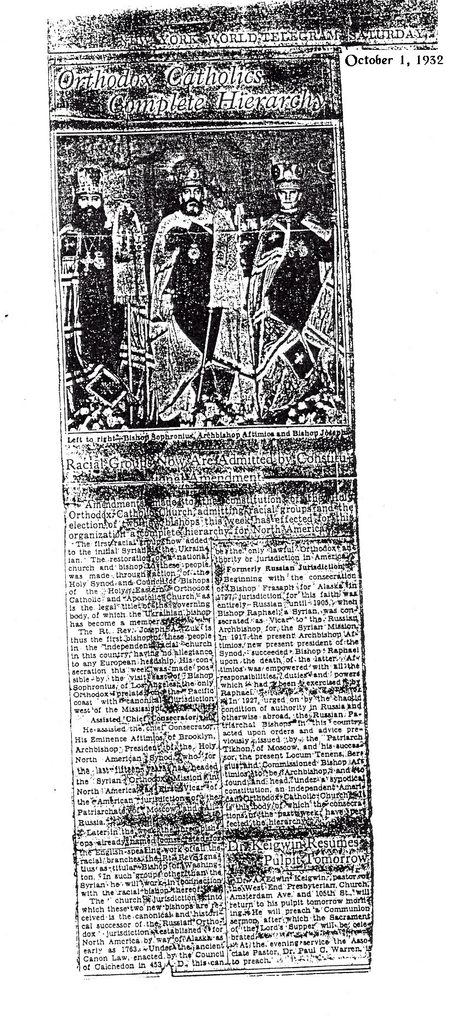
The newspaper described a functioning American synod and ecclesiastical structure that claimed independence from overseas administration.
The AOCC’s historical account regards this as evidence of a legitimate American Orthodox hierarchy. Questions concerning the precise canonical authority of its founding, its recognition, and its subsequent succession remain disputed within the broader Orthodox world.
Nevertheless, the historical record demonstrates that an effort to establish a united American Orthodox Church was underway nearly a century ago.
What Happened to That Vision?
The American Orthodox Catholic Church did not become the unified Church its founders envisioned.
The upheaval following the Russian Revolution and the sweeping changes by communism, disagreements over ecclesiastical authority, internal difficulties, and the continued expansion of ethnic jurisdictions created enormous challenges.
The AOCC’s historical understanding is that the proliferation of competing jurisdictions undermined the effort to establish a single territorial American Church.
Other Orthodox authorities have interpreted the canonical history differently.
We should acknowledge those disagreements without assigning motives or presuming bad faith.
But whatever our interpretation of the history, the result is difficult to ignore.
Instead of one united Orthodox Church in America, we developed overlapping jurisdictions, frequently dependent upon ecclesiastical authorities overseas.
Nearly a century later, the problem remains unresolved.
The contemporary AOCC seeks to recover that original vision of an American Orthodox Church. Still, the AOCC acknowledges the history of Orthodoxy in America and seeks communion with our brothers and sisters in Orthodoxy. We do not seek to establish authority over anyone, but seek to be a bridge to a healthy solution in brotherly love and the unity of the Orthodox Church.
Nevertheless, the underlying vision remains worth considering.
The Assembly of Bishops and the Unfinished Work of Unity
Today, the Assembly of Canonical Orthodox Bishops of the United States acknowledges the irregularity of overlapping jurisdictions.
Established following the 2009 Pan-Orthodox conference in Chambésy, the Assembly has worked to promote cooperation, common ministry, and a more canonically organized American Church.
Its Committee for Canonical Regional Planning has been tasked with developing proposals for organizing Orthodox Christians in America according to canonical territorial principles.
Yet the fundamental jurisdictional problem remains.
The Assembly does not possess the independent authority to impose a reorganization, and achieving one would require agreement among the relevant Churches.
Unfortunately, the ongoing crisis in Ukraine has made this challenge even more difficult.
In 2018, the Moscow Patriarchate suspended participation in certain inter-Orthodox structures, including the Assembly, and the Russian Orthodox Church Outside of Russia (ROCOR) has likewise been absent from its meetings.
As recently as November 2025, the Assembly publicly expressed sorrow over the continued absence of Russian Orthodox hierarchs and encouraged their return.
The consequences extend far beyond America.
On October 15, 2018, Moscow formally broke Eucharistic communion with Constantinople over Constantinople’s intervention in Ukraine and its recognition of Ukrainian ecclesiastical leaders whom Moscow regarded as schismatic.
In January 2019, Constantinople granted autocephaly to the newly established Orthodox Church of Ukraine.
Moscow rejected that decision, arguing that Constantinople had exceeded its canonical authority and violated territory Moscow considered to be under its jurisdiction.
As of November 2026, the rupture in Eucharistic communion remains unresolved.
Under Moscow’s restrictions, its clergy cannot concelebrate with clergy of the Ecumenical Patriarchate, and its faithful are prohibited from receiving the sacraments in churches under Constantinople.
Other Orthodox Churches have taken differing positions regarding the recognition of the Orthodox Church of Ukraine. The dispute has not divided every Orthodox Church into two completely separate communions, but it has seriously damaged relations within the Orthodox world.
And here is what concerns me.
We have an Assembly established, in part, to overcome canonical division in America, yet the jurisdictional disagreements within the broader Orthodox world have themselves disrupted the Assembly’s work toward unity.
I do not presume to judge the intentions of the patriarchs and bishops involved.
These are complicated historical, theological, and canonical questions.
But surely we must recognize the tragedy of the situation.
If the canons were established to preserve the unity and order of the Church, what does it say about our present circumstances when competing interpretations of canonical authority contribute to broken Eucharistic communion?
This is precisely why I believe the recovery of a single American Orthodox Catholic Church deserves renewed and serious consideration.
Why should America not have one united Orthodox Catholic Church, governed by its own synod of bishops, preserving the apostolic faith while embracing the legitimate cultural and liturgical traditions of its people?
Such a Church need not reject the ancient Patriarchates or abandon the rich traditions of Greek, Russian, Antiochian, Serbian, Romanian, and other Orthodox communities.
Unity does not require uniformity.
Rather, it should give fuller expression to the territorial and synodal unity the ancient canonical tradition envisions.
Our Other Canonical Inconsistencies
The American jurisdictional situation is especially important because it concerns the structure and unity of the Church.
But it is not the only area where ancient canonical regulations and modern practices differ.
Nicaea I Canon 15 and related canons restrict the transfer of bishops between dioceses, yet transfers occur today under recognized ecclesiastical procedures.
Neocaesarea Canon 11 and Trullo Canon 14 establish a minimum age of 30 for priests, yet many American clergy have historically been ordained younger.
Ancient canons restrict clergy from attending certain theatrical entertainments and frequenting taverns, while modern priests regularly attend movies and eat in restaurants.
Nicaea I Canon 20 prohibits kneeling on Sundays, yet kneeling remains common in some American Orthodox communities.
Trullo Canon 72 restricts marriages between Orthodox and non-Orthodox Christians, while American jurisdictions often permit marriage to other Trinitarian-baptized Christians under specified conditions.
Other examples involve fasting, penitential discipline, liturgical customs, and relations with other Christians.
Some represent legitimate applications of economia. Others reflect later canonical modifications, historical developments, or disagreements over interpretation.
Not every departure is a violation.
And that distinction matters.
But if we recognize the importance of historical context, pastoral discretion, and ecclesiastical development when examining our own practices, should we not extend that same careful consideration to other Orthodox Christians?
This is where I believe humility must guide our approach.
Economia: Pastoral Wisdom or an Excuse?
Orthodox tradition recognizes two important principles.
Akribeia refers to strictness or exactness in applying the canons.
Economia refers to the pastoral discretion exercised by legitimate Church authorities when applying ecclesiastical discipline.
These principles are not enemies.
They exist together because the Church must preserve truth while caring for wounded human beings.
Canon 102 of the Council in Trullo beautifully illustrates this principle.
It directs spiritual fathers to consider the nature of a sin, the disposition of the penitent, and the appropriate remedy.
The goal is healing.
A physician who gives every patient the same treatment, regardless of the illness, is not practicing good medicine.
But neither is a physician who refuses to treat a serious condition because the remedy might be uncomfortable.
The spiritual life requires discernment.
Economia, properly understood, is not permission to abandon canonical principles whenever they become inconvenient.
Nor is akribeia permission to impose ancient disciplinary regulations without regard for their original purpose.
Both must remain accountable to truth and the spiritual welfare of the faithful.
This raises an uncomfortable but necessary question.
When we invoke economia for practices within our own jurisdictions but demand strict canonical exactness from others, are we exercising consistent pastoral judgment?
Or are we in danger of applying two different standards?
I am not suggesting that every difference in practice is hypocrisy.
There are legitimate disagreements about canonical interpretation.
But selective obedience can become hypocrisy when we demand from others a standard we are unwilling to examine in ourselves.
That danger deserves our attention.
When Canonical Faithfulness Becomes Legalism
Can a desire to preserve ancient canons become a form of legalism that the Apostles themselves would not have intended?
I believe it can.
Not because obedience is unimportant, but because obedience can become detached from its spiritual purpose.
Jesus repeatedly confronted religious leaders who were meticulous in observing regulations while neglecting mercy, justice, and faithfulness.
He declared:
“Justice and mercy and faith; these you ought to have done, without neglecting the others.” (Matthew 23:23)
Notice that Christ did not reject obedience.
He rejected obedience separated from the greater purposes of God.
This is an important distinction for Orthodox Christians.
We should not imagine that preserving the apostolic faith requires us to reproduce every disciplinary practice of the ancient Roman Empire.
At the same time, we should not discard a canon simply because modern society finds it inconvenient.
The real question is whether the spiritual and theological principle underlying the canon remains essential and how the Church should faithfully express that principle today.
Some canons protect enduring truths concerning the Church’s sacramental and ecclesiastical life.
Others regulate historical circumstances that have changed substantially.
Still others have been modified by subsequent councils or interpreted differently within the canonical tradition itself.
Treating all these categories as though they were identical is not faithfulness.
It is a failure to appreciate the richness and complexity of our tradition.
And when the canons become instruments for condemning other Orthodox Christians rather than guiding all of us toward repentance and communion, we have lost sight of something essential.
The Canons Should Unite Us, Not Become Weapons Against One Another
I love the Orthodox Church.
My journey into Orthodoxy was shaped by a conviction that the Church had faithfully preserved the apostolic faith through Scripture, Sacred Tradition, the Fathers, the Councils, and the sacramental life.
That conviction remains.
But preserving the apostolic faith requires more than possessing the correct historical documents or defending the correct canonical arguments.
It requires that we embody the spiritual life those documents were intended to protect.
We can defend ecclesiastical order while neglecting unity.
We can insist upon canonical exactness while withholding mercy.
We can accuse others of departing from tradition while failing to examine our own accommodations.
And we can become so concerned with proving ourselves correct that we forget that the purpose of the Church is to bring human beings into communion with Jesus Christ.
Saint Paul asks:
“Is Christ divided?” (1 Corinthians 1:13)
That question should trouble us whenever our canonical disputes threaten the unity of the Body of Christ.
Of course, unity cannot come at the expense of truth.
But neither should genuine canonical concerns be used unnecessarily to deepen divisions between Orthodox Christians who confess the same faith.
I am not calling for the abandonment of the canons.
I am calling for their faithful, consistent, and pastorally responsible application.
I am calling for greater humility in how we judge the practices of other jurisdictions.
And I am calling for serious attention to the unresolved canonical divisions that continue to shape American Orthodox life.
Above all, I am asking that we remember why the ancient Church established the canons in the first place.
They were given to protect the Church, preserve her unity, correct disorder, and guide souls toward salvation.
Economia should serve that purpose.
Canonical exactness should serve that purpose.
Our bishops, priests, and faithful should work together toward that purpose.
And our conversations about the canons should reflect the same humility, charity, and commitment to truth that we profess in our worship.
So perhaps the most important question is not simply whether another Orthodox Christian is following the canons as strictly as we believe they should.
Perhaps we should begin by asking ourselves:
Are we using the canons as the Church intended, as instruments of healing and unity, or have we sometimes turned them into weapons against one another?
Because canonical faithfulness is not measured merely by how successfully we identify the shortcomings of others.
It must also be demonstrated in our willingness to examine ourselves.
Want the entire article distilled into one clear, printable page? Download your free summary and keep it with you.
Get the free PDF + join thousands of people receiving short, practical Orthodox insights in the “Morning Brew with Father Don” to help you grow in Christ each week.