
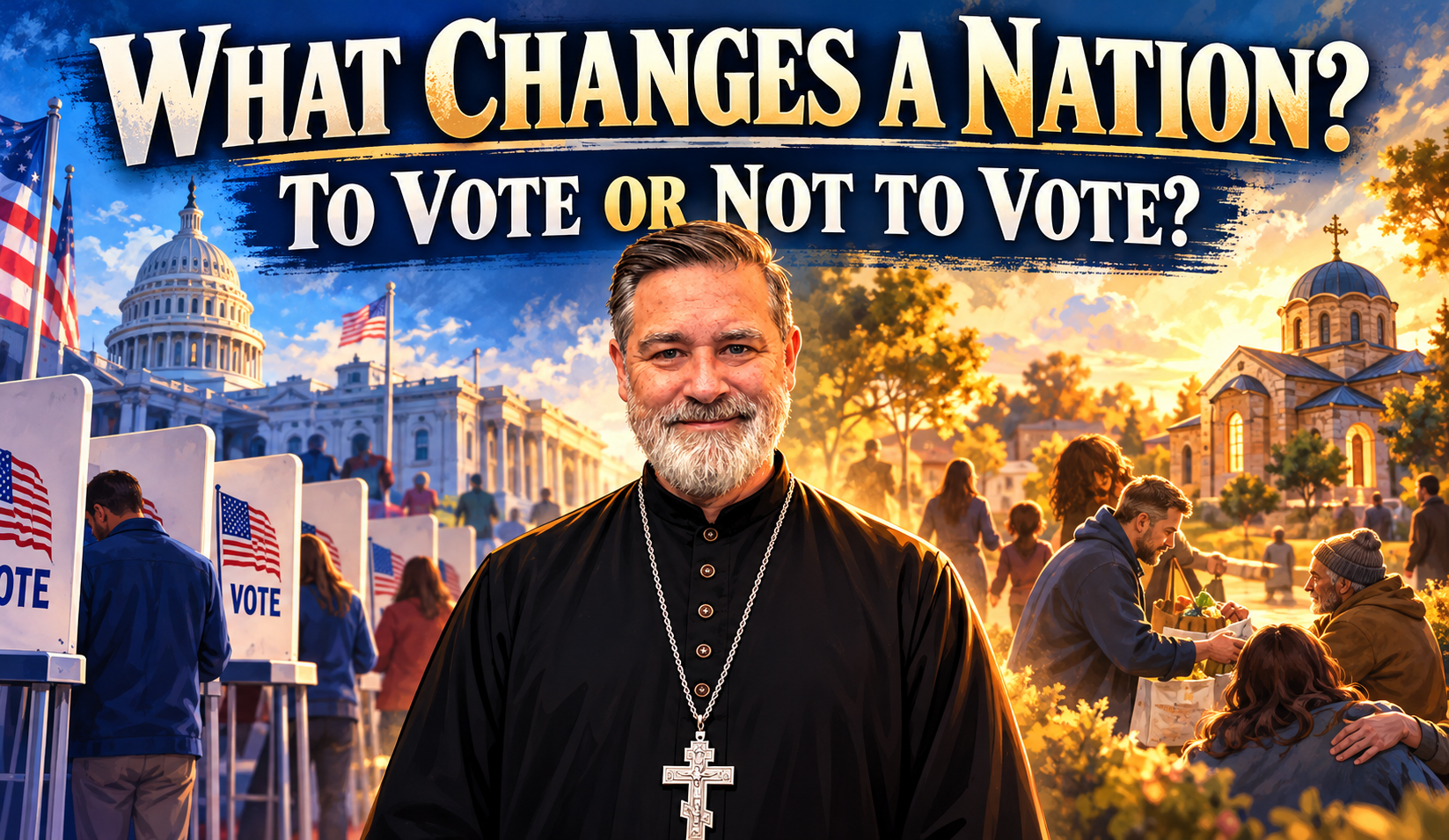
What if our greatest civic responsibility isn’t what we do at the ballot box, but how we live every day?
Every election season, Americans are told that the future of our country hangs in the balance.
We are told that this election is the most important of our lifetime. That everything we hold dear is at stake. That if the wrong people win, our country may never recover.
And Christians are often among the loudest voices repeating these warnings.
Every 2 to 4 years, the country grows less and less happy with our elected officials. It’s a seesaw from one end of the political spectrum to the other that keeps shifting with every election since 2000.
But I have a question.
What if we’ve misunderstood our greatest responsibility as citizens?
What if the most important thing you do for your country isn’t something you do every two or four years?
What if it’s something you do every single day?
I’m not writing this article to tell you whether you should vote, or who you should vote for if you choose to cast a ballot. Nor am I going to disclose whether I will or will not cast a ballot and for whom.
That’s not my purpose.
I want us to consider something far more fundamental about our responsibilities as Christians living in America.
What if the kind of country we want depends less on whom we elect and more on the kind of people we become?
Would that change our country and transform our politics in a positive direction?
A Lesson From the Exiles in Babylon
Some 2,600 years ago, the prophet Jeremiah wrote a letter to the Jewish people who had been carried away from Jerusalem into Babylonian captivity.
Imagine their circumstances.
Their homeland had been invaded. Their national independence was gone. Their political leaders had failed them. They were living under the authority of a foreign empire whose religious beliefs and moral practices were profoundly different from their own.
These were not people who had chosen to immigrate in search of a better life. They were exiles, taken from their homes and forced to live under Babylonian rule.
Yet God’s instructions through Jeremiah were extraordinary.
He told them to build houses, plant gardens, marry, raise children, and establish themselves in the land where they had been taken.
And then He said:
“But seek the welfare of the city where I have sent you into exile, and pray to the Lord on its behalf, for in its welfare you will find your welfare.” ~ Jeremiah 29:7
Think about that.
God did not tell them to abandon their faith and assimilate into Babylonian religion.
He did not tell them to place their hope in a new Babylonian ruler.
And He certainly did not suggest that their faithfulness depended upon gaining political control over Babylon.
Instead, He called them to live faithfully in the place where they found themselves and contribute to its well-being.
Their spiritual identity was not to be surrendered. But neither were they to withdraw from the society around them.
They were to pray for their neighbors, build families, cultivate the land, and seek the good of their communities.
There’s a lesson here for Christians in America.
We may be citizens of this country, but the Apostle Paul reminds us that our ultimate citizenship is in heaven (Philippians 3:20).
Our allegiance to Christ transcends every political party, movement, and nation.
And yet, while we live here, we have a responsibility to contribute to the good of the communities in which God has placed us.
Not simply by demanding that government make things better.
But by becoming people who make things better.
Have We Made Government Responsible for Too Much?
Every two or four years, America seems to repeat the same exhausting cycle.
One political party gains power. Millions celebrate. Millions despair.
A few years later, dissatisfaction grows. Promises go unfulfilled. Frustration builds. And voters begin looking to the other party to fix what the current one supposedly broke.
Back and forth we go.
Like a seesaw, American politics swings from one side to the other.
And with every swing, our expectations of government seem to grow.
We want politicians to fix our economy, our schools, our neighborhoods, our families, our culture, and even our moral disagreements.
Certainly, governments have legitimate responsibilities. Laws matter. Justice matters. Public safety matters. Protecting the vulnerable matters.
But here’s where I believe we need to rethink something.
The American constitutional system was not designed with the expectation that government could solve every problem of society.
Quite the opposite.
Many of the Founders were deeply concerned about concentrated political power.
James Madison, writing in Federalist No. 51 in 1788, explained:
“If men were angels, no government would be necessary.”
He continued by arguing that government must be structured not only to govern the people but also to control its own exercise of power.
Madison understood something about human nature that Christians should immediately recognize.
Human beings are fallen.
We are susceptible to pride, greed, ambition, selfishness, and the desire to control others.
And putting someone into public office does not suddenly remove those tendencies.
This is precisely why the Constitution established a system of checks and balances.
Power was divided among the legislative, executive, and judicial branches. Each was given means to restrain the others.
Power was also divided between the federal government and the states.
Madison explained in Federalist No. 45:
“The powers delegated by the proposed Constitution to the federal government are few and defined.”
He contrasted those with the broader powers expected to remain with the states.
Beyond that federal arrangement, Americans developed institutions of state, county, municipal, and local government, where communities could address many concerns closer to home.
The system was intentionally designed to make the concentration and exercise of power difficult.
It also creates an inherently divided country by design to limit the power and influence of government on everyday life.
That doesn’t mean the Founders believed no legislation should ever be passed. Nor does it mean they agreed on every question about the proper scope of government.
They certainly didn’t.
But the constitutional structure recognized that disagreement is inevitable and that political power must be restrained.
Our government was not designed to eliminate every disagreement or produce an endless stream of new laws. It was designed, in significant part, to prevent the passions of the moment from becoming unchecked power.
And that raises a question.
If our government was designed to limit power, why have we increasingly come to expect it to transform society from the top down?
Perhaps we’ve asked government to accomplish things that can only truly begin in the human heart.
The Founders Understood Something About Morality
The Founders were not uniform in their religious beliefs.
Some were committed Christians. Others held more unorthodox theological views. They disagreed about church establishments, religious liberty, and the relationship between religion and government.
It would be historically inaccurate to suggest they all shared one Christian theology or wanted the federal government to operate as a church.
Nevertheless, many of them believed that a free society could not survive without a morally responsible people.
George Washington made this point powerfully in his Farewell Address of 1796:
“Of all the dispositions and habits which lead to political prosperity, religion and morality are indispensable supports.”
Washington went on to argue that virtue and morality were essential to government.
John Adams was even more direct.
In an October 11, 1798, letter to officers of the Massachusetts militia, he warned about the danger of human passions unrestrained by morality and religion.
He wrote:
“Our Constitution was made only for a moral and religious people.”
And then added:
“It is wholly inadequate to the government of any other.”
Now, consider the implications.
These men understood that a constitutional system, no matter how carefully constructed, could not replace personal virtue.
A society cannot legislate its way into honesty.
Government cannot manufacture genuine compassion.
It cannot force people to love their neighbors.
It cannot create humility, kindness, integrity, or self-sacrifice within the human heart.
Those virtues must be cultivated within people, families, churches, and communities.
And for Christians, they flow from something far deeper than civic education or cultural tradition.
They flow from a life transformed by Jesus Christ.
A free society needs people who can govern themselves, not merely people who demand that others be governed.
This is where the Church has something extraordinary to offer.
Not a political platform.
Not a campaign strategy.
But a way of life.
When Christianity Became a Political Movement
I want to ask a difficult question, especially of my fellow Christians.
Have we become so consumed with changing the government that we’ve neglected the Gospel’s call to change ourselves?
This question is not directed exclusively at conservatives or liberals. It is a question every Christian should consider, regardless of political affiliation.
But to understand how we arrived at this moment, we need to examine a significant development in American Christianity.
During the late 1970s and throughout the 1980s, a powerful movement emerged among evangelical Christians.
Religious leaders became increasingly concerned about abortion, changing sexual morality, the breakdown of the family, secularization, and what they perceived as the exclusion of Christianity from public life.
Many of these concerns were sincerely held. Some involved profound moral questions that Christians cannot simply dismiss.
But the strategy for addressing them increasingly turned toward political organizing through various forms of media, activism, and lobbying Congress and statehouses.
In 1979, Jerry Falwell helped establish the Moral Majority, which sought to mobilize conservative Christians as a political force.
In 1977, James Dobson founded Focus on the Family, initially emphasizing parenting and family life. During the 1980s, Dobson’s influence expanded into public policy and political advocacy.
Following his unsuccessful 1988 presidential campaign, Pat Robertson established the Christian Coalition in 1989. It became an influential force in conservative politics during the 1990s.
Christian political activism was not new, of course. Christians had participated in abolitionism, civil rights, charitable reform, and numerous other public movements long before the 1980s.
Nor should we ignore the good that Christian organizations have accomplished through family counseling, adoption support, charitable assistance, and advocacy for vulnerable people.
But something significant happened as evangelical identity became more closely associated with organized partisan politics.
For many Christians, political activism was no longer simply one expression of their faith.
It increasingly became a defining expression of their faith.
The language of spiritual warfare was applied to electoral campaigns. Political opponents were sometimes portrayed as enemies of Christianity itself.
Winning elections became closely associated with defending the faith.
And eventually, for some believers, political loyalty became almost indistinguishable from religious loyalty.
I understand why this happened.
When people believe their deeply held convictions are under attack, they naturally want to defend them.
But we must ask whether our chosen methods have sometimes undermined the very faith we claim to protect.
Have we begun measuring Christian faithfulness by political victories rather than by holiness of life?
Have we become more concerned about who occupies the White House than whether Christ occupies the throne of our hearts?
Have we spent more time trying to defeat our political opponents than trying to love our neighbors?
These are not comfortable questions.
But I believe they are necessary ones.
There Is a Difference Between Changing Laws and Changing Hearts
Here’s something I’ve come to believe very deeply.
Politics can change what people are legally permitted to do. The Gospel changes who people are becoming.
Those are not the same thing.
Good laws can protect the innocent, restrain injustice, and encourage the common good. Christians need not apologize for seeking just laws.
But laws alone cannot create virtue.
You can pass legislation concerning marriage, but legislation cannot teach a husband to love his wife sacrificially.
You can create laws protecting children, but laws cannot replace parents who patiently nurture and guide their sons and daughters.
You can legislate against theft, but legislation cannot produce generosity.
You can forbid certain forms of discrimination, but legislation cannot create genuine love between neighbors.
And you can elect politicians who share your religious convictions without creating a society that actually lives according to those convictions.
This is the fundamental distinction we must recover.
The Church’s mission is not simply to make society behave in a more Christian manner.
The Church’s mission is to bring people into communion with Jesus Christ, where their lives can be transformed by His grace.
That transformation necessarily has consequences for society.
A man who learns to love his wife as Christ loves the Church changes his family.
Parents who raise their children in prayer, kindness, discipline, and faithfulness influence future generations.
A business owner who refuses to exploit employees makes the workplace more just.
A neighbor who cares for the elderly, feeds the hungry, and helps those who are struggling changes the character of a community.
These actions may never make the evening news.
They may never influence a national election.
But they make the world a better place.
Yet, they are the kinds of actions Christians are commanded to undertake.
Have We Forgotten What It Means to Be the Church?
I believe we must recover a vision of Christianity that is much deeper than political activism.
And let me be clear about something.
I am not advocating for a Christianity that abandons historic Christian moral teaching to accommodate progressive culture.
Quite the opposite.
I believe the Church must remain faithful to the Gospel, the Apostolic Tradition, the teachings of the Fathers, and the moral life handed down through the centuries.
But fidelity to Christian truth does not give us permission to abandon Christian love.
Truth and love are not enemies.
We do not have to choose between upholding the moral teachings of the Church and treating people with kindness, patience, dignity, and compassion.
In fact, we are commanded to do both.
Yet look at how Christianity is sometimes presented in our culture today.
Angry.
Judgmental.
Condemning.
Harsh.
Unsympathetic toward the struggles of others.
And sometimes more recognizable by political affiliation than by the fruits of the Holy Spirit.
I’m not suggesting this describes every politically active Christian. It doesn’t.
But I am asking whether we have allowed our public witness to become distorted.
When someone encounters a Christian, should their first thought be about that person’s political party?
Or should they encounter someone whose life reflects the character of Jesus Christ?
The Apostle Paul describes the fruit of the Spirit in Galatians 5:22–23:
Love. Joy. Peace. Patience. Kindness. Goodness. Faithfulness. Gentleness. Self-control.
Where do anger, contempt, bitterness, and the desire to humiliate others fit into that list?
They don’t.
And yet we sometimes seem to excuse those behaviors when they are directed toward someone on the other side of the political aisle.
Brothers and sisters, we cannot defend the Gospel by violating its commandments.
We cannot claim to stand for Christian morality while treating other human beings as though they are our enemies.
And we cannot expect the world to recognize Christ in us if all it sees is our political anger.
The Early Church Changed the World Without Controlling the Government
Consider the first three centuries of Christianity.
The Church did not have political control over the Roman Empire.
Christians did not elect the emperor.
They did not possess a powerful lobbying organization in Rome.
They were often misunderstood, marginalized, and, during periods of persecution, imprisoned or executed.
And yet Christianity spread.
How?
Through the preaching of the Gospel.
Through the witness of the martyrs.
Through prayer and worship.
Through the care of the poor, the sick, widows, orphans, and strangers.
Through men and women whose lives had been transformed by an encounter with the risen Christ.
The early Christian writer Tertullian, around the beginning of the third century, described how outsiders recognized the extraordinary love Christians had for one another (Apology, 39).
This was not simply an intellectual argument for Christianity.
It was a visible demonstration of Christian life.
And that witness mattered.
Christianity grew within an empire that often opposed it because the Church offered something radically different.
Not merely a competing political philosophy.
A transformed humanity in Christ.
To be clear, the story of Christianity’s growth is complicated. Imperial patronage, theological controversies, political power, and institutional developments all played important roles in later centuries.
But the Church’s witness began long before it possessed imperial favor.
And that should tell us something.
The Church does not need to control the government to be faithful to Christ or to transform the lives of those around it.
Its power is not derived from politicians.
Its authority does not come from elections.
Its life comes from the Holy Spirit.
And its mission is to proclaim Jesus Christ, crucified and risen.
What If We Actually Lived the Gospel?
Jesus said in the Sermon on the Mount:
“Let your light so shine before men, that they may see your good works, and glorify your Father which is in heaven.” ~ Matthew 5:16,
Notice what He did not say.
He did not tell us to demand that others live according to our convictions before we begin living them ourselves.
He told us to let our light shine.
And how does that light shine?
Through good works that glorify God.
Not ourselves.
Not our political party.
Not our favorite candidate.
Our Father in heaven.
Jesus also commanded His disciples:
“Love one another; as I have loved you.” ~ John 13:34
Consider the standard He established.
Not love others as long as they agree with you.
Not love others as long as they share your values.
Not love others as long as they vote the same way you do.
Love as Christ has loved us.
And how did Christ love?
He loved sacrificially.
He forgave His enemies.
He showed compassion to sinners while calling them to repentance.
He touched lepers, welcomed the outcast, fed the hungry, and gave Himself for the life of the world.
Then He told those who would follow Him:
“If any man will come after me, let him deny himself, and take up his cross daily, and follow me.” ~ Luke 9:23
There is nothing easy about this Christianity.
It requires repentance.
It requires self-denial.
It requires confronting the passions within ourselves.
It requires learning to love people we may not particularly like.
And it requires recognizing that the greatest enemy to our spiritual life may not be a politician or political movement.
It may be our own fear, pride, anger, selfishness, and lack of love.
The Orthodox Church understands salvation not merely as a legal declaration but as a lifelong process of healing and transformation through union with Christ.
We call this theosis, participation in the divine life by grace.
Through prayer, repentance, fasting, confession, the Eucharist, and the life of the Church, we are continually being conformed to the likeness of Christ.
This is not an escape from the world.
It is how Christians are prepared to live faithfully within it.
And a society filled with people genuinely seeking holiness, practicing self-restraint, loving their neighbors, and caring for those in need would look very different from the society we see around us.
Not because everyone had been forced to comply.
But because hearts and lives were being changed.
Your Greatest Civic Responsibility May Be Closer Than You Think
What if we stopped thinking of civic responsibility primarily in terms of national elections?
What if we began asking what we could do today to improve the place where God has put us?
Think about your own community.
There are lonely people who need friendship.
There are families struggling to make ends meet.
There are children who need positive examples of adulthood.
There are elderly neighbors who need someone to check on them.
There are marriages under strain.
There are people suffering in silence.
There are schools, charities, community organizations, and local institutions that need responsible people willing to serve.
And there are countless opportunities to practice honesty, generosity, patience, forgiveness, and love.
None of these requires permission from Washington, D.C.
You don’t need to win an election to become a better husband or wife.
You don’t need a new law to teach your children to love God and their neighbors.
You don’t need a political movement to visit someone who is lonely.
You don’t need government funding to show kindness to a stranger.
And you certainly don’t need to know someone’s political affiliation before offering them compassion.
This is where civic responsibility becomes deeply personal.
Because the question is no longer simply what government should do.
The question becomes:
What am I doing to contribute to the kind of society I want to live in?
Am I trustworthy?
Am I generous?
Am I patient with people who disagree with me?
Do I care about my neighbors?
Am I willing to sacrifice something of myself for the good of another person?
Do I participate in the life of my community?
Am I raising my children to become people of integrity and compassion?
And, most importantly, does my life bear witness to Jesus Christ?
These are questions worth asking every day, not merely during election season.
Repentance May Be the Most Radical Thing We Can Do
There is a temptation among Christians to look at the condition of our society and immediately identify everything that is wrong with everyone else.
We see the moral confusion.
We see the hostility.
We see the broken families, struggling communities, and growing divisions.
And we want someone to fix it.
But the Christian life begins with a very different question.
Lord, what needs to change in me?
This is the heart of repentance.
The Greek word metanoia speaks of a change of mind, a turning of the whole person toward God.
Repentance is not simply feeling guilty about something we’ve done.
It is a reorientation of our lives toward Christ.
And perhaps this is precisely what the Church in America needs most urgently.
Not another political strategy.
Not another campaign to seize cultural influence.
Not another round of outrage directed at our opponents.
But a return to prayer.
A return to humility.
A return to confession and repentance.
A return to the Eucharistic life of the Church.
A return to loving our neighbors, serving the poor, caring for the suffering, and showing mercy to those who have fallen.
A return to Christ.
That does not mean retreating from our responsibilities as citizens.
A Christian may vote, serve in public office, advocate for just laws, participate in local government, and speak clearly about moral issues.
There is nothing inherently wrong with those things.
But they must remain subordinate to our identity and calling as followers of Jesus Christ.
Politics must never become our religion.
And the Gospel must never become merely a tool for advancing our politics.
To Vote or Not To Vote?
So, should you vote?
I’m not going to answer that question for you.
I believe it is something each person must prayerfully consider, exercising conscience, discernment, and responsibility before God.
What I will say is this:
Don’t confuse casting a ballot with fulfilling your responsibility to your country.
Voting may be an important civic act.
But it is not the sum total of civic virtue.
And for Christians, it is certainly not the highest expression of faithfulness.
Our responsibility does not begin when the polls open or end when they close.
It begins when we wake up in the morning and decide how we will live.
Will we love God?
Will we love our neighbors?
Will we speak truthfully?
Will we care for the vulnerable?
Will we forgive those who have wronged us?
Will we raise our families in faithfulness?
Will we contribute to the peace and welfare of our communities?
Will we become the kind of people whose presence makes the world around us better?
Because perhaps the greatest thing we can do for America is not simply to elect better leaders.
Perhaps it is to become better neighbors.
Better parents.
Better spouses.
Better friends.
Better citizens.
And, above all, more faithful disciples of Jesus Christ.
Jeremiah told the exiles to seek the welfare of the city where God had placed them.
Jesus told us to let our light shine before others.
And He commanded us to deny ourselves, take up our crosses, and follow Him.
These are not merely religious ideals to admire on Sunday morning.
They are instructions for how we are to live every day.
Imagine what would happen if Christians in America became known less for whom they supported politically and more for how deeply they loved, how generously they served, how humbly they lived, and how faithfully they followed Christ.
Imagine the difference that would make in our homes, our churches, our neighborhoods, and our communities.
That kind of change cannot be manufactured by a political campaign.
It begins in the human heart.
It begins with repentance.
It begins with us.
And it begins today.
So, to vote or not to vote?
That’s a question worth considering.
But I believe there is an even more important one.
Whether you cast a ballot or not, what kind of life are you casting into the world?
Because your neighbors will live with the consequences of that answer long after the election is over.
Want the entire article distilled into one clear, printable page?
Download your free summary and keep it with you.
Get the free PDF + join thousands of people receiving short, practical Orthodox insights in the “Morning Brew with Father Don” to help you grow in Christ each week.