Why Penal Substitution Does Not Fit Orthodox Theology
Why did Jesus have to die?
For many Christians, especially those formed within evangelical or Reformed traditions, the answer seems obvious.
Humanity sinned. God is perfectly just. Sin deserves punishment. Because God cannot simply overlook sin, someone must receive that punishment. We deserve it, but Jesus steps into our place. On the Cross, the Father pours the punishment we deserve upon His Son. Once the penalty has been paid, God can forgive us.
That explanation is commonly called penal substitutionary atonement.
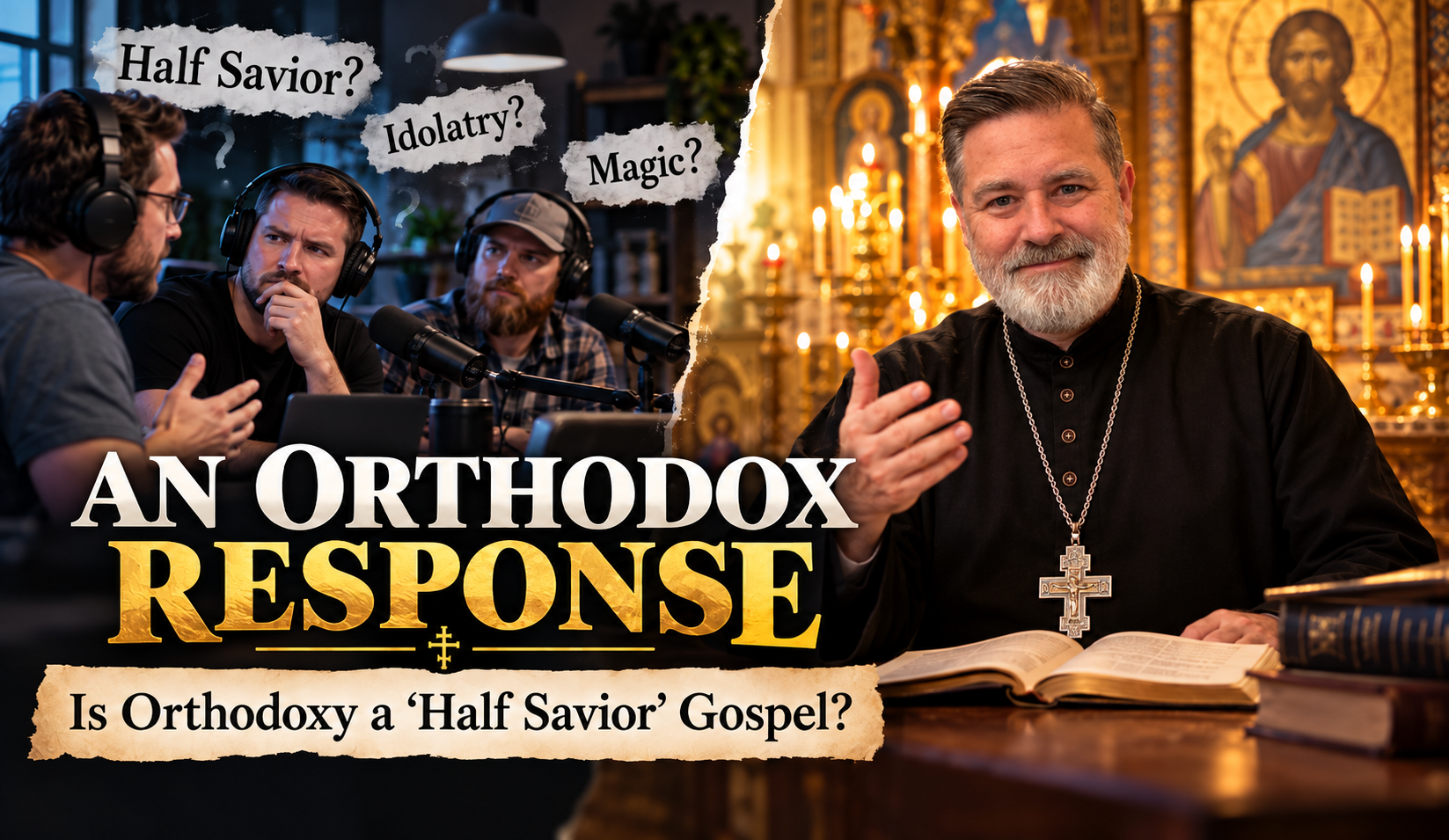
For years, I lived and studied within theological environments where this way of understanding the Cross was simply assumed. It was not usually presented as one theory among several. It was often presented as the Gospel itself.
But when I encountered the theology of the Orthodox Church, I discovered something much larger.
The Orthodox Church absolutely teaches that Christ died for our sins.
We absolutely believe that Christ offered Himself for us.
We absolutely believe that He bore our sins.
We absolutely believe that His death was sacrificial.
We absolutely believe that without Christ we are lost.
What Orthodoxy does not teach is that the Father needed to punish the Son before He could forgive humanity.
And that distinction changes everything.
What Is Penal Substitution?
Definitions matter.
The phrase penal substitution contains two ideas.
Substitution means that Christ acts on our behalf. He does something for us that we could never accomplish for ourselves.
Orthodoxy has no problem with substitutionary language properly understood.
Christ dies for us.
Christ gives Himself for us.
Christ enters death for us.
Christ offers Himself for the life of the world.
The difficulty comes with the word penal.
Penal means punishment.
In developed penal substitutionary theology, divine justice requires that the punishment owed because of human sin actually be inflicted. Christ legally takes the sinner’s place and receives that punishment so that the sinner can be acquitted.
The Orthodox objection is therefore not to Christ acting on our behalf.
The objection is to making punishment itself the necessary mechanism by which God becomes able to forgive.
Rejecting penal substitution does not mean rejecting the Cross.
It means rejecting one particular explanation of what the Cross accomplishes.
What Is Actually Wrong With Humanity?
This is where the conversation becomes much deeper.
Penal substitution begins primarily with guilt.
Human beings have violated God’s law. Therefore, we stand legally guilty before Him. Because guilt demands punishment, salvation requires satisfaction of that penalty.
There is biblical truth here.
We are sinners.
We are guilty.
We are accountable before God.
Scripture certainly uses language of judgment, justification, debt, condemnation, and acquittal.
Orthodoxy does not deny any of this.
But the biblical and patristic diagnosis of the human condition is far larger than legal guilt.
Humanity is not merely guilty.
Humanity is corrupted.
Humanity is enslaved to the passions.
Humanity is alienated from God.
Humanity is in bondage.
And above all, humanity is dying.
That raises an important question.
If humanity’s fundamental problem is that God has not yet punished somebody for sin, then the solution must be punishment.
But what if humanity’s problem is death?
Then punishment is not enough.
A dying humanity needs resurrection.
An enslaved humanity needs liberation.
A diseased humanity needs healing.
An alienated humanity needs reconciliation.
A corrupted humanity needs transformation.
A humanity trapped in darkness needs light.
Suddenly the Gospel becomes much larger than a courtroom.
You Need More Than a Changed Legal Record
This is one of the great differences between the Orthodox understanding of salvation and many modern Western presentations of it.
You need forgiveness.
Absolutely.
But you need more than forgiveness.
You need healing.
You need freedom.
You need purification.
You need resurrection.
You need communion with God.
You need to become a partaker of the divine nature.
That is why salvation cannot simply mean that God looks at the same unchanged human being and assigns him a different legal status.
The Gospel is not simply about changing what is written beside your name in a heavenly courtroom.
It is about God changing you.
This is why the Orthodox Church speaks so much about repentance, purification, healing, sacramental life, prayer, ascetic struggle, the passions, virtue, communion, and ultimately theosis.
The goal of the Christian life is not merely to be forgiven.
The goal of the Christian life is to be transformed.
You Cannot Understand the Cross Without Pascha
One of the greatest problems with certain presentations of penal substitution is that Good Friday can become detached from everything around it.
The Cross becomes the moment when the punishment happens.
The Resurrection then risks becoming almost an appendix proving that Jesus really was who He claimed to be.
But that is not how Orthodoxy understands the saving work of Christ.
Good Friday cannot be separated from Holy Saturday.
Holy Saturday cannot be separated from Pascha.
The Incarnation cannot be separated from the Cross.
The Cross cannot be separated from the Resurrection.
The Resurrection cannot be separated from the Ascension.
The Ascension cannot be separated from Pentecost.
It is one great movement of divine salvation.
At Pascha, the Church does not stand together proclaiming:
“The necessary amount of punishment has finally been inflicted.”
We proclaim:
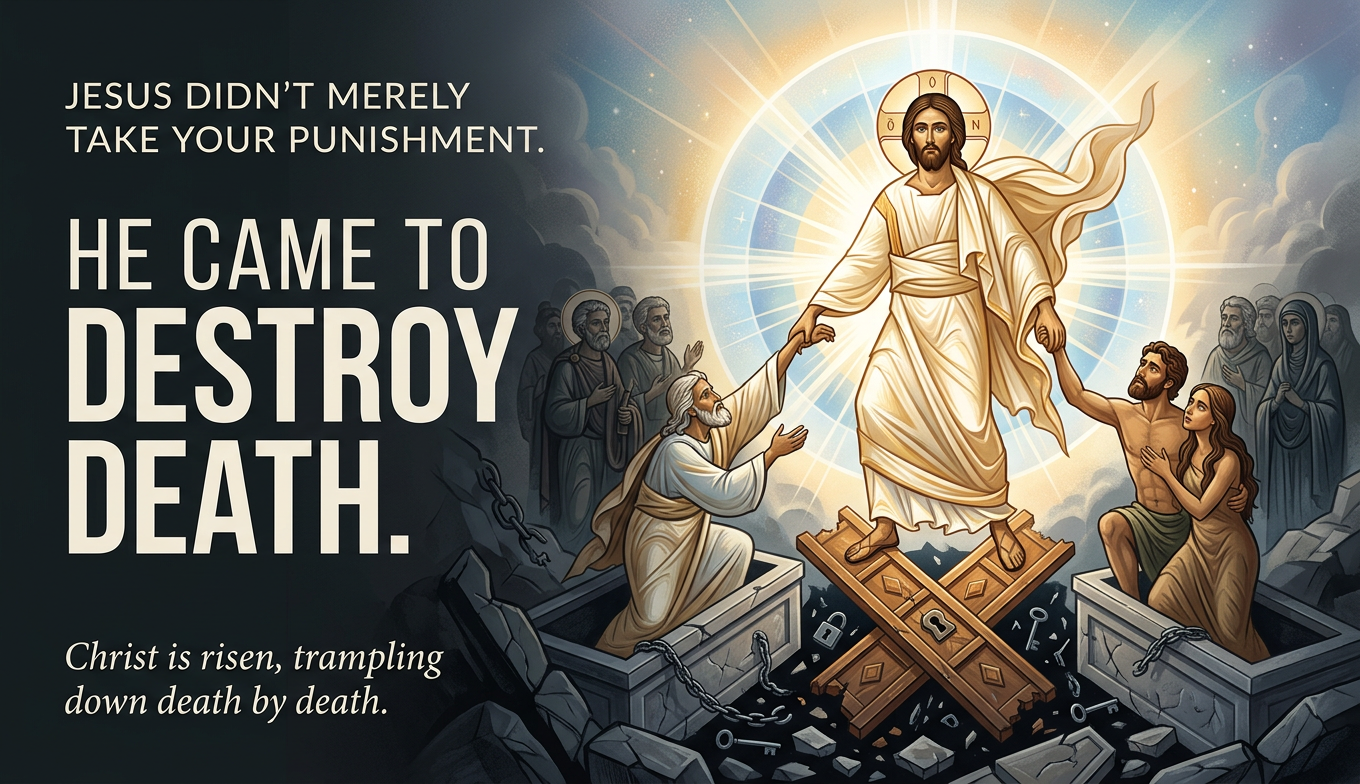
Christ is risen from the dead, trampling down death by death!
That is the heart of the Orthodox proclamation.
Christ enters death.
And death cannot hold Him.
He enters the grave.
And the grave becomes the doorway to resurrection.
He descends into the realm of death.
And He shatters its gates from within.
He takes upon Himself our mortality so that we might participate in His immortality.
The Cross is therefore sacrifice.
It is self-offering.
It is reconciliation.
It is obedience.
It is love.
It is victory.
And it is the destruction of the power of death.
Did the Father Punish Jesus?
This is where penal substitution can create a serious Trinitarian problem.
You will sometimes hear Christians say:
“God wanted to punish us, but Jesus took our punishment instead.”
Or:
“The Father poured out His wrath against Jesus so that He would not have to pour it out against us.”
But we need to ask what picture of God that creates.
Does the Father want one thing while the Son wants another?
Is the Father primarily wrathful toward humanity while Jesus is primarily merciful?
Does Jesus somehow convince the Father to love us?
Does the Son protect us from the Father?
That is deeply problematic from an Orthodox perspective.
The Father, Son, and Holy Spirit are not competing agents.
There is one God.
There is one divine will.
The Son does not become incarnate in opposition to the Father’s wishes.
The Father sends the Son because God loves the world.
The Son comes willingly because God loves the world.
The Spirit gives life because God loves the world.
Calvary is not an angry Father attacking a merciful Son.
Calvary is the self-giving love of the Triune God manifested within human history.
The Son freely offers Himself.
The Father loves humanity.
The Son loves humanity.
The Holy Spirit gives life.
There is no moment on Golgotha where an unwilling Son becomes the victim of a previously unmerciful Father.
That distinction is enormously important.
But Doesn’t the Bible Say Jesus Bore Our Sins?
Absolutely.
And Orthodoxy takes those passages very seriously.
Isaiah 53 speaks powerfully about the suffering servant.
St. Peter writes that Christ “bore our sins in His own body on the tree” in 1 Peter 2:24.
St. Paul says in 2 Corinthians 5:21 that Christ was made sin for us.
And in 1 Corinthians 15:3, Paul declares that “Christ died for our sins according to the Scriptures.”
None of that is disputed.
Christ bears our sins.
Christ dies for us.
Christ suffers for us.
Christ offers Himself for us.
But there is an important distinction:
Christ bearing our sins does not automatically mean that the Father transferred the exact punishment legally owed to every sinner onto Christ.
That additional conclusion is a theological interpretation.
It is not identical to the biblical statement itself.
This is one of the most important distinctions Christians need to understand:
Substitution does not automatically equal penal substitution.
Christ can act on our behalf without the Cross being understood primarily as the Father punishing Him instead of us.
What About Sacrifice?
Someone may respond:
“Didn’t Old Testament sacrifices involve an innocent animal being punished instead of the guilty sinner?”
Not quite.
Biblical sacrifice is far richer than that.
Sacrifice involves purification.
Offering.
Covenant.
Cleansing.
Consecration.
Communion.
Reconciliation.
Thanksgiving.
Passover.
Life.
Blood.
Holiness.
To reduce the entire sacrificial system to “God needs to punish something before He can forgive” is to force one later theological mechanism into a much broader biblical world.
This matters when we call Christ the Lamb of God.
Jesus is indeed our sacrifice.
He is the true Paschal Lamb.
He offers Himself completely.
But Passover itself is not fundamentally a story in which God punishes a lamb instead of a human being.
It is the story of liberation from slavery and deliverance from death.
The Cross Is Not God Becoming Merciful
Another major problem occurs when Christians begin to imagine that something had to happen to Jesus before the Father could become merciful toward us.
But God’s mercy does not begin at Calvary.
The Cross is the manifestation of divine love, not the event that creates divine love.
“For God so loved the world that He gave His only begotten Son.”
The love comes first.
The Father sends because He loves.
The Son comes because He loves.
Christ offers Himself because He loves.
God does not suddenly become merciful after sufficient blood has been shed.
The Cross reveals just how far divine love will go to rescue creation.
Orthodoxy Does Believe in Divine Justice
At this point, someone may think:
“Then Orthodoxy must not believe in God’s wrath or justice.”
That is false.
Orthodoxy takes divine judgment seriously.
Orthodoxy takes sin seriously.
Orthodoxy takes repentance seriously.
Orthodoxy takes hell seriously.
Orthodoxy takes the holiness of God seriously.
The objection is not that justice is irrelevant.
The objection is that divine justice cannot simply be reduced to retributive punishment.
Nor can the mystery of salvation be reduced to a single legal transaction between the Father and the Son.
Scripture gives us judicial imagery, but Scripture also gives us many other images.
Salvation is a courtroom.
But it is also a hospital.
It is a battlefield.
It is an exodus.
It is adoption.
It is marriage.
It is sacrifice.
It is new creation.
It is resurrection.
It is participation.
It is communion.
It is union with Christ.
The courtroom tells us something true.
It simply does not tell us everything.
The Hospital and the Courtroom
One of the images Orthodox Christians frequently use is the Church as a spiritual hospital.
Sin is not merely a crime to be recorded.
Sin is a sickness that deforms us.
Think about anger.
Lust.
Greed.
Pride.
Envy.
Hatred.
Bitterness.
These things are certainly sinful.
But they are also diseases of the soul.
Imagine being told that you have cancer and the doctor says:
“Good news. I changed your medical record. It now says you are healthy.”
You would immediately ask:
“But did you heal me?”
That question gets very close to the Orthodox concern.
A changed record matters very little if the disease continues destroying the person.
Salvation must actually heal humanity.
Christ does not merely declare life over those remaining permanently in death.
He raises the dead.
Theosis Changes the Entire Question
This brings us to one of the most important doctrines in Orthodox Christianity: theosis.
St. Peter writes that we are called to become “partakers of the divine nature” in 2 Peter 1:4.
The Fathers understood salvation as participation in the life of God.
St. Athanasius famously summarized the mystery of the Incarnation by teaching that God became man so that humanity might become god.
Of course, the Church does not mean that human beings become God by nature.
We do not become another member of the Trinity.
We participate in God’s life by grace.
We are united to Christ.
We are filled with the Holy Spirit.
We are transformed into the likeness of Christ.
We become what humanity was always created to become.
That is why theosis becomes so important in understanding the Cross.
If salvation is fundamentally participation in God, then Christ has not merely come to alter our legal status.
He has come to unite humanity to Himself.
He assumes our humanity.
He heals it.
He sanctifies it.
He carries it through death.
He raises it.
He glorifies it.
And He brings humanity into communion with God.
St. Athanasius and the Logic of the Incarnation
This is why St. Athanasius is so important when discussing salvation.
Athanasius does not begin by asking:
“How can God punish sin while forgiving sinners?”
His great concern is corruption and death.
Humanity has fallen away from communion with the One who is Life.
As a result, humanity is returning toward corruption and death.
So what does God do?
The Word becomes flesh.
The One through whom creation was made enters creation.
The Life of the world enters mortality.
Christ takes what is ours so that He may give us what is His.
This is one of the great patristic patterns of salvation.
Christ assumes humanity in order to heal humanity.
What is not assumed cannot be healed.
What is united to Christ is brought into His victory.
This is far more than a legal fiction.
It is an ontological transformation of human existence.
Why Did Jesus Have to Die?
Now we can answer the question directly.
If God did not need to punish Jesus before He could forgive us, why did Jesus have to die?
Because humanity was dying.
The eternal Son truly assumed our mortal human nature.
He entered the full reality of our condition, except for sin.
He entered suffering.
He entered mortality.
He entered death itself.
And because the One entering death is Life Himself, death encounters something it has never encountered before.
It encounters the God-Man.
Death consumes Christ’s humanity, but it cannot contain His divinity.
The grave receives Him, but cannot hold Him.
Christ enters death and destroys death from within.
He rises bodily.
Human nature rises in Him.
The way into incorruption has been opened.
This is why St. Paul does not merely say that Christians have been acquitted.
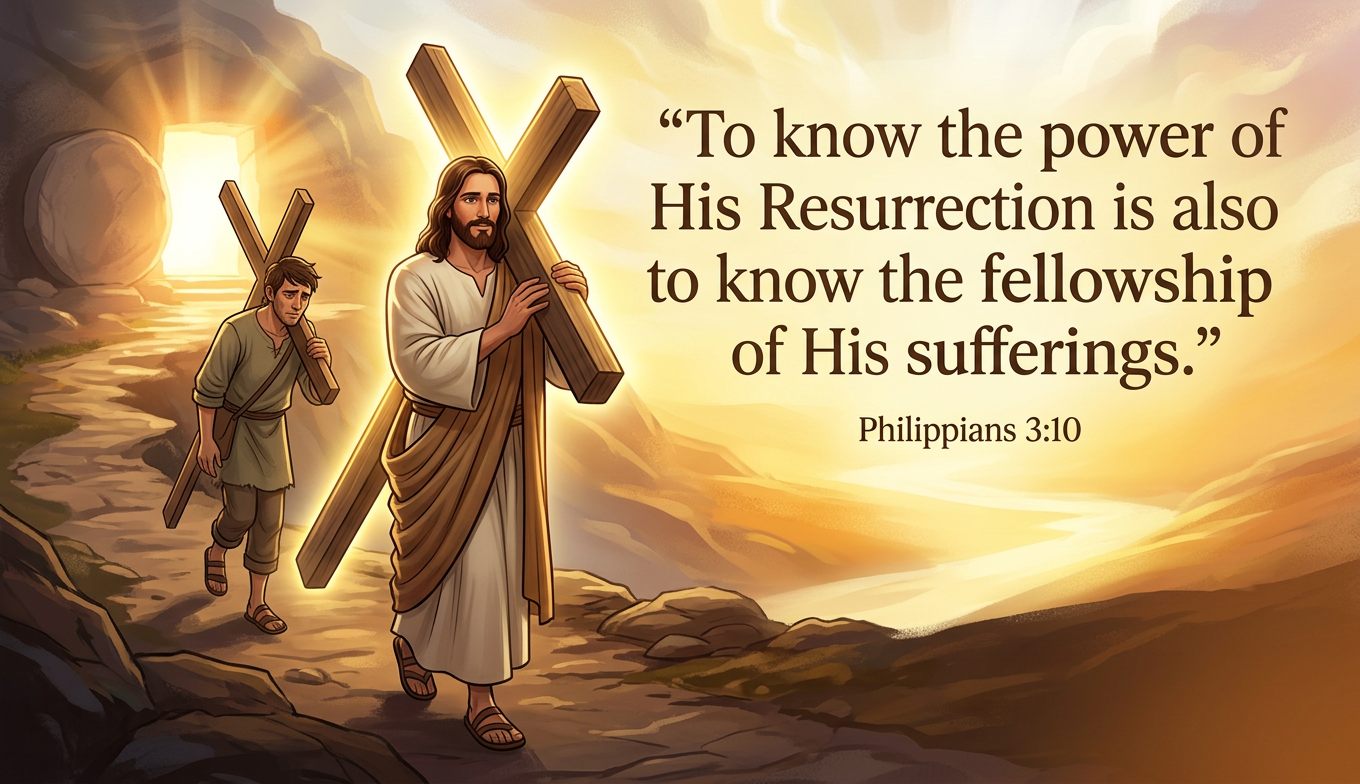
He speaks about dying with Christ.
Being buried with Christ.
Being raised with Christ.
Living in Christ.
The Gospel is participatory.
We are brought into His death so that we may participate in His life.
Christmas Is Part of Salvation Too
This is another place where our theology matters.
Sometimes Christianity is presented as though the Incarnation merely gets Jesus into position to die.
Christmas becomes the transportation system that delivers the sacrifice to Good Friday.
But the Incarnation itself is salvific.
The eternal Word takes human nature into union with Himself.
His birth is salvific.
His obedience is salvific.
His baptism is salvific.
His ministry is salvific.
His Cross is salvific.
His descent into Hades is salvific.
His Resurrection is salvific.
His Ascension is salvific.
Pentecost belongs to this same saving economy.
It is all one divine work of restoring humanity to communion with God.
Salvation is not a single isolated transaction occurring during several hours on Good Friday.
It is the entire saving work of Christ.
Christianity Is “The Way”
This is also why I so often emphasize that Christianity is not merely a collection of propositions that we intellectually accept.
The earliest Christians called it the Way.
It is a life.
A path.
A movement toward purity of heart and union with Christ.
Christ does not simply do something entirely outside of us so that nothing ultimately needs to happen inside of us.
He brings us into His life.
We repent.
We pray.
We fast.
We confess.
We forgive.
We receive the Eucharist.
We struggle against the passions.
We learn humility.
We practice mercy.
We participate in the sacramental life of the Church.
None of this means that we save ourselves.
Everything is grace.
But grace does not leave us unchanged.
Grace transforms.
Grace heals.
Grace restores.
Grace makes us alive.
The Christian life is participation in what Christ has accomplished.
A Word to My Protestant Friends
I want to be very careful here.
Many Protestants who use the language of penal substitution deeply love Christ.
They believe the Cross is an expression of God’s love.
They believe Jesus willingly offered Himself.
They believe in the bodily Resurrection.
They believe Christians should be sanctified and transformed.
They are not consciously imagining the Father as cruel or Jesus as an unwilling victim.
So this should never become an opportunity for Orthodox Christians to caricature other Christians.
We should criticize theological ideas fairly.
The issue is not whether Protestants love Jesus.
The issue is whether the mechanism of penal substitution adequately expresses the biblical and patristic vision of salvation.
I do not believe it does.
And I say that as someone who came from that world.
What Does God Actually Want From You?
There is also a deeply pastoral reason this matters.
Your theology shapes your spiritual life.
If salvation is primarily about penal acquittal, the Christian may naturally ask:
“How do I know my punishment has been covered?”
But Orthodox spirituality asks a larger set of questions.
How is Christ healing me?
How is Christ freeing me from my passions?
Am I becoming more loving?
More merciful?
More forgiving?
More humble?
Is my heart being purified?
Am I learning to pray?
Am I becoming more like Christ?
Am I entering communion with God?
Am I becoming what I was created to become?
Forgiveness matters enormously.
But forgiveness is the beginning of restoration, not the end of salvation.
God does not merely want forgiven corpses.
He wants sons and daughters who are alive in Him.
The Gospel Is Bigger Than Punishment
This is where I believe the Orthodox vision of the Cross is so beautiful.
Christianity is not ultimately the announcement that God found someone else to punish.
It is the proclamation that God Himself came for us.
The Word became flesh.
Christ entered our mortality.
He entered our suffering.
He confronted sin.
He confronted the devil.
He confronted corruption.
He confronted death.
He entered the grave.
He descended into the realm of death.
And He shattered its gates.
Then He rose.
Not symbolically.
Not metaphorically.
Bodily.
Gloriously.
Victorious.
And because He lives, humanity now has a path into life.
That is Pascha.
That is the Gospel.
That is why Orthodoxy does not need penal substitution in order to take the Cross seriously.
Quite the opposite.
The Orthodox vision is larger.
Christ does not merely save us from a penalty.
He saves us from sin.
He saves us from corruption.
He saves us from death.
He saves us from alienation.
He saves us from bondage.
And He does all of this so that, united to Him by grace, we may become what humanity was always created to be.
The Cross is not God finally finding someone to punish.
The Cross is God entering the darkest depths of the human condition to bring His creation home.
And Pascha gives us the final word:
Christ is risen from the dead, trampling down death by death, and upon those in the tombs bestowing life.