The release of Steven Spielberg’s latest film, Disclosure Day, has reignited a conversation that has steadily moved from the fringes of society into mainstream culture: Are we alone in the universe?
But Spielberg is not merely asking a scientific question.
He is asking a theological one.
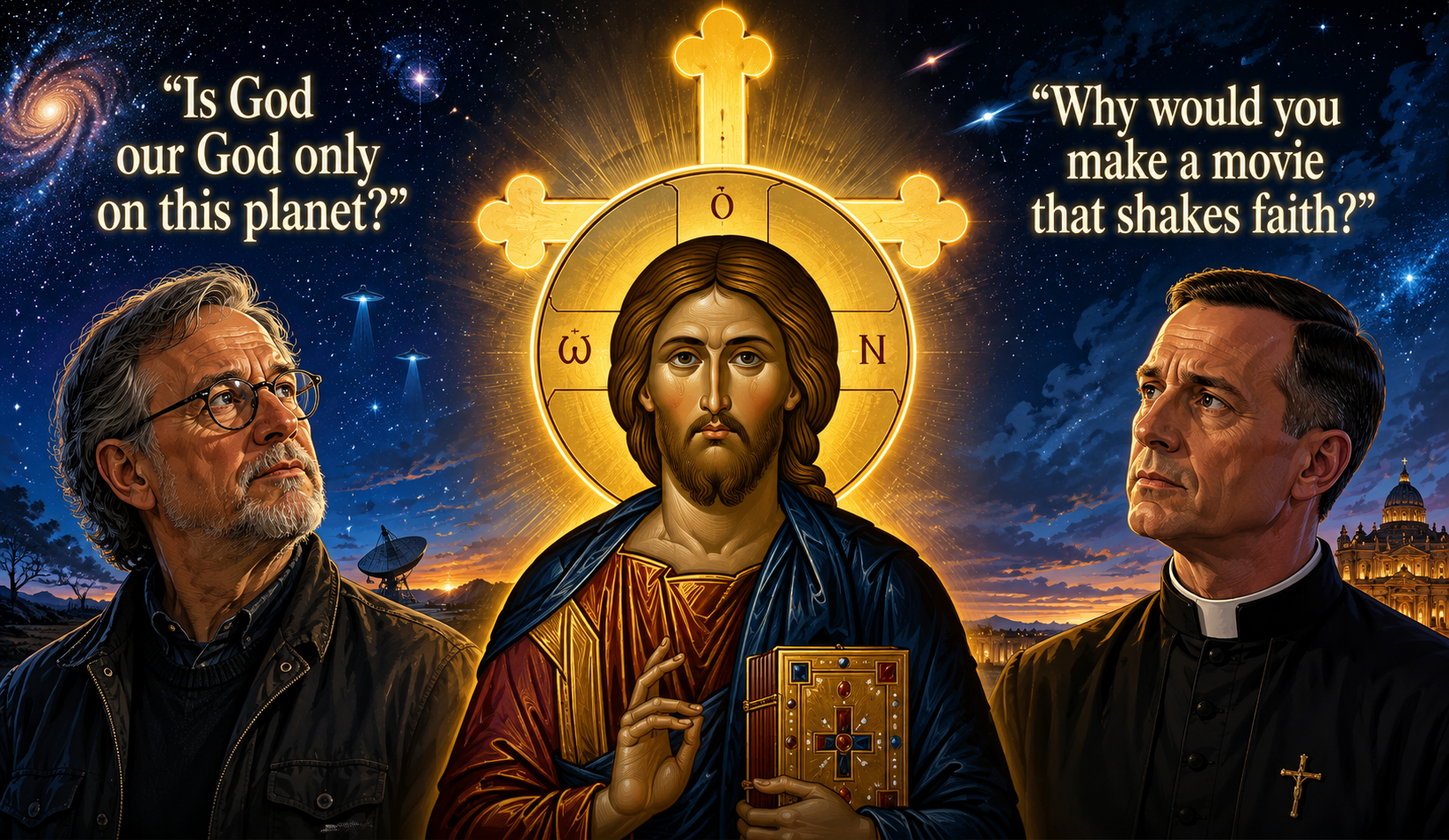
Recently, Roman Catholic priest and exorcist Father Dan Reehil made headlines after responding to Spielberg’s comments about Disclosure Day. Reehil expressed concern that the film’s theological implications could undermine Christian belief, asking:
“Why would you make a movie with the distinct outcome being people’s faith would be shaken or lost? That seems very much like something the Antichrist would do—or Satan.”
He later warned that spiritual deception can sometimes accompany forms of entertainment, even suggesting that a film could be influenced in ways viewers do not recognize.
Predictably, many dismissed Father Reehil’s concerns as superstition or fearmongering. Yet behind the controversy lies a question that deserves serious consideration.
What happens when a cultural phenomenon about extraterrestrials becomes a conversation about theology?
That is precisely the question Spielberg himself appears to be asking.
In a recent interview discussing the film, Spielberg explained:
“The movie also takes the position of the church. What does this do to the fundamental beliefs that many of us have? Is God our God only on this planet? Or is God a God for every system where there’s civilization and intelligent life, and even developing life?”
Those are not insignificant questions.
In fact, they are precisely the kinds of questions Christians should be prepared to answer.
The Orthodox Church has been wrestling with questions about non-human intelligences for nearly two thousand years.
The difference is that the Church has never called them aliens.
You can Now Listen to Each Article
The Modern Myth of Disclosure
One of the most fascinating aspects of the modern UFO movement is that it increasingly resembles a religion.
For decades, the narrative was relatively simple. Strange lights appeared in the sky. Governments supposedly concealed evidence. Witnesses reported encounters with extraterrestrial visitors.
But in recent years, the story has evolved.
Now we are told that these entities may not be extraterrestrial at all. They may be “interdimensional.” They may exist in a realm beyond ordinary perception. They may possess psychic abilities. They may communicate telepathically. They may offer humanity new spiritual knowledge capable of transforming civilization.
Notice what has happened.
The discussion has quietly shifted from science into spirituality.
What began as speculation about life on other planets has become a conversation about unseen intelligences interacting with humanity.
At that point, we are no longer discussing astronomy.
We are discussing theology.
What the Heavens Are Actually Proclaiming
One of the assumptions underlying much of the modern disclosure movement is that the heavens are withholding a secret that humanity desperately needs to discover.
The Scriptures present a very different picture.
King David writes:
“The heavens declare the glory of God; and the firmament showeth His handiwork. Day unto day uttereth speech, and night unto night revealeth knowledge. There is no speech nor language where their voice is not heard.” (Psalm 19:1-3)
Notice what David says the heavens are declaring.
They are not proclaiming hidden civilizations.
They are not proclaiming cosmic saviors.
They are not proclaiming secret knowledge reserved for an enlightened few.
They are proclaiming the glory of God.
The heavens are not silent. They are already speaking. Every star, every galaxy, every nebula, every celestial body bears witness to the majesty, wisdom, and power of its Creator.
This is why Orthodox Christianity has always viewed creation sacramentally. Creation is not an end in itself. It is a signpost pointing beyond itself to God.
The modern fascination with disclosure often reverses this order. Instead of allowing creation to lead us to the Creator, it encourages us to become fixated on the creation itself. The stars cease to be witnesses to God’s glory and become objects of spiritual speculation.
Ironically, humanity may spend billions of dollars searching the heavens for intelligence while overlooking the very message the heavens have been proclaiming since the foundation of the world.
To Spielberg’s credit, he recognizes that the discovery of non-human intelligence would not merely be a scientific event but a theological one. Yet the underlying assumption of the question deserves examination.
The Christian faith does not rest upon humanity being the only intelligent beings in creation.
Christianity rests upon the revelation of God in Jesus Christ.
If God created other intelligent creatures somewhere in His universe, they too would owe their existence to Him. The existence of additional creatures would not diminish God; it would magnify His creative power.
The real issue is not whether other intelligences exist.
The real issue is whether the intelligences presently seeking humanity’s attention are what they claim to be.
The greatest mystery of the cosmos is not that there may be other created beings somewhere in God’s vast universe.
The greatest mystery is that the Creator of the universe entered His creation, took on flesh, died, rose again, and invites mankind into communion with Him.
That is the disclosure that changes everything.
The Orthodox Church Has Never Denied the Unseen Realm
One of the great tragedies of modern Western Christianity is the tendency to separate the physical world from the spiritual world.
The Orthodox Church has never done this.
The Scriptures reveal a cosmos filled with visible and invisible realities. Angels exist. Demons exist. Principalities and powers exist. The saints repeatedly testify that the spiritual world is not merely symbolic but profoundly real.
St. Paul reminds us:
“For we wrestle not against flesh and blood, but against principalities, against powers, against the rulers of the darkness of this world, against spiritual wickedness in high places.”
The modern mind often assumes that if something cannot be measured, it cannot be real.
The Orthodox mind understands that some of the most powerful realities in existence cannot be seen with physical eyes.
Love cannot be measured.
Grace cannot be placed under a microscope.
Neither can demons.
What the Fathers Teach About Deception
The Desert Fathers repeatedly warned that fallen spirits often present themselves as beings of light.
St. Anthony the Great encountered apparitions and manifestations that appeared beautiful, intelligent, and even holy. Yet he understood that appearances alone prove nothing.
The demons do not typically introduce themselves as demons.
They present themselves as helpers.
As guides.
As enlightened teachers.
As bearers of hidden knowledge.
As beings who can reveal secrets unavailable through ordinary means.
This should sound remarkably familiar to anyone who has spent time studying modern UFO literature.
Many alleged encounters contain recurring themes:
- Secret knowledge
- Cosmic enlightenment
- Humanity entering a new age
- Transcending traditional religion
- The rejection of Christianity as outdated
- Messages that diminish Christ’s uniqueness
- Promises of salvation through higher consciousness
The Fathers would immediately recognize these patterns.
Not because they studied UFOs.
But because they studied demons.
The Ancient Heresy Hidden Inside Modern Disclosure
Perhaps the most overlooked aspect of the modern disclosure movement is that it closely resembles one of the oldest heresies the Church ever confronted: Gnosticism.
The Gnostics claimed that salvation did not come through repentance, participation in the life of the Church, or union with Christ. Instead, they taught that salvation came through hidden knowledge—gnosis—available only to those enlightened enough to receive it.
The pattern should sound familiar.
Today we are told that humanity stands on the verge of a great awakening. Hidden truths are supposedly being concealed by governments, religious institutions, and powerful elites. Soon, we are told, disclosure will occur. Secret knowledge will be revealed. Human consciousness will evolve. The world will never be the same.
In other words, salvation comes through enlightenment.
The Church has heard this message before.
Nearly two thousand years ago, St. Irenaeus of Lyons confronted the Gnostics in his monumental work Against Heresies. He recognized that their teachings always revolved around secret revelations, hidden mysteries, and privileged knowledge unavailable to ordinary believers.
St. Irenaeus wrote:
“Error, indeed, is never set forth in its naked deformity… but it is craftily decked out in an attractive dress, so as, by its outward form, to make it appear to the inexperienced more true than the truth itself.”
His words are remarkably relevant today.
Many disclosure narratives are wrapped in the language of science, progress, enlightenment, and discovery. Yet beneath the surface lies a familiar promise: hidden knowledge will save us.
In contrast, Christianity proclaims something radically different.
The Gospel is not a secret.
Christ did not whisper hidden teachings to an enlightened few while leaving the rest of humanity in darkness.
The truth was proclaimed openly.
The Apostles preached publicly.
The Church worships publicly.
The faith was delivered “once for all to the saints.”
St. Irenaeus argued that the true faith could be traced openly through the Apostles and the bishops who succeeded them. The Gnostics, by contrast, always claimed access to a higher revelation beyond what had been publicly revealed.
That distinction remains critical today.
The modern disclosure movement often presents itself as a new revelation that will fundamentally alter humanity’s understanding of reality.
But Christians must ask a simple question:
If God has already revealed Himself fully in Jesus Christ, what greater revelation are we expecting?
St. Ignatius of Antioch answered this question long before modern UFO theories existed. Writing at the beginning of the second century, he centered everything upon the Incarnation of Christ—God entering history, taking flesh, suffering, dying, and rising again.
For Ignatius, salvation was not found through secret knowledge.
It was found through communion with the incarnate Christ.
Likewise, St. Justin Martyr warned that demonic powers often imitate divine truths in order to lead people away from the Truth Himself. He understood that spiritual deception frequently works through counterfeits—offering something that appears profound while subtly redirecting people away from Christ.
This is why the Incarnation matters so profoundly in this discussion.
The disclosure narrative says:
“You need new knowledge.”
The Gospel says:
“You need Christ.”
The disclosure narrative promises that hidden truths will transform humanity.
The Gospel proclaims that God has already entered human history and transformed it forever.
The disclosure narrative encourages people to look upward toward the stars for salvation.
The Church points us toward the Cross.
This is also why Psalm 19 is so important to the discussion. The heavens do indeed proclaim a message, but according to King David, that message is not the arrival of cosmic saviors, advanced civilizations, or secret revelations.
“The heavens declare the glory of God.”
Creation points beyond itself to its Creator.
The stars are not our salvation.
Christ is.
That is why Christians should approach modern disclosure claims with discernment.
The greatest danger may not be that people believe in extraterrestrials.
The greatest danger may be that they begin looking for a savior other than Jesus Christ.
And that is precisely the temptation the Church has been confronting since the second century.
Could Extraterrestrial Life Exist?
Orthodoxy does not possess a formal dogma declaring that intelligent extraterrestrial life is impossible.
God’s creation is vast.
The universe displays a scale that humbles the imagination.
The Church has never claimed exhaustive knowledge regarding every aspect of creation.
However, this is not the primary question.
The question is not:
“Could intelligent life exist elsewhere?”
The question is:
“What is the nature of the intelligence currently seeking humanity’s attention?”
Those are two entirely different questions.
Many Christians assume that belief in extraterrestrials and belief in demons are mutually exclusive.
The Fathers would not have accepted such a simplistic framework.
The issue has never been the existence of non-human intelligences.
The issue has always been discernment.
The Danger of Spiritual Curiosity
While I would not go as far as some of Father Reehil’s more speculative comments regarding curses attached to films, Orthodox Christianity has never denied that ideas, images, stories, and cultural movements can become vehicles for spiritual influence.
The Church has long recognized that deception often enters through the imagination before it enters through doctrine.
The real concern is not whether a movie is cursed.
The real concern is whether it subtly trains people to seek salvation, revelation, and meaning apart from Jesus Christ.
One of the recurring themes throughout Scripture is that spiritual curiosity can become spiritually destructive.
Eve was not tempted with obvious evil.
She was tempted with hidden knowledge.
The Tower of Babel was not merely about architecture.
It was humanity’s attempt to ascend beyond the boundaries God established.
The occult promises access to hidden realities.
So does much of the contemporary disclosure movement.
There is a profound difference between seeking truth and seeking experiences.
The saints pursued holiness.
Modern culture increasingly pursues encounters.
The saints sought communion with God.
Many today seek contact with unknown intelligences.
These are not the same thing.
Why Hollywood Matters
Some Christians dismiss films as harmless entertainment.
Sometimes they are.
Sometimes they are not.
The deeper concern is not that a movie can summon demons.
The concern is that stories shape imagination.
Every civilization is catechized by its stories.
The stories we tell reveal what we worship.
Increasingly, modern entertainment presents humanity’s salvation as coming from advanced intelligences, superior beings, or hidden knowledge.
Notice how often Christ is absent from these narratives.
Humanity is saved through technology.
Through evolution.
Through consciousness.
Through alien intervention.
Through secret revelation.
Almost anything except repentance and union with God.
That should concern Christians far more than special effects or flying saucers.
The Real Disclosure Humanity Needs
The irony of the modern disclosure movement is that it seeks revelation while ignoring the greatest revelation already given.
God has disclosed Himself.
The Word became flesh.
The Creator entered creation.
The invisible God became visible in Jesus Christ.
No alien encounter, no government file, no recovered craft, and no interdimensional being can rival that disclosure.
The question facing humanity is not whether we are alone in the universe.
The question is whether we recognize the One who created it.
The saints did not spend their lives searching the heavens for hidden intelligences.
They spent their lives purifying their hearts so they could behold God.
That remains the Christian path today.
A Final Word of Caution
As discussions about UFOs, non-human intelligences, and interdimensional beings continue to grow, Orthodox Christians should neither panic nor become fascinated.
Fear is not the answer.
Neither is naïve acceptance.
The answer is discernment.
The Church has encountered deceptive spirits before.
The Fathers have already mapped much of this terrain.
What appears new to modern culture often proves remarkably ancient.
Whether Spielberg intended it or not, Disclosure Day raises questions that are fundamentally spiritual rather than scientific.
Christians should engage those questions thoughtfully.
But we must never forget that the greatest deception in history has always been the same:
To become so fascinated with created powers that we lose sight of the Creator Himself.
The heavens already declare His glory.
The Incarnation has already revealed His love.
The Cross has already revealed His mercy.
The Resurrection has already revealed His victory.
Humanity does not need a new disclosure. Humanity does not need secret knowledge. Humanity does not need a cosmic awakening.
Humanity needs Christ.
The heavens already declare His glory.
The Incarnation has already revealed His love.
The Cross has already revealed His mercy.
The Resurrection has already revealed His victory.
The question is not whether someone will disclose a hidden truth.
The question is whether we will believe the Truth that has already been revealed.
Want the entire article distilled into one clear, printable page?
Download your free summary and keep it with you.
Get the free PDF + join thousands receiving short, practical Orthodox insights in the “Morning Brew with Father Don” to help you grow in Christ each week.