
There is a strange loneliness that hangs over modern life.
We are more connected than any civilization in history, yet more isolated. We possess unprecedented access to information, yet seem increasingly unable to answer the most basic questions of existence. Why am I here? What gives life meaning? Why does suffering exist? Why do I feel as though something is missing?
We have mapped the human genome, walked on the moon, and placed the sum of human knowledge in our pockets. Yet despite all of our technological advancement, anxiety continues to rise. Depression continues to rise. Despair continues to rise.
Perhaps the problem is not that we know too little.
Perhaps the problem is that we have forgotten too much.
Modern man has been trained to believe that reality consists only of what can be measured, weighed, tested, and observed. If it cannot be seen under a microscope or quantified in a laboratory, it is often dismissed as irrelevant, subjective, or imaginary.
But what if that assumption itself is the source of our crisis?
What if reality is far larger than what our eyes can see?
This is precisely where the Nicene Creed confronts the modern world.
Every Sunday, Orthodox Christians stand and confess:
“I believe in one God, the Father Almighty, Maker of heaven and earth, and of all things visible and invisible.”
Those words are not merely theological poetry. They are a direct challenge to the assumptions that dominate contemporary culture.
They remind us that reality consists not only of the visible world, but also of an invisible one.
And if we fail to understand the invisible, we will never properly understand the visible.
You can Now Listen to Each Article
The Great Reduction of Reality
For most of human history, people understood that existence contained dimensions beyond the material.
The ancient world certainly had many errors and superstitions, but one thing it understood instinctively was that what is seen is not all that exists.
The Scriptures assume this reality from beginning to end.
The prophets encountered heavenly beings.
The apostles spoke openly about angels and demons.
Christ Himself repeatedly revealed that spiritual realities were operating beneath the surface of visible events.
The New Testament never presents the spiritual realm as a metaphor.
It presents it as reality.
Yet something changed in the Western imagination following the Enlightenment.
The extraordinary achievements of science led many people to conclude that scientific observation was not merely one way of understanding the world, but the only way.
Gradually, reality became flattened.
Mystery gave way to mechanism.
Meaning gave way to material causes.
The spiritual world was pushed to the margins.
Eventually, many people came to view human beings as little more than biological machines inhabiting a purposeless universe.
This is what philosophers often call materialism.
Not materialism in the sense of buying too many things.
Materialism in the sense that matter is all that exists.
Everything must be explained through physical causes alone.
Love becomes chemistry.
Consciousness becomes electrical activity.
Morality becomes social preference.
The soul disappears entirely.
What began as a philosophical theory eventually became the atmosphere in which modern people live and breathe.
Most never consciously choose it.
They simply inherit it.
The Creed Refuses to Let Reality Be Flattened
Against this backdrop, the Creed stands like a mountain.
When the Church proclaims that God is the creator of all things visible and invisible, she is making a profound statement about the nature of existence itself.
Reality is not limited to what our senses perceive.
The visible world is real.
Matter is real.
The body is real.
Orthodox Christianity has never despised creation.
In fact, we affirm its goodness more strongly than many philosophies ever have.
But creation is not self-contained.
The visible world exists within a larger spiritual framework.
The seen is sustained by the unseen.
The temporal is upheld by the eternal.
The physical is constantly interacting with realities beyond itself.
This is why Scripture repeatedly directs our attention beyond appearances.
Saint Paul writes:
“For we walk by faith, not by sight.”
Notice what he does not say.
He does not say that sight is unimportant.
He says sight is insufficient.
There are truths that cannot be perceived by the eyes alone.
There are realities that require spiritual vision.
Ancient Christianity Understood What We Have Forgotten
One of the greatest differences between the ancient Christian mind and the modern secular mind is the question of causation.
Modern people instinctively ask, “What physical event caused this?”
Ancient Christians often asked, “What spiritual reality is operating here?”
That does not mean they ignored physical causes.
Far from it.
Rather, they understood that physical events often reveal deeper spiritual realities.
When Christ encountered a storm on the Sea of Galilee, He did not merely calm weather.
He revealed His authority over creation.
When He healed the sick, He was not merely solving medical problems.
He was demonstrating the restoration of fallen humanity.
When He cast out demons, He was revealing the invisible conflict that exists behind the visible world.
The Fathers of the Church understood this deeply.
They recognized that human life cannot be understood apart from spiritual realities.
Pride, envy, greed, lust, fear, despair, and hatred are not merely psychological experiences.
They are spiritual realities that shape the soul.
The battle for human life is never merely external.
It is fundamentally internal and spiritual.
This is why the saints devoted such extraordinary attention to prayer, repentance, fasting, vigilance, and communion with God.
They understood something modern culture often forgets.
The invisible governs the visible.
Why Materialism Cannot Explain Human Experience
There is a reason materialism ultimately leaves people dissatisfied.
It cannot adequately explain the deepest aspects of human existence.
Can a chemical reaction explain why a mother sacrifices herself for her child?
Can electrical impulses explain beauty?
Can evolutionary advantage explain why we long for eternity?
Can random particles explain why every human being instinctively searches for meaning?
Materialism can describe mechanisms.
It struggles to explain purpose.
It can explain how things happen.
It cannot adequately explain why they matter.
The human heart instinctively knows there is more.
We long for transcendence because we were created for transcendence.
We hunger for eternity because we were created for eternity.
The ache we feel is not evidence that God is absent.
It is evidence that we were made for Him.
Recovering the Invisible World
The Creed does more than critique secular materialism.
It offers a cure.
Every time we confess belief in the visible and invisible creation, we are reminded that reality is larger than our immediate experience.
We remember that angels are real.
We remember that the saints are alive in Christ.
We remember that prayer matters.
We remember that worship participates in heavenly realities.
We remember that every human being bears the image of God.
We remember that death does not have the final word.
Most importantly, we remember that Christ Himself is the meeting place of heaven and earth.
In Him, the visible and invisible come together.
The eternal enters time.
The Creator enters creation.
The unseen God takes on flesh.
This is why Christianity can never be reduced to a moral system or philosophical framework.
It is a participation in reality as it truly is.
The Creed as an Act of Resistance
Every generation faces its own temptations.
One of the great temptations of our age is to believe that what we see is all there is.
The Creed teaches us to resist that lie.
When we stand in the Divine Liturgy and confess belief in all things visible and invisible, we are doing more than reciting doctrine.
We are reclaiming reality.
We are rejecting the reduction of human existence to biology, economics, politics, or psychology.
We are affirming that the world is charged with the presence of God.
We are acknowledging that the visible world points beyond itself.
And we are remembering that behind every earthly struggle stands an eternal reality.
Modern culture tells us that only the visible matters.
The Creed tells us that the visible itself depends upon the invisible.
The world says reality is merely material.
The Church says reality is sacramental.
The world says meaning is something we create.
The Church says meaning is something we discover in Christ.
And in an age increasingly trapped within the confines of material explanations, the Creed remains what it has always been:
Not merely a statement of belief.
But a doorway back into reality itself.
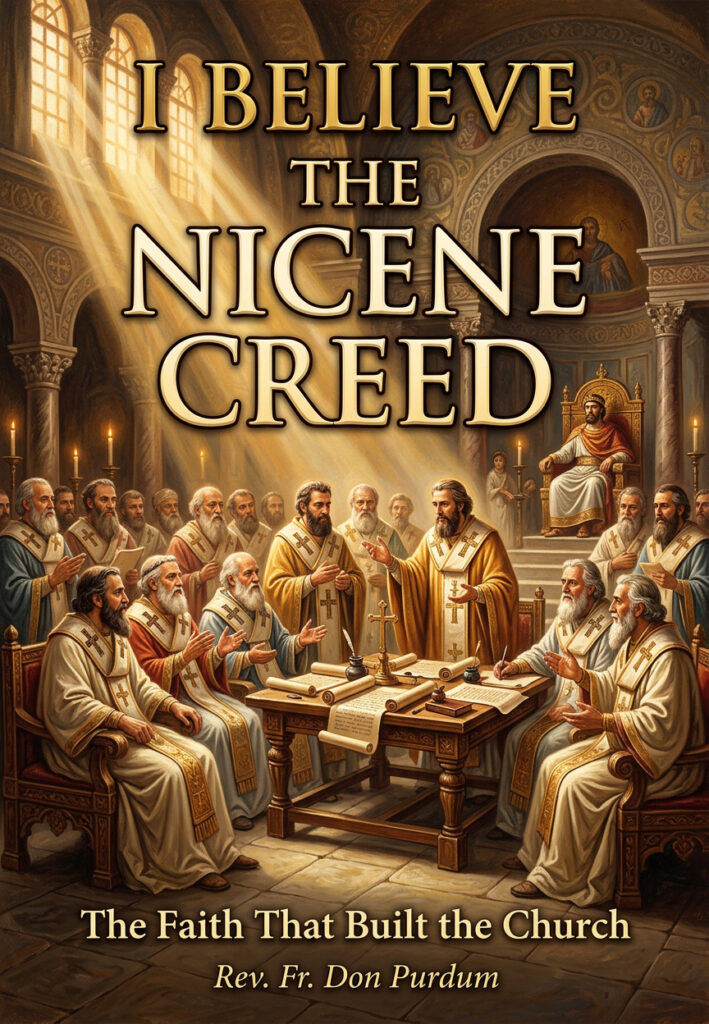
Would you like to learn the history and the deeper meaning of the Nicene Creed?
Nearly 2,000 years later, the Creed is still important. Yet, to disconnect it from it’s moment of time would be a tragedy.
In my eBook, I deep dive into the history, the controversies and heresies that drove the need for Bishops of that era to reaffirm the Apostle’s teachings on the humanity and deity of Christ, and why the past repeats itself in the modern era.
If you want to learn more, Click Here or on the bookcover below.
Want the entire article distilled into one clear, printable page?
Download your free summary and keep it with you.
Get the free PDF + join thousands receiving short, practical Orthodox insights in the “Morning Brew with Father Don” to help you grow in Christ each week.