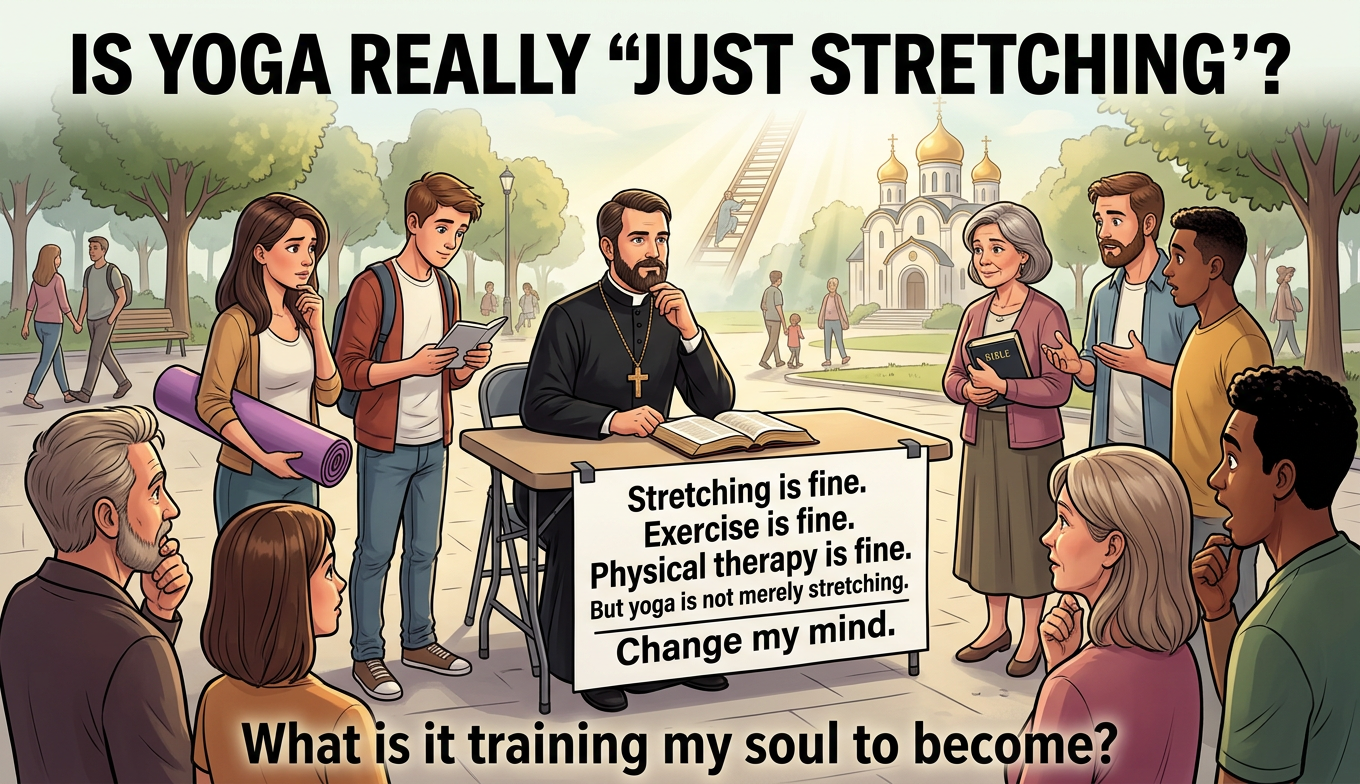
One of the most common responses I hear whenever the subject of yoga comes up is this:
“Father Don, what’s the big deal? It’s just stretching.”
At first glance, that sounds reasonable. After all, stretching is good for the body. Exercise is good for the body. Maintaining flexibility, mobility, and physical health is a wise form of stewardship. The Christian faith has never taught that the body is evil. In fact, Orthodox Christianity teaches precisely the opposite. The body is a gift from God. It is the temple of the Holy Spirit. We are called to care for it and honor it.
So if stretching is good, why would Christians have concerns about yoga?
The answer lies in understanding the difference between a physical action and the spiritual framework that gives that action meaning.
This is not ultimately a conversation about stretching.
It is a conversation about the soul.
It is a conversation about spiritual warfare.
And perhaps most importantly, it is a conversation about what enters the mind.
You can Now Listen to Each Article
The Modern Christian Blind Spot
One of the great weaknesses of modern Christianity is that many believers have unconsciously adopted a secular worldview.
We have been taught to separate the physical from the spiritual.
We tend to think that physical actions exist in one category and spiritual realities exist in another. We imagine that what we do with our bodies has little or no connection to what happens in our souls.
The ancient Christian world did not think this way.
The Apostles did not think this way.
The Apostolic, Patristic, and Desert Fathers did not think this way.
The Orthodox Church certainly does not think this way.
The Fathers understood that the visible and invisible worlds are deeply interconnected. What happens spiritually affects us physically, and what happens physically affects us spiritually. The battle for the human person is never merely external. It is always both visible and invisible.
This is why St. Paul reminds us that “we wrestle not against flesh and blood, but against principalities, against powers, against the rulers of the darkness of this age.”
The Christian life is lived in the midst of a spiritual war.
The problem is that many Christians acknowledge spiritual warfare in theory while failing to recognize how it actually operates.
Spiritual Warfare Rarely Begins with Open Rebellion
Most people imagine that Satan’s strategy is obvious.
They picture dramatic temptations.
They imagine direct invitations to reject Christ.
But that is rarely how spiritual deception works.
Satan is a deceiver.
A deceiver succeeds not by presenting evil as evil but by presenting evil as good.
He disguises darkness as light.
He disguises poison as medicine.
He disguises bondage as freedom.
And often he disguises spiritual deception as personal growth, wellness, enlightenment, healing, or self-improvement.
This is precisely why discernment is necessary.
The enemy’s most successful attacks are usually not the ones that appear dangerous.
They are the ones that appear harmless.
Understanding Logismoi
To understand why this matters, we must turn to one of the most important concepts in Orthodox spirituality: the logismoi.
St. John Climacus, along with many other Fathers of the Church, teaches that spiritual warfare begins in the realm of thoughts.
The Greek word logismoi refers to thoughts, suggestions, impressions, images, and mental proposals that present themselves to the mind.
Not every thought originates from us.
Some thoughts arise from memory.
Some arise from our passions.
Some arise from our environment.
Some are temptations introduced by demonic influence.
The Fathers describe a process by which a thought enters the mind, seeks our attention, gains our acceptance, and eventually shapes our behavior.
Every sin begins as a thought long before it becomes an action.
This is why Scripture commands us to take every thought captive to Christ.
The battlefield of salvation is often located between our ears.
The first question Christians should ask is not, “Is this physically harmful?”
The first question should be:
“What thoughts does this invite into my mind?”
“What worldview is this teaching me?”
“What understanding of God does this assume?”
“What spiritual reality am I opening myself to?”
Yoga Is Not Merely Exercise
Many Christians today encounter yoga in gyms, fitness centers, schools, physical therapy clinics, and online wellness programs.
Because of this, yoga often appears disconnected from its religious origins.
But historically speaking, yoga was never developed as an exercise system.
Its purpose was spiritual.
Its postures, breathing techniques, meditative practices, and disciplines were designed to prepare the practitioner for specific spiritual experiences rooted in Hindu religious philosophy.
At its core, yoga seeks union.
But union with what?
That question matters.
Christianity and Hinduism do not teach the same understanding of God.
They do not teach the same understanding of salvation.
They do not teach the same understanding of the human person.
They do not teach the same understanding of ultimate reality.
These differences are not minor.
They are foundational.
A Christian seeks union with the living God through Jesus Christ.
A Christian seeks purification through repentance.
A Christian seeks illumination through the Holy Spirit.
A Christian seeks theosis by grace.
The spiritual goals of classical yoga emerge from an entirely different theological system.
This is why Christians must exercise caution.
The issue is not flexibility.
The issue is formation.
Every spiritual practice forms us into something.
The question is whether that formation is directing us toward Christ or away from Him.
The Meaning Behind the Poses
At this point, someone might object and say:
“Father Don, they’re just body positions. How can a posture have spiritual significance?”
The answer is simple.
Human beings have always worshiped with their bodies.
The Scriptures are full of bodily acts connected to worship. We kneel. We bow. We prostrate ourselves. We lift our hands in prayer. We make the sign of the cross. We stand during the Divine Liturgy. We fast. We participate physically in worship because God created us as embodied beings. The body and soul are not separate realities but are intended to work together.
Because of this, bodily actions are never completely neutral. They communicate meaning. They shape the heart. They train the mind.
Traditional yoga recognizes this principle.
The various postures, known as asanas, were not originally developed as fitness exercises. They were developed as part of a larger spiritual system designed to prepare the practitioner for meditation, altered states of consciousness, and union with the divine as understood within Hindu philosophy.
Some poses imitate animals such as the cobra, cow, eagle, or lion. Others involve gestures of reverence, surrender, or meditation. The most well-known sequence, the Sun Salutation (Surya Namaskar), historically functioned as an act of reverence toward Surya, the Hindu sun deity. While many modern practitioners may not understand or intend this meaning, the historical roots remain significant.
The issue is not whether every individual who performs these movements is consciously worshiping a Hindu deity.
Most are not.
The issue is whether Christians should participate in practices originally designed to facilitate a spiritual worldview fundamentally different from the Gospel.
This brings us to a deeper concern.
Yoga as a Counterfeit of Christian Worship
One of Satan’s oldest strategies is not the creation of entirely new ideas.
It is the counterfeiting of true things.
Counterfeit money works because it resembles real money.
A counterfeit sacrament works because it resembles a real sacrament.
A counterfeit spirituality works because it resembles authentic communion with God.
Consider the parallels.
Christianity teaches stillness before God.
Yoga teaches stillness.
Christianity teaches disciplined breathing during prayer.
Yoga teaches disciplined breathing.
Christianity teaches bodily participation in worship.
Yoga teaches bodily participation.
Christianity teaches transformation of the inner person.
Yoga teaches transformation of the inner person.
At first glance, these similarities can make the two appear compatible.
Yet the destination determines everything.
Two roads may look nearly identical for miles before leading to entirely different places.
The Christian enters stillness to encounter the living God revealed in Jesus Christ.
The Christian prays not to empty the mind but to fill it with Christ.
The Christian seeks repentance, humility, obedience, and communion with God.
The Christian does not seek to awaken hidden divinity within himself but to receive divine life as a gift of grace.
By contrast, many forms of yoga seek enlightenment through self-realization, expanded consciousness, or the discovery of the divine within the self. These goals emerge from an entirely different understanding of God, humanity, sin, salvation, and ultimate reality.
This is where the concept of logismoi becomes critical.
The greatest danger may not be the pose itself.
The greatest danger is the thought that accompanies it.
The suggestion.
The subtle idea.
The gradual acceptance of a worldview that teaches salvation apart from Christ.
The Fathers repeatedly warn that deception enters the soul through seemingly harmless thoughts. A person does not wake up one morning and reject Christ. The process begins much earlier. It begins when ideas are entertained without discernment.
This is why Christians must ask more than whether a practice feels peaceful.
They must ask whether that peace is leading them deeper into Christ or quietly leading them somewhere else.
The battle is not merely over what the body is doing.
The battle is over what the heart is learning to worship.
The Subtle Danger of Spiritual Curiosity
One of the most dangerous assumptions in modern culture is the belief that all spiritual paths are essentially the same.
People often say:
“Take what is good and leave the rest.”
“All religions teach similar things.”
“It doesn’t matter where you find peace.”
But Christians must ask a deeper question.
What kind of peace?
Where does it come from?
What is its source?
The peace of Christ is not merely a feeling.
The peace of Christ is communion with God.
The peace of Christ emerges from repentance, humility, obedience, and participation in divine life.
Not every experience of calmness comes from God.
Not every spiritual experience originates with the Holy Spirit.
The Fathers repeatedly warn us that spiritual experiences themselves are not proof of truth.
Discernment remains essential.
What About Christian Yoga?
Some people attempt to solve the problem by creating what is often called “Christian yoga.”
The intention is understandable.
Many believers wish to separate the physical movements from the spiritual framework.
However, this still raises important questions.
If yoga’s original purpose was spiritual formation rooted in a non-Christian worldview, can that purpose truly be separated from the practice itself?
Reasonable Christians may disagree on where precisely that line is drawn.
But every Christian should agree on one point:
We must carefully examine any practice that has historically functioned as a spiritual discipline.
The Christian life calls us not merely to ask what is permissible.
It calls us to ask what is profitable for the soul.
The Orthodox Alternative
The Orthodox Church has never lacked methods for cultivating peace, stillness, healing, and communion with God.
We have prayer.
We have fasting.
We have silence.
We have prostrations.
We have ascetical disciplines.
We have the Jesus Prayer.
We have participation in the sacramental life of the Church.
We have centuries of spiritual wisdom handed down by saints who devoted their entire lives to union with Christ.
The Christian does not need to borrow spiritual techniques from outside the Faith in order to find God.
The treasures of the Church are already infinitely rich.
Final Thoughts
Let me be absolutely clear.
Stretching is not sinful.
Exercise is not sinful.
Physical therapy is not sinful.
Taking care of your body is wise and necessary.
But yoga is not merely stretching.
The deeper issue is not what happens to the muscles.
The deeper issue is what happens to the mind.
What enters the mind shapes the heart.
What shapes the heart shapes the soul.
And what shapes the soul shapes eternity.
The Fathers understood this.
St. John Climacus understood this.
The saints understood this.
Spiritual warfare rarely begins with dramatic rebellion.
It begins with seemingly harmless thoughts.
It begins with subtle suggestions.
It begins with ideas that slowly redirect our hearts.
This is why vigilance is essential.
This is why discernment matters.
This is why Christians must guard the mind.
Because every thought must be examined.
Every practice must be tested.
Every spirit must be discerned.
And every aspect of life must ultimately be brought under the Lordship of Jesus Christ.
The modern world asks, “What is wrong with it?”
The Fathers ask a different question:
“What is it training my soul to become?”
That is the question every Christian must ask when evaluating any spiritual practice, whether yoga, meditation, mindfulness, entertainment, social media, or even our daily habits. The issue is never merely whether something appears harmless. The issue is whether it is drawing us deeper into communion with Christ or subtly shaping our hearts according to another vision of reality.
The battle has always been the same.
The battle is for the mind.
The battle is for the heart.
The battle is for worship.
Want the entire article distilled into one clear, printable page?
Download your free summary and keep it with you.
Get the free PDF + join thousands of people receiving short, practical Orthodox insights in the “Morning Brew with Father Don” to help you grow in Christ each week.