There is a quiet revolution happening right now, and most churches are not prepared for it.
Earlier this week I read reports that Gen Z is increasingly turning to artificial intelligence not merely for information, but for emotional guidance, spiritual conversation, and even moral direction.
Young people are asking ChatGPT questions they once asked pastors. They are seeking counsel from algorithms instead of shepherds. They are not alone. Millions of Americans in all age brackets are doing the same.
And frankly, this should not surprise us.
The modern American religious landscape helped create the conditions for this moment.
For decades much of Protestant Christianity in America has gradually reduced the Christian faith to information transfer, motivational speaking, emotional experience, and symbolic interpretation. Christianity became, in many places, a system of ideas rather than participation in divine life. Sermons became TED Talks with Bible verses. Worship became emotional stimulation. Church became content consumption.
And AI is extraordinarily good at content consumption.
That is the danger.
You can Now Listen to Each Article
When Christianity Becomes Content
Artificial intelligence can already produce sermons, summarize theology, generate Bible studies, answer doctrinal questions, imitate pastoral language, and provide personalized encouragement twenty-four hours a day. It never gets tired. It never needs sleep. It can process the writings of thousands of theologians in seconds. In a world where Christianity has been reduced to “getting information about God,” AI may very well outperform many pastors.
But here is the critical distinction:
Christianity was never meant to be merely about information.
It was meant to be about union.
That is where ancient Christianity stands apart from the modern religious experiment.
The Orthodox Church cannot be replaced by artificial intelligence because the Church is not fundamentally an information system.
The Church is a sacramental reality.
It is the living Body of Christ.
It is participation in the life of God Himself.
An algorithm cannot consecrate the Eucharist.
A chatbot cannot hear confession.
A machine cannot lay hands on the sick.
A digital avatar cannot baptize.
An AI cannot transmit apostolic succession.
And perhaps most importantly, artificial intelligence cannot suffer with you in the mystery of human existence.
The Difference Between Information and Communion
Modern society increasingly believes that knowledge alone transforms people. But Christianity has never taught that.
The demons possess theological knowledge.
Satan himself knows scripture.
Information alone does not heal the human heart.
The crisis of modern man is not ignorance. It is disintegration.
This is why so many people today know endless facts about Christianity yet remain spiritually hollow. We are over-informed and under-formed. We have access to infinite content yet very little communion. We are drowning in data while starving for transcendence.
The early Christians understood something we have forgotten.
The faith was called “The Way” before it was ever called a religion. Christianity was not merely agreement with doctrines; it was participation in a transformed mode of existence. As I have often said in my teachings, theology is not merely speaking about God. True theology emerges from knowing God intimately through revelation and communion.
That distinction matters enormously in the age of AI.
Artificial intelligence can speak about God.
It cannot know Him.
It cannot repent.
It cannot pray.
It cannot partake of grace.
It cannot enter into communion with the Holy Trinity.
Why Ancient Christianity Cannot Be Automated
The modern world often assumes that if something can simulate humanity, it can replace humanity. But Orthodoxy understands that human beings are not reducible to cognition.
We are sacramental beings.
We are body and soul together.
We are liturgical creatures formed by worship, fasting, repentance, communion, suffering, beauty, and participation in the life of Christ.
This is one reason why modern secular culture increasingly struggles to understand ancient Christianity.
The modern world operates almost entirely through abstraction.
Orthodoxy operates through incarnation.
The Christian faith is not merely symbolic.
It is ontological.
This is where many modern churches unintentionally made themselves vulnerable. Once the faith becomes primarily symbolic or intellectual, it becomes digitizable. Once worship becomes a performance, it can be streamed endlessly. Once the sermon becomes the center of Christianity, the sermon can be automated.
But sacramental Christianity resists automation because sacraments are not symbols alone. They are encounters with divine reality.
The Eucharist is not merely a reminder.
Confession is not merely therapeutic conversation.
Baptism is not merely public symbolism.
Marriage is not merely contractual affirmation.
The Church is not merely a gathering.
These are mysteries through which God acts.
And mysteries cannot be replicated by algorithms.
AI May Expose the Weaknesses of Modern Christianity
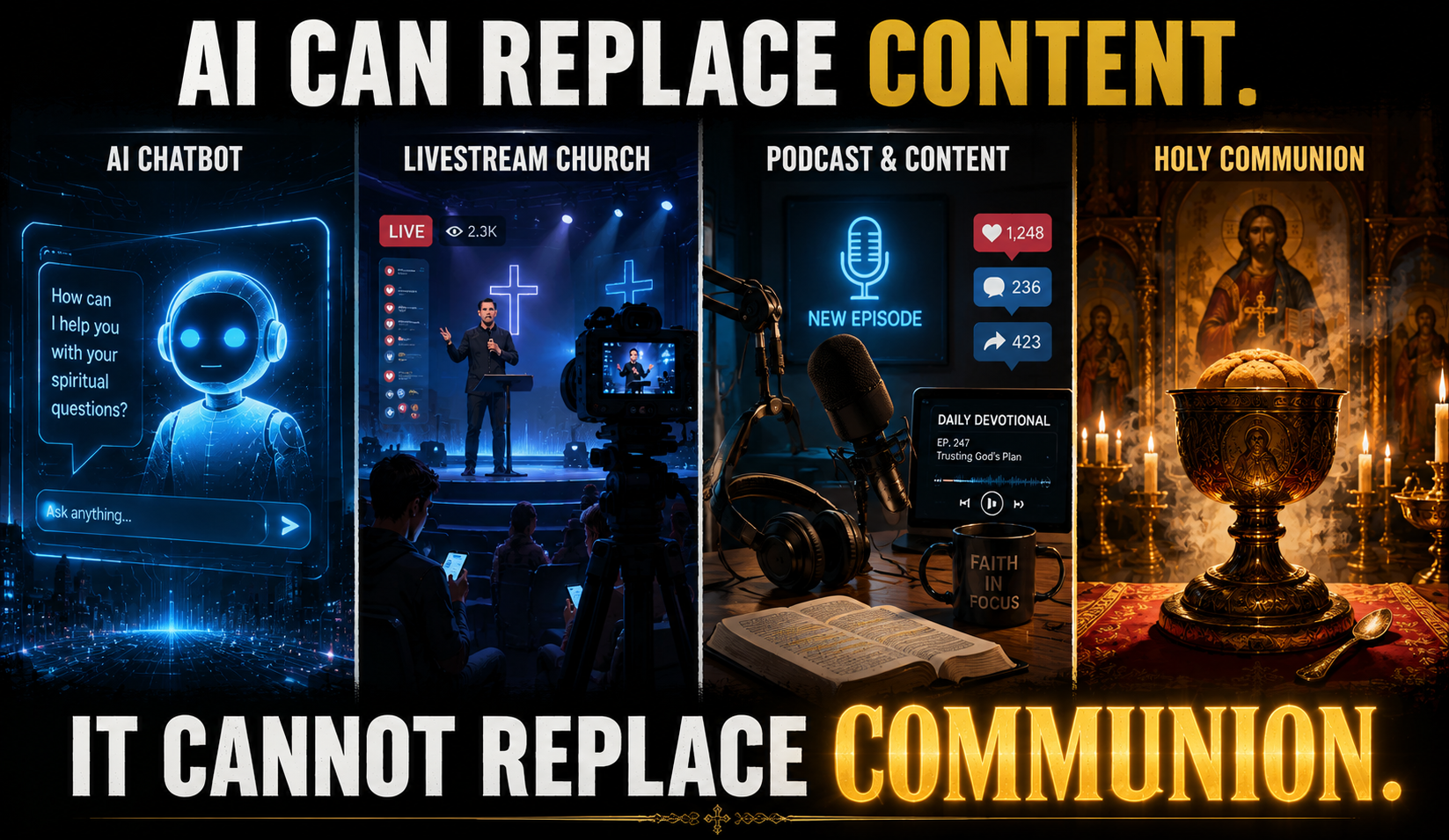
In many ways, AI may expose the weaknesses of modern Christianity. It may force churches to confront an uncomfortable question: if your church experience can be fully replaced by a sophisticated chatbot and a livestream, what exactly was the Church offering in the first place?
That is not an attack. It is a serious theological question.
Because the ancient Church never understood herself primarily as a distributor of religious information. She understood herself as an ark of salvation, a hospital for the soul, the very presence of Christ continuing in history.
This is why the Orthodox understanding of spiritual formation matters so deeply right now.
The modern world trains people to live almost entirely in the intellect. But the Fathers understood that transformation happens through ascetic struggle, sacramental participation, prayer, repentance, and purification of the heart. Christianity is not merely about thinking correctly; it is about becoming whole. As I have taught before, the issue is not simply theology that speaks about God, but the experience of God Himself.
Why Gen Z May Be Searching for Something Ancient
And this brings us to Gen Z specifically.
Many young people today are exhausted by institutional hypocrisy, shallow answers, performative religion, political idolatry, and emotional manipulation masquerading as spirituality. They are suspicious of systems that feel artificial because they have grown up in a world saturated with artificiality.
Ironically, this may actually create an opening for Orthodoxy.
Because Orthodoxy does not attempt to reinvent itself every five years to remain culturally relevant. It does not market itself through trends. It does not reduce worship to entertainment. It offers something the digital age cannot manufacture: rootedness, transcendence, mystery, continuity, beauty, and participation in something eternal.
Gen Z is spiritually starving for authenticity.
Not authenticity as modern culture defines it — self-expression without limits — but authenticity grounded in reality itself.
And reality is ultimately found in Christ.
The More Artificial the World Becomes, the More Humanity Will Crave Incarnation
The irony is profound: the more artificial the world becomes, the more compelling ancient Christianity may appear.
As virtual reality expands, people will hunger for incarnation.
As AI generates infinite words, people will hunger for silence.
As algorithms simulate relationships, people will hunger for communion.
As digital life fragments the self, people will hunger for wholeness.
And the Church — the true Church — still offers these things because she offers Christ Himself.
The Future of Christianity Will Not Be Digital
This is why I do not ultimately fear AI.
I fear a Christianity that has forgotten what the Church actually is.
If Christianity becomes nothing more than inspirational content, moral commentary, symbolic ritual, or emotional affirmation, then yes, artificial intelligence may eventually outperform many churches.
But if Christianity remains what it has always been — participation in the death and resurrection of Jesus Christ through the sacramental life of the Church — then no machine will ever replace it.
Because Christ did not establish an algorithm.
He established a Body.
And bodies cannot be digitized.
Grace and Peace,
Father Don
Want the entire article distilled into one clear, printable page?
Download your free summary and keep it with you.
Get the free PDF + join thousands receiving short, practical Orthodox insights in the “Morning Brew with Father Don” to help you grow in Christ each week.