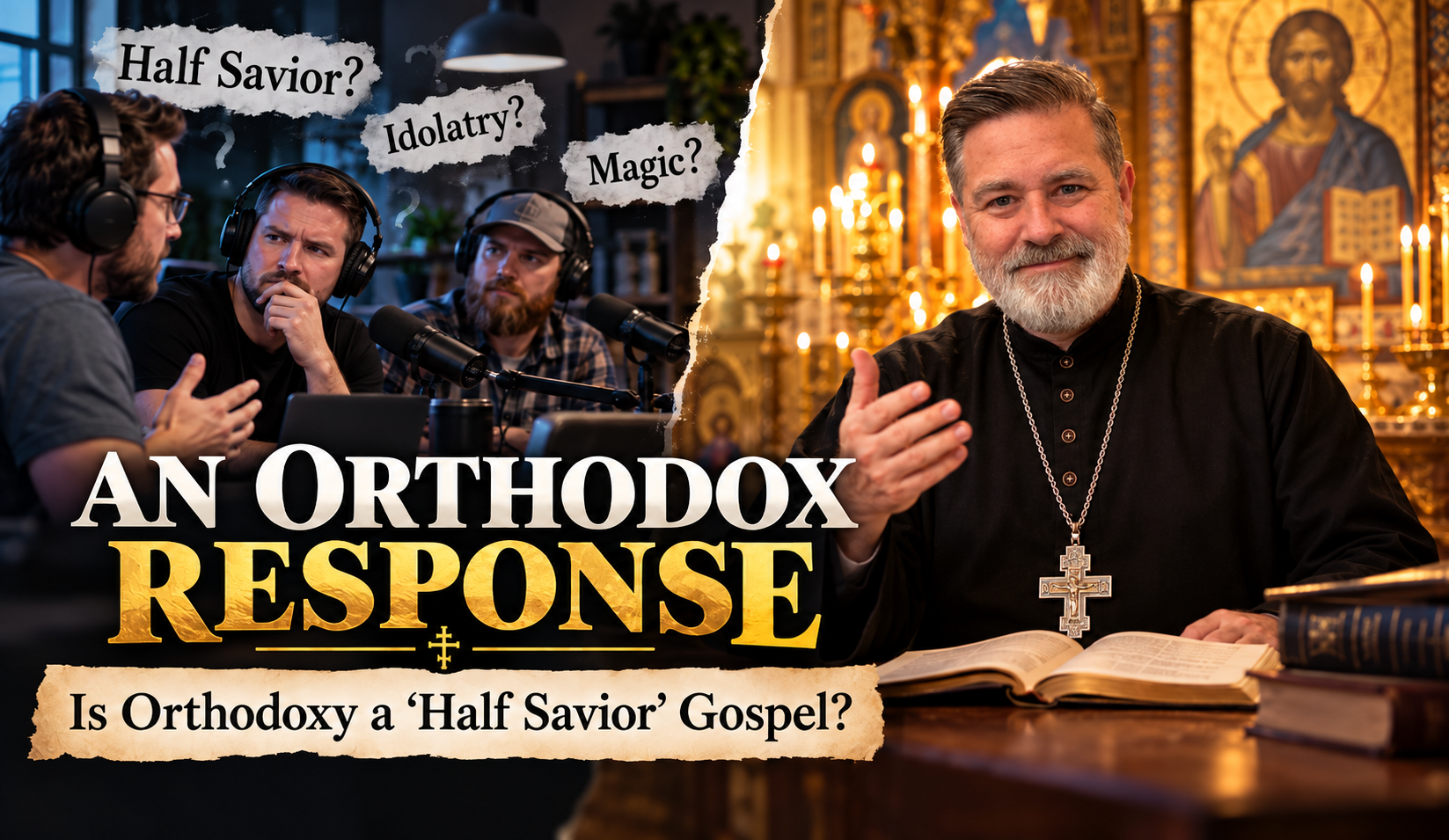

This is one of those questions that continues to surface, especially in online discussions, and for good reason. It touches something deeply human. What happens to us after death is not merely a theological curiosity. It is a question that presses into how we live, how we repent, and how we understand our relationship with God.
But before we try to answer it, we need to establish something foundational.
In the Orthodox Christian worldview, theology is not merely about explaining God. It is about knowing Him. It is about participation. It is about union.
And that reality changes how we approach the question of the afterlife.
The Problem with Framing the Question
When people ask about purgatory, tollhouses, or a step-by-step afterlife process, they are often asking for a system.
They want clarity. They want certainty. They want something that can be diagrammed and explained in a clean, linear way.
But Orthodoxy resists that impulse.
Not because the Church has nothing to say. Quite the opposite. It has a great deal to say. But it refuses to reduce the mystery of salvation and judgment into a mechanical process.
We have inherited a modern mindset that wants formulas. The ancient Christian mind did not think this way.
And so if we approach the afterlife like a system to be decoded, we are already starting in the wrong place.
What About Purgatory?
Orthodox Christianity does not teach purgatory in the way it is defined in Roman Catholic theology.
Before I go any further, I have had Catholics argue with me on Facebook that Purgatory is not a place of punishment. Yet, that is not true according to the doctrine of the Roman Catholic Church.
According to Catholic Answers,
“Purgatory (Lat., purgare, to make clean, to purify) in accordance with Catholic teaching is a place or condition of temporal punishment for those who, departing this life in God‘s grace, are not entirely free from venial faults, or have not fully paid the satisfaction due to their transgressions.”
In Orthodox theology, there is no formal doctrine of a created “place” where souls go to be purified through temporal punishment in order to satisfy divine justice.
Why?
Because salvation in Orthodoxy is not framed primarily in legal terms. It is not about balancing a ledger.
It is about healing.
It is about transformation.
It is about becoming united to Christ.
So while the Orthodox Church does affirm that the soul continues to grow, experience, and encounter God after death, it does not define that experience in the juridical categories that purgatory depends on.
Instead, it speaks in the language of mystery.
The Reality of the Particular Judgment
Orthodoxy does affirm that there is a judgment after death.
This is often referred to as the “particular judgment,” where the soul encounters the reality of God and begins to experience either the joy or the anguish of that encounter.
But here is the key distinction.
Heaven and hell are not seen as separate “places” in the way we often imagine them.
They are experiences of the same God.
The same divine presence.
For the one who loves God, that presence is light, peace, and joy.
For the one who rejects God, that same presence is experienced as torment.
This is why the Orthodox tradition emphasizes that the afterlife is not about God changing toward us.
It is about whether we have been transformed enough to receive Him.
What About the Tollhouses?
Now we come to the most controversial aspect of this discussion.
The idea of aerial tollhouses.
Some in the Orthodox tradition, particularly in certain patristic writings and later spiritual texts, describe the soul passing through stages after death where it is tested or accused by demonic forces.
These are often referred to as “tollhouses.”
But here is where careful discernment is required.
Tollhouses are not defined dogma of the Orthodox Church.
They are part of the broader spiritual and ascetical tradition.
They are images. They are descriptions meant to convey a deeper truth about spiritual reality.
And what is that truth?
- That our lives matter.
- That our choices matter.
- That the spiritual warfare we engage in now does not suddenly disappear at death.
Whether one interprets tollhouses literally or symbolically, the core message is the same.
We will face the truth of our lives.
There will be no illusions.
There will be no hiding.
The Deeper Reality Behind All Three Questions
When we step back and look at purgatory, tollhouses, and afterlife processes, we begin to see something important.
These are all attempts to answer the same underlying question.
What happens to the soul when it encounters God?
Orthodoxy answers that question not with a system, but with a relationship.
You are not entering a process.
You are encountering a Person.
And that encounter will reveal everything.
This is why the Church emphasizes repentance now.
This is why it emphasizes purification of the heart.
This is why it speaks of life in Christ as a path.
Because the afterlife is not disconnected from this life.
It is the continuation and unveiling of it.
Why This Matters for Us Today
We live in a culture that wants certainty about the future without transformation in the present.
We want to know what happens after death, but we are often less interested in what is happening in our souls right now.
And that is the real danger.
Because the Orthodox perspective shifts the focus away from speculation and toward preparation.
The question is not:
What is the exact sequence of events after I die?
The question is:
Am I becoming the kind of person who can stand in the presence of God?
Final Thoughts
So do Orthodox Christians believe in purgatory?
No, not in the formal, doctrinal sense.
Do they believe in tollhouses?
Some accept them as part of the tradition, others interpret them more symbolically, but they are not dogmatically defined.
Is there a specific afterlife process?
There is an encounter. There is a judgment. There is a continuation of the soul’s experience in relation to God.
But it is not a mechanical system.
It is a revelation of truth.
And ultimately, it is a question of love.
Because at the end of the day, the afterlife is not about passing through stages.
It is about whether we have become capable of communion with the living God.
And that is being determined right now.
Grace and Peace,
Father Don