There is a fundamental misunderstanding in modern Christianity that needs to be addressed with clarity and precision. Many Protestants sincerely believe that the priesthood was abolished and replaced with what is often called the “priesthood of all believers.” Flowing out of that assumption is the elevation of the “pastor” as the primary leader of the Church.
The problem is that this framework does not arise from the historical Church, nor does it reflect the structure we see in the New Testament. What we are dealing with is not simply a difference in terminology, but a completely different understanding of what the Church is, how grace is mediated, and how Christ continues His ministry in the world.
If we are going to approach this honestly, we have to do so from three angles. Scripture, history, and the lived reality of the early Church.
You can Now Listen to Each Article
The Biblical Continuity of Priesthood
One of the first things we have to correct is the idea that priesthood somehow disappears in the New Testament. That is simply not what the Scriptures teach.
Christ is revealed as the Great High Priest in the book of Hebrews. He does not abolish priesthood. He fulfills it. And if He is the High Priest, then the question becomes very simple. How does His priesthood continue in His Body, which is the Church?
The Apostles did not create a loose, undefined community. They established order. They established structure. And that structure is very clear in the New Testament.
We see three offices:
- Bishop, the overseer
- Presbyter, what we would call priest
- Deacon, the servant
This is not speculation. This is the pattern laid down in the apostolic writings themselves. When St. James tells the faithful to call for the elders of the Church to pray over the sick, we are not looking at a casual group of older men. We are looking at those who have been set apart for a specific ministry.
The priesthood was not removed. It was transformed and fulfilled in Christ and continued through His Church.
Presbyter as Priest: Linguistic and Historical Reality
Now we have to deal with language, because this is where much of the confusion begins.
The Greek word used in the New Testament is presbyteros. Over time, that word developed linguistically into what we now call “priest.” That is not a theological invention. That is how language works across centuries.
But something happened during the Reformation that needs to be understood.
Protestant translators made a deliberate choice to render presbyteros as “elder” instead of “priest.” That decision was not neutral. It was theological. It was meant to move away from the idea of a sacramental priesthood.
Now let me be clear. At a basic level, presbyteros can mean elder. That is true. But the question is not whether the word can be translated that way. The question is whether that translation captures the reality of what that office actually was in the life of the Church.
Because when you look at the early Church, the presbyters were not simply older men offering advice.
They were:
- Celebrating the Eucharist
- Administering the sacraments
- Acting under the authority of the bishop
And we are not left guessing about this. The early Church Fathers speak directly and powerfully to it.
One of the most important witnesses is St. John Chrysostom, who wrote an entire treatise titled On the Priesthood sometime between 381–391 AD. This work is not theoretical. It is pastoral, theological, and deeply experiential.
In that treatise, Chrysostom makes several critical points. He emphasizes the immense spiritual weight and responsibility of the priesthood. The priest stands before God on behalf of the people and before the people on behalf of God. He describes the priest as one who handles divine mysteries, especially the Eucharist, something he treats with profound reverence and even fear. He warns that the priest will be held to a stricter judgment, because he is entrusted with the care of souls. He highlights that the priest’s work is not merely external or administrative. It is deeply spiritual, sacramental, and transformative, involving the healing and guiding of the human soul.
Chrysostom even admits that he initially fled ordination because he understood how serious and demanding the priesthood truly is. That alone tells us something. In the early Church, this was not viewed as a functional leadership role. It was a sacred calling that required purification, humility, and accountability before God.
Why is this important?
Because it shows us that from the earliest centuries, the Church did not view presbyters as mere elders in the modern sense. They were understood as priests in the fullest sense of the word. Men entrusted with the mysteries of God and the care of His people.
So when modern translations reduce presbyteros to “elder,” we have to recognize what is being lost. Not just a word, but an entire theological and sacramental reality.
And this is where we have to be honest. Translation is never neutral. It always carries interpretation with it.
Pastor: Office or Gift?
Now let’s talk about the word “pastor,” because this is where much of modern confusion is centered.
The term “pastor” simply means shepherd. It is used in Scripture, particularly in Ephesians 4, where Paul speaks about apostles, prophets, evangelists, pastors, and teachers.
But here is the key point.
This is not a list of offices. It is a list of gifts.
There is no place in the New Testament where someone is ordained into the office of “pastor” as a distinct rank within the Church. You will not find instructions for appointing pastors in the same way you find instructions for appointing bishops and deacons.
Pastoral care is something that bishops and priests do. It is part of their function. It is not a separate office.
So what has happened in much of Protestantism is that a spiritual gift has been elevated into an office that the New Testament itself does not define.
The Priesthood of All Believers: What It Means and What It Does Not
Now we need to address what is often the central argument. The priesthood of all believers.
Orthodoxy does not reject this. In fact, we affirm it fully. Scripture clearly teaches that we are a royal priesthood.
But the meaning of that phrase has to be understood correctly.
What it means is that every baptized believer participates in the life of Christ. Every believer offers spiritual sacrifices. Prayer, repentance, worship, self-offering. This is the life of the Christian.
But what it does not mean is that there is no distinction within the Church.
Even in the Old Testament, Israel is called a kingdom of priests. Yet within Israel, there is still a distinct priesthood. Those two realities coexist.
The same is true in the Church.
There is a universal priesthood of all believers. And there is a ministerial priesthood that is set apart to serve the Church sacramentally.
Those are not in conflict. They are complementary.
Sacramental Reality vs. Functional Ministry
At the heart of this issue is a much deeper divide.
Is the Church sacramental, or is it primarily functional?
In the Orthodox understanding, the priest is not simply a teacher or a leader. He is participating in the life of Christ in a very real and tangible way, especially in the Eucharist.
This is where modern thinking has to be challenged.
We live in a world that wants to separate the spiritual from the physical. We want to reduce everything to function, to logic, to structure. But that is not how the ancient Church understood reality.
As has been said before, we cannot separate the physical from the spiritual. They work together. They coexist.
And if that is true, then the priesthood makes sense. Because grace is not abstract. It is lived. It is embodied. It is encountered.
When you remove the sacramental reality, what you are left with is a functional leader. That is where the modern concept of the pastor fits. But that is not the fullness of what the Church has always been.
Historical Consensus of the Early Church
Finally, we have to deal with history.
For the first 1,500 years of Christianity, the Church operated with a clear and consistent structure. Bishop, priest, and deacon. This was not debated. It was not controversial. It was simply the life of the Church.
The Eucharist was understood as sacrificial. The priesthood was understood as real. Apostolic succession was preserved.
The idea that the priesthood was abolished does not appear until the 16th century.
So we have to ask a very serious question.
Did the entire Church misunderstand itself for 1,500 years, or did something shift much later?
Because once you begin to see that, you realize this is not just a theological disagreement. It is a question of continuity.
Conclusion
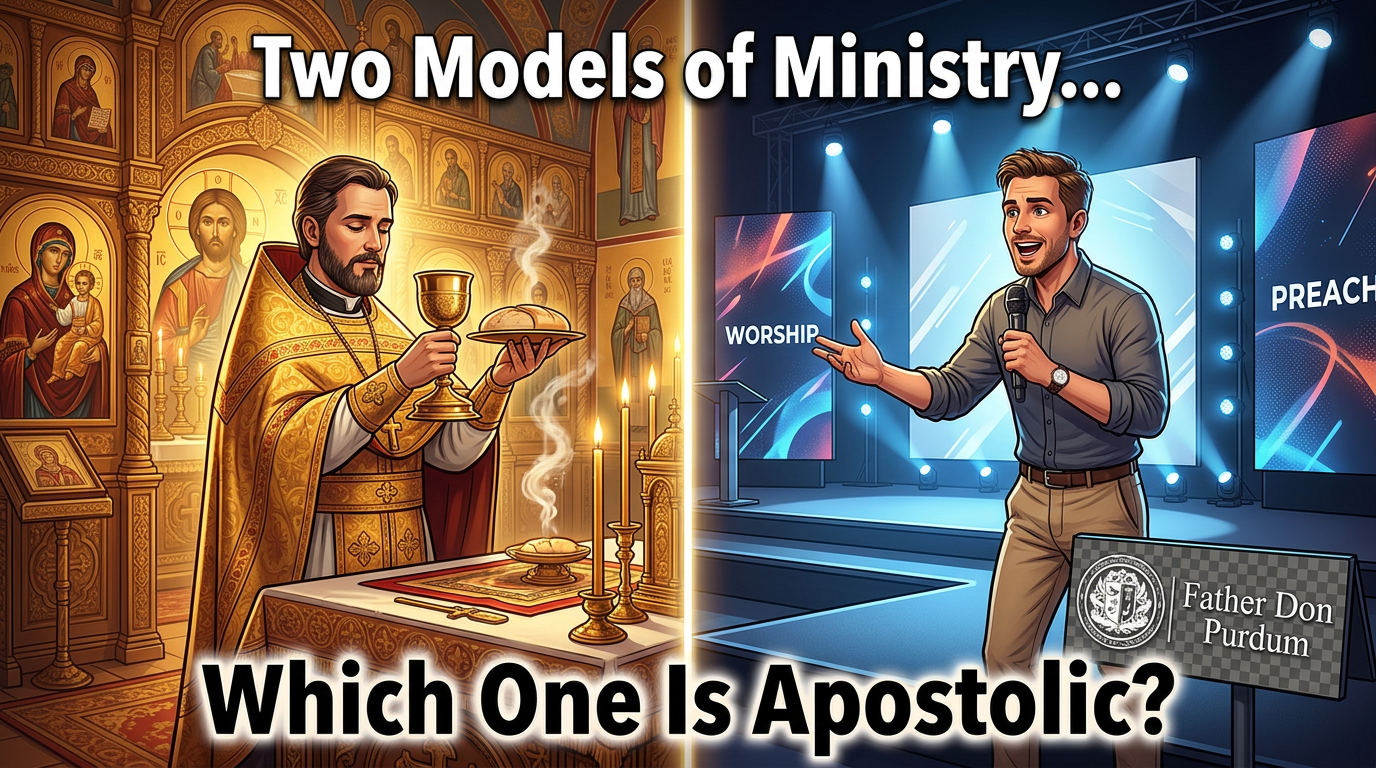
When we step back and look at the full picture, the contrast becomes very clear.
The Orthodox Church maintains what has been handed down from the Apostles. A sacramental priesthood. A structured Church. A lived experience of grace that is both spiritual and physical.
The Protestant model, in many cases, redefines ministry in functional terms. It elevates the concept of the pastor while redefining or dismissing the priesthood.
And underlying much of that shift are interpretive decisions, including how Scripture itself has been translated and understood.
So the real question is not whether believers share in Christ’s priesthood. They do.
The real question is whether Christ established a visible, sacramental priesthood to serve His Church.
From the Orthodox perspective, the answer is yes. And it has never ceased.