“Oh Lord of hosts, be with us. For we are none other help in times of trouble… have mercy on us.”
This ancient prayer frames not only the spiritual posture of the Orthodox Christian tradition, but also its historical memory, especially when reflecting on one of the most misunderstood episodes in Christian history: the Crusades.
For many in the modern West, the Crusades are often remembered as heroic campaigns, noble pilgrimages undertaken to reclaim the Holy Land from Muslim control. This narrative, shaped largely by Latin Christian sources, emphasizes courage, sacrifice, and religious zeal. Yet from the Orthodox Christian perspective, the Crusades tell a profoundly different story, one not of triumph, but of misalignment, tension, and ultimately, betrayal.
A Different Starting Point: Constantinople, Not Rome
To understand the Orthodox view of the Crusades, one must begin not in Jerusalem, nor in Western Europe, but in Constantinople, the heart of the Byzantine, or Eastern Roman, Empire.
The story begins in the late 11th century with one of the most devastating defeats in Byzantine history: the Battle of Manzikert. In this catastrophic loss, Byzantine forces were overwhelmed by the Seljuk Turks, resulting in the loss of vast territories in Anatolia, modern day Turkey.
This defeat was not merely military. It triggered a political and existential crisis. The empire’s eastern frontier collapsed, leaving its interior vulnerable to further incursions. What followed was instability, fragmentation, and a desperate need for military assistance.
The Rise of Alexios I and the Appeal to the West
Into this chaos rose Emperor Alexios I Komnenos, a capable and strategic leader who sought to stabilize the empire. Recognizing the severity of the situation, Alexios turned to the West for help, not for conquest, but for mercenary support.
This distinction is critical.
Alexios did not envision a massive religious war. Rather, he sought disciplined military aid to help reclaim lost territories. However, the response from the West would far exceed, and ultimately distort, his request.
The Problem of the Normans: A Foreshadowing
Even before the First Crusade, the Byzantines had already experienced the dangers of relying on Western forces.
Norman mercenaries, initially hired to assist the empire, began carving out their own territories instead of serving Byzantine interests.
This pattern, Western forces pursuing their own agendas under the guise of alliance, would become a defining feature of the Crusades from the Orthodox perspective.
A Fundamental Misalignment
When Pope Urban II called for the First Crusade in 1095, the movement took on a life of its own. What the Byzantines saw as a request for limited military aid became, in the West, a sweeping spiritual and political campaign.
This marked a fundamental misalignment:
- Byzantine intent was strategic military assistance to restore imperial territory
- Western interpretation was a divinely sanctioned mission to reclaim the Holy Land
These differing motivations created tension from the outset. The Byzantines expected cooperation and coordination. The Crusaders often acted independently, driven by their own theological, political, and economic ambitions.
From Cooperation to Betrayal
While early interactions between the Byzantines and Crusaders were complex and sometimes cooperative, the relationship steadily deteriorated. Suspicion grew on both sides:
- The Byzantines viewed the Crusaders as unpredictable and self serving
- The Crusaders often saw the Byzantines as untrustworthy or insufficiently zealous
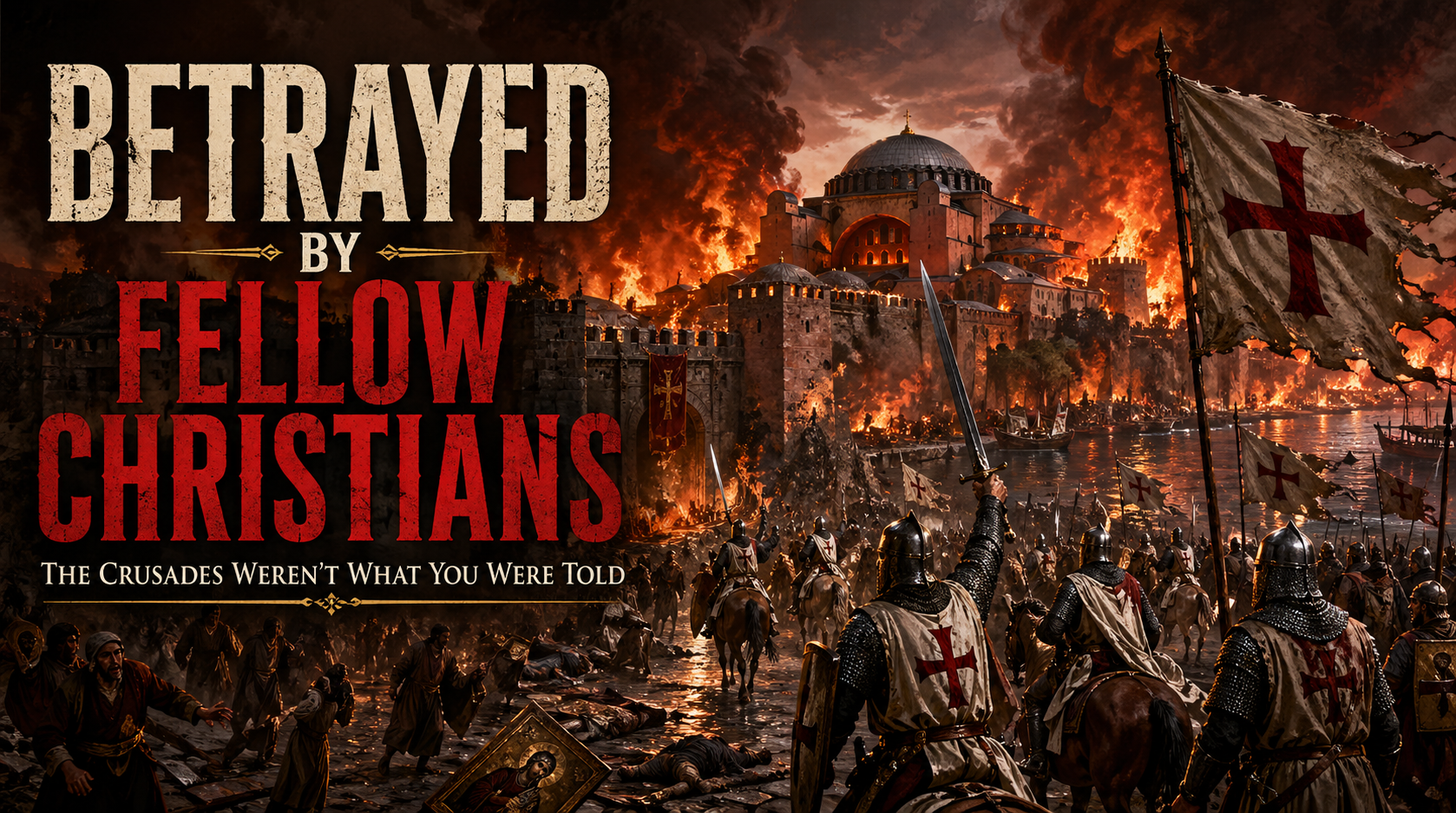
This mutual distrust reached its tragic climax in the Fourth Crusade in 1204, when Crusader forces, originally bound for Jerusalem, sacked Constantinople itself.
For the Orthodox world, this event was not merely a political catastrophe. It was a profound spiritual wound, an act of betrayal by fellow Christians.
Theological and Cultural Implications
From an Orthodox perspective, the Crusades reveal deeper theological and cultural divergences between East and West:
1. Different Understandings of Power and Holiness
The Western model increasingly fused military conquest with spiritual legitimacy. In contrast, the Orthodox tradition maintained a more cautious view of violence, emphasizing asceticism, repentance, and the mystery of God.
2. The Danger of Spiritualizing Political Ambition
What began as a call to aid fellow Christians became, in many cases, a vehicle for territorial expansion and personal gain. The Orthodox critique highlights the danger of conflating divine will with human ambition.
3. The Fracturing of Christian Unity
Rather than uniting Christendom, the Crusades deepened the divide between Eastern and Western Christianity, a division that had already been formalized in the Great Schism of 1054.
Reframing the Narrative
The Orthodox perspective does not deny the complexity of the historical context, nor does it ignore the challenges posed by Islamic expansion. However, it insists on a more nuanced and critical evaluation of the Crusades, one that acknowledges both the intentions and the consequences.
Rather than a story of heroic liberation, the Crusades become a cautionary tale about:
- Miscommunication between cultures
- The misuse of religious authority
- The consequences of disunity within the Church
Conclusion: Memory, Repentance, and Understanding
History is not merely a record of events. It is a lens through which we understand ourselves and our faith. The Orthodox remembrance of the Crusades calls for humility, discernment, and a willingness to confront uncomfortable truths.
In a world still marked by religious and cultural conflict, this perspective offers a vital lesson: that alignment with God’s will requires more than zeal. It requires wisdom, unity, and a deep commitment to truth.
And perhaps, above all, it calls us back to prayer:
“Oh Lord of hosts, be with us… for we are none other help.”