There is a crisis quietly unfolding inside modern Christianity.
On one side, there are believers who have become consumed with activism, politics, outrage, cultural battles, and “changing the world,” yet inwardly they are spiritually exhausted, anxious, angry, prayerless, and disconnected from Christ.
On the other side, there are Christians who have retreated so deeply inward that faith has become almost entirely private. Salvation becomes reduced to “me and Jesus,” while the suffering world burns around them.
And somewhere in the middle of this tension, many sincere believers are asking a very honest question:
“If Christ and the Apostles were sent out healing people, preaching publicly, casting out demons, and building the Kingdom of God, then why are Christians often told to just focus on their own salvation? I see Jesus and the Apostles actively praying for people and healing many. On Ascension and the Great Commission especially, it seems clear that every believer has some role in building the Kingdom. So what is the appropriate Orthodox understanding of this?”
That is an extraordinarily important question.
Because how we answer it shapes the entire way we understand the Christian life.
And I think many modern Christians misunderstand both sides of this equation.
You can Now Listen to Each Article
Christ Did Not Call the Apostles Into Isolation
When you read the Gospels honestly, Jesus is constantly moving toward human suffering.
He touches lepers.
He heals the blind.
He raises the dead.
He casts out demons.
He feeds the hungry.
He confronts corruption.
He enters into the pain of humanity.
And then He turns to His disciples and says:
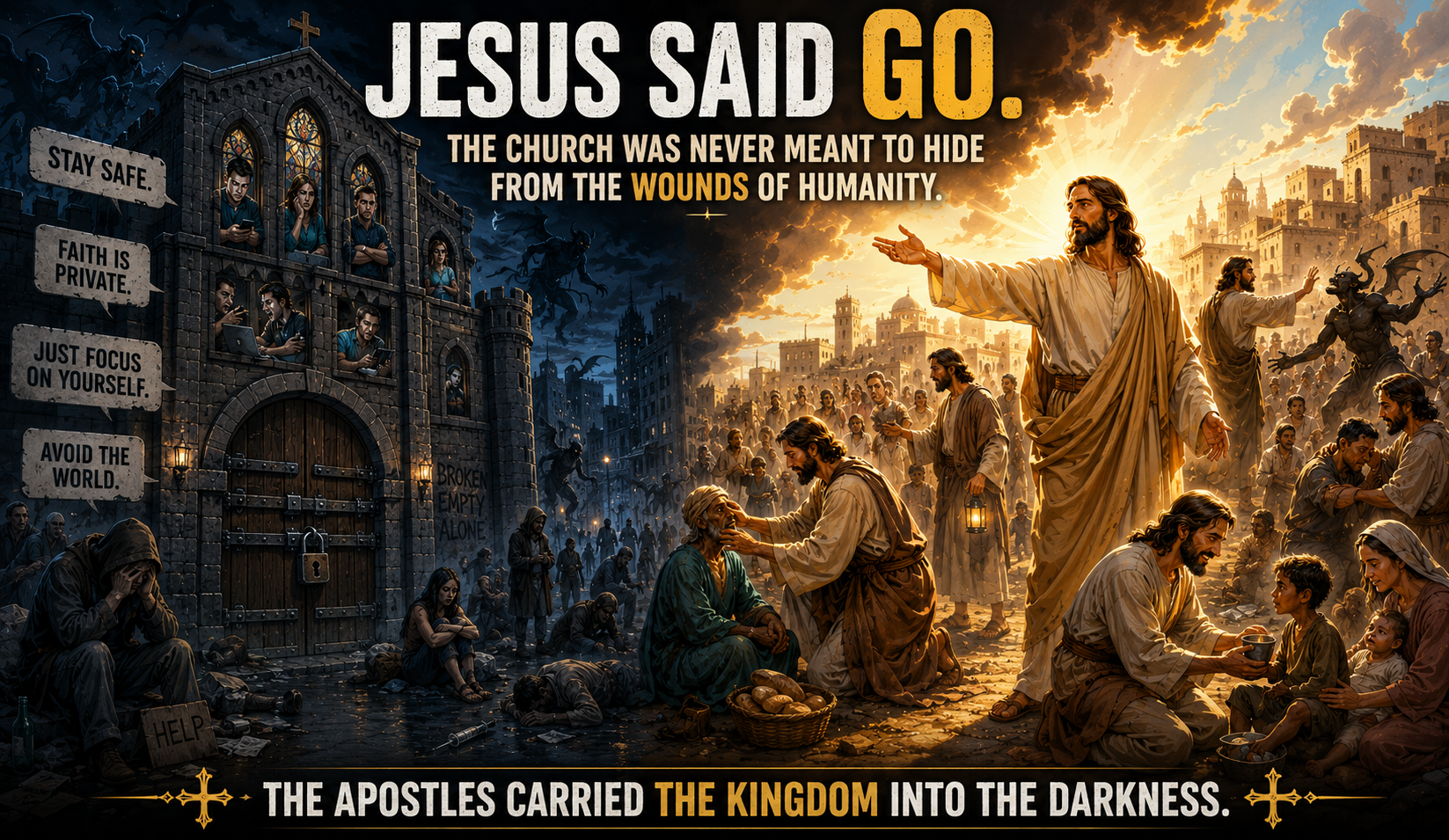
“Go.”
Not “hide.”
Not “retreat from the world.”
Not “build a comfortable religious subculture.”
Go.
The Great Commission is not optional. It is foundational to Christianity itself.
On the Feast of the Ascension, this reality becomes even more striking. Christ ascends into glory, yet before He ascends, He commissions the Apostles to go into the nations carrying the Gospel into a broken world.
And what happens?
Acts 2 happens.
The Church is born.
Thousands are baptized.
People are healed.
Demons are cast out.
Communities are transformed.
The Kingdom of God begins overturning the kingdoms of darkness.
So the question becomes unavoidable:
If this was the mission of the early Church, what does that mean for us today as Orthodox Christians?
The Mistake Modern Christianity Often Makes
The problem is that modern Christians often separate things the ancient Church never separated.
We separate personal holiness from mission.
We separate repentance from evangelism.
We separate theology from transformation.
We separate spiritual warfare from daily life.
We separate the inward life from the outward witness.
But the Apostles never understood Christianity that way.
The reason the Apostles transformed the world was not because they had superior strategies, marketing, charisma, or political influence.
It was because they had become filled with the Holy Spirit.
Acts 2 was not the triumph of human ambition.
It was the overflow of divine life from purified hearts.
This is where Orthodoxy brings incredible depth and balance to the conversation.
The Orthodox Church teaches that the healing of the world begins with the healing of the human person.
Not because salvation is selfish.
Not because suffering people do not matter.
But because a darkened soul cannot radiate divine light.
You cannot give the world what you yourself do not possess.
“Acquire the Spirit of Peace”
St. Seraphim of Sarov famously said:
“Acquire the Spirit of Peace, and thousands around you will be saved.”
That statement is often misunderstood.
Some interpret it as passive spirituality, as though Christians should simply withdraw from the world and focus entirely on themselves.
But that is not what the saints meant.
The saints were anything but passive.
The Apostles crossed oceans.
The martyrs stood before emperors.
The missionaries entered pagan lands.
The monks counseled kings.
The bishops defended the poor.
The Church built hospitals, orphanages, and communities of mercy.
The saints transformed civilizations.
But they understood something we modern people often forget:
True ministry flows from union with Christ, not from ego-driven activism.
A man can preach sermons and still be spiritually dead.
A person can fight cultural battles online and still be consumed by pride, hatred, fear, and vanity.
A church can be outwardly active while inwardly disconnected from God.
Orthodoxy insists that the inner life matters because the heart is the wellspring of everything else.
As I’ve said before in many teachings, there is a tremendous difference between merely talking about God and actually knowing Him through experience and communion. Theology is not simply information about God. It is participation in the life of God Himself.
The Apostles Were Healed Before They Healed Others
This is important.
The Apostles themselves had to be transformed first.
Before Pentecost they were fearful.
Confused.
Cowardly.
Self-protective.
Arguing over status and greatness.
Peter denied Christ.
Thomas doubted.
Many fled during the crucifixion.
But after Pentecost?
Everything changed.
Why?
Because Christianity is not merely intellectual agreement with doctrines.
It is the indwelling life of Christ transforming the human person.
The Apostles became bold because the Holy Spirit purified them.
And from that transformation, healing flowed outward into the world.
This is why the Fathers place such emphasis on prayer, fasting, confession, repentance, humility, sacramental life, and purification of the heart.
Not because Christianity is inward-focused.
But because the human heart becomes either:
a vessel of divine grace
or
a vessel of chaos.
There is no neutral ground.
The Kingdom Is Built Through Transformed People
One of the great tragedies of modern Christianity is that many believers want to change the world without first allowing Christ to change them.
We want influence without repentance.
Authority without humility.
Mission without purification.
Power without holiness.
But the Kingdom of God does not spread through fleshly ambition.
It spreads through crucified people.
The saints did not merely preach Christ.
People encountered Christ through them.
Their peace healed others.
Their humility disarmed others.
Their compassion restored others.
Their holiness exposed darkness.
As I often teach, the spiritual and physical worlds cannot truly be separated. What is happening spiritually inside a person eventually manifests outwardly in relationships, culture, and society itself.
This is why one truly holy person can transform an entire community.
Not through worldly power.
But through divine presence.
So What Is Every Orthodox Christian Called To Do?
This is the heart of the matter.
Yes, every believer has a role in the Great Commission.
Absolutely.
But not every believer fulfills that role in the same way.
Some are called to preach.
Some to teach.
Some to serve quietly.
Some to raise children in holiness.
Some to build communities of mercy.
Some to defend truth publicly.
Some to counsel the broken.
Some to endure suffering faithfully.
Some to pray hidden prayers the world will never see.
Every Orthodox Christian is called to participate in the healing of the world because every Orthodox Christian is called to become united with Christ.
The Church is not meant to be a fortress hiding from the world.
It is meant to be a hospital entering into the wounds of humanity carrying the presence of Christ Himself.
But we cannot become healers while refusing to be healed ourselves.
This is the balance Orthodoxy preserves so beautifully.
We do not retreat from the world.
But neither do we rush into activism disconnected from repentance and communion with God.
The inward life and outward mission belong together.
The more deeply united we become with Christ, the more His life naturally flows through us into the lives of others.
Ascension Reminds Us That Christ Still Sends His People
The Feast of the Ascension is not Christ abandoning the world.
It is Christ enthroning humanity in heaven and sending His Church into the earth carrying His presence.
The Apostles went because Christ first transformed them.
And perhaps that is the real question every Christian must wrestle with:
Not merely:
“What am I supposed to do for the Kingdom?”
But rather:
“Am I becoming the kind of person through whom Christ can reveal His Kingdom to others?”
Because ultimately, the greatest witness the world will ever encounter is not merely a Christian who talks about Jesus.
It is a Christian who has become radiant with Him.
Want the entire article distilled into one clear, printable page?
Download your free summary and keep it with you.
Get the free PDF + join thousands receiving short, practical Orthodox insights in the “Morning Brew with Father Don” to help you grow in Christ each week.