
Something troubling is happening in our culture, and it has very little to do with politics.
Across much of the developed world, many young men are struggling.
They are less likely to attend college than previous generations. More likely to report loneliness. Less likely to participate in the workforce. Less likely to marry. More likely to spend significant portions of their lives disconnected from meaningful responsibility and community.
At the same time, women have achieved remarkable gains in education, professional life, and public leadership. These are developments that should be celebrated. A healthy society benefits when women are able to fully develop their God-given gifts and talents.
The challenge before us is not that women have succeeded.
The challenge is that many men have not been formed equally well for the demands of adulthood.
Somewhere along the way, many of the institutions that once helped shape young men into responsible husbands, fathers, workers, and citizens weakened or disappeared. Families became more fragmented. Communities became less connected. Technology created new forms of distraction and isolation. Schools often struggled to engage boys. And cultural messages about masculinity became increasingly confused.
The result is not a story of women advancing at the expense of men.
It is a story of a society that has become less certain about how to form men while continuing to create pathways for women to succeed.
That distinction matters.
Blaming women’s success for male decline is both inaccurate and unfair. The flourishing of women is not the cause of the challenges facing men.
Yet it would be equally mistaken to ignore the cultural shifts that accompanied these changes. Some forms of radical feminism moved beyond advocating for women’s dignity and opportunity and began treating masculinity itself as inherently suspect. Instead of calling men toward virtue, discipline, sacrifice, and responsibility, many cultural voices simply deconstructed traditional masculinity without offering a compelling vision of what healthy manhood should become.
As a result, many young men were left with mixed messages. They were told what not to be, but often received little guidance about what they should become.
This growing imbalance affects everyone.
It affects relationships.
It affects marriage.
It affects family formation.
It affects birth rates.
It affects communities.
And ultimately, it affects the spiritual health of society itself.
The real question is not who is winning and who is losing.
The real question is whether we still understand what men and women are for.
Not politically.
Not economically.
Not culturally.
But theologically.

You can Now Listen to Each Article
The Deeper Crisis: Formation
The issue before us is not primarily economic or political.
It is a crisis of formation.
Human beings do not simply drift into maturity. We must be formed by families, communities, institutions, and ultimately by God. When those structures weaken, people often struggle to become the men and women they were created to be.
Across America, something deeper is wrong with too many of our young men. They are not stupid, and they are not hopeless. Yet too many are drifting. Less resilient. Less anchored. Less prepared to carry adult responsibility when life becomes less negotiable than it once was.
Educators increasingly observe that many young men arrive with talent and ambition, yet struggle with the disciplines that make success possible: sustained focus, perseverance, teachability, and the maturity to control impulses rather than be controlled by them.
The broader evidence reflects the same concern.
In October 2024, the U.S. Bureau of Labor Statistics reported that 69.5% of young women aged 16-24 were enrolled in college, compared with 55.4% of young men.
Gallup reported in 2025 that one in four men aged 15-34 said they felt lonely much of the previous day.
And labor force participation among men aged 20-24 has steadily declined over the past two decades.
These are not merely economic statistics.
They point to something spiritual.
A Theological Vision of Men and Women
The Christian faith offers a different starting point from much of modern cultural debate.
“In the image of God He created them; male and female He created them.” (Genesis 1:27)
Notice something beautiful here.
God did not create rivals.
He created a communion.
From the beginning, man and woman were given together as a gift to the world. Distinct, yes. Different, certainly. But ordered toward one another in love, responsibility, and shared vocation.
The Church Fathers often remind us that creation itself has a harmony, an order that reflects the wisdom of God. Men and women are not interchangeable, but neither are they enemies. Each bears the image of God fully. Each is called to holiness. Each contributes uniquely to the life of the family, the Church, and society.
When that order is forgotten, confusion follows.
The Church’s Call to Men
The Church has always called men upward.
Toward sacrifice.
Toward courage.
Toward discipline.
Toward responsibility.
Men are called to protect the vulnerable, build stable families, serve their communities, and offer themselves in love.
True masculinity is not domination.
It is self-giving strength patterned after Christ, who came not to be served, but to serve.
Strength without humility becomes tyranny.
Ambition without virtue becomes selfishness.
The Christian vision of manhood requires both strength and love.
The Church’s Honor for Women
At the same time, the dignity of women has always been honored in the life of the Church.
This is one of the great misconceptions about Christianity. Many assume the Church has historically viewed women as secondary or insignificant. Yet the history of the Orthodox Church tells a very different story.
The Theotokos stands as the supreme example of womanhood.
Not through rivalry with men.
But through faithfulness, courage, humility, and spiritual strength.
Her “yes” to God changed the world.
Yet she is not alone.
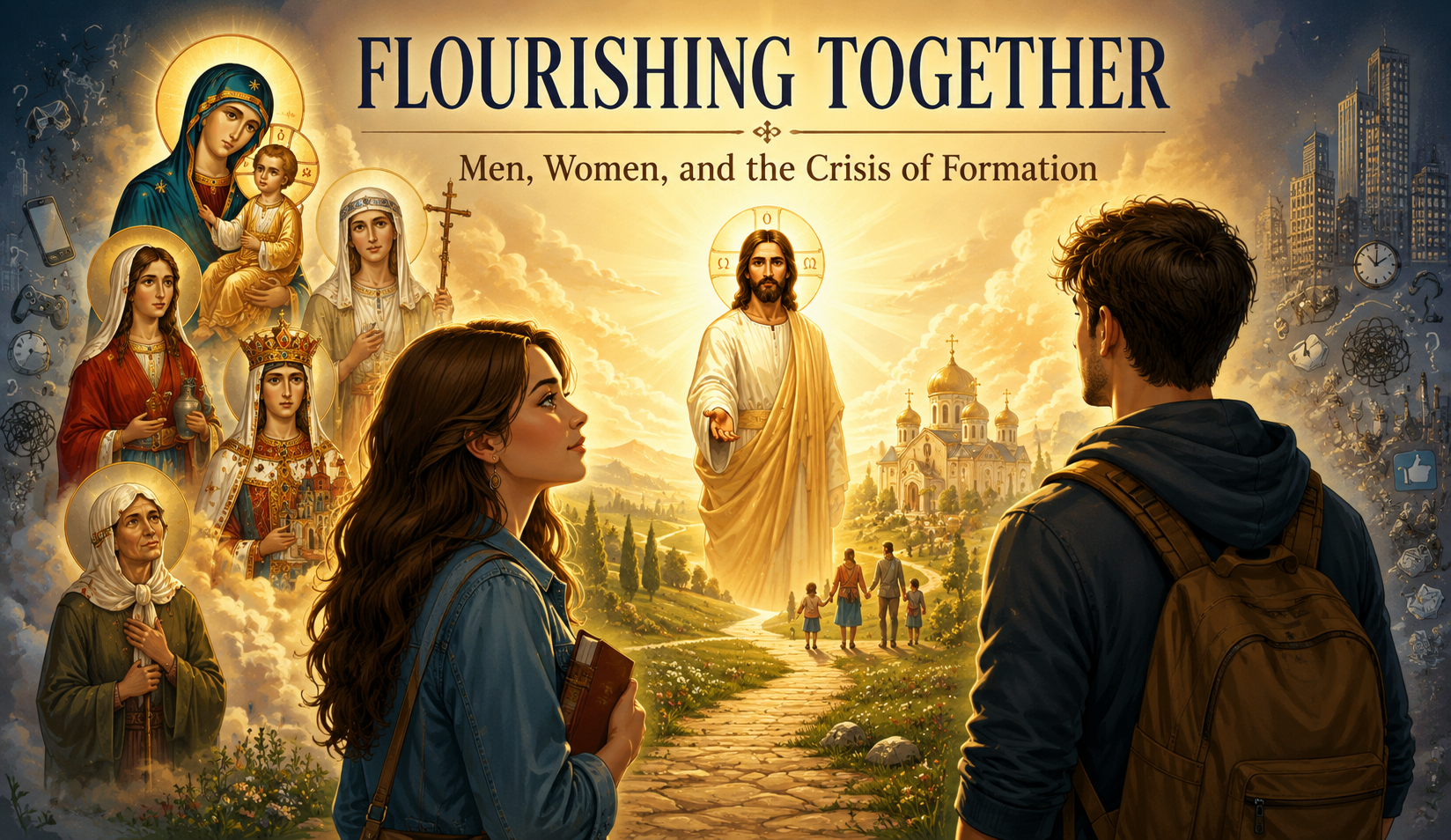
The Church is filled with women whose holiness helped shape Christian history.
There is Saint Mary Magdalene, Equal-to-the-Apostles, the first witness of the Resurrection and the one sent to proclaim the risen Christ to the disciples.
There is Saint Photini, the Samaritan woman at the well, who became a fearless evangelist and brought many to faith in Christ.
There is Saint Helen, mother of Emperor Constantine, whose devotion led to the discovery of the Holy Cross and whose influence helped establish Christianity throughout the Roman Empire.
There is Saint Macrina the Younger, whose wisdom profoundly influenced her brothers, St. Basil the Great and St. Gregory of Nyssa, two of the greatest theologians in Christian history.
There is Saint Monica, whose persistent prayers and faithfulness became instrumental in the conversion of her son, St. Augustine.
There is Saint Olga of Kiev, whose conversion prepared the way for the Christianization of an entire nation.
There is Saint Mary of Egypt, whose dramatic repentance reminds us that no person is beyond the reach of God’s mercy.
There is Saint Xenia of Saint Petersburg, who embraced radical humility and became one of the most beloved saints of Russia.
There is Saint Nina of Georgia, Equal-to-the-Apostles, whose missionary labors brought the Gospel to an entire people.
There is Saint Catherine the Great Martyr, whose intellectual brilliance and unwavering courage confounded emperors and philosophers alike.
There is Saint Elizabeth the New Martyr, whose life of charity and service continues to inspire Christians around the world.
These women were not honored because they imitated men.
Nor were they honored because they sought power.
They were honored because they became fully alive in Christ.
Some were queens.
Some were mothers.
Some were nuns.
Some were scholars.
Some were martyrs.
Some were missionaries.
Some lived hidden lives of prayer.
Others transformed nations.
Their paths differed, but their destination was the same: union with God.
The Church does not diminish women by affirming difference.
Rather, she sees the distinct gifts of women as essential to the life of humanity and the work of salvation.
The countless women saints of the Church testify that holiness is not reserved for one sex, one vocation, or one station in life.
The call of Christ is universal.
And throughout Christian history, women have answered that call with extraordinary faith, courage, wisdom, and love.
Synergy, Not Competition
The Christian understanding is not a struggle for dominance between the sexes.
It is synergy.
Our cooperation with God’s grace and with one another.
When men and women rediscover their God-given vocation, something beautiful happens.
Families become more stable.
Children flourish.
Communities grow stronger.
Society finds greater balance.
This renewal does not require turning back the clock or undoing legitimate gains for women.
It requires recovering a vision in which both men and women are called to maturity, virtue, sacrifice, and service.
Where Renewal Begins
Public policy has a role to play.
But the deepest renewal will not begin in legislatures.
It begins in hearts.
It begins with repentance.
It begins with formation.
It begins with returning to the wisdom God built into creation itself.
The question before us is not whether one sex is winning and the other losing.
The question is whether we are becoming the people God created us to be.
How is Christ forming us, as men and women, into the people we were created to become?
Because when that formation begins, renewal always follows.
Want the entire article distilled into one clear, printable page?
Download your free summary and keep it with you.
Get the free PDF + join thousands receiving short, practical Orthodox insights in the “Morning Brew with Father Don” to help you grow in Christ each week.