The relationship between the Orthodox Church and the Roman Catholic Church is one of the most painful realities in Christian history. Any honest discussion about the division between East and West has to begin with humility, sorrow, and love.
The purpose of examining these divisions is not to create hostility, foster triumphalism, or deepen suspicion. Rather, it is to explain why reconciliation has proven extraordinarily difficult despite sincere efforts, theological dialogue, and a shared reverence for Jesus Christ.
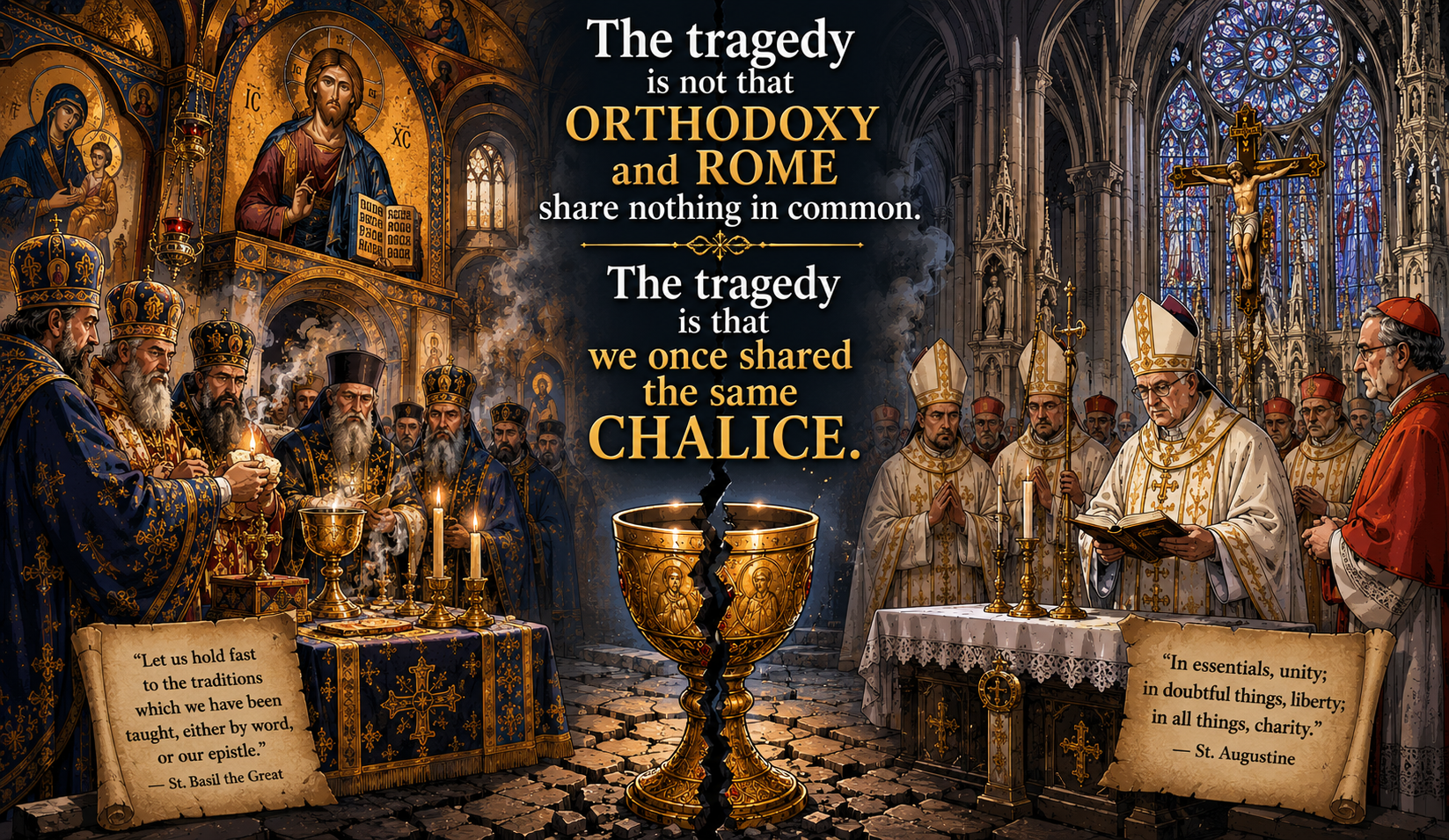
The tragedy of the separation is precisely this: the Orthodox and Roman Catholic Churches share far more in common than they differ on. Both confess the Holy Trinity, the divinity of Christ, the bodily resurrection, the sacraments, apostolic succession, the historic episcopate, the Virgin Mary as Theotokos, the saints, liturgical worship, and the authority of Sacred Tradition. Both trace themselves to the apostolic Church founded by Christ and preserved through the Ecumenical Councils. Both possess profound spiritual treasures and a deep sacramental worldview that sees Christianity not merely as intellectual assent, but as participation in divine life.
And yet, despite all these commonalities, full communion remains elusive.
The reasons are not merely political, emotional, or cultural. At the heart of the difficulty are fundamentally different understandings of authority, theology, ecclesiology, and increasingly, moral anthropology itself.
You can Now Listen to Each Article
The Great Schism of 1054: A Wound Long in the Making
The Great Schism of 1054 did not emerge overnight. It was the culmination of centuries of growing tension between the Latin West and the Greek East. Linguistic barriers, cultural differences, political rivalries, and differing theological emphases slowly widened the divide.
The Western Church increasingly centered around Rome and the authority of the Pope, while the Eastern Church preserved a conciliar structure rooted in the communion of bishops. The collapse of the Western Roman Empire further accelerated divergence. As the Bishop of Rome filled political and social vacuums in the West, papal authority expanded in ways unfamiliar to the East.
Several theological controversies intensified the separation:
- The addition of the Filioque clause to the Nicene Creed in the West, “and the Son,” regarding the procession of the Holy Spirit.
- Disputes over papal supremacy.
- Liturgical differences.
- Questions regarding jurisdiction and authority.
The Orthodox objection to the Filioque was not merely semantic. It involved both theology and ecclesiology. Theologically, the East believed the original Creed protected the monarchy of the Father within the Trinity. Ecclesiologically, the unilateral alteration of an Ecumenical Creed by Rome without an Ecumenical Council represented, for the East, a dangerous innovation in Church authority.
By 1054, mutual excommunications formalized a division already centuries in development.
But even then, the schism was not necessarily viewed as irreversible. Tragically, later historical events deepened the fracture beyond theology alone.
The Fourth Crusade: A Catastrophic Breach
If 1054 represented the formal rupture, the Fourth Crusade in 1204 hardened the wound almost beyond repair. Latin crusaders sacked Constantinople, desecrated Orthodox churches, looted relics, and committed atrocities against fellow Christians.
For many Orthodox Christians, this event permanently altered the emotional and spiritual landscape of East-West relations. It was no longer merely a theological disagreement. It became a profound betrayal.
Historical memory matters in the life of the Church. Ecclesial wounds are not healed merely through signed statements or diplomatic meetings. They live in liturgy, memory, monasticism, and inherited spiritual consciousness.
Theological Innovations and Why They Matter
One of the deepest Orthodox concerns regarding Rome is not simply that doctrinal differences exist, but that doctrines continued developing in ways the Orthodox Church believes departed from the consensus of the early Church Fathers.
From the Orthodox perspective, the issue is not whether theology can be articulated more clearly over time. The Orthodox Church itself has clarified theological language throughout history. The issue is whether later doctrinal developments remain faithful to the mind, or phronema, of the undivided Church.
Several doctrines are especially significant in this regard.
Papal Supremacy and Papal Infallibility
The Orthodox Church recognizes the Bishop of Rome as historically holding a primacy of honor among bishops in the early Church. However, Orthodoxy rejects the later Roman Catholic claims of universal jurisdiction and papal infallibility as defined at the First Vatican Council in 1870.
For Orthodoxy, no bishop, including the Bishop of Rome, stands above the Church itself. Truth is preserved conciliarity through the whole body of the Church guided by the Holy Spirit.
This is not merely administrative disagreement. It reflects radically different understandings of how authority operates within the Body of Christ.
Purgatory
The Roman Catholic doctrine of Purgatory became formally articulated in the medieval West and was later dogmatically affirmed at councils such as Florence and Trent. In Roman Catholic theology, Purgatory is understood as a postmortem purification for those ultimately destined for heaven but still requiring cleansing from the temporal effects of sin.
The Orthodox Church does pray for the dead and believes in a mysterious intermediate state after death. However, Orthodoxy generally rejects the Latin juridical framework surrounding Purgatory, especially ideas involving:
- Quantified temporal punishments.
- Satisfaction for sin through suffering.
- A quasi-legal purification process.
- Treasury-of-merit concepts connected to indulgences.
Orthodoxy approaches salvation more therapeutically than juridically. Sin is viewed primarily as spiritual illness requiring healing and union with God rather than simply legal guilt requiring punishment. Thus, many Orthodox theologians see the Western doctrine of Purgatory as emerging from a fundamentally different theological mindset.
Indulgences
The controversy surrounding indulgences became one of the great crises of Western Christianity during the Reformation.
In Roman Catholic theology, indulgences involve the remission of temporal punishment due to sin through the authority of the Church drawing upon the “treasury of merits” of Christ and the saints.
For Orthodoxy, indulgences became emblematic of deeper concerns regarding:
- Over-centralized ecclesiastical authority.
- Excessively juridical understandings of salvation.
- The commodification of grace.
- The idea that spiritual penalties could be administratively reduced through institutional mechanisms.
While abuses surrounding indulgences were acknowledged and corrected within Catholicism itself, the Orthodox concern goes beyond abuse into the underlying theological framework.
The Immaculate Conception
Defined dogmatically by Rome in 1854, the Immaculate Conception teaches that the Virgin Mary was conceived free from original sin from the first moment of her existence.
Orthodoxy deeply venerates the Theotokos and calls her “all-holy,” or Panagia. However, the Orthodox Church generally rejects the Roman Catholic formulation because the East and West historically developed different understandings of original sin itself.
Western theology, especially after Augustine, often emphasized inherited guilt. Orthodox theology tends instead to emphasize ancestral sin, meaning humanity inherits mortality and corruption rather than juridical guilt itself.
Because Orthodoxy does not define original sin in the same manner as medieval Western theology, the Immaculate Conception is viewed by many Orthodox theologians as answering a theological problem the East never formulated in the same way.
Additionally, Orthodoxy traditionally hesitates to define doctrines dogmatically outside the framework of Ecumenical Councils.
The Filioque
The original Nicene-Constantinopolitan Creed states that the Holy Spirit proceeds “from the Father.” The Western Church later added “and the Son,” or Filioque.
Orthodox objections involve both theology and process:
- Theologically, the East believes this risks confusing the distinct persons within the Trinity and undermining the Father as sole source within the Godhead.
- Ecclesiologically, Rome altered an Ecumenical Creed without an Ecumenical Council.
To Orthodoxy, this represented both doctrinal and structural innovation.
Scholastic Definitions of Grace and Salvation
Orthodox theologians have also historically expressed concern regarding certain Western scholastic tendencies:
- Defining grace in overly created or mechanistic categories.
- Excessively legal understandings of atonement.
- Highly systematized sacramental frameworks.
- Attempts to rationally define divine mysteries too precisely.
The Orthodox tradition generally emphasizes mystery, ascetic transformation, participation in divine life, or theosis, and experiential communion with God rather than tightly codified theological systems.
This distinction is not anti-intellectualism. Rather, Orthodoxy resists reducing divine mystery to philosophical certainty.
Hierarchical vs. Conciliar Ecclesiology
This distinction is essential to understanding why unity remains difficult.
Roman Catholic Structure: Hierarchical Centralization
The Roman Catholic Church is fundamentally hierarchical in a centralized sense. Authority flows downward from the Pope, who serves as the supreme visible head of the Church on earth. Bishops remain in communion with Rome and exercise authority under papal jurisdiction.
This model emphasizes:
- Universal administrative unity.
- Doctrinal uniformity under Rome.
- Centralized authority capable of definitive rulings.
For Catholics, this structure safeguards unity and doctrinal stability.
Orthodox Structure: Conciliar Communion
The Orthodox Church is conciliar rather than centralized. Authority is shared among bishops gathered in synod. No single bishop possesses universal jurisdiction over the entire Church.
Conciliarity means:
- The Church governs through councils.
- Truth emerges through the consensus of the whole Church.
- Authority is relational, sacramental, and communal rather than monarchical.
The Orthodox model sees the Church less as a centralized institution and more as a communion of local churches united in shared faith, sacraments, and apostolic continuity.
This distinction shapes everything:
- How doctrine develops.
- How disputes are resolved.
- How bishops relate to one another.
- How unity itself is understood.
The Orthodox concern is that excessive centralization risks reducing the Church to institutional administration rather than mystical communion.
Scholasticism vs. Mystery
Another major difference involves theological method itself.
Western theology, particularly after the medieval period, increasingly adopted scholastic categories influenced by Aristotelian philosophy. Theology became highly systematized, analytical, and juridical.
Orthodoxy, while valuing reason, remains deeply apophatic and mystical. The East tends to emphasize:
- Mystery over systematization.
- Healing over legal categories.
- Theosis, or union with God, over purely forensic understandings of salvation.
This difference does not mean Orthodoxy rejects theology or reason. Rather, Orthodoxy resists the idea that divine mystery can be fully contained within rational systems.
As one often sees within Orthodox thought, theology is not merely about speaking about God, but about experiential communion with God. The Christian faith is understood as “the way,” a path of purification, illumination, and union with Christ. This emphasis appears repeatedly within contemporary Orthodox teaching and spiritual formation.
Modern Developments and Growing Tensions
In recent decades, the challenges to unity have become even more complex.
Many Orthodox Christians observe significant shifts within sectors of modern Catholicism regarding anthropology, sexuality, identity, and pastoral practice. While official Roman Catholic doctrine still upholds traditional Christian moral teaching concerning marriage and sexuality, debates within Catholicism have become increasingly public and polarized.
Particular concerns within Orthodoxy include:
- Ambiguity in pastoral language surrounding LGBTQ issues.
- Public blessings or recognition discussions involving same-sex relationships in some regions.
- Increasing accommodation to modern secular frameworks surrounding identity and personhood.
- Tensions between traditional doctrine and modern pastoral adaptation.
For many Orthodox Christians, these developments are not viewed merely as pastoral adjustments but as symptoms of a broader theological crisis emerging from modernity itself.
Orthodoxy generally approaches human identity through an ascetical and sacramental lens rather than an expressive individualistic one. The modern Western emphasis on self-definition, psychological identity, and personal autonomy often stands in direct tension with the Orthodox understanding of personhood as transformation through repentance, communion, and participation in Christ.
This is where contemporary divisions become especially difficult. The disagreements are no longer only about medieval disputes or papal authority. Increasingly, they involve fundamentally different understandings of:
- Human nature.
- Freedom.
- Desire.
- Personhood.
- Salvation.
- The purpose of the Church in relation to modern culture.
Why Unity Is So Difficult
Many Christians outside these traditions assume reunion could occur simply through compromise or diplomacy. But the issues are much deeper than administrative reconciliation.
The difficulty lies in this reality:
The Orthodox Church generally believes that fidelity requires preserving the faith exactly as received from the Apostles and Fathers without doctrinal innovation. Meanwhile, Roman Catholicism possesses a theological framework that allows for doctrinal development under magisterial authority.
These are not small differences. They are fundamentally different visions of how the Church preserves truth.
Additionally:
- The wounds of history remain deep.
- Spiritual cultures have developed differently for nearly a thousand years.
- Liturgical life formed different instincts and theological emphases.
- Modern cultural pressures affect East and West differently.
And yet, despite all this, there remains genuine love and mutual respect between many Orthodox and Roman Catholic Christians.
What the Churches Still Share
Even amid division, the common ground remains extraordinary.
Both churches:
- Worship the Triune God.
- Confess Christ as fully God and fully man.
- Preserve apostolic succession.
- Celebrate sacramental worship.
- Honor the saints and martyrs.
- Defend the sanctity of life.
- Uphold the historic Christian understanding of marriage.
- Believe the Church is not merely symbolic, but mystical and incarnational.
This shared inheritance matters deeply.
The tragedy of division is painful precisely because both churches recognize much of the grace, beauty, and historic continuity present in the other.
A Final Word
The path toward healing cannot be built on denial, sentimentalism, or pretending the differences are insignificant. Authentic unity requires truth, repentance, humility, and clarity.
At the same time, Christians must resist the temptation toward bitterness or caricature. The goal is not hostility, but honesty. Not triumphalism, but faithfulness.
The division between Orthodoxy and Roman Catholicism is extraordinarily difficult because the questions involved are extraordinarily deep: What is the Church? How is truth preserved? Who possesses authority? How should doctrine develop? What does it mean to remain faithful to the Apostolic deposit?
These are not merely academic questions. They shape the spiritual life of millions of Christians around the world.
And so, the longing for unity remains, not as a political project, but as a prayer offered with tears before Christ, who Himself prayed “that they all may be one.”
Want the entire article distilled into one clear, printable page?
Download your free summary and keep it with you.
Get the free PDF + join thousands receiving short, practical Orthodox insights in the “Morning Brew with Father Don” to help you grow in Christ each week.