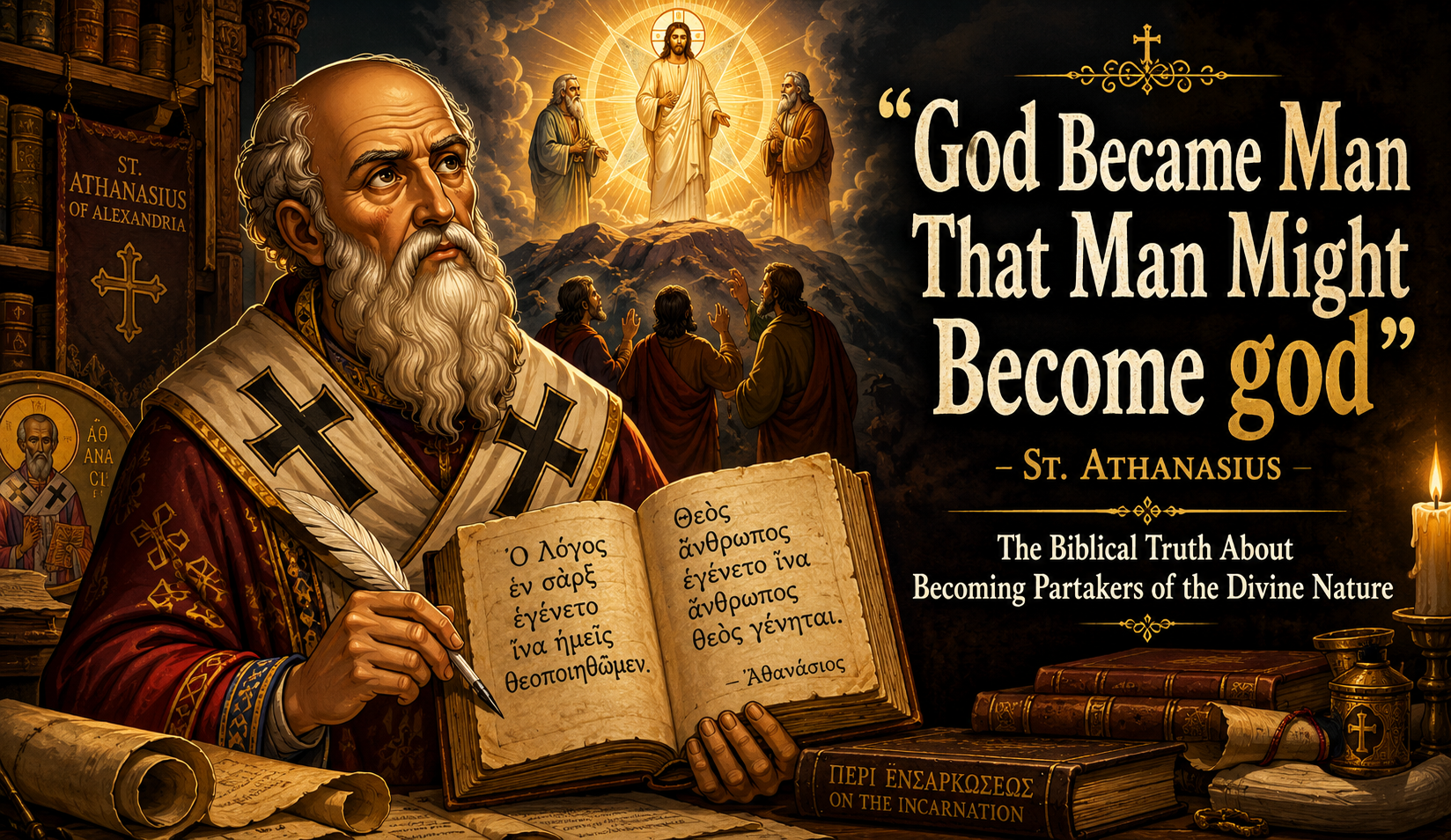
Among the most misunderstood statements in all of Christian theology is the famous declaration of St. Athanasius of Alexandria:
“For He was made man that we might be made god.”
To many modern Protestants, this language sounds shocking, even blasphemous. Some hear in it the idea that Christians become equal with God, merge into God’s essence, or somehow cease to be creatures. Others dismiss it as an example of “Eastern mysticism” disconnected from Scripture.
Yet nothing could be further from the truth.
What St. Athanasius articulated was not a strange theological innovation, but the very heart of historic Christian salvation: union with God through Jesus Christ. The doctrine is deeply biblical, profoundly Christological, and universally taught in the early Church. In the Orthodox Christian tradition, this reality is called theosis or deification (I wrote a recent article on this titled “You’re Missing the Point of Christianity: Why Deification Changes Everything)
Far from diminishing God, the doctrine magnifies the glory of the Incarnation. It reveals why Christ became man in the first place.
You can Now Listen to Each Article
The Historical Context of St. Athanasius’ Statement
The quote comes from On the Incarnation, written in the fourth century during one of the most turbulent theological battles in Christian history.
St. Athanasius lived during the Arian controversy, when Arius taught that Jesus Christ was not truly God but merely the highest created being. According to Arius, the Son was exalted, but not eternal and not fully divine.
Athanasius recognized immediately that this teaching destroyed salvation itself.
Why?
Because if Christ is not truly God, then humanity cannot truly be united to God.
Only God can save. Only God can conquer death. Only God can restore fallen human nature. And only if Christ possesses the fullness of divinity can humanity participate in divine life through Him.
Thus Athanasius relentlessly defended the truth proclaimed at the First Council of Nicaea: that Christ is “of one essence” (homoousios) with the Father.
When Athanasius wrote:
“God became man that man might become god,”
he was defending the full divinity of Christ and the transformative purpose of salvation itself.
He did not mean that human beings become gods by nature, essence, or independent deity. Rather, he meant that through union with Christ, humanity participates in the life, holiness, immortality, and communion of God by grace.
This distinction is absolutely essential.
The Biblical Foundation: Partakers of the Divine Nature
The clearest biblical foundation for theosis is found in 2 Peter 1:4:
“By which have been given to us exceedingly great and precious promises, that through these you may be partakers of the divine nature…”
This verse alone should force Christians to grapple seriously with the language of participation in God.
The Apostle Peter does not say believers merely imitate God externally. He says they become “partakers of the divine nature.”
The Greek word used here is koinōnoi, meaning participants, sharers, or communicants.
Peter is describing genuine participation in the life of God.
Not equality with God.
Not absorption into God.
Not becoming divine by essence.
But true communion with Him.
This is precisely what Athanasius meant.
Salvation Is More Than Legal Forgiveness
One reason many Protestants struggle with theosis is because modern Western theology often reduces salvation primarily to legal categories.
Salvation becomes:
- guilt removed,
- wrath satisfied,
- punishment canceled,
- justification declared.
Orthodoxy certainly affirms forgiveness and justification. But salvation in Scripture is much larger than legal acquittal.
The New Testament describes salvation as:
- union with Christ,
- participation in divine life,
- transformation into holiness,
- conformity to the image of Christ,
- victory over corruption and death.
The goal is not merely to be declared righteous externally, but to become transformed internally by grace.
This is why St. Paul writes:
“It is no longer I who live, but Christ lives in me.”
— Galatians 2:20
And again:
“We all… are being transformed into the same image from glory to glory.”
— 2 Corinthians 3:18
And again:
“Christ in you, the hope of glory.”
— Colossians 1:27
The language of participation permeates the New Testament.
The Incarnation Makes Theosis Possible
The doctrine of theosis flows directly from the Incarnation.
In Jesus Christ, divinity and humanity are united without confusion.
Christ is:
- fully God,
- fully man,
- one divine Person.
Because Christ united human nature to Himself, human nature can now be healed, sanctified, glorified, and united to God.
As the Church Fathers often said:
“What is not assumed is not healed.”
Christ assumed human nature entirely in order to redeem it entirely.
This is why the Incarnation is not merely a mechanism for the Cross. The Incarnation itself is salvific. God enters humanity so humanity may enter communion with God.
The Gospel is not simply that Christ died for us.
The Gospel is that Christ united Himself to us.
We Become “God” by Grace, Not by Nature
This distinction cannot be overstated.
Orthodox Christianity never teaches that man becomes God by essence.
There is only one uncreated God:
- Father,
- Son,
- Holy Spirit.
Human beings remain creatures forever.
Theosis means participation by grace in God’s energies, life, holiness, immortality, and communion.
The Fathers consistently distinguished between:
- God’s essence (which remains utterly transcendent), and
- God’s energies or operations (through which He truly communicates Himself).
A simple analogy is the sun:
- no one can touch the core of the sun itself,
- but everyone can genuinely participate in its light and warmth.
Likewise, Christians do not become identical to God in essence, but truly participate in His life.
This is why Scripture repeatedly uses familial language:
- adopted sons,
- heirs with Christ,
- children of God.
Participation is relational and transformative.
Theosis Throughout Scripture
Theosis is not based on a single verse. It saturates the Bible.
Romans 8:29
“For whom He foreknew, He also predestined to be conformed to the image of His Son.”
John 17:21–23
Christ prays:
“That they all may be one, as You, Father, are in Me, and I in You; that they also may be one in Us.”
This is staggering language.
Christ invites believers into the communion shared between the Father and the Son.
Psalm 82:6
“I said, ‘You are gods, and all of you are children of the Most High.’”
Christ Himself quotes this passage in John 10:34.
1 John 3:2
“When He is revealed, we shall be like Him.”
Ephesians 4:13
“…to the measure of the stature of the fullness of Christ.”
Hebrews 12:10
“…that we may be partakers of His holiness.”
The biblical witness is overwhelming:
salvation is participation, transformation, communion, and glorification.
Why Many Protestants Object
Most Protestant objections arise from three primary concerns.
1. Fear of Polytheism
Many hear “become god” and assume Christians are teaching multiple gods.
But Orthodoxy emphatically rejects this.
Theosis never means independent deity or equality with God.
It means union with God through grace.
Ironically, Protestants themselves already use similar language when they speak of:
- being indwelt by the Holy Spirit,
- union with Christ,
- sanctification,
- becoming Christlike.
Theosis simply takes these biblical realities seriously and consistently.
2. The Influence of Western Scholastic Categories
After centuries of scholastic theology and later Protestant debates about justification, salvation in the West became increasingly framed in legal and forensic terms.
Orthodoxy preserved the earlier patristic emphasis:
- healing,
- participation,
- transformation,
- communion.
Thus many Protestants think theosis sounds foreign simply because their theological categories have narrowed over time.
3. Confusion About Grace
In much Protestant theology, grace is often treated primarily as divine favor.
In Orthodoxy, grace is also understood as God’s uncreated life actively shared with humanity.
Grace is not merely God feeling kindly toward us.
Grace is God giving Himself to us.
This is why the saints speak so boldly about union with God.
The Early Church Universally Taught This
The language of deification was not unique to Athanasius.
It appears everywhere in the early Church.
St. Irenaeus of Lyons wrote:
“If the Word became a man, it was so men may become gods.”
St. Basil the Great wrote:
“Through the Spirit we become partakers of God.”
St. Gregory Nazianzen declared:
“Let us become as Christ is, since Christ became as we are.”
St. Maximus the Confessor taught extensively that humanity’s destiny is union with God through grace.
This was mainstream Christianity for centuries before the Protestant Reformation.
Theosis Is Ultimately About Communion
At its core, theosis is not about power, exaltation, or mystical elitism.
It is about communion.
God created humanity for union with Himself.
Sin shattered that communion.
Christ restores it.
The Christian life therefore is not merely moral improvement. It is participation in divine life through:
- prayer,
- repentance,
- sacramental life,
- ascetic struggle,
- love,
- holiness,
- union with Christ.
As believers are purified, illumined, and sanctified, they increasingly participate in the life of God.
This is why the saints radiate holiness.
Not because they become independent deities, but because the life of God shines through them.
The Glory of the Gospel
The Gospel is far more astonishing than many modern Christians realize.
God did not merely come to improve humanity morally.
He came to unite humanity to Himself.
The Incarnation is not simply about escaping punishment after death. It is about restoration into communion with the living God.
This is the breathtaking vision proclaimed by St. Athanasius:
God became man so that man might become god.
Not by nature.
Not by essence.
But by grace.
And this is nothing less than the fulfillment of the Apostle Peter’s words:
“…that you may be partakers of the divine nature.”
— 2 Peter 1:4
In the Orthodox understanding, this is the very destiny of humanity in Christ.
To be filled with the life of God.
To become by grace what Christ is by nature.
To shine with His holiness forever.
And that is not heresy.
It is the triumphant hope of the Gospel itself.
Grace and Peace,
Father Don
Want the entire article distilled into one clear, printable page?
Download your free summary and keep it with you.
Get the free PDF + join thousands receiving short, practical Orthodox insights in the “Morning Brew with Father Don” to help you grow in Christ each week.