If someone taught you that the Orthodox Church and the Roman Catholic Church split on July 16, 1054, they suggested something convenient, memorable, and deeply misleading.
Something tragically important certainly happened that day.
Cardinal Humbert entered Hagia Sophia in Constantinople during the Divine Liturgy and placed a bull of excommunication upon the altar. The document condemned Patriarch Michael Cerularius and several of his associates.
The patriarch responded.
A synod in Constantinople condemned Humbert and those who had accompanied him.
It was dramatic.
It was hostile.
Some even called it scandalous.
But it was not the moment when one perfectly united Church suddenly broke into two different Churches that evolved into the Eastern Orthodox Church and the Roman Catholic Church.
History simply did not happen that neatly.
In fact, one of the great mistakes Christians make when talking about the Great Schism is imagining that communion between East and West disappeared everywhere at the same moment.
It did not.
The estrangement between Eastern and Western Christianity developed over centuries.
The events of 1054 were one episode in a much longer deterioration of communion involving theology, ecclesiology, politics, language, culture, economic rivalry, ethnic hostility, military violence, and, tragically, the failure of Christians on both sides to love one another as Christians.
And if Orthodox Christians are going to tell this story truthfully, we must resist two temptations.
The first is the temptation to pretend that the theological differences separating Orthodoxy and Rome are insignificant.
They are not.
The second is the temptation to tell the history as though Rome changed, Rome sinned, Rome attacked, and Byzantium merely stood there innocently preserving the faith.
That is not accurate either.
The Church may be holy.
That does not mean every Orthodox emperor, bishop, priest, monk, politician, merchant, soldier, or mob throughout history behaved holy.
If anything, possessing the truth gives us a greater responsibility to tell the truth.
And the truth about the Great Schism is much more uncomfortable than the story most of us learned.
What Actually Happened in 1054?
The familiar story begins with Cardinal Humbert.
Humbert had been sent to Constantinople as a papal legate of Pope Leo IX during a period of already significant tension between Rome and Constantinople.
On July 16, 1054, Humbert entered Hagia Sophia and deposited a bull of excommunication upon the altar.
Patriarch Michael Cerularius and those surrounding him were condemned.
The patriarch’s synod subsequently condemned Humbert and his companions.
It sounds like the perfect moment to identify as the Great Schism.
Rome excommunicated Constantinople.
Constantinople excommunicated Rome.
Christianity split.
Except that is not what actually happened.
The condemnations involved particular people.
They were not universal declarations excommunicating every Christian belonging to the Eastern or Western Church.
The Constantinopolitan synod did not declare every Latin Christian outside the Church.
Humbert’s bull did not somehow sever sacramental communion between every Eastern and Western Christian everywhere in the world.
In fact, the Catholic-Orthodox Joint Declaration of 1965 explicitly recognized that the censures concerned particular persons rather than the Churches themselves.
That matters enormously.
Even if Humbert’s action were assumed to have been perfectly legitimate, it still would not mean that on July 16, 1054, “Rome excommunicated Orthodoxy.”
Likewise, the response from Constantinople did not constitute the Orthodox Church excommunicating every Christian in the West.
The popular picture of two institutional Churches standing across from one another and mutually anathematizing one another on a single afternoon is historically inaccurate.
There is another complication.
Pope Leo IX was already dead.
He had died on April 19, 1054, almost three months before Humbert placed the bull on the altar.
Humbert had been commissioned by Leo as a papal legate.
That raises a significant canonical question.
Did Humbert’s authority as a legate continue after the death of the pope who commissioned him?
Serious historians have questioned this.
I would not go so far as to say that the bull unquestionably had no legal force. Historical questions are rarely solved by rhetorical certainty.
But there are substantial canonical grounds for questioning whether Humbert still possessed the authority under which he acted.
At the very least, the juridical status of the bull is deeply problematic.
So already the simplistic story begins falling apart.
The pope was dead.
The legate’s authority was questionable.
The condemnation targeted particular persons.
The response from Constantinople targeted particular persons.
And communion between Christians in the East and West did not suddenly vanish everywhere.
Even the 1965 Catholic-Orthodox declaration described the events surrounding 1054 as excesses whose consequences eventually extended far beyond what those involved originally intended.
This is why I increasingly think Christians should stop talking about 1054 as though it were the birthday of the Great Schism.
It was an important moment.
It was not the beginning of the story.
And it certainly was not the end of it.
There Was Already a Schism Before “The Schism”
By the time Humbert walked into Hagia Sophia, centuries of tension had already accumulated between the Christian East and West.
One of the more revealing episodes in the development of papal authority is the so-called Donation of Constantine. This document claimed that the Emperor Constantine had granted Pope Sylvester I and his successors sweeping authority over Rome, Italy, and large portions of the Western Empire. In effect, it presented the pope not simply as the bishop of Rome, but as the recipient of imperial privileges and political supremacy supposedly handed down by Constantine himself.
There is only one problem. The Donation of Constantine was a forgery. It was produced centuries after Constantine’s death, most likely in the eighth century, and was eventually exposed as fraudulent in the fifteenth century by Lorenzo Valla, who demonstrated that its language and historical details could not possibly have come from Constantine’s time. That does not mean every later claim of Roman authority rested on this document alone, but it does reveal something important. As papal claims expanded in the medieval West, documents such as the Donation could be used to give those claims an appearance of ancient legitimacy that they did not actually possess.
Then there had been the Photian controversy from 863 to 867. It centered on who had the right to name the Patriarch of Constantinople. It also involved arguments over authority, land, and beliefs.
There had been growing political separation following the collapse of imperial authority in Western Europe.
There had been the coronation of Charlemagne and the emergence of competing political visions of Christian empire.
There was increasing linguistic isolation.
Western theologians increasingly wrote and thought in Latin.
Eastern theologians primarily wrote and thought in Greek.
That may sound insignificant until we remember that theology often depends upon precise language.
When people no longer speak the same language, they can eventually stop understanding one another even when they think they are discussing the same concepts.
Different canonical customs developed.
Different liturgical practices developed.
East and West argued about leavened and unleavened bread.
They argued about clerical discipline.
They argued about fasting.
They argued about jurisdiction.
And underneath many of these disputes was an increasingly serious disagreement about something much larger.
What is the structure of the Church itself?
That question eventually became inseparable from the question of Rome.
The Filioque Was Never Just About Three Words
One of the most famous theological disagreements between Orthodoxy and Roman Catholicism concerns the Filioque.
The original form of the Nicene-Constantinopolitan Creed confesses that the Holy Spirit proceeds from the Father.
In the West, the phrase “and the Son,” Filioque in Latin, eventually became part of the Creed.
For Orthodox Christians, the controversy involves at least two different questions.
The first is theological.
The Orthodox Church has consistently guarded what the Fathers call the monarchy of the Father.
The Father is the single arche, the single source within the Holy Trinity.
The Son is eternally begotten of the Father.
The Holy Spirit eternally proceeds from the Father.
Orthodox theology absolutely recognizes the relationship of the Holy Spirit to the Son. Scripture speaks repeatedly of the Spirit being sent through the Son, manifested through the Son, and resting upon the Son.
But eternal procession and temporal manifestation are not simply interchangeable concepts.
However, there is another issue that is sometimes even more important historically.
Who had the authority to change the Creed?
This was the central and most important issue.
The Filioque was not part of the Creed promulgated by the Ecumenical Councils of Nicaea and Constantinople.
Its incorporation into Western liturgical usage occurred gradually over centuries.
Rome itself did not immediately adopt the altered form.
Pope Leo III famously resisted changing the wording of the Creed even while defending certain Western theological expressions concerning the relationship between the Son and the Spirit.
So the Orthodox objection is not merely, “We dislike three Latin words.”
The question is ecclesiological.
What bishop, patriarch, local council, or regional Church possesses the authority to alter a Creed received by the universal Church through an Ecumenical Council?
And that brings us directly to the deeper disagreement.
The papacy.
The Larger Question Was Becoming Rome
Orthodoxy does not need to deny that Rome possessed a special place in the ancient Church.
It unquestionably did.
Rome enjoyed a profound primacy.
The bishop of Rome occupied the first place within the ancient ecclesial taxis.
The Roman see possessed extraordinary honor.
Its theological witness was enormously influential.
Its judgments were sought in disputes.
Its apostolic association with Saints Peter and Paul was deeply respected.
The historical debate is not over whether Rome had primacy.
The debate is over what that primacy meant.
From the Orthodox perspective, Rome’s first-millennium primacy operated within a conciliar Church composed of bishops who shared the fullness of the episcopal ministry.
The pope was first.
But being first did not mean being an absolute ecclesiastical monarch possessing immediate ordinary jurisdiction over every Christian everywhere.
That distinction became increasingly important.
Over the centuries, the Western understanding of papal authority developed toward a far more centralized model.
Eventually, the First Vatican Council defined doctrines concerning universal papal jurisdiction and papal infallibility in terms that Orthodox Christians believe cannot simply be read backward into the first millennium.
This is why reunion is not accomplished simply by saying, “The pope had primacy in the ancient Church, so the Orthodox should accept the pope.”
Of course Rome had primacy.
The real question is what kind of primacy.
Can primacy exist within conciliarity?
Can the bishop of Rome function as first among the bishops without becoming the universal bishop in the later juridical sense?
Can universal primacy serve communion without becoming universal monarchy?
Those are real questions.
And interestingly, contemporary Catholic-Orthodox theological dialogue increasingly frames the first millennium precisely in terms of primacy and synodality functioning together.
So even serious Catholic theology today is much more nuanced than the popular argument that reunion simply means the Orthodox finally recognizing papal supremacy.
Orthodox Christians Must Talk About 1182
This is where an Orthodox telling of history needs to become uncomfortable.
We talk frequently about 1204.
We should.
The Fourth Crusade and the sack of Constantinople remain among the darkest moments in Christian history.
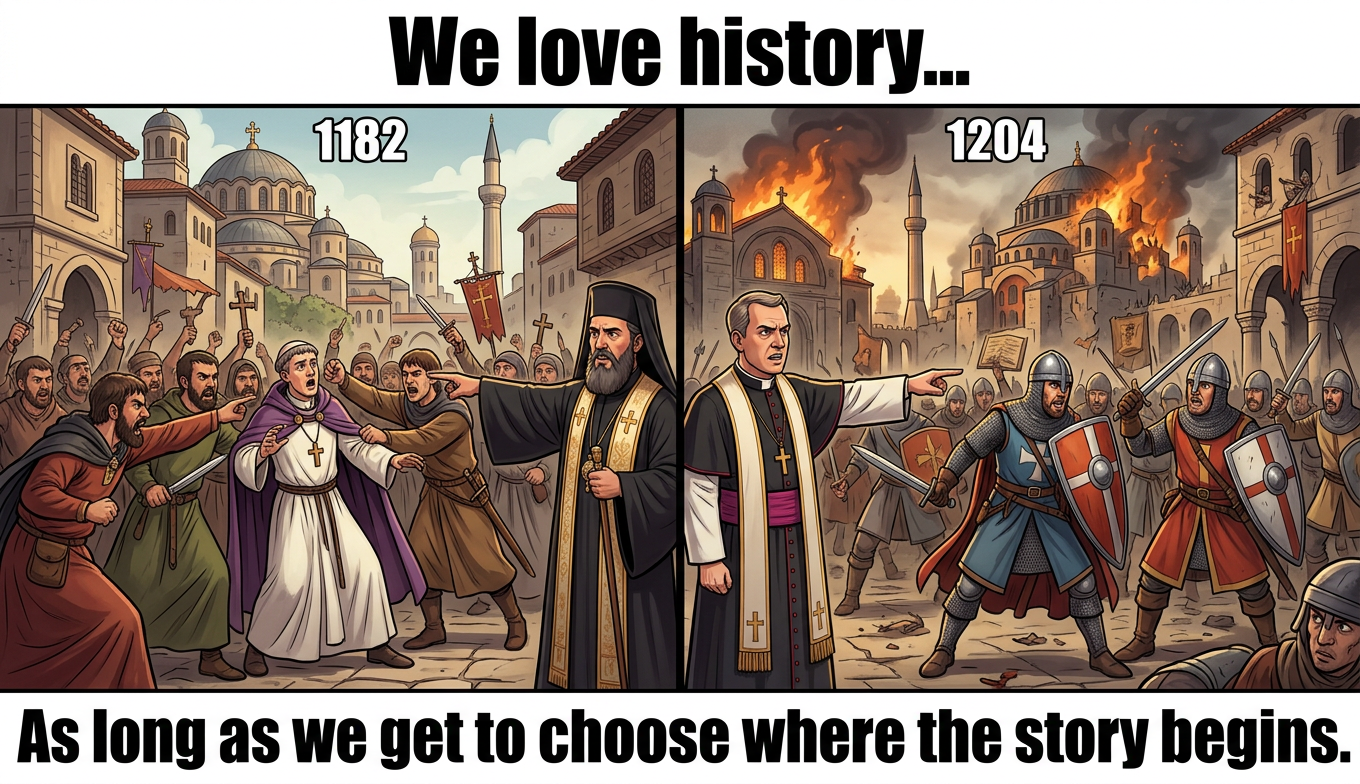
But if we are going to talk about 1204, intellectual and spiritual honesty requires us to talk about 1182.
By the late twelfth century, anti-Latin resentment had become increasingly intense in Constantinople.
Part of that resentment was economic.
Western merchants, particularly Genoese and Pisans, had acquired substantial economic privileges and influence within Byzantine society.
Political tensions intensified the hostility.
Ethnic contempt followed.
Then, during the political upheaval surrounding the rise of Andronikos Komnenos in 1182, violence exploded against the Latin population of Constantinople.
The Latin quarter was attacked.
Men were killed.
Women were attacked.
Clergy were targeted.
Homes were destroyed.
Churches and charitable institutions were violated.
Western medieval sources preserve horrific descriptions of what occurred.
Byzantine authorities failed to prevent the violence.
We should not minimize it.
We should not excuse it.
We should not pretend it becomes morally acceptable because Latins had economic privileges or because relations between Byzantines and Westerners were politically complicated.
It was evil.
Now there is another important historical correction that needs to be made.
You will sometimes encounter the claim that 60,000 Latins were slaughtered in Constantinople in 1182.
That number should not be repeated as though it were established historical fact.
The traditional figure appears to derive in part from medieval estimates of the Latin population of Constantinople, estimates modern historians have good reason to question.
More recent demographic work suggests the directly affected Genoese and Pisan population may have numbered only several thousand.
We do not know the exact death toll.
There is also a traditional claim that approximately 4,000 captives were sold into slavery among the Turks.
That should likewise be presented as part of the medieval narrative rather than as demographic certainty.
But here is the important point.
Correcting inflated numbers does not weaken the moral argument.
It strengthens it.
Orthodox Christians should not need 60,000 corpses before we are willing to call a massacre evil.
If 500 innocent people were murdered, it would be evil.
If 5,000 were murdered, it would be evil.
Historical repentance cannot depend upon maximizing the sins of our opponents or minimizing the sins of our own people.
And we certainly should not exaggerate our own history merely to create rhetorical symmetry.
Truth does not need exaggeration.
Did 1182 Cause the Fourth Crusade?
Another simplistic story sometimes appears in discussions of this history.
It says that the massacre of Latins in 1182 caused the sack of Constantinople in 1204.
That goes too far.
The massacre unquestionably intensified the atmosphere of hostility between Latins and Byzantines.
Retaliatory violence followed.
The Norman sack of Thessalonica in 1185, for example, occurred in a context heavily shaped by growing anti-Byzantine hostility.
But the Fourth Crusade took place twenty-two years later and resulted from an extraordinarily complicated chain of political, economic, military, and dynastic events.
There were Venetian interests.
There were crusader debts.
There was the diversion to Zara.
There were internal Byzantine dynastic struggles.
There were promises made by Alexios Angelos to the crusaders.
There were enormous financial pressures.
There were military calculations.
There was political collapse in Constantinople.
There was escalating distrust.
There was no single straight road leading from the massacre of 1182 to the sack of 1204.
And that distinction matters because Christians have a tendency to weaponize chronology.
We begin history precisely where the sins of the other side become visible.
A Roman Catholic might begin in 1182 and say, “Look what the Byzantines did to the Latins.”
An Orthodox Christian might begin in 1204 and say, “Look what the Latins did to Constantinople.”
Both stories become propaganda when they deliberately hide what happened before the date most useful to our argument.
1182 does not excuse 1204.
1204 does not retroactively justify 1182.
One atrocity cannot sacramentally cleanse another atrocity.
Christians killing Christians in Constantinople in 1182 was evil.
Crusaders slaughtering, looting, and desecrating Constantinople in 1204 was evil.
There is no theological equation in which one sin cancels another.
Why 1204 Changed Everything
Even though 1182 must be remembered, 1204 still occupies a unique place in Orthodox historical memory.
The Fourth Crusade transformed the nature of the separation between East and West.
Until then, many disagreements could still appear to ordinary Christians as arguments involving bishops, theologians, emperors, canon law, jurisdiction, and doctrine.
The sack of Constantinople made the conflict visceral.
Constantinople was captured.
Churches were looted.
Sacred objects were carried away to the West.
Relics were stolen.
Political institutions were destroyed.
A Latin political order was imposed upon Byzantine territory.
A Latin ecclesiastical hierarchy was established over conquered Eastern Christians.
This was no longer an argument about terminology in theological manuscripts.
People watched fellow Christians desecrate their churches.
They watched sacred things taken from their sanctuaries.
They watched foreign ecclesiastical structures imposed upon them.
Collective trauma became part of ecclesiastical memory.
After 1204, it became much harder for an ordinary Eastern Christian to imagine the dispute with Latin Christianity as something merely technical.
The theological separation had become embodied in violence.
And once theological disagreement becomes joined to ethnic resentment, political domination, and inherited trauma, reconciliation becomes extraordinarily difficult.
Byzantium Was Not Immaculate
Orthodox Christians must be mature enough to say this clearly.
Byzantium was not the Kingdom of God.
It was an empire inhabited by sinners.
Sometimes magnificent saints emerged from it.
Sometimes brilliant theologians emerged from it.
Sometimes emperors acted courageously in defense of the Church.
Sometimes bishops acted heroically.
And sometimes Byzantine political leaders were corrupt, violent, deceitful, ambitious, and cruel.
Sometimes Orthodox Christians despised Latins simply because they were Latins.
Sometimes mobs behaved like mobs.
Sometimes political factions manipulated religious identity.
Sometimes ecclesiastical leaders failed to restrain hatred.
Sometimes Christians who possessed the Orthodox faith did deeply un-Orthodox things.
None of that proves Orthodoxy false.
That is an extraordinarily important distinction.
The truth of the Orthodox faith does not depend upon proving that every Byzantine behaved like Saint John Chrysostom.
The holiness of the Church is the holiness of Christ dwelling in His Body.
It does not mean every Christian perfectly participates in that holiness.
In fact, we should expect something else.
If we really believe we possess the fullness of the apostolic faith, then we have an even greater responsibility to repent when we fail to live according to it.
The Orthodox conviction that Rome departed from important aspects of the first-millennium faith does not require us to create a fictional Byzantium in which Orthodox Christians never sinned.
Truth does not need mythology to defend it.
Historical Honesty Does Not Mean Doctrinal Relativism
There is an opposite mistake we must also avoid.
Once someone acknowledges the sins committed by Christians on both sides, it can be tempting to say the division was basically a giant misunderstanding.
Perhaps everyone was proud.
Perhaps everyone behaved badly.
Perhaps everyone simply needs to apologize.
Then we could reunite.
I wish it were that simple.
It is not.
The schism cannot be reduced to wounded feelings.
Serious theological and ecclesiological differences remain.
From the Orthodox perspective, the development of universal papal jurisdiction raises profound questions about the nature of episcopacy.
Papal infallibility raises profound questions about how the Church recognizes and receives dogmatic truth.
The Filioque raises questions about Trinitarian theology and the authority to alter the universal Creed.
Later uniquely Western dogmatic developments raise further questions concerning the relationship between doctrinal development and the faith received by the whole Church.
These differences cannot simply be hugged away.
Christian love requires truth.
And Christian truth requires love.
If we sacrifice truth for unity, we have created sentimentality.
If we sacrifice love for truth, we have forgotten that Truth Himself is Jesus Christ.
The Roman Catholic Church Today Is Not Simply the Western Church of AD 1000
This is another reason why Christians cannot solve the schism simply by “going back to 1054.”
Roman Catholicism continued developing throughout the second millennium.
Its ecclesiastical structure became substantially more centralized.
Claims surrounding papal jurisdiction became increasingly explicit.
Vatican I eventually articulated papal infallibility and universal jurisdiction dogmatically.
These were not questions formulated in precisely the same manner during the first millennium when East and West remained in communion.
That means reunion would involve more than withdrawing ancient condemnations.
It requires asking what later dogmatic definitions mean.
What exactly is the universal primacy of Rome?
How should papal infallibility be understood?
What does reception by the whole Church mean?
What authority belongs to an Ecumenical Council?
Can later doctrinal formulations be interpreted in ways consistent with the first millennium?
What happens when a dogmatic definition has been solemnly promulgated by one side but is rejected by the other?
These are not minor matters.
They concern the very nature of the Church.
At the same time, Orthodox Christians should also recognize that contemporary Roman Catholic ecclesiology is not frozen in 1870.
The Second Vatican Council renewed Catholic discussion of the Church as communion.
Catholic theologians have increasingly explored the relationship between synodality and primacy.
Official Catholic-Orthodox dialogue has even considered whether distinctions might be made between the pope’s patriarchal ministry within the Latin Church and a universal primatial ministry serving the communion of the Churches.
That does not mean the Orthodox objections have been solved.
They have not.
But it does mean the conversation occurring today is far more sophisticated than, “Accept the pope and everything will be fine.”
What Pope Leo XIV and Patriarch Bartholomew Are Actually Doing
This brings us to the present.
Pope Leo XIV and Ecumenical Patriarch Bartholomew met in 2025 during the commemoration of the 1,700th anniversary of the Council of Nicaea.
They issued a joint declaration expressing their desire to continue theological dialogue in love and truth toward the hoped-for restoration of full communion.
Notice those words.
Love and truth.
Not love instead of truth.
Not truth without love.
Both.
Their declaration acknowledged that genuine obstacles remain.
That is important.
There is sometimes an assumption among Orthodox Christians that every meeting between a pope and an Ecumenical Patriarch means reunion is about to happen behind everyone’s back.
That misunderstands both the dialogue and the structure of the Orthodox Church.
The theological questions have not disappeared.
In fact, as recently as June 2026, the Coordinating Committee of the Joint International Commission for Theological Dialogue between the Catholic Church and the Orthodox Church met at Pannonhalma Archabbey in Hungary.
One of the principal subjects under consideration was infallibility.
Think about that.
They are not merely meeting for photographs.
They are not simply issuing vague statements about friendship.
They are addressing one of the most difficult ecclesiological issues separating Rome and Orthodoxy.
The draft under consideration still required additional revision and clarification.
Another coordinating meeting is planned.
That should tell us something.
The people actually engaged in serious dialogue know these questions cannot simply be bypassed.
Patriarch Bartholomew Cannot Simply Reunite Orthodoxy With Rome
This is another misconception that frequently appears in online Orthodox discussion.
The Ecumenical Patriarch occupies an extraordinary and historically important place within Orthodox Christianity.
But he is not an Orthodox pope.
He does not possess the power to wake up one morning, sign a document with Rome, and compel every Orthodox Christian in the world into sacramental communion with the Roman Catholic Church.
Orthodox ecclesiology does not work that way.
Nor does the Ecumenical Patriarch claim this authority.
Any genuine restoration of communion would raise enormous questions of pan-Orthodox reception.
Autocephalous Churches would have to respond.
Bishops would have to receive the agreement.
Theological disputes would have to be addressed.
Synodality would matter.
Consensus would matter.
Dogma would matter.
Reception by the Church would matter.
Whatever role the Ecumenical Patriarch might exercise in a future reconciliation, he cannot simply redefine Orthodox dogma by personal decree.
Ironically, pretending that he could would require adopting precisely the kind of centralized ecclesiology Orthodoxy rejects.
Dialogue Should Not Frighten Orthodox Christians
I understand why some Orthodox Christians become nervous when they hear about theological dialogue with Rome.
The history is painful.
Modern ecumenism has sometimes produced deeply confused theological language.
There are legitimate concerns about reducing doctrine to diplomacy.
But dialogue itself is not betrayal.
Christ prayed that His disciples would be one.
We should desire the healing of Christian division.
The question is what kind of unity we desire.
Unity cannot mean pretending theological contradictions do not matter.
Unity cannot mean quietly setting aside dogma because disagreement is uncomfortable.
Unity cannot mean reducing the Church to the lowest theological denominator everyone can tolerate.
But neither should faithfulness mean cultivating hatred toward Roman Catholics.
It should not mean celebrating division.
It should not mean treating reconciliation itself as suspicious.
It should not mean turning every Roman Catholic into an enemy.
A genuinely Orthodox approach should be capable of saying two things simultaneously.
We desire unity.
And unity must be unity in the apostolic faith.
That is precisely why the language of dialogue in love and truth matters.
Love without truth becomes sentimentality.
Truth without love becomes a weapon.
Christ calls us to both.
What Would Real Reunion Actually Require?
This is where romantic conversations about reunion become difficult.
Imagine that tomorrow every Orthodox patriarch and the pope gathered together and announced that they deeply regretted the sins committed by Christians throughout the last thousand years.
Wonderful.
They should.
Imagine they apologized for massacres.
Good.
Imagine stolen relics were returned.
Good.
Imagine ancient grievances were acknowledged.
Good.
But then what?
What does Roman primacy actually mean?
Can the canonical practice of the first millennium provide a normative framework?
How should Vatican I’s definitions concerning papal jurisdiction be understood?
What does papal infallibility mean in relation to the infallibility of the Church?
What status would later uniquely Western dogmatic definitions possess?
What does it mean for the whole Church to receive a dogma?
What role does an Ecumenical Council possess?
How do primacy and synodality function together?
Can universal primacy exist without becoming universal monarchy?
Can synodality exist without degenerating into isolated national Churches behaving independently of one another?
These questions cannot be answered by emotion.
And the fact that contemporary Catholic-Orthodox dialogue is actively engaging questions of primacy, synodality, and infallibility demonstrates that theologians on both sides know this.
Real reunion would require more than good feelings.
It would require theological clarity.
The Deeper Sin Behind Schism
When I look at the thousand-year separation between East and West, what strikes me most is not simply that Christians disagreed.
Christians have always disagreed.
The Church held councils because Christians disagreed.
The Fathers debated because Christians disagreed.
Disagreement by itself does not necessarily produce schism.
Something more happens.
Doctrinal disagreement becomes joined to political ambition.
Then economic resentment.
Then ethnic hostility.
Then historical grievance.
Then fear.
Then contempt.
Then the desire to dominate.
Eventually we stop seeing the other person as a brother who is wrong.
We begin seeing him merely as an enemy.
That is when schism becomes almost inevitable.
1054 shows us ecclesiastical hostility.
1182 shows us what happens when ethnic resentment becomes violence.
1204 shows us what happens when political and religious rivalry becomes conquest and desecration.
Each event exposes another stage in the spiritual anatomy of schism.
And that is why this history matters for Christians today.
Not merely because we need to know which side was historically correct.
But because the same machinery still operates inside the human heart.
Communion Can Be Lost Before Anyone Admits There Is a Schism
East and West did not wake up one morning and decide to stop being one Church.
They accumulated grievances.
They misunderstood one another.
They stopped trusting one another.
They developed separate habits.
Separate institutions.
Separate theological vocabularies.
Separate political loyalties.
Separate memories.
Eventually separation felt normal.
By the time Christians officially recognized how deep the division had become, generations had already lived inside it.
That may be the most frightening lesson of the Great Schism.
Communion can be lost long before anyone admits there is a schism.
And this happens on smaller scales all the time.
It happens in parishes.
It happens between jurisdictions.
It happens among clergy.
It happens in families.
It happens online.
Someone hurts us.
We remember.
We begin collecting evidence.
We reinterpret everything they do through the lens of suspicion.
We tell the story repeatedly, always beginning at the precise moment that makes us look innocent.
We surround ourselves with people who confirm our version.
We stop asking whether we have anything to repent of.
Eventually reconciliation becomes almost unimaginable because the grievance has become part of our identity.
Then we call it faithfulness.
We call it discernment.
We call it defending truth.
Sometimes it is simply pride.
Truth Requires Repentance
I believe the Orthodox Church has preserved the fullness of the apostolic faith.
I believe the theological questions separating Orthodoxy and Roman Catholicism are real.
I do not believe reunion can occur by pretending those differences do not exist.
But believing Orthodoxy is true does not give Orthodox Christians permission to lie about history.
We do not have to exaggerate Roman Catholic sins.
We do not have to hide Orthodox sins.
We do not have to invent an immaculate Byzantium.
We do not have to treat every Catholic as an enemy.
We do not have to fear honest historical scholarship.
If Orthodoxy is true, then truth is not dangerous to Orthodoxy.
And perhaps that is where genuine reconciliation must begin.
Not with pretending doctrine does not matter.
Not with pretending history does not matter.
Not with one side surrendering everything to the other.
But with repentance.
Real repentance.
The kind that allows us to say:
Here is where you changed the faith.
Here is where we believe you are wrong.
Here is where serious theological disagreement remains.
And here is where we sinned against you.
Both statements can be true.
They must be true if we are going to speak as Christians.
The events of 1054 were not the moment Christianity suddenly split in half.
They were one episode in a centuries-long tragedy.
East and West gradually became divided because theological disagreement became entangled with politics, culture, pride, violence, mistrust, and the accumulated memory of injury.
Perhaps that is why the most important question is not simply whether Rome and Constantinople will someday restore communion.
The more uncomfortable question is whether we have learned anything from the thousand years that followed.
Because if reconciliation between East and West requires truth without historical dishonesty and love without theological compromise, then eventually both sides will have to confront the same question.
And so will we.
Are we prepared for the repentance reconciliation requires?
Not merely from them.
From us.
Want the entire article distilled into one clear, printable page?
Download your free summary and keep it with you.
Get the free PDF + join thousands of people receiving short, practical Orthodox insights in the “Morning Brew with Father Don” to help you grow in Christ each week.