One of the quickest ways to misunderstand Orthodox Christianity is to watch an Orthodox Christian do something without first asking what that Orthodox Christian believes he is doing.
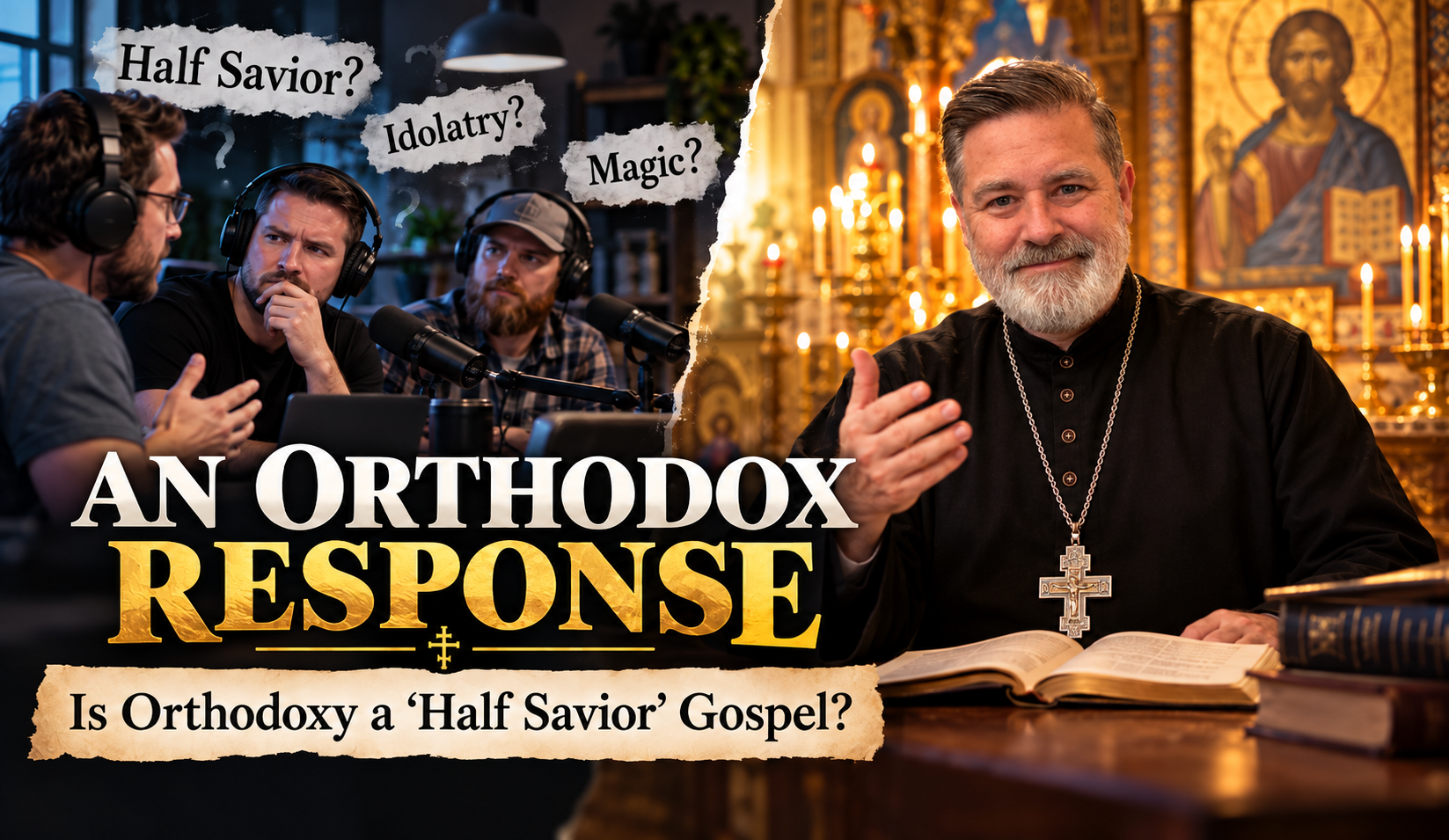
You walk into an Orthodox Church and see someone bow before an Icon.
You see someone kiss the Cross.
You hear someone say, “Most Holy Theotokos, save us.”
You hear Orthodox Christians asking saints to pray for them.
And for many Christians, especially those coming from Protestant or Evangelical backgrounds, the immediate reaction is:
“That looks like worship.”
I understand that reaction.
In fact, years ago, I probably would have had many of the same questions.
But before we accuse someone of worshiping Mary, worshiping saints, or worshiping Icons, we need to do something that has become increasingly rare in our culture.
We need to define our terms.
Because if we use the word worship to mean every act of religious honor, reverence, bowing, kissing, respect, or devotion, then Orthodox Christianity will always look strange.
But that is not how historic Christianity has understood these things.
There is a very important distinction between veneration and worship.
And once you understand that distinction, much of what initially seems confusing about Orthodox Christianity begins to make sense.
Veneration Is Not Worship
Let us begin as simply as possible.
Veneration is honor, reverence, respect, and love shown toward someone or something because of its relationship to God.
Worship belongs to God alone.
Worship is the offering of ourselves to the Father, through the Son, in the Holy Spirit.
The Church has historically even used different words to describe these realities.
Latria refers to the worship and adoration due to God alone.
Dulia refers to the honor or veneration shown to the saints.
Hyperdulia refers to the unique honor given to the Theotokos because of her unique place in the mystery of the Incarnation.
Mary is not God.
The saints are not gods.
Icons are not gods.
Angels are not gods.
The Holy Trinity alone is God, and the Holy Trinity alone receives worship.
That distinction is not a theological loophole invented to justify Orthodox practices. It reflects something human beings already understand in almost every other part of life.
Honor Does Not Automatically Mean Worship
Think about how we behave in ordinary life.
A judge walks into a courtroom and everyone stands.
Is the judge being worshiped?
A soldier salutes a superior officer.
Is the officer being worshiped?
A husband kisses his wife.
Is she being worshiped?
A grieving daughter kneels beside the grave of her mother and kisses the headstone.
Is she practicing idolatry?
You may keep a photograph of a deceased parent or grandparent in your home. You may even touch it, kiss it, or speak to their memory with tears in your eyes.
Nobody seriously concludes that you believe the photograph is a god.
Why?
Because we understand that physical gestures have meaning.
A kiss can mean affection.
A bow can mean respect.
Standing can mean honor.
Kneeling can mean grief.
A salute can mean obedience and recognition of authority.
The physical act by itself does not tell you everything.
You have to ask what the action means.
And this is where many conversations about Orthodox Christianity go wrong.
Someone sees the external gesture and immediately assigns a theological meaning to it that the Orthodox Christian himself explicitly denies.
The question cannot simply be:
“Did that person bow?”
The question must be:
“What does that bow mean?”
We Are Not Disembodied Brains
There is something else happening here that is much deeper.
Modern people tend to separate the physical from the spiritual.
We often imagine that genuine spirituality takes place entirely inside the mind.
If I believe something internally, that is spiritual.
If I do something physically, we become suspicious.
But biblical Christianity does not treat the human person that way.
We are embodied creatures.
We love with our bodies.
We grieve with our bodies.
We repent with our bodies.
We celebrate with our bodies.
We fast with our bodies.
We receive the Eucharist with our bodies.
We kneel.
We bow.
We make the sign of the Cross.
We raise our hands.
We embrace.
We kiss.
We eat.
We drink.
The Christian life is not a religion of disembodied thoughts.
God created us as physical and spiritual beings.
And then something even more astonishing happened.
God Himself became flesh.
That changes everything.
The Incarnation Changes How Christians Understand Matter
The defense of Icons is ultimately not about religious artwork.
It is about Jesus Christ.
The invisible God became visible.
The eternal Son of God took flesh from the Virgin Mary.
He could be seen.
He could be touched.
He could be embraced.
His feet could be washed.
His face could be struck.
His hands could be pierced.
His body could be laid in a tomb.
And His body could rise from the dead.
Christianity does not teach that matter is evil.
It does not teach that physical things are spiritually meaningless.
God entered His creation.
Matter can therefore bear witness to grace without becoming God.
Water remains water, yet God uses it in Baptism.
Oil remains oil, yet the Church uses it in anointing.
Bread and wine are offered in the Eucharistic mystery.
Human voices chant the Scriptures.
Human hands bless.
Human bodies bow.
Wood and paint can proclaim Christ in an Icon.
None of these things become another god.
They become part of the embodied life of the Church.
This is why an overly suspicious attitude toward everything physical can actually move us away from the logic of the Incarnation.
The Christian question is not whether something is material.
The Christian question is how that material reality participates in our relationship with God.
“But What About Graven Images?”
This is probably the most common biblical objection.
People will quote the Second Commandment and say:
“Doesn’t God forbid graven images?”
God certainly forbids idolatry.
But the commandment cannot mean that the creation of every religious image is inherently sinful.
How do we know?
Because in the same Old Testament, God commands sacred imagery to be made.
The Ark of the Covenant itself included images of cherubim.
So the problem cannot simply be:
“An image exists.”
The problem is:
“Is this image being treated as a god?”
That gives us an important distinction.
An idol takes something created and treats it as divine.
An Icon points beyond itself toward the person represented.
Idolatry terminates in the created thing.
Veneration passes through the image toward the person depicted.
Nobody kneels before an Icon of Christ believing that wood and paint created the universe.
Nobody kisses an Icon of St. Peter believing the board is an apostle.
The Icon is a witness.
It tells us that Christ truly became man and that human beings can truly be transformed by His grace.
Why Orthodox Christians Honor the Saints
This brings us to another common misunderstanding.
Why honor saints at all?
Why not just honor Jesus?
Because when we honor the saints, we are honoring what Jesus has accomplished in human beings.
The saints do not compete with Christ.
They reveal Christ.
Think of stained glass.
When sunlight passes through stained glass, you notice the beauty of the colors.
But where did the light come from?
The glass did not create it.
The saint is not the source of holiness.
God is.
Whatever is beautiful, holy, courageous, merciful, or Christlike in a saint is there because the grace of God has transformed that person’s life.
So when we honor St. Peter, St. Paul, St. Mary of Egypt, St. John Chrysostom, or any other saint, we are not saying:
“Look how wonderful this independent spiritual power is.”
We are saying:
“Look what Jesus Christ can do with a human life surrendered to Him.”
The saint becomes evidence of grace.
And frankly, we need that evidence.
Sometimes Christianity can feel abstract.
The saints show us what repentance looks like in flesh and blood.
They struggled.
They fell.
They suffered.
They repented.
They prayed.
They endured.
They were transformed.
And that gives the rest of us hope.
Why Ask Saints to Pray?
Then comes the next question.
“Why would you ask a saint to pray for you? Why not go directly to Jesus?”
My response is usually very simple.
Do you ever ask another Christian to pray for you?
Most Christians do.
If you receive a cancer diagnosis, lose your job, struggle in your marriage, or watch your child suffer, you may call someone and say:
“Please pray for me.”
Nobody says:
“You have just denied the mediatorship of Christ.”
Why?
Because asking another Christian for prayer does not mean replacing Jesus.
It means Christians pray for one another.
Orthodoxy simply takes seriously the belief that the Church is not divided by death.
Jesus says that God is not the God of the dead, but of the living.
Those who have died in Christ have not ceased to belong to Christ.
The Church is one Body.
So asking a saint to pray is not asking a saint to become your Savior.
Christ alone saves.
Christ alone conquered death.
Christ alone reconciles humanity to the Father.
The saints intercede because they belong to Him.
There is an enormous difference between intercession and replacing Christ as the unique Savior and Mediator.
And this needs to be said clearly.
If any devotion to Mary, a saint, an angel, an Icon, or a relic actually displaced Jesus Christ, it would cease to be authentically Orthodox.
Everything must lead us toward Christ.
Why Does Mary Receive So Much Honor?
The Theotokos deserves special attention because this is often where Protestant Christians become the most uncomfortable.
Let me make something absolutely clear.
Orthodox Christians do not believe Mary is a goddess.
She is not part of the Holy Trinity.
She did not exist eternally.
She did not create the universe.
She is not an alternative Savior.
She is a human being.
But she is a human being who occupies a completely unique place in salvation history.
She carried God incarnate in her womb.
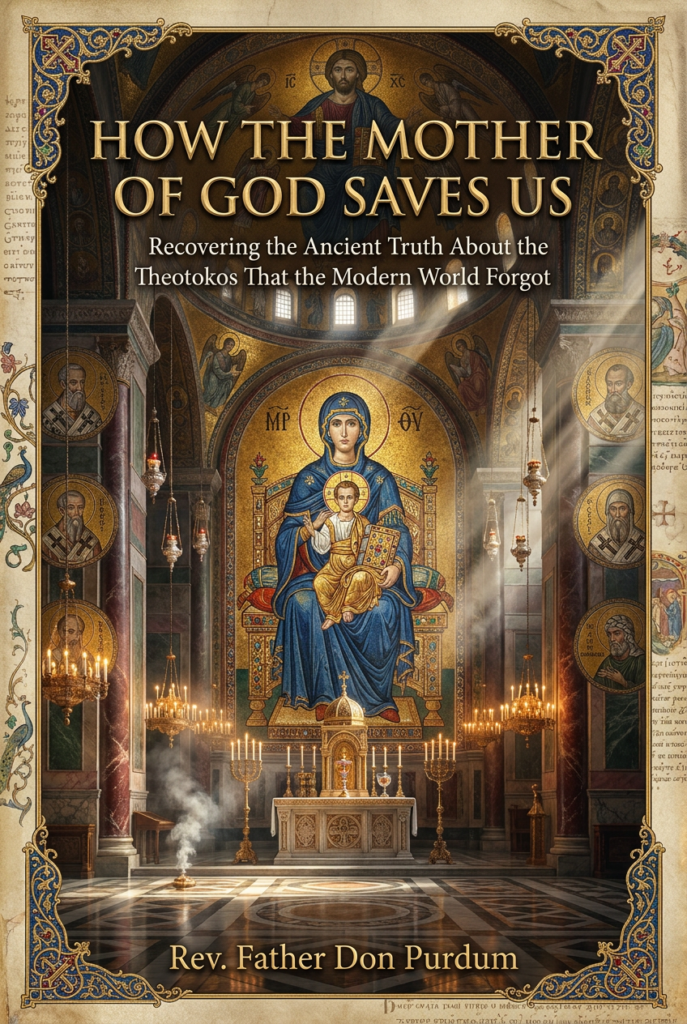
The title Theotokos, usually translated “Mother of God” or “God-bearer,” is actually a statement about Jesus before it is a statement about Mary.
Why do we call Mary the Mother of God?
Because the One born from her is God.
We are not saying Mary created the divine nature.
We are confessing that Jesus Christ is one Person who is truly God and truly man.
The Church defended the title Theotokos precisely because the identity of Christ was at stake.
So when Orthodox Christians honor Mary, the honor ultimately points toward the mystery of the Incarnation.
Her greatness comes from what God has done in and through her.
Even Mary herself says:
“My soul magnifies the Lord.”
That is what authentic Marian devotion must always do.
Magnify the Lord.
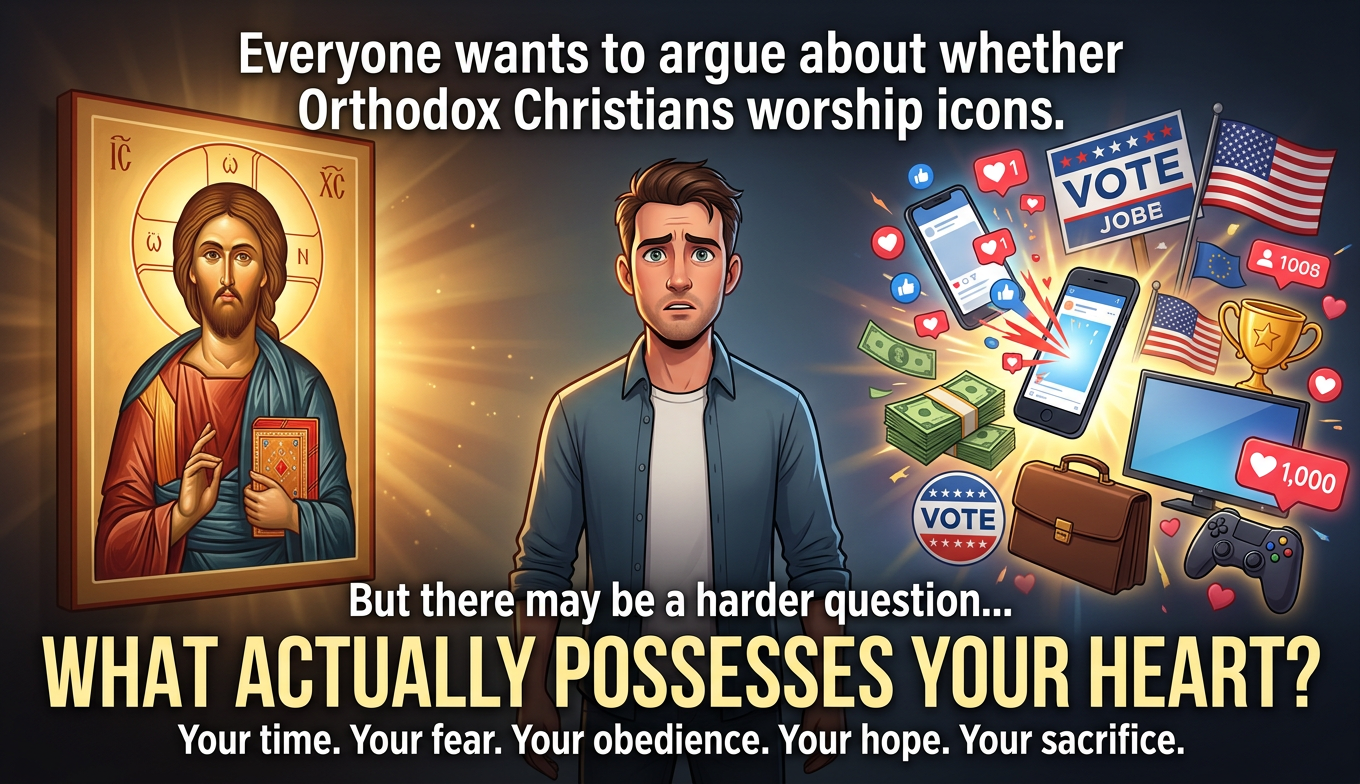
But Here Is the Question That Makes Me Uncomfortable
It is very easy to spend all our time arguing about whether somebody else is practicing idolatry.
But I think there is another question Christians ought to ask.
And this one hits closer to home.
What do I worship?
Not merely:
“What do I claim to worship?”
What actually owns my heart?
You can refuse to bow before an Icon and still spend your entire life bowing before money.
You can accuse Orthodox Christians of idolatry while organizing your entire existence around politics.
You can reject veneration of the saints while being completely consumed by career, sexuality, reputation, entertainment, comfort, success, or your own opinions.
There is formal idolatry.
And there is functional idolatry.
Most of us are probably much more vulnerable to the second.
So ask yourself:
What receives the best of my time?
What receives my attention?
What determines my obedience?
What causes my greatest fear?
What am I unwilling to surrender?
Where do I place my hope?
What would devastate me if I lost it?
What do I sacrifice for?
What actually possesses my heart?
Those questions may tell us more about our worship than our theological vocabulary does.
Worship Is Bigger Than Music
This is another place where our modern vocabulary can mislead us.
We often call the musical part of a church service “worship.”
“We had worship, then the sermon.”
Or:
“The worship was really powerful today.”
There is nothing wrong with singing praise to God. Singing is biblical and beautiful.
But historically, worship is much larger than music.
Worship is the offering of the human person to God.
St. Paul writes in Romans 12:1:
“Present your bodies as a living sacrifice, holy, acceptable to God, which is your reasonable service.”
Notice the language.
Bodies.
Sacrifice.
Offering.
Worship involves the whole person.
This is why Orthodox worship reaches its fullest expression in the Divine Liturgy and especially in the Eucharistic offering.
We do not merely sing about God.
We offer ourselves to God.
Again and again in the Liturgy we hear:
“Let us commend ourselves and each other and all our life unto Christ our God.”
That is worship.
All our life.
Our minds.
Our bodies.
Our money.
Our relationships.
Our ambitions.
Our wounds.
Our sins.
Our hopes.
Our fears.
Everything.
Given to Christ.
A Simple Way to Think About the Difference
If you are trying to understand Orthodox practice, ask a few basic questions.
When an Orthodox Christian honors a saint, does that honor ultimately point toward the grace of Christ?
When an Orthodox Christian venerates an Icon, does he believe the wood and paint are divine?
When Orthodox Christians honor Mary, do they believe she is God, or are they rejoicing in what God accomplished through her?
When Orthodox Christians gather for the Divine Liturgy, to whom is the Eucharistic offering made?
The answers matter.
Because appearance is not enough.
We have to understand what the Church actually teaches.
The distinction between worship and veneration protects two truths at the same time.
God alone is worshiped.
And:
Those transformed by God’s grace may genuinely be honored.
There is nothing unchristian about honor.
Scripture itself tells us to give honor where honor is due.
Christian humility does not require us to pretend God has accomplished nothing extraordinary in other human beings.
When we honor the saints, we are not honoring them instead of Jesus.
We honor them because of Jesus.
Before Calling Someone an Idolater
There is also a pastoral issue here that I think Christians need to take much more seriously.
Before accusing another Christian of idolatry, make sure you actually understand what that Christian believes.
It is very easy to condemn a belief someone does not hold.
If an Orthodox Christian tells you:
“I do not worship Mary,”
you cannot simply respond:
“Yes, you do.”
At that point you are no longer critiquing Orthodox theology.
You are assigning motives to another person’s heart.
We should be careful.
There are legitimate theological disagreements between Christians, and we should discuss them.
Ask questions.
Challenge ideas.
Study Scripture.
Read the Fathers.
Study history.
But we should represent one another accurately.
And sometimes humility requires saying:
“I thought I understood what you believed. Maybe I did not.”
That is not compromise.
That is intellectual honesty.
The Bigger Question Is Whether We Are Becoming Icons
But I do not want to end this article by merely giving you ammunition for an apologetics debate.
There is a much more important question.
The goal is not simply to prove that Icons are permissible.
The goal is to become an Icon.
The word icon means image.
Every Christian is called to make Christ visible in the world.
When people encounter you, do they see His mercy?
His patience?
His courage?
His holiness?
His compassion?
His self-control?
His willingness to forgive?
His love for the sinner?
His hatred of sin?
His faithfulness?
His humility?
We can learn all the correct terminology about latria, dulia, and hyperdulia and still fail to surrender our own lives to Christ.
We can defend Icons while failing to become one.
We can kiss an image of Christ while refusing to forgive the person sitting three pews away.
We can venerate a saint’s humility while remaining proud.
We can praise the martyrs’ courage while allowing fear to govern our own lives.
We can honor the Theotokos for saying, “Let it be to me according to your word,” while spending our lives telling God, “I will obey You only when Your will agrees with mine.”
That is where theology must become life.
So What Is Veneration, and What Is Worship?
Veneration recognizes and honors the grace of God reflected in His creation and in His saints.
Worship gives the whole person to God Himself.
Veneration says:
“Look what God has done in this person.”
Worship says:
“My Lord and my God, my entire life belongs to You.”
Those are not the same thing.
Understanding that distinction is essential if we are going to understand Orthodox Christianity fairly.
But once we understand the distinction, we are confronted with an even more serious question.
Not:
“Do I know the correct definition of worship?”
But:
“Have I actually worshiped God with my life?”
Because in the end, God is not simply asking us to correctly identify idolatry in somebody else.
He is asking for us.
Our hearts.
Our bodies.
Our minds.
Our desires.
Our obedience.
Our repentance.
Our entire lives.
And He alone is worthy of them.
Want the entire article distilled into one clear, printable page?
Download your free summary and keep it with you.
Get the free PDF + join thousands of people receiving short, practical Orthodox insights in the “Morning Brew with Father Don” to help you grow in Christ each week.