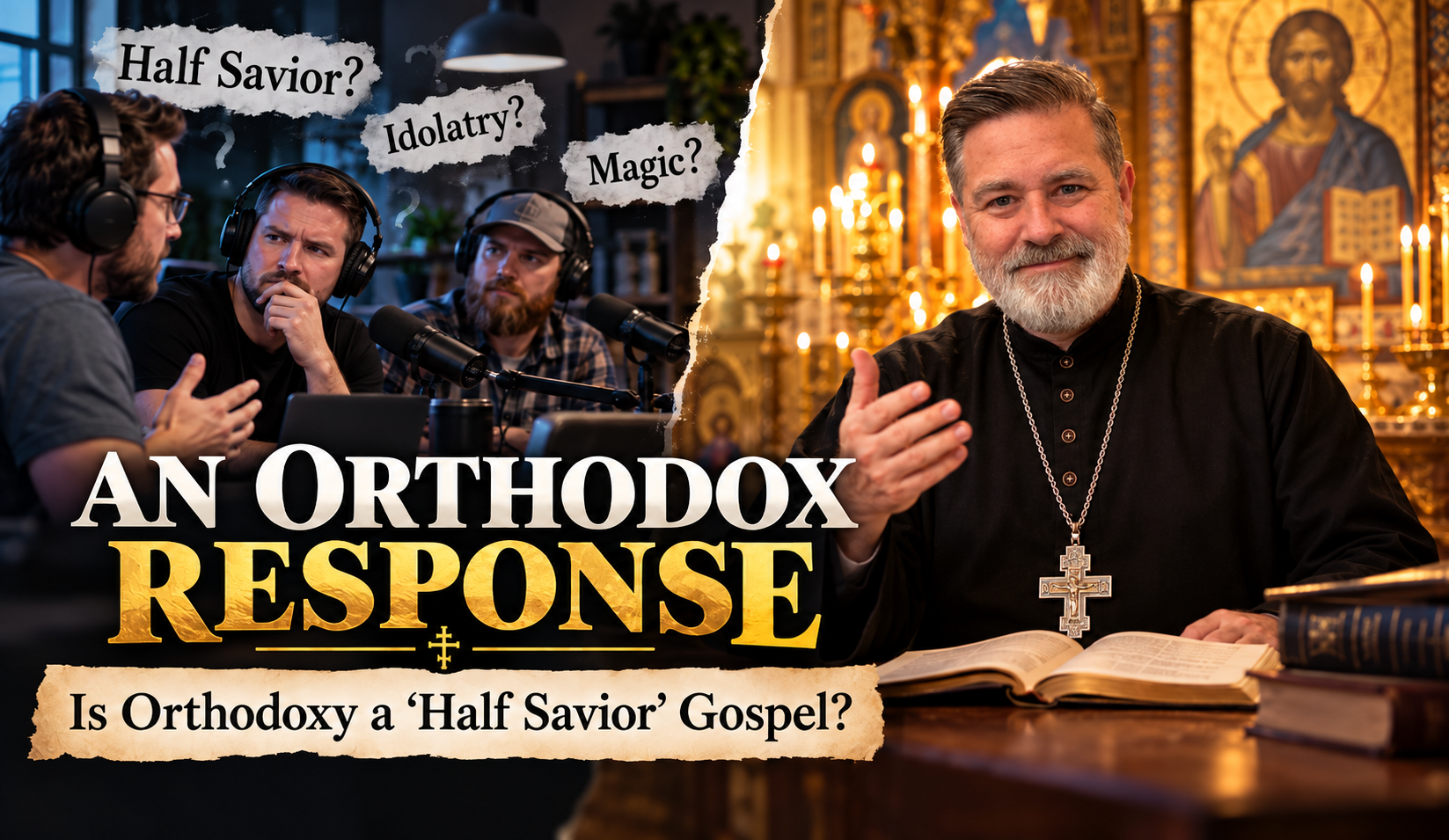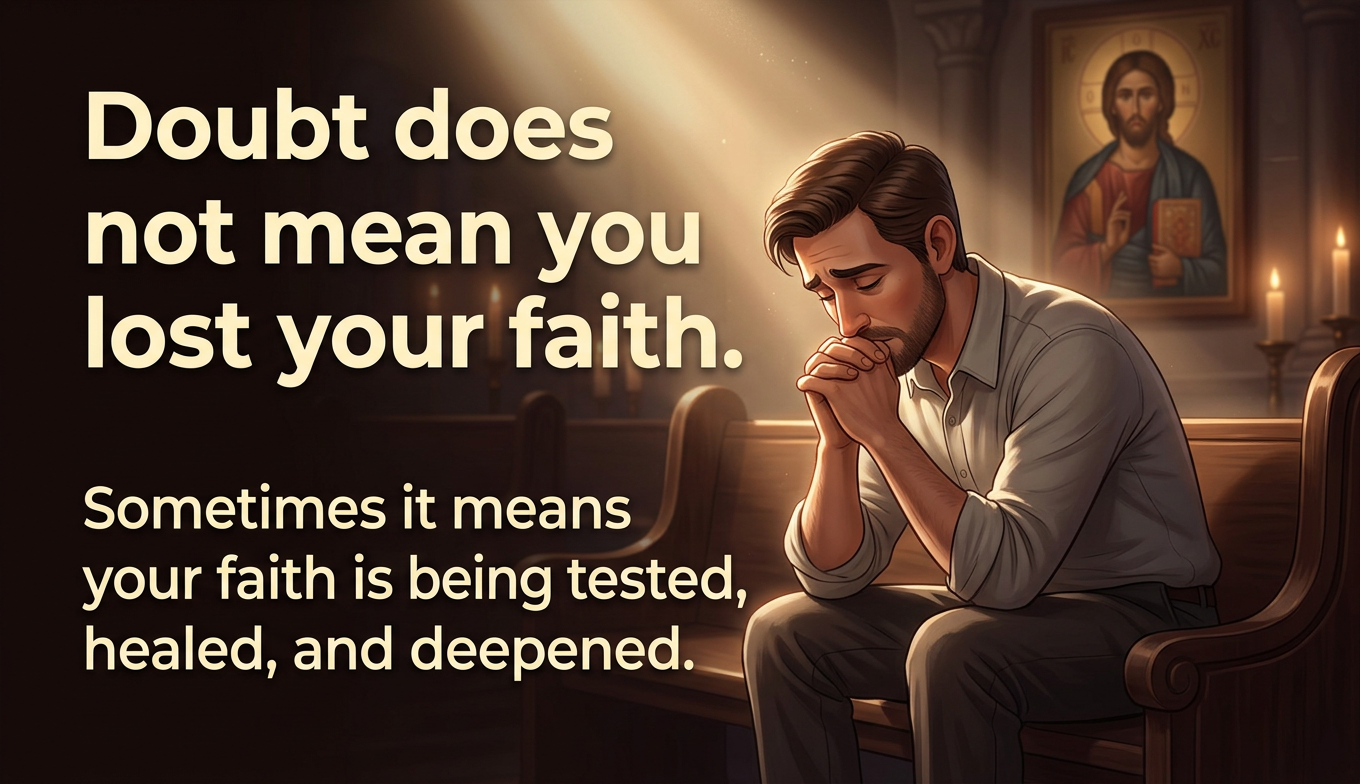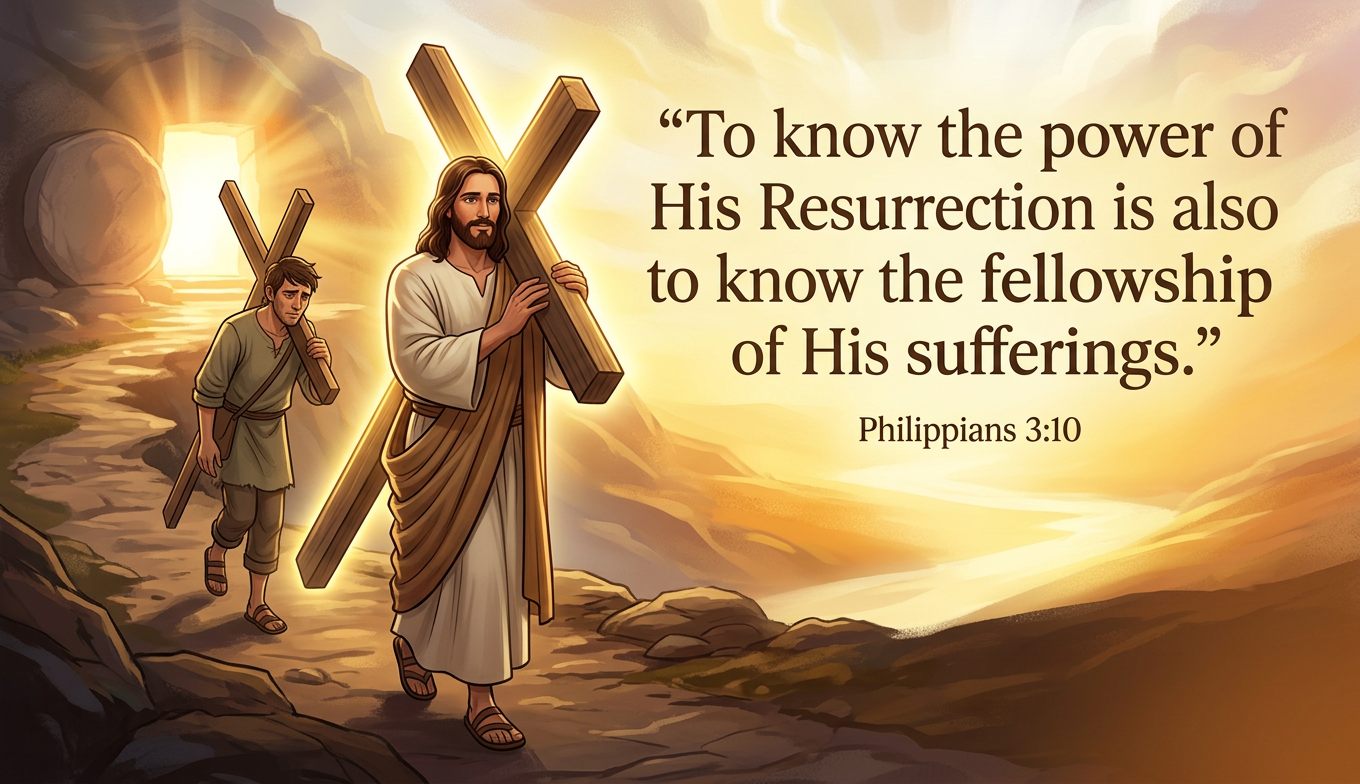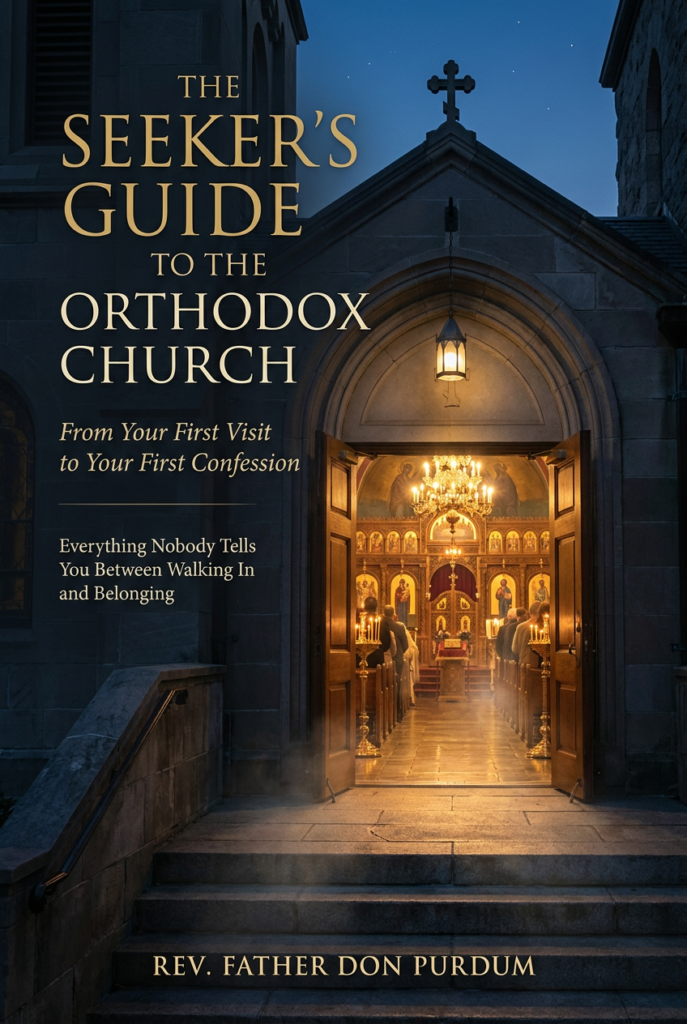
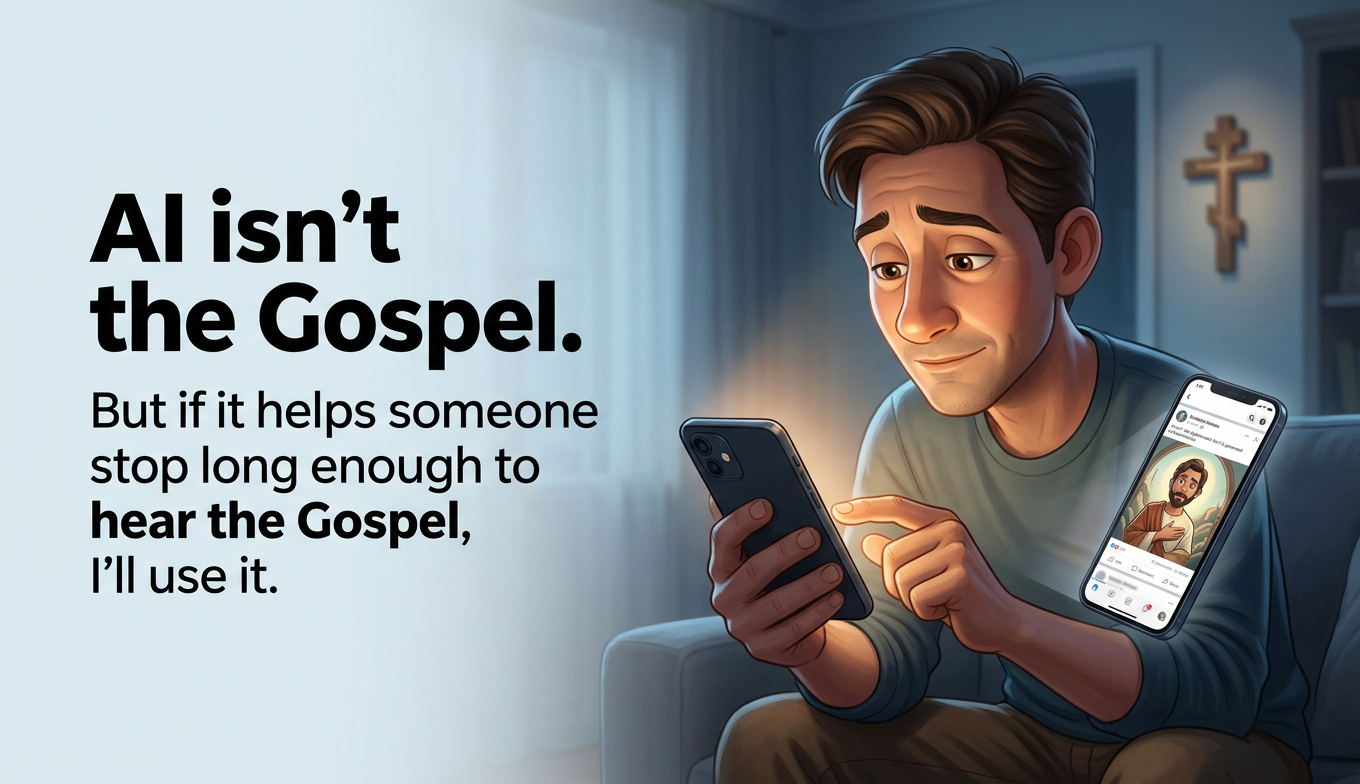
For the last year, I have used AI-generated semi-cartoonish images with many of my Facebook posts.
The images were never intended to replace the message. They were intended to help people stop scrolling long enough to encounter it.
I write every word of the text myself.
The theology is mine. The stories are mine. The pastoral reflections are mine. The arguments are mine. The prayers, explanations, questions, and calls to repentance come from me.
The AI-generated image is an illustration.
Yet over the past several months, I received criticism from some people who strongly objected to my use of these images. Some simply disliked the style. Others objected because the images were generated using artificial intelligence. A few seemed to believe that using AI-generated artwork was itself somehow inappropriate for Christian ministry.
I listened.
I did not immediately dismiss the criticism. As a priest, I have to ask more than, “Am I allowed to do this?”
I also have to ask:
Is this helping people?
Is it distracting people?
Is it becoming a stumbling block?
Is the tool serving the Gospel, or is the tool beginning to overshadow the Gospel?
Those are legitimate questions.
So I conducted a little experiment.
I stopped using the images.
And what happened surprised me.
What Happened When I Stopped Using AI Images
For nearly a week, I posted without a single AI-generated semi-cartoonish image.
The difference was dramatic.
I had been averaging approximately 147,000 people reached per day.
Without the images, that number fell to approximately 27,000 per day.
Those numbers by themselves do not tell me precisely why it happened. Facebook’s algorithms may treat text-only posts differently. People may simply scroll past a large block of text when there is nothing visually catching their attention. It may be some combination of both.
But the practical result was difficult to ignore.
Fewer people were encountering the posts.
That meant fewer opportunities to talk about Christ.
Fewer opportunities to explain Scripture.
Fewer opportunities to introduce someone to a saint.
Fewer opportunities to explain Orthodox theology.
Fewer opportunities to answer misconceptions about the Church.
Fewer opportunities to reach the person quietly wondering whether God has forgotten him.
So on Saturday, I told people what had happened and asked them directly.
I essentially said, “Help me understand this. Do you like the images or dislike them? Tell me why.”
The response was overwhelming.
Hundreds of people responded.
The vast majority said they preferred the images.
Even more revealing, many told me something I had not expected:
They had barely seen my posts during the week when I stopped using them.
Only a relatively small number said they opposed or disliked the AI-generated images.
That experience forced me to think about a larger question.
Not merely:
Should I use AI images?
But:
How should Christians think about AI at all?
I believe we need something more thoughtful than either blind enthusiasm or immediate condemnation.
We need a theology of discernment.
A Tool Is Not the Same Thing as the Use of the Tool
Christians have confronted new technologies many times before.
The printing press could distribute pornography.
It could also print Bibles.
Radio could broadcast hatred, propaganda, and obscenity.
It could also broadcast the Gospel.
Television has communicated enormous amounts of foolishness and corruption.
It has also allowed millions of people to witness historical events, receive education, hear sermons, and encounter Christian teaching.
The internet gave humanity unprecedented access to pornography, conspiracy theories, deception, and vice.
It also made the writings of the Church Fathers available to someone sitting alone at two o’clock in the morning wondering whether Christianity has anything deeper to offer.
Google spent decades using extraordinarily sophisticated algorithms to organize the internet.
Those algorithms could take you to godly things or ungodly things.
The existence of misuse did not automatically make the technology itself sinful.
Consider something far more dramatic.
Nuclear technology can generate enormous amounts of electricity. It can power cities and provide energy to millions of human beings.
The same knowledge can be weaponized to destroy cities and potentially threaten human civilization.
The moral question cannot simply be:
“Is this technology powerful?”
The deeper question must be:
“Toward what end is this power being directed?”
St. John Chrysostom made essentially this distinction when discussing wealth. He wrote that “neither is wealth an evil, nor poverty in itself.” What matters is the free choice of those who use them.
His subject was wealth, not artificial intelligence.
But the moral principle is remarkably applicable.
A thing can become the occasion for terrible evil without therefore being intrinsically evil in itself.
Money can feed a hungry child or purchase drugs.
A knife can prepare someone’s dinner or murder someone.
A camera can preserve a family’s memories or create pornography.
A smartphone can connect someone with a priest at the darkest moment of his life or become the instrument through which he destroys his marriage.
The moral character of our actions involves not simply the existence of the instrument, but the purpose, disposition, truthfulness, and consequences surrounding its use.
AI requires precisely this kind of discernment.
“But AI Can Be Used for Evil”
Absolutely.
That is not seriously debatable.
AI can be used to deceive.
It can manufacture false photographs.
It can imitate voices.
It can impersonate people.
It can generate pornography.
It can spread propaganda.
It can enable fraud.
It can be used irresponsibly by students to avoid learning, by writers to avoid thinking, and by Christians to project spiritual wisdom they do not actually possess.
Those things should concern us.
But notice the logical mistake we can easily make.
The fact that something can be abused does not prove that every use of it is abuse.
If that were our standard, Christians would have to abandon most modern technology.
The real Christian response is not panic.
It is discernment.
St. Paul wrote:
“All things are lawful for me, but not all things are helpful.”
1 Corinthians 6:12
And again:
“All things are lawful, but not all things are helpful. All things are lawful, but not all things edify.”
1 Corinthians 10:23
That is a much more mature Christian framework.
The question is not merely whether something is technically permissible.
Does it edify?
Does it serve another human being?
Does it communicate truth?
Does it encourage virtue?
Does it tempt me toward vanity?
Does it deceive someone?
Does it replace something genuinely human that ought not be replaced?
Does it help me fulfill the work God has actually given me?
Those questions are far more useful than simply attaching the word “AI” to something and declaring it either wonderful or evil.
The Fathers Teach Us to Take What Is Useful
St. Basil the Great gave young Christians a fascinating approach to the pagan literature surrounding them.
He did not tell them that everything outside explicitly Christian writing was worthless.
Neither did he tell them to absorb everything indiscriminately.
He taught discernment.
Using the imagery of the bee, St. Basil points toward gathering what is beneficial without consuming everything one encounters. Elsewhere he tells Christians, “Take the bee for your model.”
That seems remarkably relevant to our technological moment.
We do not have to worship technology.
We do not have to fear technology.
We have to discern technology.
Take what is useful.
Reject what is harmful.
Recognize its limitations.
Guard your heart.
Do not allow the tool to become your master.
And use whatever good can legitimately be found within it for the glory of God.
AI Should Assist Human Creativity, Not Eliminate Human Responsibility
This is an important distinction for me.
When I create a Facebook post, I am not asking artificial intelligence to become Father Don.
I am not asking a machine to have faith for me.
AI cannot pray for me.
It cannot repent for me.
It cannot love Christ for me.
It cannot stand before the altar for me.
It cannot hear someone’s confession.
It cannot hold the hand of a grieving widow.
It cannot look into someone’s eyes while he tells me his marriage is falling apart.
It cannot receive the Eucharist.
It cannot become holy.
Those are human realities.
AI has no nous to purify, no passions to overcome, no soul progressing toward theosis.
So when I use an AI-generated image to accompany something I have written, I understand exactly what it is.
It is a tool.
I wrote the message.
I chose the subject.
I determined the theological content.
I decided what needed to be said.
I considered how it should be communicated.
Then I used technology to create an illustration that might help someone notice the message.
That distinction matters.
Christians Have Always Used the Communication Tools Available to Them
Christianity is not a religion opposed to communication technology.
The Apostles wrote letters using the communication systems available in the Roman world.
Christians copied manuscripts.
The Church developed extraordinarily sophisticated visual communication through iconography, architecture, mosaics, hymnography, and liturgical symbolism.
Christians eventually used the printing press.
Then newspapers.
Then radio.
Then television.
Then websites.
Then email.
Then podcasts.
Then YouTube.
Then Facebook.
Now artificial intelligence has entered the picture.
None of those mediums guarantees holiness.
None guarantees corruption either.
Each presents opportunities.
Each presents dangers.
And each requires discernment.
The Church’s mission has never depended upon finding a perfectly uncontaminated technology.
It has depended upon Christians faithfully using what is available without allowing themselves to be conformed to the spirit of the age.
There Is Also a Question of Mission
Here is where my little Facebook experiment became much more than a question of aesthetics.
Suppose I personally prefer text-only posts.
Suppose a semi-cartoonish image is not my favorite artistic style.
But suppose that image causes someone to stop scrolling.
They read the first paragraph.
Then the second.
Then something hits them.
Perhaps they have never heard that the Eucharist was understood as the Body and Blood of Christ from the earliest centuries of Christianity.
Perhaps they discover St. Ignatius of Antioch.
Perhaps they encounter the Jesus Prayer.
Perhaps they learn why Orthodox Christians venerate icons.
Perhaps they begin questioning assumptions they have held about Christianity for thirty years.
Perhaps they find my parish.
Perhaps they walk through the doors on Sunday morning.
Perhaps they meet Christ there.
Now the question becomes different.
Was the cartoonish picture the Gospel?
Of course not.
It was the road sign.
The sign is not the destination.
But road signs still matter.
When my reach dropped from approximately 147,000 to 27,000 per day after removing these illustrations, I had to confront the practical consequences of abandoning a tool simply because some people disliked it.
I was listening to the critics.
But perhaps I was unintentionally becoming less accessible to the people I was actually trying to reach.
That matters too.
But Numbers Cannot Become Our God
There is an important warning here.
I do not want anyone reading this to conclude that the Christian principle is:
“If it increases engagement, do it.”
Absolutely not.
That would be its own form of idolatry.
The Gospel is not a marketing campaign.
Christ did not call us to maximize impressions.
The Apostles were not influencers.
Truth does not become more true because Facebook rewards it.
If posting something dishonest gave me two million views, I should not post it.
If anger generated ten times the engagement of peace, I should not manufacture outrage.
If sensationalism produced followers, I should not distort the faith to gain them.
If controversy increased reach, I should not intentionally provoke people simply to feed an algorithm.
There are things more important than numbers.
Truth.
Integrity.
Love.
Faithfulness.
The salvation of souls.
So numbers are not the ultimate standard.
But neither are numbers completely meaningless.
If the Church is commanded to proclaim the Gospel, then whether people are actually hearing us is worth considering.
Reach is not the mission.
People are the mission.
Behind every number is a person.
We Must Also Take Scandal Seriously
There is another side to this.
Christian freedom never means indifference toward our neighbor.
If something I do creates an unnecessary stumbling block, I should be willing to examine it.
That is one reason I stopped using the images temporarily.
I wanted to know.
Was my personal preference getting in the way?
Were people so distracted by the image that they could no longer hear the message?
Those were legitimate concerns.
But Christian love does not mean that the existence of criticism gives every critic veto power over ministry.
If one hundred people are helped by something and three object to it, the existence of those three objections does not automatically make the thing wrong.
Otherwise nothing could ever be done.
Many decades ago I learned something that remains painfully true:
You cannot please everyone.
There will always be someone who dislikes the font.
The music.
The sermon length.
The website.
The photograph.
The priest’s beard.
The lack of the priest’s beard.
The church building.
The terminology.
The way an article is written.
And now, apparently, the illustrations.
Christian discernment requires listening to criticism without becoming ruled by criticism.
Sometimes critics see something we cannot see ourselves.
Sometimes they save us from genuine mistakes.
Sometimes they are simply expressing preferences.
Wisdom is learning the difference.
The Deeper Danger Is Not AI. It Is the Human Heart.
I suspect this is the part of the conversation that gets overlooked.
We are worried about artificial intelligence.
Perhaps we should be even more worried about human passions using artificial intelligence.
Pride can use AI.
Greed can use AI.
Lust can use AI.
Deception can use AI.
Vanity can use AI.
But humility can use technology too.
Education can use it.
Medicine can use it.
Missionary work can use it.
Translation can use it.
Accessibility can use it.
Christian evangelism can use it.
AI magnifies human intention and capability. That makes discernment more important, not less important.
Technology does not eliminate the spiritual struggle.
It gives the spiritual struggle new territory.
My Principles for Using AI
After listening to the criticism, conducting this experiment, and hearing from hundreds of people, I have arrived at several principles that I intend to follow.
First, AI should serve the message, never become the message.
If people remember the picture but never encounter Christ, something has gone wrong.
Second, I should not use AI to intentionally deceive people.
An illustration should function as an illustration. I should never manufacture something designed to convince people that a fictional event actually happened.
Third, human responsibility cannot be surrendered to a machine.
If my name is attached to something, I remain responsible for what it says.
Fourth, technology should increase ministry without replacing ministry.
An AI image may help someone discover my parish. It cannot replace welcoming that person when he walks through the door.
Fifth, criticism deserves consideration, but not automatic obedience.
We listen. We pray. We examine the fruit. Then we make the best decision we can.
Sixth, effectiveness matters, but faithfulness matters more.
I want people to see these posts. But I will not sacrifice truth simply to make people see them.
Finally, every tool must remain subordinate to Christ.
The moment technology begins shaping our values rather than serving them, something has gone terribly wrong.
AI Is Here. The Question Is What Christians Will Do With It.
Whether we like artificial intelligence or not, it is not disappearing.
We can complain about that.
We can fear it.
We can idolize it.
We can misuse it.
Or we can approach it with the kind of spiritual sobriety Christianity has always required when encountering the powers and possibilities of this world.
I believe Christians should learn how these technologies work.
We should identify their dangers.
We should establish moral boundaries.
We should defend human dignity.
We should refuse deception.
We should resist allowing machines to replace genuinely human relationships.
And where these tools can legitimately be used for good, I believe we should use them for good.
If an image helps someone stop scrolling long enough to hear about Christ, I am willing to use the image.
If technology allows the writings of St. John Chrysostom to reach someone who has never heard his name, I am grateful for the technology.
If an algorithm places a teaching about repentance before someone who desperately needs to repent, I will not apologize because an algorithm helped deliver it.
The algorithm is not holy.
The computer is not holy.
Artificial intelligence is not holy.
Christ is holy.
The tool is simply a tool.
And perhaps the better question for Christians is not:
“Can this tool be used for evil?”
Almost every powerful tool can.
Perhaps the better questions are:
Can this be used truthfully?
Can this be used responsibly?
Can this be used without violating human dignity?
Can this help me love my neighbor?
Can this help communicate what is good, beautiful, and true?
Can this serve the Gospel rather than distort it?
If the answer is yes, then I believe we should be very careful before declaring something evil simply because it is new.
The Christian life has never called us to fear every new instrument human beings create.
It calls us to something much harder.
Discernment.
To know what to receive.
To know what to reject.
To know how far to go.
To know when to stop.
And above all, to make certain that whatever is placed into our hands remains a servant rather than becoming our master.
As for the semi-cartoonish images?
You will probably start seeing them again.
Not because everyone likes them.
They don’t.
Not because artificial intelligence is flawless.
It certainly isn’t.
But because after listening, experimenting, examining the results, and hearing from hundreds of you, I have become convinced that these simple illustrations are helping more people encounter the message I am trying to share.
And if a picture causes someone to stop scrolling long enough to hear about Jesus Christ, the Scriptures, the saints, the traditions of the Church, or the ancient Orthodox faith, then I believe that is a tool worth using.
Carefully.
Honestly.
Responsibly.
And always for the glory of God.
Want the entire article distilled into one clear, printable page?
Download your free summary and keep it with you.
Get the free PDF + join thousands of people receiving short, practical Orthodox insights in the “Morning Brew with Father Don” to help you grow in Christ each week.