Fasting is one of those ancient Christian practices that can seem strange to modern Christians.
For many people, the word itself immediately sounds negative.
It sounds like deprivation.
It sounds like religious rule keeping.
It sounds like giving up food in order to prove devotion to God.
And for Christians coming from Protestant or evangelical backgrounds, there is often an additional question:
Why are Orthodox Christians still doing this at all?
Didn’t Christ fulfill the Law?
Didn’t Jesus declare all foods clean?
Didn’t Saint Paul warn Christians against becoming obsessed with dietary regulations?
So why does the Orthodox Church still tell Christians to abstain from meat, dairy, eggs, wine, oil, and sometimes fish throughout different periods of the year?
To understand the answer, we first have to understand what fasting actually is.
What Is Christian Fasting?
At its simplest, fasting is the voluntary restraint of our appetite for the sake of spiritual growth.
It is deliberately saying no to something we are permitted to have so that we can learn not to be ruled by what we desire.
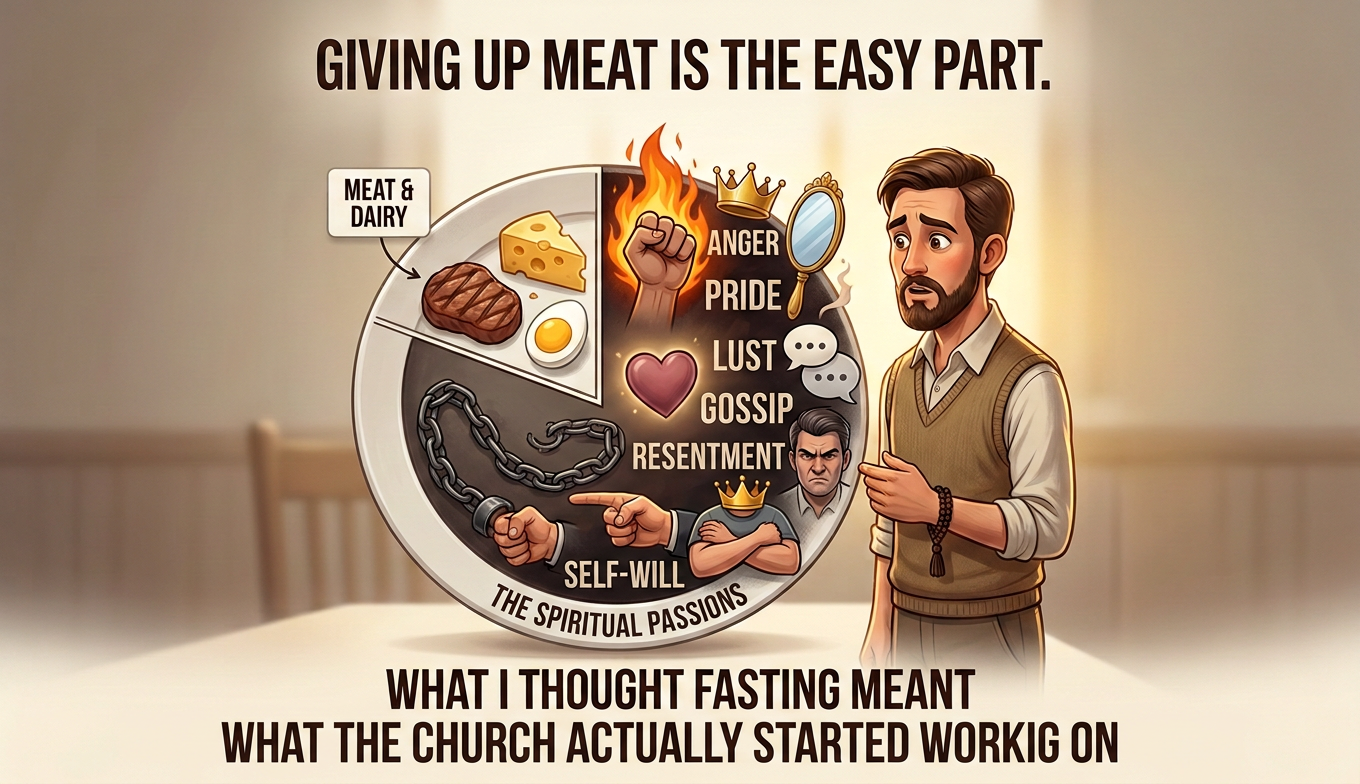
That is why Orthodox fasting is not fundamentally about food.
Food is simply where the training begins.
Human beings are creatures of appetite. We hunger for food, certainly, but we also hunger for comfort, pleasure, attention, control, entertainment, approval, sex, possessions, recognition, and countless other things.
None of those desires is automatically evil.
The problem begins when desire becomes domination.
When “I would like this” becomes “I must have this.”
When “I enjoy this” becomes “I cannot function without this.”
When an appetite begins determining our choices rather than remaining under the lordship of Christ, that appetite has become spiritually dangerous.
Fasting confronts that problem in an extraordinarily practical way.
The stomach says:
“Feed me what I want.”
The fast replies:
“No, not everything I want must be obeyed.”
That sounds incredibly simple.
Spiritually, however, it is profound.
Because learning to say no to the stomach helps train the heart to say no elsewhere.
No to anger.
No to lust.
No to gossip.
No to resentment.
No to drunkenness.
No to impulsive spending.
No to endless entertainment.
No to pride.
No to the thousand little demands our passions make upon us every day.
Fasting is therefore not primarily a dietary practice.
It is an ascetical practice.
The Greek word behind asceticism carries the idea of training or exercise.
Think of an athlete.
An athlete does not train because the body is evil.
He trains because the body must be disciplined if it is going to accomplish what it was created to accomplish.
In the same way, the Christian does not fast because food is evil or because the body is bad.
We fast because the whole human person is being trained for communion with God.
Fasting Is Older Than Orthodoxy as We Know It
Fasting is not some strange custom invented by medieval monks.
It runs throughout Scripture.
Moses fasted.
Elijah fasted.
The people of Israel fasted during times of repentance and spiritual crisis.
The prophets spoke repeatedly about fasting.
Saint John the Baptist lived an intensely ascetical life.
And most importantly, Jesus Christ Himself fasted.
Before beginning His public ministry, Christ entered the wilderness and fasted for forty days.
That fact alone should make us cautious about dismissing fasting as unnecessary legalism.
If fasting had no spiritual value, Christ would not have fasted.
But He went even further.
When Jesus taught His disciples about spiritual life in Matthew 6, He spoke about three practices almost side by side:
Almsgiving.
Prayer.
Fasting.
And notice His language.
Jesus says:
“When you give…”
“When you pray…”
And then:
“When you fast…”
Matthew 6:16.
He does not say, “If you happen to fast.”
He assumes His followers will.
What Christ condemns is not fasting.
He condemns hypocrisy.
He condemns turning the fast into religious theater.
Do not walk around looking miserable so everyone knows how spiritual you are.
Do not use asceticism to gain admiration.
Do not turn fasting into pride.
Christ did not abolish fasting.
He purified it.
But Didn’t Christ Fulfill the Law?
Yes.
Absolutely.
And this distinction is essential.
Orthodox Christians are not keeping the dietary laws of ancient Israel.
The old covenant contained distinctions between clean and unclean foods. Those dietary laws helped distinguish Israel from the nations and belonged to Israel’s covenantal life under the Law.
Christ fulfilled that Law.
Jesus declared foods clean.
Peter’s vision in Acts 10 dramatically confronted the old clean and unclean distinctions.
Saint Paul warned Christians against treating dietary regulations as though they themselves make us righteous before God.
So an Orthodox Christian does not avoid meat during Lent because meat has somehow become spiritually contaminated.
Pork is not unclean.
Cheese is not sinful.
Eggs do not separate you from God.
The Church’s fasting discipline is not Torah observance disguised as Christianity.
That is why one sentence from this whole discussion is worth remembering:
We do not fast because food is unclean. We fast because our hearts are disordered.
Christ fulfilled the Law, but He did not abolish asceticism.
The old dietary laws asked questions about what could be eaten within Israel’s covenantal life.
Christian fasting asks a different question:
What has mastery over me?
That is why Saint Paul’s words in 1 Corinthians 6:12 are so important:
“I will not be dominated by anything.”
Christian freedom does not mean that I must exercise every freedom available to me.
Quite the opposite.
True freedom means that I am increasingly able to say:
“I can have this, but I do not need this.”
That is fasting.
Why Do Orthodox Christians Still Fast?
Because the human heart has not stopped needing training.
Christ has risen.
Death has been defeated.
The Law has been fulfilled.
But I can still become angry.
I can still become greedy.
I can still become lustful.
I can still become addicted to comfort.
I can still make pleasure into an idol.
I can still become obsessed with food, money, entertainment, alcohol, attention, politics, technology, or the approval of other people.
The Resurrection did not turn Christians into people who no longer need repentance.
Quite the opposite.
Because we belong to Christ, we now enter deliberately into the work of healing the passions.
That is where fasting belongs.
Fasting is not how we earn salvation.
It is what people who are being saved learn to do with their freedom.
We discipline our appetites because we want Christ to become the center of our desires.
We remove some comforts because we want to discover where our real comfort lies.
We allow ourselves to become hungry because we need to remember that our deepest hunger cannot be satisfied by bread.
Christ Himself said:
“Man shall not live by bread alone, but by every word that proceeds from the mouth of God.”
Fasting makes that truth physical.
For a few hours, or for a season of the Church year, the body feels the absence of something it normally receives.
And every time that desire rises, it can become a reminder:
I hunger for Christ more than I hunger for this.
At least, that is what we are learning to say.
The Apostolic Church Continued Fasting
This also answers the idea that fasting disappeared after the Resurrection.
It did not.
The Book of Acts records Christians continuing to fast.
In Acts 13, the Church was worshiping and fasting when the Holy Spirit called Barnabas and Saul to missionary work.
Then the Christians prayed and fasted before sending them out.
That happened after Christ’s Resurrection.
The earliest Christians also developed specifically Christian fasting days.
The Didache, one of the earliest Christian writings outside the New Testament, witnesses to fasting on Wednesdays and Fridays.
That practice remains embedded in Orthodox life.
Wednesday recalls the betrayal of Christ.
Friday recalls His Crucifixion.
So every week, the Church places the Passion of Christ into the rhythm of our bodies.
We do not merely remember the Cross intellectually.
Our lives are rearranged around it.
Then Why Do We Have Great Lent?
This brings us to Lent.
Great Lent is not forty days during which Orthodox Christians pretend certain foods suddenly become evil.
Lent is forty days during which the Church intentionally rearranges our lives.
We pray more.
We simplify our food.
We repent.
We worship.
We give.
We confess.
We become more attentive.
We prepare ourselves to enter more deeply into the mystery of Christ’s Passion and Resurrection.
The fast creates space.
And sometimes what happens in that space surprises us.
Take away someone’s normal coffee and see what happens.
Remove a favorite food.
Skip the evening glass of wine.
Stop ordering takeout.
Simplify meals.
Suddenly irritation can appear.
Impatience surfaces.
Complaining begins.
We discover just how deeply certain comforts have attached themselves to our hearts.
Lent did not create those passions.
Lent revealed them.
That is one of fasting’s great gifts.
Fasting Is Not Dieting
This distinction is incredibly important.
Because it is entirely possible to fast Orthodox foods while completely missing the Orthodox fast.
A diet primarily asks:
“What will eating this way do to my body?”
Christian fasting asks:
“What is happening in my relationship with God, my neighbor, and my passions?”
A diet may measure calories.
A diet may measure carbohydrates.
A diet may measure your weight.
A diet may measure body fat.
Fasting does not work that way.
The fruits we are looking for are repentance, humility, prayer, generosity, self-control, attentiveness, mercy, and love.
You could lose twenty pounds during Great Lent and accomplish almost nothing spiritually.
You could technically follow every food restriction perfectly while becoming angry, judgmental, proud, irritable, and obsessed with ingredients.
If that happens, something has gone wrong.
The goal of the fast is not simply changing what enters your mouth.
The goal is allowing Christ to change what is happening inside your heart.
Fasting Creates a Boundary Around Appetite
This may be one of the most practical ways to understand fasting.
Fasting creates a voluntary boundary.
Your appetite says:
“I want this.”
The fast replies:
“Not everything I want must immediately be obeyed.”
That is a powerful lesson.
And it goes far beyond food.
Because the person who cannot tell his stomach “no” may also struggle to tell his anger “no.”
Or his lust.
Or his shopping.
Or his drinking.
Or his entertainment.
Or his gossip.
Or his social media addiction.
Or his resentment.
Or his desire for comfort.
Food becomes one small battlefield in a much larger spiritual war.
The Church is teaching us how to say:
“No. You are not my master.”
Our passions are terrible masters.
Christ alone belongs on the throne of the human heart.
Fasting Is Not Punishing the Body
There is another misunderstanding we need to avoid.
Orthodox Christianity does not believe the body is evil.
We are not trying to punish the body until the soul becomes spiritual enough.
That is not Christianity.
Human beings are embodied creatures.
We pray with our bodies.
We make the sign of the Cross.
We bow.
We prostrate.
We kiss icons.
We smell incense.
We hear chanting.
We receive Holy Communion into our bodies.
We give physical possessions to people in need.
So of course repentance involves the body.
Salvation concerns the whole human person.
Fasting works through the body because the body and soul are not two unrelated worlds.
What I do physically affects me spiritually.
And what is happening spiritually often reveals itself physically.
You Can Keep the Menu and Break the Fast
This is something Orthodox Christians themselves need to hear.
It is possible to keep the fasting menu and completely break the spirit of the fast.
You can avoid meat and spend a fortune on elaborate vegan substitutes.
You can avoid dairy while spending hours searching for the perfect fasting dessert.
You can refuse eggs while devouring gossip.
You can give up cheese while feeding your mind rage-filled political media every evening.
You can abstain from meat while judging the person sitting beside you who is eating it.
You can follow every food regulation and complain the entire time.
You can fast from dairy while consuming pornography.
You can save money by eating simply and never give a dollar of those savings to someone who is hungry.
This is why the Fathers repeatedly remind us that the outward fast must be accompanied by an inward fast.
Fast from anger.
Fast from gossip.
Fast from lust.
Fast from judgment.
Fast from greed.
Fast from bitterness.
Fast from self-will.
But notice something important.
That does not mean we replace the food fast with something else.
People sometimes tell me:
“Instead of fasting from meat, I am fasting from Facebook.”
Perhaps you should fast from Facebook.
It might do some of us tremendous spiritual good.
But that does not automatically make it a replacement for the fast the Church has given us.
There is something spiritually important about receiving a discipline rather than designing one ourselves.
The Rule Is Given to Us, Not Invented by Us
Modern Christianity is extremely individualistic.
We naturally think:
“I’ll choose what works for me.”
“I’ll decide what I want to give up.”
“I’ll create my own spiritual plan.”
Orthodoxy challenges that instinct.
The Church gives us a common rhythm.
We fast together.
We feast together.
We pray together.
We worship together.
That means I do not always get to choose the spiritual discipline that feels most meaningful to me.
Sometimes obedience itself is part of the medicine.
Perhaps giving up chocolate would be harder for you than giving up meat.
Fine.
You could give up chocolate too.
But the point of the Church’s common fast is not simply identifying your favorite pleasure and eliminating it.
The common fast teaches us that Christianity is not merely “Jesus and me.”
We belong to a Body.
When Do Orthodox Christians Fast?
For someone new to Orthodoxy, the fasting calendar can initially seem complicated.
The basic rhythm is actually fairly understandable.
Wednesdays and Fridays
With certain designated fast-free periods and exceptions, Orthodox Christians traditionally fast on Wednesday and Friday.
Wednesday commemorates the betrayal of Christ.
Friday commemorates His Crucifixion.
This gives every week a small ascetical rhythm centered on the Passion of Christ.
Great Lent and Holy Week
Great Lent prepares us for Pascha, the Feast of Christ’s Resurrection.
This is the fasting season most people associate with Orthodoxy.
The traditional preparation begins gradually. Meat is removed after Meatfare Sunday, followed by dairy and eggs after Cheesefare Sunday.
During the stricter periods of the fast, fish, wine, and oil may also be limited.
The Apostles’ Fast
The Apostles’ Fast occurs after Pentecost and concludes with the feast of Saints Peter and Paul.
Its length varies from year to year because its beginning depends on the date of Pascha.
The Dormition Fast
The Dormition Fast traditionally runs from August 1 through August 14 and prepares us for the Feast of the Dormition of the Mother of God.
The Nativity Fast
The Nativity Fast runs from November 15 through December 24 and prepares us for the celebration of Christ’s Nativity.
The Christian year, therefore, develops a beautiful rhythm.
Fast.
Feast.
Fast.
Feast.
Repent.
Rejoice.
Prepare.
Celebrate.
Orthodoxy does not worship deprivation.
We fast so that we may also learn how to feast rightly.
So What Do Orthodox Christians Actually Eat?
At the most recognizable practical level, fasting meals generally center around plant-based foods.
Vegetables.
Fruit.
Grains.
Beans.
Lentils.
Rice.
Nuts.
Seeds.
Bread.
Pasta prepared without restricted ingredients.
During many fasting periods, Orthodox Christians abstain from:
- Meat
- Dairy
- Eggs
Depending upon the specific day and fasting season, fish, wine, and oil may also be restricted or permitted.
This is why Orthodox calendars often contain fasting indicators for particular days.
There are also particular feast days that occur during fasting seasons when certain foods may again be permitted.
This can sound complicated when someone is first learning Orthodoxy.
Do not panic.
You are learning a rhythm, not preparing for an exam.
What About Seafood?
This often confuses people.
Traditional Orthodox fasting practice frequently distinguishes fish with backbones from shellfish and other seafood.
Certain calendars and local traditions handle these distinctions differently, and particular feast days may permit fish even during a fasting season.
This is one reason I strongly encourage people not to build their Orthodox fasting practice from random internet charts.
Ask your priest.
Follow the practice of your parish.
Orthodoxy is lived in the Church, not assembled through Google searches.
The Eucharistic Fast Is Different
There is also another form of fasting that should be distinguished from the seasonal fasts.
Orthodox Christians traditionally prepare to receive Holy Communion by abstaining from food and drink for a period before the Divine Liturgy.
The precise application of the Eucharistic fast should be discussed with your priest or confessor.
It is connected to our preparation to approach the Holy Mysteries and should not simply be confused with Wednesday and Friday fasting or with Great Lent.
Fasting Must Be Pastoral
Now we need an extremely important word of caution.
The fasting rule is medicine.
It is not a competition.
It is not a spiritual CrossFit program.
The goal is not to discover the strictest fasting rule you can physically survive and then congratulate yourself for surviving it.
Age matters.
Health matters.
Pregnancy matters.
Medications matter.
Eating disorders matter.
Physical occupations matter.
Poverty matters.
Travel can matter.
There are legitimate reasons why someone may need a fasting rule adapted to his or her circumstances.
This is why Orthodoxy gives us priests and confessors.
The question is not:
“What is the strictest possible rule I can endure?”
The better question is:
“What kind of fasting will actually teach me repentance, obedience, humility, and dependence upon Christ?”
Sometimes zeal can be another form of pride.
The person eating bread and vegetables should not judge the diabetic whose priest has blessed a modified fast.
The elderly should not be made to feel guilty because their health requires something different.
Parents must be wise with children.
Someone recovering from an eating disorder may require a very different ascetical discipline.
Fasting is medicine.
Medicine is applied to actual people.
Fasting, Prayer, and Almsgiving Belong Together
The Church does not give us fasting by itself.
Prayer, fasting, and almsgiving belong together.
If your meals become simpler, perhaps you have a little extra money.
Give some of it away.
If you spend less time thinking about food, use some of that time to pray.
Attend another service.
Read Scripture.
Pray the Jesus Prayer.
Go to Confession.
Call someone who is lonely.
Forgive someone.
Feed someone.
Help someone quietly.
Fasting empties us.
Prayer turns that emptiness toward God.
Almsgiving turns it toward our neighbor.
Separated from prayer and generosity, fasting easily degenerates into religious dieting.
Fasting Is Eucharistic
There is something even deeper happening.
The first great human tragedy in Scripture involves food.
Adam and Eve receive creation outside obedience to God.
They grasp.
They take.
They consume.
Instead of receiving creation eucharistically, meaning with thanksgiving and communion with God, they attempt to possess it apart from God.
We have been repeating the pattern ever since.
I see.
I want.
I take.
I consume.
I want more.
Fasting interrupts that cycle.
For a short time, I voluntarily step away from something good so that I may learn how to receive it again properly.
Not as something I deserve.
Not as something I must possess.
Not as something without which I cannot function.
But as gift.
Christian asceticism is not ultimately about rejecting creation.
It is about learning to receive creation correctly.
Fasting Teaches Us to Long for Christ
Jesus once described Himself as the Bridegroom.
When people asked why His disciples were not fasting at that moment, Christ said the days would come when the Bridegroom would be taken away.
Then they would fast.
Matthew 9:15.
Christian fasting therefore contains longing.
Christ has come.
Christ has risen.
Christ is present among His people.
Christ gives Himself to us in the Eucharist.
And yet we still await the fullness of His Kingdom.
Our fasting bodily expresses that longing.
We hunger.
We wait.
We prepare.
We pray.
Come, Lord Jesus.
“But Father, Aren’t All Foods Clean?”
Yes.
Absolutely.
And that is precisely the point.
We are not fasting from meat because meat is sinful.
We are voluntarily abstaining from something good because learning to say no even to good things helps train us to say no to destructive things.
Cheese may be clean.
But my appetite can still be disordered.
Wine may be good.
But my relationship with wine may not be.
Food is not the problem.
The heart is where the battle occurs.
Christ fulfilled the Law, but that fulfillment does not make fasting meaningless.
It reveals what Christian fasting has become.
We are no longer distinguishing ourselves from the nations through clean and unclean foods.
We are training the whole human person for communion with God.
Wednesday and Friday.
Great Lent.
The Apostles’ Fast.
The Dormition Fast.
The Nativity Fast.
Again and again the Church teaches us to hunger.
To wait.
To repent.
To pray.
To give.
And finally, to feast.
So perhaps the most important question concerning fasting is not:
“Father, what am I forbidden to eat?”
The deeper question is:
“What has my heart learned that it cannot live without?”
And then comes the question that matters even more:
Is Christ first among those things?
Want the entire article distilled into one clear, printable page?
Download your free summary and keep it with you.
Get the free PDF + join thousands of people receiving short, practical Orthodox insights in the “Morning Brew with Father Don” to help you grow in Christ each week.