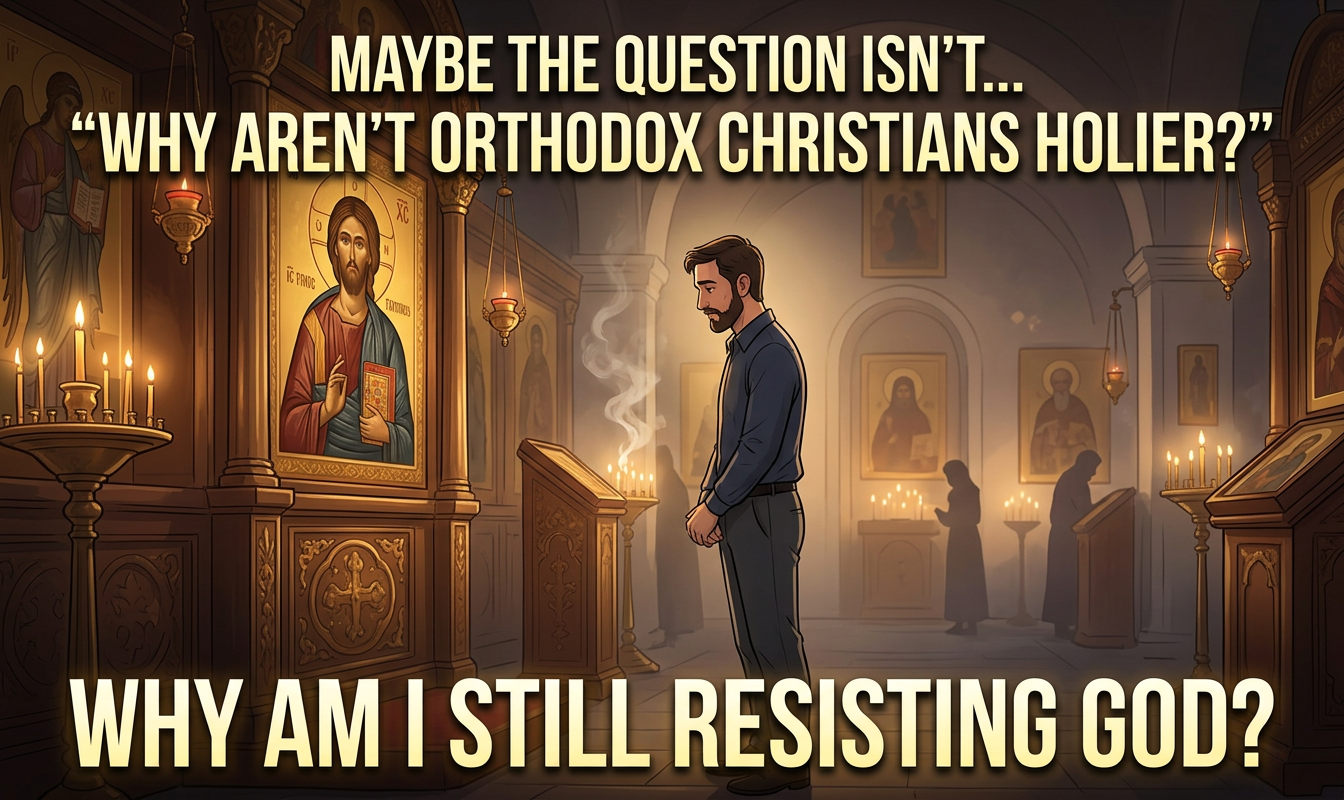
There is a criticism of Orthodoxy that I think Orthodox Christians need to stop avoiding.
It goes something like this:
If theosis is true, where is the fruit?
If the Orthodox Church really possesses this ancient understanding of salvation as participation in the life of God, why are Orthodox Christians still angry?
Why are we still proud?
Why are we still divisive, bitter, hypocritical, addicted, cruel, worldly, unforgiving, judgmental, and spiritually mediocre?
If Orthodoxy teaches that salvation is not merely a legal declaration but an actual transformation of the human person, should we not expect Orthodox Christians to look transformed?
That is not an unfair question.
In fact, I think it is one of the most serious questions Orthodox Christians can be asked.
And I do not want to answer it by becoming defensive.
I want us to allow the question to do what a good spiritual question should do.
I want it to expose us.
Because Christianity really does claim transformation.
What Theosis Actually Means
We need to begin by defining theosis correctly.
Theosis does not mean that human beings become God by nature.
There is only one God.
We remain human beings forever.
The Orthodox Church has never taught that we somehow dissolve into the divine essence or become additional members of the Holy Trinity.
Nor does theosis mean that Christians eventually achieve some kind of psychological or moral flawlessness where they never struggle, never suffer temptation, and never stumble.
Theosis is the lifelong transformation of the human person through communion with God.
It is participation in the divine life by grace.
St. Peter describes Christians as becoming:
“partakers of the divine nature.”
2 Peter 1:4
We participate in the life and energies of God while remaining completely human.
Theosis is what happens as the human person is healed, purified, illumined, and increasingly united to God through the Father, in the Son, by the Holy Spirit.
It begins sacramentally in Baptism.
We are united with Christ.
We are sealed with the gift of the Holy Spirit in Chrismation.
We receive the Body and Blood of Christ in the Eucharist.
We return again and again through repentance and Confession.
We pray.
We fast.
We give alms.
We forgive.
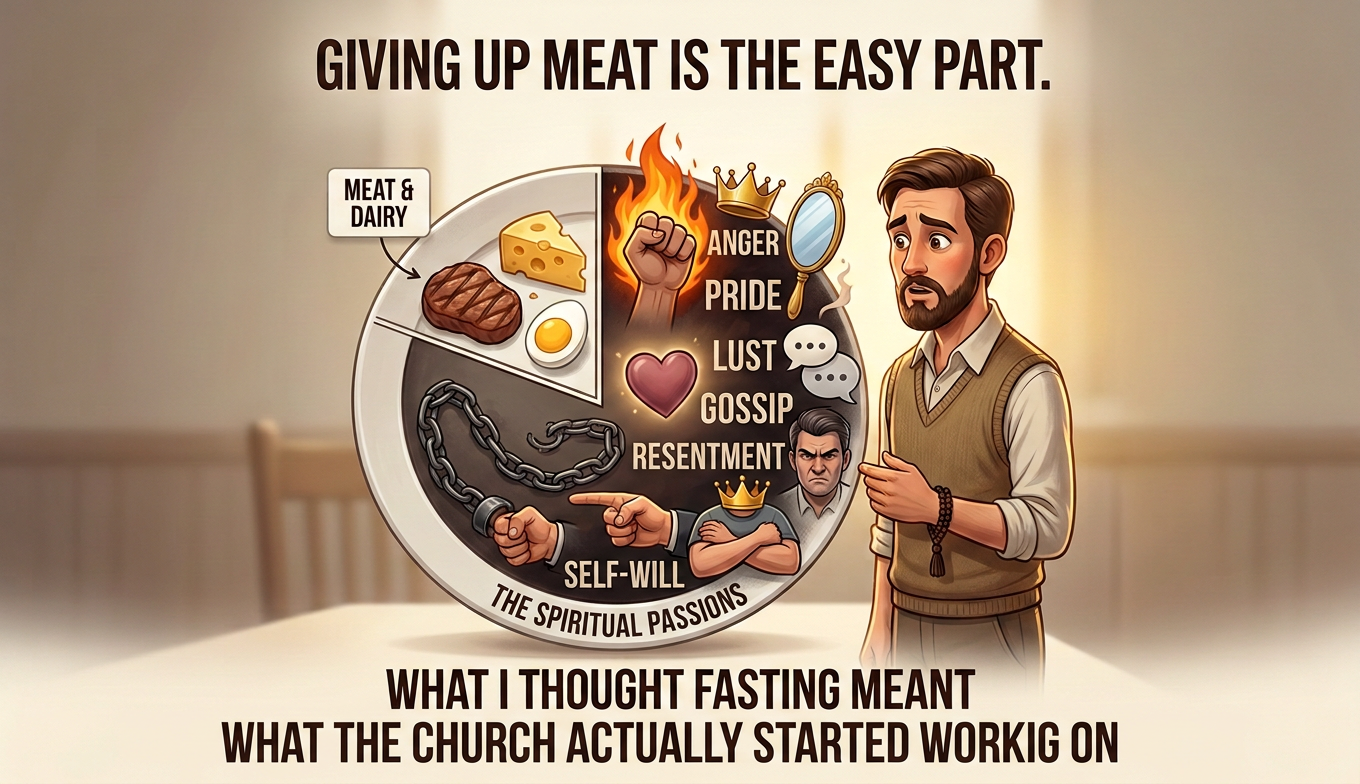
We struggle against the passions.
We learn to love.
We fall.
We repent.
We get up again.
And through this entire life of communion with God, something begins to happen to the human person.
We become more like Christ.
That is theosis.
But Here Is the Part We Sometimes Leave Out
Theosis is possible.
It is not automatic.
Being baptized does not mechanically make someone holy.
Receiving the Eucharist does not automatically transform someone regardless of how that person lives.
Going to Divine Liturgy does not guarantee spiritual maturity.
Owning icons does not produce humility.
Knowing the Fathers does not produce repentance.
Growing a beard does not produce holiness.
Knowing the correct theology does not mean that we have actually allowed that theology to change us.
God gives grace freely.
But the human person must cooperate with grace.
This is what the Orthodox Church means when it speaks of synergy.
God acts.
We respond.
God calls.
We follow.
God gives Himself.
We must receive Him.
The Church can place medicine before us, but she will not force us to swallow it.
And that means a person can spend decades standing inside the Church while resisting the very transformation the Church is offering.
Yes, Some Orthodox Christians Should Be Holier Than We Are
I think we need to say something uncomfortable.
Yes.
Some Orthodox Christians should be visibly holier than they are.
Some of us should be more patient by now.
Some of us should be more forgiving by now.
Some of us should be less angry by now.
Some of us should be less concerned with being right and more concerned with becoming righteous.
Some of us should have learned how to apologize.
Some of us should have learned how to forgive our enemies.
Some of us should have become more generous.
Some of us should have become more compassionate.
Some of us should have become less defensive, less prideful, and less obsessed with the failures of everyone around us.
And this includes clergy.
It includes priests.
It includes bishops.
It includes converts.
It includes cradle Orthodox Christians.
It includes people who have been receiving the Eucharist for fifty years.
We cannot defend the doctrine of theosis by pretending that spiritual mediocrity does not exist inside Orthodox churches.
It does.
The real question is why.
You Can Inherit Orthodoxy Without Being Formed by Orthodoxy
Part of the problem is catechesis.
A person can inherit Orthodoxy culturally without ever deeply learning Orthodoxy spiritually.
Someone can know when to make the sign of the Cross.
He can know when to bow.
He can know how to venerate an icon.
He can know what foods to avoid during Lent.
He can know the melody of the hymns.
He can know whether Pascha falls before or after Western Easter.
He may even know the debates surrounding the filioque, papal supremacy, the Ecumenical Councils, essence and energies, apostolic succession, and the history of the schism.
And he may still be cruel to his wife.
He may still refuse to forgive his brother.
He may still gossip.
He may still lie.
He may still harbor hatred.
He may still be ruled by lust.
He may still worship money.
He may still be consumed by political rage.
He may still humiliate people.
He may still refuse Confession.
He may still never pray outside the Divine Liturgy.
That person may know Orthodoxy.
But knowing Orthodoxy is not necessarily the same thing as living Orthodoxy.
And I think this distinction desperately needs to be recovered.
Information Is Not Transformation
One of the great dangers in modern Orthodox Christianity is confusing theological information with spiritual transformation.
You can define theosis and never experience it.
You can explain hesychasm and never become quiet before God.
You can discuss the nous and never purify your heart.
You can quote St. Maximus the Confessor and refuse to forgive the person sitting three pews away from you.
You can defend the Real Presence of Christ in the Eucharist while remaining completely indifferent to the hungry person outside the church doors.
You can win every theological argument online and lose your soul to pride.
Theology is not simply speaking about God.
True theology comes from knowing God.
Christianity is not primarily about accumulating correct religious information.
It is about becoming united with Christ.
That is why Christ says:
“Blessed are the pure in heart, for they shall see God.”
Matthew 5:8
He does not say, “Blessed are those who can explain every doctrinal controversy.”
Knowledge matters.
Doctrine matters.
Truth matters.
But doctrine exists to lead us into communion.
Theology should bring us to repentance.
The Fathers should bring us to prayer.
The sacraments should lead us into union with Christ.
The truth should change us.
Participation Is the Missing Category
This is where I think the discussion about theosis often becomes confused.
A person can be sacramentally located within the Church and still resist the life into which the sacraments are calling him.
Orthodox Christianity is profoundly participatory.
We participate in the Eucharist.
We participate through repentance.
We participate through prayer.
We participate through fasting.
We participate through almsgiving.
We participate by struggling against the passions.
We participate through Confession.
We participate by forgiving those who have wounded us.
We participate by reconciling ourselves with our brothers and sisters.
We participate when we humble ourselves.
We participate when we get back up after falling.
We participate when we bring our entire life to Christ.
This is not about earning grace.
Grace cannot be purchased.
Theosis is not a spiritual wage God pays us because we fasted enough Wednesdays and Fridays.
It is about opening ourselves to the grace already being poured out upon us.
God will not force communion upon us.
Love never does.
Forty Years of Eucharist Should Mean Something
Now we come to the uncomfortable part.
Suppose someone has received the Eucharist for forty years.
Forty Paschas.
Forty Great Lents.
Forty years of hearing the Gospel.
Forty years of receiving the Body and Blood of Christ.
Forty years of standing before icons of saints.
Forty years of hearing, “Let us love one another.”
And after forty years that person is no more forgiving than when he began.
No more patient.
No more compassionate.
No more truthful.
No more humble.
No more loving.
What should we say?
We cannot simply shrug our shoulders and say:
“Well, nobody is perfect.”
Of course nobody is perfect.
That is not the issue.
The issue is whether transformation is taking place.
Christianity claims that transformation is possible.
Christ Himself said:
“By their fruits you will know them.”
Matthew 7:20
So where is the fruit?
That question should not offend us.
It should drive us toward repentance.
Because if there is no fruit, something needs examination.
Maybe I am receiving the sacraments while refusing repentance.
Maybe I am fasting while feeding my pride.
Maybe I am attending Liturgy while refusing to forgive.
Maybe I am confessing sins without actually attempting to change.
Maybe I am studying theology because knowing things about God is easier than surrendering something to God.
Maybe I have substituted Orthodox identity for Orthodox spirituality.
That possibility should frighten us.
The Church Is a Hospital
At the same time, we must reject another error.
Theosis does not mean instant perfection.
The Church has always understood salvation medicinally.
Christ is the Physician.
Sin is sickness.
The passions distort the human person.
Grace heals.
Repentance is part of that healing.
The sacraments are medicine.
The Church is therefore more like a hospital than a museum of saints.
And hospitals contain people at radically different stages of healing.
Some people have just arrived.
Some are beginning treatment.
Some are recovering.
Some are fighting for their lives.
Some have experienced remarkable healing.
Some keep refusing the medicine.
Some take the medicine inconsistently.
Some leave treatment and return later.
Some relapse.
Some struggle for years against the same passion.
Some fall ten thousand times and repent ten thousand and one.
So when you walk into an Orthodox parish, you should not expect to find a room filled with perfected human beings.
You are entering a hospital.
The presence of sick people does not disprove medicine.
But if nobody in the hospital is getting better, then we have every right to ask whether the medicine is actually being used.
That is the distinction.
Look at the Saints
This is why the strongest evidence for theosis is not the average nominal Orthodox Christian.
It is the saints.
Orthodoxy does not claim that every baptized Orthodox Christian reaches the same degree of holiness.
It never has.
What the Church claims is that human beings who profoundly cooperate with divine grace can actually be transformed.
And then she points to the saints.
Look at St. Mary of Egypt.
Look at St. Seraphim of Sarov.
Look at St. Silouan the Athonite.
Look at St. Porphyrios.
Look at St. Paisios.
Look at St. Nektarios.
Look at the martyrs who forgave their executioners.
Look at men and women who renounced wealth, pride, comfort, reputation, and self-will because they desired God more than anything else.
These were not people who simply acquired Orthodox religious information.
They participated.
They prayed.
They repented.
They fasted.
They forgave.
They suffered.
They struggled.
They fell.
They got back up.
They surrendered themselves to God again and again.
And eventually the life of Christ became visible through them.
That is what holiness is.
The saints are not exceptions that disprove our humanity.
They are witnesses to what human beings can become when human nature is healed by grace.
What Does Theosis Actually Look Like?
We sometimes talk about theosis in such lofty theological language that we forget how practical it is.
Want to know what theosis looks like?
St. Paul tells us.
“The fruit of the Spirit is love, joy, peace, patience, kindness, goodness, faithfulness, gentleness, self-control.”
Galatians 5:22-23
There is your test.
Not mystical vocabulary.
Not theological sophistication.
Not how many prayer ropes you own.
Not how many Orthodox podcasts you listen to.
Not whether you know the difference between ousia and energies.
Are you becoming loving?
Are you becoming joyful?
Are you becoming peaceful?
Are you becoming patient?
Are you becoming kind?
Are you becoming good?
Are you becoming faithful?
Are you becoming gentle?
Are you developing self-control?
Are you becoming more like Jesus Christ?
That is what matters.
Theosis should eventually become visible.
It becomes visible in how you treat your spouse.
It becomes visible in how you speak to your children.
It becomes visible in how you treat a waiter who gets your order wrong.
It becomes visible in what happens when someone insults you.
It becomes visible in whether you forgive.
It becomes visible in how you use money.
It becomes visible in whether you tell the truth when lying would be easier.
It becomes visible when you are exhausted, frustrated, embarrassed, or wounded.
It becomes visible when nobody is watching.
The purpose of Christianity is not simply that we believe correct things about Christ.
It is that Christ begins to live through us.
His hands become our hands.
His compassion becomes our compassion.
His mercy becomes our mercy.
His love becomes visible through our lives.
Parish Life Must Be About More Than Attendance
This critique cannot remain focused only on individual Christians.
Those of us who lead parishes must also examine ourselves.
Are we actually forming Christians?
Or are we simply maintaining churches?
Are we catechising people into repentance?
Or merely teaching them Orthodox terminology?
Are we showing people how to pray?
Are we teaching them how to confess?
Are we helping them understand the passions?
Are we teaching forgiveness?
Are we calling people toward sexual purity?
Are we challenging materialism?
Are we forming people in generosity?
Are we teaching people how to struggle against anger?
Are we teaching spiritual watchfulness?
Are we creating communities where Christians are accountable for their spiritual lives?
Or are we satisfied when people attend Liturgy, donate money, show up for festivals, and occasionally participate in parish events?
This question matters tremendously.
A person can convert to Orthodoxy and spend years learning what Orthodoxy believes while receiving very little formation in how an Orthodox Christian actually lives.
That should concern us.
Catechesis cannot end when someone is Chrismated.
In many ways, that is when catechesis truly begins.
Because learning Orthodoxy and becoming Orthodox are not exactly the same thing.
Becoming Orthodox means learning to live a life of continual repentance and communion with Christ.
Orthodoxy Without Repentance Becomes Triumphalism
There is another danger here.
The doctrine of theosis should make Orthodox triumphalism almost impossible.
If we truly believe that the Orthodox Church preserves the fullness of the sacramental and therapeutic life given by Christ, then our response should not be self-congratulation.
It should be trembling.
Because greater grace means greater accountability.
Saying:
“We have the true Church.”
can become spiritually dangerous if it replaces the much more important question:
“Am I actually being transformed into the likeness of Christ?”
Imagine a man lying in the finest hospital in the world.
He has access to the best physicians.
The best medicine.
The best treatment.
And every day he boasts to the patients in neighboring hospitals about how superior his hospital is.
But he refuses to take the medicine.
What good is his boasting?
That is exactly the danger of Orthodox triumphalism.
The fullness of the faith is not a trophy.
It is a summons.
It is a responsibility.
It is a call to repentance.
The proper response to discovering Orthodoxy should never be:
“Now I finally know why everyone else is wrong.”
The proper response is:
“Dear God, now that I have been given so much, teach me to repent.”
Where Is the Fruit?
So let us return to the original objection.
If theosis is true, why are Orthodox Christians not visibly holier?
Sometimes the answer is painfully simple.
Because we are not participating deeply enough in the life that theosis describes.
The failure of individual Orthodox Christians to become holy does not disprove theosis.
But it may reveal how little many of us are actually cooperating with grace.
It may expose our shallow catechesis.
It may expose our pride.
It may expose our nominal Christianity.
It may expose our unwillingness to repent.
And the doctrine of theosis should make us more accountable for that, not less.
There should be fruit.
Maybe not immediately.
Maybe not dramatically.
Maybe not in ways that attract attention.
But over time, something should change.
More patience.
More mercy.
More humility.
More forgiveness.
More prayer.
More compassion.
Less anger.
Less pride.
Less judgment.
Less obsession with ourselves.
More Jesus Christ.
Because the goal of Christianity is not simply to make religious people.
The goal is the healing and transformation of the human person through communion with God.
The goal is Christ formed in us.
The goal is holiness.
The goal is theosis.
And perhaps the question Orthodox Christians should fear is not:
“If theosis is true, why aren’t Orthodox Christians holier?”
Perhaps the question we should fear is this:
“If theosis is truly being offered to me in the Church, why am I still resisting it?”
Want the entire article distilled into one clear, printable page?
Download your free summary and keep it with you.
Get the free PDF + join thousands of people receiving short, practical Orthodox insights in the “Morning Brew with Father Don” to help you grow in Christ each week.