
What St. Anthony the Great, the Desert Fathers, and the ancient Church can teach us about Halloween, our fascination with darkness, and the unseen battle for the human soul.
Every October, something strange happens in our culture.
We decorate our homes with images of death. We hang skeletons from our porches. We fill our yards with gravestones, dismembered bodies, and frightening creatures. We dress our children as monsters, demons, and the undead. And we spend billions of dollars entertaining ourselves with images of torture, violence, bloodshed, and evil.
Then we call it fun.
But I want to ask you a question that may make you uncomfortable.
When did Christians become so comfortable celebrating the very things Christ came to destroy?
Think about that for a moment.
We worship a Savior who conquered death, yet we decorate our homes with death. We proclaim that Jesus Christ has defeated Satan, yet we turn demonic imagery into entertainment. We teach our children that they are called to become holy, yet we invite them to laugh at and sometimes imitate the very darkness the Scriptures warn us against.
And when someone raises a concern, the response is almost predictable.
“Father, it’s just Halloween. It’s harmless fun.”
But is it?
I’m not suggesting that every child wearing a costume is worshiping Satan. I’m not suggesting that parents handing out candy are consciously invoking demons. Nor do I believe that every autumn celebration is spiritually dangerous.
What I am suggesting is that we have become so accustomed to darkness that we have stopped questioning why we find it entertaining.
And this is precisely where the wisdom of the early Church becomes so important.
Because the early Christians understood something that our modern world has largely forgotten.
The spiritual world is real. Demons are real. And the battle for the human soul is far more subtle than most people imagine.
The early Church never questioned the reality of demons
One of the greatest differences between ancient Christianity and much of modern Christianity is how seriously the early believers understood spiritual warfare.
For the early Church, demons were not fictional characters invented to frighten children. They were fallen spiritual beings who actively sought to separate humanity from communion with God.
The Apostle Paul warned:
“For we wrestle not against flesh and blood, but against principalities, against powers, against the rulers of the darkness of this world, against spiritual wickedness in high places.” (Ephesians 6:12, KJV)
Notice what Paul does not say.
He does not say that our greatest battle is against people with whom we disagree. He does not say that our struggle is primarily political, cultural, or intellectual.
He tells us that behind the visible struggles of this world there is also an invisible spiritual battle.
The Orthodox Church has never abandoned this understanding.
In fact, before someone is baptized into the Orthodox faith, the prayers of the Church explicitly include renunciation of Satan and his works. The person turns away from Satan and unites himself to Christ.
Why?
Because becoming a Christian is not simply accepting a set of religious ideas. It is entering into the life of Jesus Christ and turning away from everything that opposes Him.
This is why the Church takes seriously what we allow into our minds, what we entertain in our hearts, and what we teach our children to admire.
And perhaps no early Christian illustrates this more powerfully than St. Anthony the Great.
St. Anthony: The man who confronted the demons

In the fourth century, St. Athanasius of Alexandria wrote one of the most influential biographies in Christian history, The Life of St. Anthony.
Anthony was an Egyptian Christian who left behind his possessions to seek God through prayer, fasting, solitude, and repentance.
But what Anthony discovered in the desert was not simply peace and quiet.
He discovered spiritual warfare.
St. Athanasius describes Anthony’s encounters with demonic temptation in remarkable detail.
Interestingly, the devil’s first attacks were not dramatic appearances of frightening creatures.
They were thoughts.
According to Athanasius, the enemy reminded Anthony of the wealth he had abandoned, the responsibilities he had left behind, the pleasures he might have enjoyed, and the difficulties of pursuing holiness.
The goal was to convince Anthony that following Christ was simply too costly.
This is important.
The devil did not begin by asking Anthony to worship him. He began by trying to make Anthony question whether obedience to God was worth the sacrifice.
When these temptations failed, the attacks became more terrifying.
Athanasius recounts how Anthony withdrew into a tomb to pray, where he endured violent assaults attributed to demons.
At one point, Anthony was found lying on the ground, apparently near death. He was carried back to the village, but once he regained his strength, he insisted on returning to the tomb.
His response was extraordinary.
Even as he lay injured, he proclaimed that nothing would separate him from the love of Christ, echoing the Apostle Paul’s words in Romans 8:35.
Then came another assault.
Athanasius describes demons appearing in terrifying forms, filling the tomb with the likenesses of wild animals and other threatening creatures.
But Anthony recognized something that many Christians today have forgotten.
The demons wanted his attention.
They wanted his fear.
They wanted him to become so overwhelmed by their frightening displays that he would lose sight of Christ.
Yet Anthony refused.
In The Life of St. Anthony, chapter 23, Athanasius records Anthony’s teaching that demons attempt to deceive believers through evil thoughts and, when these fail, through frightening appearances. But he also explains that these manifestations need not terrify Christians because faith, prayer, and the sign of the Cross defeat their attempts at intimidation.
The point is not that Christians should become fascinated by demons.
It is precisely the opposite.
Anthony would not allow the demons to become the center of his attention.
He understood that the Christian life is not about becoming an expert in darkness. It is about becoming so united to Christ that darkness loses its power over us.
What if the greatest demonic deception is making evil entertaining?
This brings us back to Halloween.
Consider the contrast.
In the fourth century, demons appeared to St. Anthony in terrifying forms because they wanted to frighten him and distract him from God.
Today, we willingly spend money to surround ourselves with many of those same images.
We turn them into costumes, decorations, movies, games, and entertainment.
And then we wonder why someone might suggest that there is a spiritual problem.
Now, I want to be careful here. A plastic skeleton is not automatically a demonic presence. A child dressing as a fictional character is not the same as participating in an occult ritual.
But I believe there is a much deeper issue we are failing to recognize.
We have allowed our culture to teach us that evil deserves our fascination.
The more grotesque the image, the more attention it receives.
The more disturbing the violence, the more exciting the entertainment becomes.
The more terrifying the depiction of demonic activity, the more eagerly people consume it.
And gradually, what once disturbed our conscience begins to amuse us.
Consider how many horror films depend upon human suffering for entertainment. Scenes of torture, murder, cruelty, and desecration are packaged as enjoyable experiences.
We buy tickets. We purchase costumes. We gather with friends to watch.
We laugh.
And sometimes we even cheer.
Why?
At what point did the suffering of another human being, even a fictional one, become something we celebrate?
At what point did evil become something we admire for its creativity?
At what point did images associated with the enemies of God become charming decorations?
These are not unreasonable questions.
They are precisely the kinds of questions Christians should be asking.
St. Anthony understood that demonic temptation often begins by influencing the imagination, introducing thoughts that gradually capture the heart.
And this is why we must be careful about what we repeatedly choose to contemplate.
The enemy does not need us to consciously worship him if he can persuade us to become indifferent toward the things that destroy the soul.
St. John Chrysostom warned about the entertainment of his own day
St. John Chrysostom, the great fourth-century Archbishop of Constantinople, frequently warned Christians about the influence of public entertainment.
His world had no horror movies, streaming services, or Halloween attractions.
But it certainly had spectacles that exploited human weakness, lust, cruelty, and the appetite for excitement.
In his fifteenth homily On the Statues, Chrysostom warned that seemingly insignificant entertainments could lead people toward far more serious sins. He specifically criticized theaters and public spectacles for their capacity to encourage disordered passions and destructive behavior.
In Homily 37 on Matthew, he challenged Christians who sought delight in corrupt spectacles while neglecting the better joys available in family life, nature, and the remembrance of the saints.
His reasoning was deeply pastoral.
What we repeatedly enjoy influences what we begin to desire.
And what we desire eventually influences how we live.
This is exactly why the Orthodox Church teaches us to guard the heart.
We do not become holy merely by avoiding certain outward behaviors.
We become holy by allowing Christ to transform our desires, our thoughts, our imagination, and our affections.
This is what the Fathers call purification of the heart.
Christ Himself said:
“Blessed are the pure in heart: for they shall see God.” (Matthew 5:8)
If our hearts are continually filled with images of violence, terror, hatred, and cruelty, how can we expect those images to have no influence upon our spiritual lives?
Certainly, not everyone who enjoys a scary movie becomes violent or cruel. That would be an irresponsible claim.
But the absence of an obvious behavioral consequence does not mean there is no spiritual consequence.
Sometimes the damage is far more subtle.
We become less sensitive to suffering.
We become less disturbed by cruelty.
We become more comfortable with what is spiritually ugly.
And perhaps most dangerously, we stop recognizing that anything has changed.
Halloween and the danger of becoming comfortable with darkness
There is another issue I want us to consider.
Halloween is not simply one thing. Its history includes ancient seasonal customs, later Western Christian observances surrounding All Saints’ Day, and modern secular traditions that have developed over generations.
The name itself comes from All Hallows’ Eve, the evening before the Western observance of All Saints.
We should not pretend that every Halloween tradition has the same meaning or that every family participates for the same reasons.
Orthodox Christians themselves have taken different pastoral approaches to Halloween. Some avoid it altogether, while others distinguish neighborhood activities and innocent costumes from occult practices or entertainment that glorifies evil.
But historical complexity does not eliminate the need for spiritual discernment.
In fact, it makes discernment even more important.
The question is not simply whether Halloween began as something Christian or pagan.
The more important question is this:
What is this celebration teaching us to love today?
When children dress as firefighters, astronauts, or their favorite storybook characters and collect candy from their neighbors, that is substantially different from intentionally glorifying Satan, participating in occult practices, or delighting in depictions of torture and murder.
We should be honest enough to recognize those distinctions.
Nevertheless, I believe the modern cultural fascination with the demonic, the grotesque, and the violent represents a serious spiritual problem.
The Apostle Paul writes:
“And have no fellowship with the unfruitful works of darkness, but rather reprove them.” (Ephesians 5:11, KJV)
And again:
“Abhor that which is evil; cleave to that which is good.” (Romans 12:9, KJV)
These instructions are not limited to our outward behavior.
They also challenge what we celebrate, what we admire, and what we invite into our hearts.
When Christians knowingly glorify cruelty, celebrate demonic imagery as something desirable, or pursue occult experiences, we are cooperating with the very darkness we renounced at baptism.
That is a serious statement, and I do not make it lightly.
But spiritual participation is not limited to kneeling before an altar and offering worship.
We also participate in things through our choices, habits, desires, and affections.
When we repeatedly choose to delight in evil, we allow evil to influence us.
This does not mean that every person who celebrates Halloween is consciously participating in demonic worship. It means we must examine whether particular choices are drawing us toward Christ or training our hearts to become comfortable with what opposes Him.
And that brings us to something that is perhaps even more important than Halloween itself.
The battlefield is the human heart
The Desert Fathers understood that spiritual warfare usually does not begin with spectacular demonic manifestations.
It begins with thoughts.
A temptation appears.
We entertain it.
We begin to imagine it.
Eventually, we develop an affection for it.
And what we once resisted becomes something we welcome.
The Fathers described this process with remarkable spiritual insight.
St. Hesychios the Priest, writing in the tradition of the Desert Fathers, emphasized nepsis, or watchfulness, as an essential part of the Christian life.
Watchfulness means remaining spiritually attentive to the thoughts, desires, and images that approach the heart.
In his teaching on watchfulness, preserved in the Philokalia, St. Hesychios explains that through vigilance and God’s grace, Christians can resist destructive thoughts before they develop into sinful actions.
This is not the same as becoming anxious about every passing thought.
Nor should Christians assume that every unwanted thought comes directly from a demon.
The Fathers distinguish between the appearance of a temptation and our voluntary acceptance of it.
A thought can enter the mind without becoming a sin.
The danger arises when we begin to embrace it, cultivate it, and find pleasure in it.
And this is where our cultural fascination with darkness becomes relevant.
When we willingly immerse ourselves in images of demonic power, cruelty, sexual violence, or the desecration of human life, what are we teaching our imagination to enjoy?
Are we cultivating compassion?
Are we strengthening purity?
Are we developing love for our neighbor?
Are we becoming more attentive to the presence of Christ?
Or are we training ourselves to derive pleasure from images that contradict the beauty and goodness of God?
These are questions every Christian should take seriously, and not merely during October.
Because Halloween lasts one evening.
But the formation of the soul takes place every single day.
How should Christians respond to people who believe Halloween is innocent fun?
This is where I want to offer a pastoral word.
If you are convinced that certain Halloween practices are spiritually harmful, the solution is not to become angry at your neighbors.
It is not to shame parents.
It is not to frighten children.
And it certainly is not to declare that every Christian who takes a child trick-or-treating is intentionally serving Satan.
That approach is neither fair nor spiritually helpful.
Remember what St. Paul told us.
Our struggle is not against flesh and blood.
The family next door is not your enemy. The parents handing out candy are not your enemy. The people who disagree with you are not your enemy.
They are people created in the image and likeness of God.
And they deserve our love.
In fact, if we truly believe spiritual warfare is real, we should be even more committed to treating others with humility, patience, and compassion.
Why?
Because anger, pride, judgment, and contempt are themselves dangerous spiritual temptations.
The devil would be perfectly satisfied if our opposition to Halloween made us hateful toward the very people Christ has called us to love.
So how should we respond?
1. Ask questions instead of starting arguments
When someone tells you that Halloween is simply innocent fun, consider asking a question.
“Have you ever wondered why our culture finds images of death, demons, and violence so entertaining?”
Or perhaps:
“Do you think the things we repeatedly watch and celebrate can influence the way we think and feel?”
These questions can open a conversation without immediately putting someone on the defensive.
The goal is not to win an argument.
The goal is to encourage reflection.
2. Explain your convictions without condemning other people
You might say something like this:
“I understand why you see Halloween as harmless. I know most families are simply enjoying time together. But as an Orthodox Christian, I’ve been learning more about how the early Church understood spiritual warfare, and it’s caused me to rethink the way we celebrate images of evil and violence.”
Notice the difference.
You are not accusing anyone of being evil.
You are explaining how your faith informs your choices.
People are far more likely to listen when they feel respected rather than attacked.
3. Teach children about beauty rather than making them terrified of evil
If you are raising children, I encourage you to focus on what is beautiful and holy.
Tell them about the saints.
Teach them about the angels.
Share the stories of men and women who courageously resisted temptation and followed Jesus Christ.
Explain why Christians believe that human life is sacred and why cruelty and violence should never become objects of admiration.
But do not teach children to fear every decoration, costume, or unfamiliar symbol.
St. Anthony did not defeat demonic temptation by becoming terrified of the world around him.
He overcame it by trusting Christ.
Our children need that same confidence.
4. Offer positive alternatives
If your family chooses not to participate in Halloween, consider organizing an evening of fellowship.
Invite families to share a meal.
Have an autumn gathering.
Tell stories about the lives of the saints.
Enjoy wholesome games and activities.
Pray together.
Consider making small gifts or treats for neighborhood children.
And if you decide to welcome trick-or-treaters at your door, treat them with warmth and kindness.
There is no reason why refusing to glorify darkness should make us unfriendly toward our neighbors.
In fact, our homes should become places where others encounter the generosity and love of Christ.
5. Remember that our witness matters more than winning a cultural argument
There is something deeply unattractive about a Christian who condemns the world while displaying very little evidence of Christ’s love.
If we insist that our neighbors reject images of evil, but they repeatedly encounter anger, bitterness, and judgment from us, what have we accomplished?
We have demonstrated that we can identify darkness in the culture while overlooking darkness in our own hearts.
That is not the example St. Anthony gave us.
Anthony fought against pride, anger, vanity, greed, and sinful desires within himself.
He understood that holiness begins with repentance.
And so must we.
The real answer to spiritual warfare is not fear. It is the Orthodox life.
I sometimes encounter Christians who become so fascinated with demons that nearly every problem in their lives becomes evidence of demonic activity.
They are constantly looking for signs, manifestations, curses, and spiritual attacks.
But this is not the pattern of Orthodox spirituality.
The Fathers consistently direct our attention away from obsessive curiosity about demons and toward communion with God.
In The Life of St. Anthony, chapter 30, Athanasius records Anthony’s teaching that the demons fear the virtues cultivated through the Christian life, including prayer, fasting, humility, meekness, generosity, and faith in Christ.
And in chapter 42, Anthony urges believers to remember that the Lord is with them and to rejoice in hope rather than dwell upon fear of the enemy.
Think about how extraordinary this is.
The man who encountered terrifying demonic temptations did not spend his life teaching Christians to be afraid.
He taught them to pursue holiness.
And this brings us to the practical wisdom of the Orthodox Church.
The Jesus Prayer: Calling upon the name above every name
One of the most powerful spiritual disciplines handed down through Orthodox Christianity is the Jesus Prayer.
Lord Jesus Christ, Son of God, have mercy on me, a sinner.
Simple words.
Yet they contain the confession of Christ’s divinity, an acknowledgment of our need for mercy, and an act of humble dependence upon God.
When destructive thoughts arise, we can turn our attention toward Christ.
When anxiety overwhelms us, we can pray.
When temptation approaches, we can call upon His holy name.
St. John Climacus, in The Ladder of Divine Ascent, Step 21, commends invoking the name of Jesus against spiritual temptation.
The Orthodox Church has preserved this practice as part of its tradition of unceasing prayer.
The Jesus Prayer is not a magical formula.
It is a means of returning the heart to Christ.
And that is ultimately the purpose of spiritual warfare.
Not to become fascinated with the enemy, but to become increasingly united to the Lord.
Confession: Bringing darkness into the light
There is something the demons seek to cultivate in us.
Secrecy.
Shame.
Pride.
The refusal to acknowledge our sins.
But Holy Confession brings these things into the healing light of Christ.
When we confess our sins before God in the presence of the priest, we stop pretending that everything is fine.
We acknowledge our wounds.
We receive God’s forgiveness.
And we begin again.
Confession is not simply a religious ritual that removes guilt.
It is part of the therapeutic life of the Church, through which God heals the soul.
The Orthodox tradition understands that repentance is an ongoing turning toward God, not merely a momentary feeling of remorse.
The Greek word metanoia points toward a profound change of mind and heart.
And this is exactly what we need when we recognize that our desires have been influenced by things that oppose the life of Christ.
The Eucharist: Our participation in the victory of Christ
Perhaps the greatest tragedy of modern discussions about spiritual warfare is how frequently they overlook the centrality of the Divine Liturgy.
Christ has already defeated death through His death and Resurrection.
When we enter into the Divine Liturgy, we are not merely attending a religious service.
We are entering into the worship of heaven.
We stand with the angels and the saints, offering praise and thanksgiving to the living God.
And in the Holy Eucharist, we receive the true Body and Blood of Jesus Christ.
This is the heart of Orthodox Christian life.
We do not overcome darkness merely by becoming more knowledgeable about demons.
We overcome darkness by participating in the life of the One who conquered it.
Through repentance, prayer, fasting, confession, and worthy participation in the Eucharist, we are continually being transformed by the grace of God.
This transformation is what the Orthodox Church calls theosis, our participation by grace in the divine life.
And nothing could be more contrary to the purposes of the demons than a human being becoming increasingly united to Jesus Christ.
Why the devil would rather you laugh at evil than recognize it
I want to return to something I said earlier because I believe it deserves serious consideration.
We often imagine that the devil’s greatest desire is for people to become openly evil.
And certainly, Scripture warns about the destructive influence of Satan and the demonic powers.
But one of the more subtle ways temptation works is by making evil appear ordinary, attractive, or insignificant.
Sometimes temptation presents itself as pleasure.
Sometimes as entertainment.
Sometimes as curiosity.
And sometimes as something so culturally accepted that questioning it seems ridiculous.
This is why I believe our growing fascination with gore, cruelty, and demonic imagery should concern Christians.
Not because every horror film contains a supernatural force.
Not because every costume opens a spiritual doorway.
But because we are gradually being taught to celebrate things that the Christian faith teaches us to resist.
And the most troubling aspect is that we no longer recognize the contradiction.
We proclaim the sanctity of human life while entertaining ourselves with its destruction.
We proclaim that Christ is the Light of the world while deliberately seeking amusement in images of spiritual darkness.
We pray for deliverance from evil while allowing our imaginations to become comfortable with its portrayal as desirable or exciting.
There is a profound spiritual inconsistency here.
And perhaps the greatest danger is not that people will suddenly become demonically possessed.
Perhaps the more ordinary danger is that our consciences become so accustomed to darkness that we no longer recognize when we are drifting away from Christ.
St. Anthony understood this.
He knew that the enemy’s goal was not simply to frighten him.
It was to distract him from God.
The devil sought his attention, his imagination, his desires, and ultimately his will.
And the same battle continues today.
Christ did not call us to fear the darkness. He called us to become light.
I want to conclude with something that I believe should give every Christian tremendous hope.
We do not need to be afraid of October 31.
We do not need to fear costumes, decorations, or the cultural changes taking place around us.
We certainly do not need to become obsessed with demons.
Why?
Because we belong to Jesus Christ.
The Apostle John tells us:
“Greater is he that is in you, than he that is in the world.” (1 John 4:4)
And St. Paul reminds us:
“For God has not given us a spirit of timidity, but of power and love and discipline.” (2 Timothy 1:7, KJV)
Those are not merely encouraging words.
They express the reality of our life in Christ.
We are called to holiness.
We are called to discernment.
We are called to resist evil.
But above all, we are called to love.
So as Halloween approaches, I encourage you to examine your heart.
Ask yourself what you are celebrating.
Ask yourself what you are teaching your children.
Ask yourself whether the entertainment you enjoy is helping cultivate the virtues of Christ or slowly making you comfortable with the things He came to overcome.
And please, do not use this season as an excuse to condemn your neighbors.
Love them.
Pray for them.
Show them kindness.
Let them encounter in you something that is increasingly rare in our world: a Christian whose life genuinely reflects the beauty, peace, humility, and love of Jesus Christ.
Because ultimately, our greatest witness against darkness is not how loudly we condemn it.
It is how faithfully we live in the Light.
St. Anthony discovered that the demons could threaten, deceive, and terrify, but they could not separate him from the love of Jesus Christ.
That same victory is available to us through the grace of God.
The real question is not whether demons exist.
The real question is whether we are living as though Christ has already defeated them.
And that, my friends, is the battle worth fighting.
A Special Halloween Gift: What Are We Allowing Into Our Souls?
What if the most frightening thing about Halloween isn’t what we see on the screen, but what remains in our hearts long after the screen goes dark?
My friends, the early Church understood that the images we entertain can shape our thoughts, desires, and ultimately our souls.
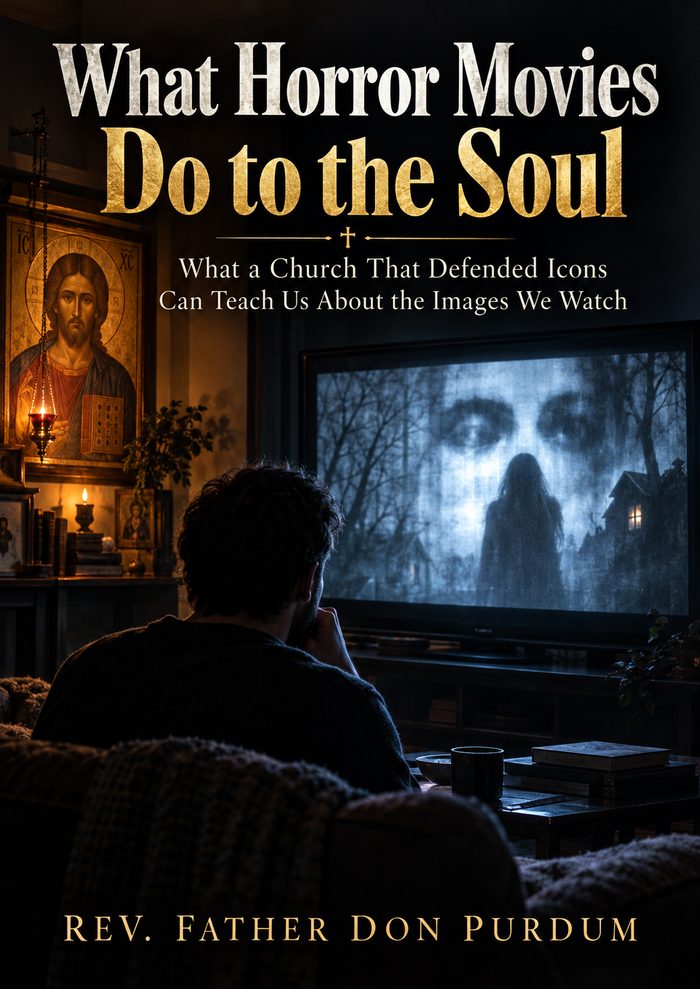
That’s why, this Halloween season, I’m offering you a FREE eBook, What Horror Movies Do to the Soul.
Drawing upon the wisdom of the ancient Church, this short book explores how disturbing images influence us, why spiritual discernment matters, and how we can protect our hearts and guide our children without living in fear.
You cannot always control the darkness around you, but you can choose what you invite into your heart.
I encourage you to get your free copy today and discover how the wisdom of the early Church can help you guard your soul and draw closer to Jesus Christ.
Click Here to Get Your FREE Halloween eBook
Want the entire article distilled into one clear, printable page?
Download your free summary and keep it with you.
Get the free PDF + join thousands of people receiving short, practical Orthodox insights in the “Morning Brew with Father Don” to help you grow in Christ each week.