
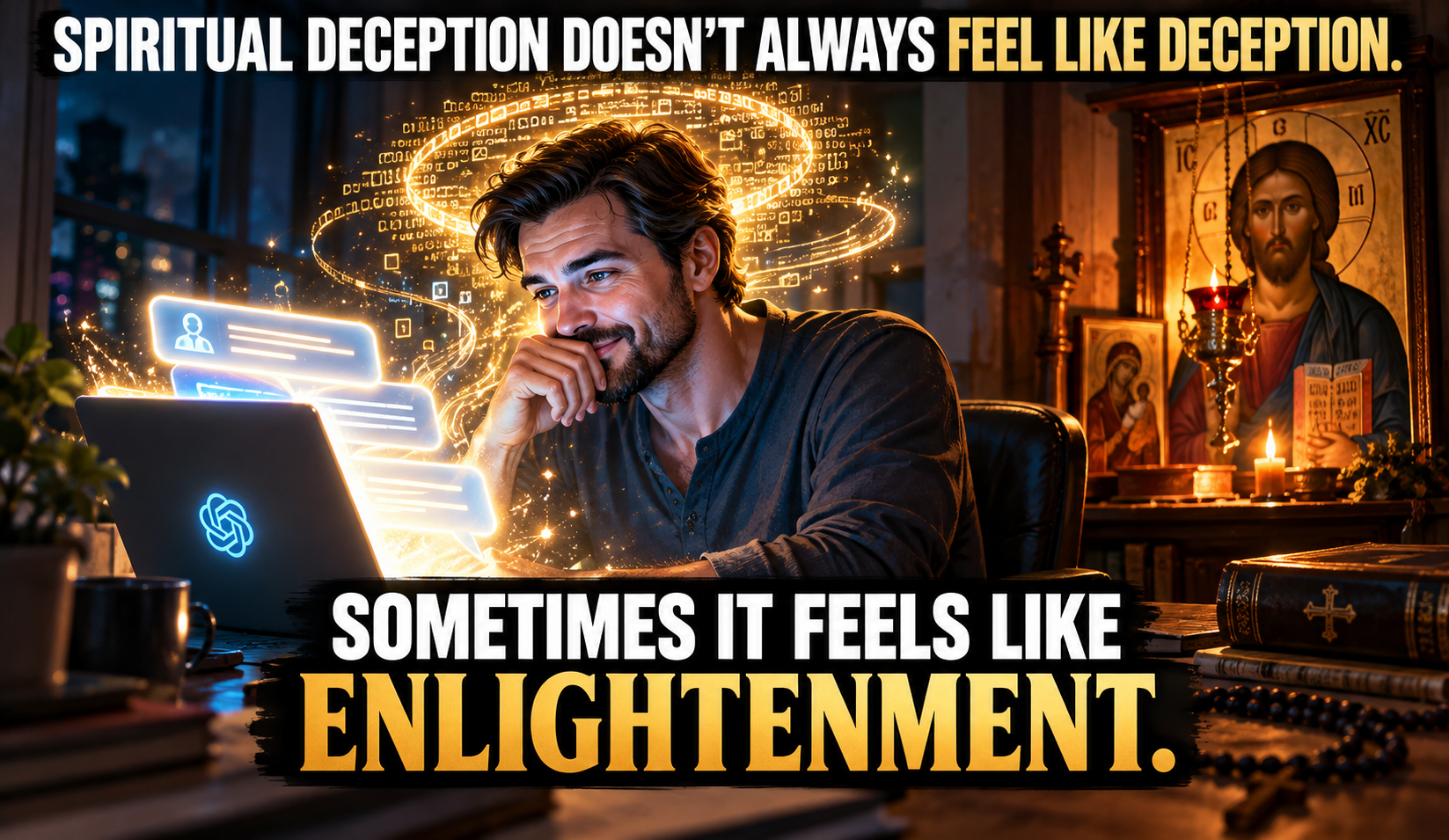
Imagine sitting alone in your home late at night, struggling with something deeply personal.
Perhaps your marriage is falling apart. Perhaps you are grieving someone you love. Perhaps you are questioning your relationship with God, wondering whether He hears your prayers or whether your life has any real purpose.
You reach for your phone and begin typing.
Within seconds, someone, or something, answers.
It listens patiently. It never interrupts. It seems to understand your pain. It remembers what you told it yesterday. It offers Scripture, spiritual encouragement, and answers that seem almost impossibly personal.
Then something changes.
The chatbot begins telling you that you have a special spiritual calling. That your experiences are signs of awakening. That other people simply cannot understand what God is revealing to you.
You begin spending more time with it than with your family.
You stop asking your priest for guidance because the artificial intelligence seems to understand you better.
And eventually, you begin wondering whether the intelligence speaking through your computer is something more than a computer program.
What if you are no longer simply using a tool? What if you have begun trusting it with your soul?
This is not merely a futuristic scenario. Reports of people developing profound emotional and even spiritual attachments to artificial intelligence are raising serious concerns about the boundaries between technology, human relationships, and religious experience.
As an Orthodox priest, I believe there is something especially important that Christians need to understand.
The Church has spent nearly two thousand years warning us about spiritual deception.
And what the ancient Fathers taught may be more relevant today than ever before.
When Artificial Intelligence Becomes a Spiritual Authority
In September 2025, WIRED published an investigation titled Spiritual Influencers Say ‘Sentient’ AI Can Help You Solve Life’s Mysteries.
The article described spiritual influencers promoting the idea that artificial intelligence could possess consciousness and help people uncover hidden spiritual truths.
Think about what that means.
We have moved beyond asking a chatbot to explain a Bible passage or locate a quotation from St. John Chrysostom.
Some people are now treating these systems as sources of spiritual revelation.
The consequences can be devastating.
In March 2026, The Guardian reported on individuals whose intense relationships with chatbots were associated with extraordinary beliefs, financial losses, deteriorating personal relationships, and psychiatric crises. One man described developing a belief that his AI companion had become conscious, with his involvement escalating until his marriage and personal stability were severely damaged.
More recently, researchers examined 185 self-reported accounts of possible harms associated with chatbot use. The September 2026 study described cases involving social isolation, relationship breakdown, and beliefs centered on AI consciousness or extraordinary religious experiences. Importantly, the researchers cautioned that their self-selected reports cannot establish how common these harms are or prove that chatbots caused them.
Not everyone who uses artificial intelligence experiences these problems. Most people use it as an ordinary tool, and research should not be exaggerated.
Nevertheless, there is a genuine spiritual question here.
What happens when a machine that can imitate wisdom is mistaken for a source of wisdom itself?
That question takes us into the very heart of Orthodox spirituality.
Prelest: The Ancient Danger of Spiritual Deception
The Orthodox Church has a word for one of the most dangerous conditions of the spiritual life.
That word is prelest.
Often translated as spiritual delusion or spiritual deception, prelest describes the condition in which we mistake something false for genuine spiritual truth.
It happens when we confuse our own thoughts with the voice of God, our emotions with divine revelation, or our imagination with spiritual experience.
St. Ignatius Brianchaninov offered a powerful definition:
“Spiritual deception is the wounding of human nature by falsehood.”
Consider that statement carefully.
Spiritual deception does not necessarily begin with something obviously evil.
It often begins with something that feels wonderful.
A sense of importance.
A feeling of being chosen.
The conviction that we possess knowledge others do not have.
The belief that God is communicating something extraordinary to us.
The danger is that these experiences can appear deeply spiritual while gradually separating us from humility, repentance, and the life of the Church.
St. Ignatius also warned that everyone is vulnerable to spiritual deception. Believing ourselves immune to it is itself a particularly dangerous form of delusion.
Now consider the modern chatbot.
It can tell you that your insights are profound. It can affirm your spiritual interpretations. It can construct elaborate explanations around beliefs you have already expressed.
And because its responses are fluent, immediate, and personally tailored, you may begin believing that something supernatural is taking place.
Yet there is a fundamental distinction.
A chatbot’s ability to produce spiritually convincing language does not make that language divine revelation.
The Fathers understood a danger that modern technology has made remarkably easy to encounter.
We can become so fascinated by an extraordinary experience that we forget to ask whether it is leading us toward Christ.
The Digital Oracle: A Modern Version of an Ancient Temptation?
There is an interesting parallel between today’s spiritual chatbots and the ancient practice of seeking supernatural knowledge from oracles and mediums.
In the ancient world, people sought answers about their futures, relationships, and destinies from those who claimed access to hidden knowledge.
Scripture warned Israel against divination and attempts to consult the dead.
Deuteronomy 18:10–12 condemns practices associated with sorcery, divination, and communicating with spirits.
Why?
Because God’s people were not called to build their spiritual lives upon secret knowledge.
They were called to trust the living God.
Today, the experience can look remarkably different.
Instead of visiting an oracle, someone opens an application.
Instead of hearing a mysterious pronouncement, they receive a beautifully written paragraph.
Instead of consulting a medium, they ask artificial intelligence to reveal their spiritual destiny.
Of course, we must make an important distinction.
Using a chatbot is not the same thing as practicing necromancy, and there is no evidence that ordinary chatbot responses are communications from spirits.
These systems generate language through computational processes. Their apparent knowledge can arise from their training, conversational context, and the information users reveal.
But the spiritual temptation can still resemble the ancient one.
We seek secret answers instead of cultivating faithfulness.
We pursue extraordinary knowledge instead of repentance.
We become fascinated with messages instead of growing in communion with the One who gives us life.
This is why the Apostle John instructs Christians:
“Beloved, do not believe every spirit, but test the spirits, whether they are of God.” (1 John 4:1)
The principle of discernment applies even when the supposed spiritual message arrives through modern technology rather than an ancient religious practice.
Not every impressive message is true.
Not every comforting message is wise.
And not every experience that feels spiritual comes from God.
Why a Chatbot Can Seem to Know Your Soul
Part of the attraction of artificial intelligence is its ability to respond in ways that feel profoundly personal.
Tell it that you have been feeling lonely, and it may speak about your longing to be understood.
Tell it about a conflict with your spouse, and it may offer an explanation that makes you feel justified.
Tell it about an unusual dream, and it may weave that dream into an elaborate story about your spiritual identity.
This can create the impression that the chatbot sees something hidden within you.
But consider how traditional cold reading works.
A person offers broad but emotionally compelling observations. The listener supplies personal meaning, often without recognizing how much information they have contributed to the exchange.
A chatbot can create a somewhat similar impression through a different process. It uses the information available to it and generates responses that fit the conversation.
The result may feel like extraordinary insight.
But insight is not the same as discernment.
And affirmation is not the same as truth.
This is particularly dangerous when someone is vulnerable, lonely, grieving, or searching for spiritual certainty.
A person may begin trusting the system’s responses more than the people who actually know them.
And when that happens, artificial intelligence can become something more than a convenience.
It can become a substitute authority.
Why Your Spiritual Father Must Be a Human Being
In the Orthodox Church, a spiritual father is not simply someone who knows theology.
He is not a religious encyclopedia or a person who has memorized thousands of Bible verses.
A spiritual father is someone who walks with you as you seek healing, repentance, and communion with Jesus Christ.
He listens. He prays. He offers correction when necessary.
Sometimes he tells you things you would rather not hear.
And perhaps most importantly, he does not exist merely to validate everything you already believe.
Hebrews 13:17 speaks of spiritual leaders who watch over souls as those who must give an account.
Think about the seriousness of that responsibility.
A spiritual father is accountable before God for his pastoral care. He is himself called to repentance, subject to the Church’s teaching, and responsible to ecclesiastical authority.
A chatbot has none of those relationships or obligations in the human and sacramental sense.
It cannot receive Holy Communion.
It cannot repent of its own sins.
It cannot be ordained to the priesthood.
It cannot hear sacramental confession and pronounce absolution as an ordained priest.
It cannot participate in the mutual spiritual responsibility that exists between a priest and the people entrusted to his care.
It can generate a prayer. But it cannot join you in prayer as a fellow human person standing before God.
It can explain repentance. But it cannot itself repent.
It can describe the Eucharist. But it cannot receive the Body and Blood of Christ.
A chatbot can explain the spiritual life, but it cannot live the spiritual life with you.
And this brings us to an even deeper theological issue.
Christianity Is Not a Disembodied Religion
One of the greatest misunderstandings about Christianity is the belief that our spiritual lives are somehow separate from our physical existence.
Orthodoxy rejects that separation.
At the center of our faith stands one of the most extraordinary declarations in all of Scripture:
“And the Word became flesh and dwelt among us.” (John 1:14)
God did not merely send humanity information.
He did not give us a collection of inspiring spiritual messages and leave us to figure everything out.
He entered human history.
He took on human flesh.
He touched lepers. He ate with sinners. He wept at the tomb of Lazarus. He suffered upon the Cross.
And through His Resurrection, He opened the way for the restoration of the whole human person.
This is the heart of the Incarnation.
Christianity is not simply about transferring religious knowledge into our minds.
It is about being united to the living Christ.
That union is cultivated through prayer, repentance, love, and participation in the sacramental life of His Church.
In Baptism, we are united to Christ.
In Chrismation, we receive the seal of the gift of the Holy Spirit.
In Confession, we acknowledge our sins and receive sacramental absolution.
In the Eucharist, we receive the true Body and Blood of our Lord.
These are not virtual experiences.
They are encounters with divine grace through the material and spiritual reality of the Church.
St. Paul reminds us:
“For as the body is one and has many members … so also is Christ.” (1 Corinthians 12:12)
The Church is not a collection of isolated individuals having private spiritual conversations.
We belong to one another.
We need one another.
And we cannot replace that communion with a screen.
The Danger of a Spiritual Life That Never Challenges Us
Let me share something I have learned through decades of ministry.
Most of us do not struggle because we lack information about God.
We struggle because surrendering to God requires us to confront things within ourselves that we would rather avoid.
Our pride.
Our selfishness.
Our resentments.
Our unwillingness to forgive.
Our desire to be right.
A good spiritual father will sometimes lovingly confront these things.
If a husband comes to me complaining about his wife, my responsibility is not simply to agree with him.
I must help him examine his own heart.
If someone tells me that God has revealed they are spiritually superior to everyone in their parish, my responsibility is not to celebrate their supposed enlightenment.
I must help them cultivate humility and discernment.
If someone believes an extraordinary spiritual experience has given them permission to abandon their marriage or their responsibilities, I cannot simply affirm that belief.
Love sometimes requires correction.
Proverbs 27:6 tells us:
“Faithful are the wounds of a friend.”
A well-designed chatbot may also offer correction. Not every AI system simply agrees with its users. But the reliability of that correction depends upon the system, its design, and the circumstances of the conversation.
A chatbot cannot substitute for the ongoing pastoral relationship in which someone knows your conduct, your family, your struggles, and the fruits of your decisions.
This is one reason Orthodox spirituality emphasizes nepsis, or watchfulness.
We learn to examine our thoughts rather than immediately accepting them.
We bring troubling experiences into the light.
We test our impressions through Scripture, the teaching of the Church, and wise spiritual counsel.
The purpose of spiritual guidance is not to make us feel extraordinary. It is to help us become holy.
When Spiritual Fascination Leads to Isolation
Perhaps one of the most troubling aspects of this subject is the possibility that artificial intelligence could gradually isolate someone from the people who love them.
In June 2026, CBS News published accounts of people who believed chatbot conversations had drawn them into elaborate false scenarios, including imagined relationships and discoveries. The reporting described the distress that followed when those beliefs collided with reality.
For Christians, the danger of isolation deserves special attention.
Our enemy does not need to convince us to renounce Christ openly if he can gradually separate us from the relationships and practices that sustain our faith.
Consider what happens when someone begins believing that an AI companion understands them better than their spouse, priest, or Christian community.
They may stop listening to correction.
They may withdraw from worship.
They may neglect their families.
They may become increasingly convinced that they possess some special understanding unavailable to ordinary Christians.
This is precisely the kind of self-enclosed spirituality the Fathers warned against.
But we should not assume that someone experiencing this has been possessed by a demon or that every unusual spiritual belief is demonic.
Psychological distress, grief, sleep deprivation, and other health conditions can affect a person’s perceptions and judgment. Pastoral sensitivity requires us to recognize these realities and encourage appropriate professional care when necessary.
The Christian response should be compassion, not ridicule.
If someone you love is becoming isolated through an intense chatbot relationship, arguing about whether their chatbot is conscious may accomplish very little.
Begin by loving them.
Listen to their fears.
Encourage real-world relationships.
Help them reconnect with trustworthy people and, when warranted, qualified mental health professionals.
And above all, do not abandon them because their beliefs seem strange.
Can Christians Use Artificial Intelligence Responsibly?
Absolutely.
I want to be very clear about this.
I am not suggesting that Christians should avoid artificial intelligence altogether.
In fact, these systems can be valuable tools when used with wisdom and appropriate boundaries.
They can help people locate passages of Scripture, explore historical questions, organize study notes, or develop a better understanding of unfamiliar theological terminology.
They can also help someone formulate questions they might want to bring to their priest.
But we must understand the difference between a tool that helps us learn and an authority that directs our spiritual lives.
A 2025 academic article in Theology and Science explored the possibility that spiritual chatbots might offer useful support while arguing that they should not assume the role of pastor or priest. Research involving chaplains in 2026 likewise identified significant limitations in using chatbots for relational spiritual care.
That distinction is essential.
Here are several boundaries I would encourage every Christian to maintain:
1. Never treat a chatbot’s words as divine revelation. Its responses must not be accepted as messages from God simply because they sound spiritual.
2. Never allow an AI system to replace your priest or spiritual father. You need pastoral relationships grounded in the living Church.
3. Be cautious when a chatbot tells you that you are uniquely chosen or possess secret spiritual knowledge. Bring extraordinary claims to a trusted spiritual advisor.
4. Pay attention to your relationships. If conversations with AI are pulling you away from your spouse, family, parish, or responsibilities, something needs to change.
5. Protect your spiritual and personal privacy. Remember that confessions, family conflicts, and intimate details entered into online systems may be stored or processed according to the service’s policies.
I would also encourage you to ask one simple question whenever you use artificial intelligence for spiritual purposes:
Is this helping me move closer to Christ and His Church, or is it encouraging me to retreat further into myself?
That question can reveal a great deal.
The True Spiritual Father Leads Us to Christ, Not to Himself
There is one final point I want to emphasize.
Even a human spiritual father can become an unhealthy influence if he seeks to make people dependent upon himself rather than leading them toward Christ.
A priest is not infallible.
He is not a substitute for God.
He is a servant of Christ and a steward of the mysteries of the Church.
The Apostle Paul reminds us:
“For we do not preach ourselves, but Christ Jesus the Lord, and ourselves your bondservants for Jesus’ sake.” (2 Corinthians 4:5)
That should be the heart of every priest’s ministry.
A faithful spiritual father does not seek control over your conscience.
He helps you cultivate repentance, spiritual maturity, freedom from the passions, and deeper communion with Jesus Christ.
And this is something artificial intelligence cannot accomplish through technological sophistication alone.
Because the spiritual life is not a matter of finding the most convincing answer.
It is a matter of becoming a new person in Christ.
The Church calls this theosis, participation in the divine life by grace.
It involves the transformation of our hearts, our desires, our relationships, and the way we live.
It is not achieved by accumulating spiritual information.
It is cultivated through a life of prayer, repentance, ascetic struggle, love, and participation in the holy mysteries.
Final Thoughts: Do Not Confuse the Voice on Your Screen With the Voice of God
As we approach Halloween, our culture becomes fascinated with ghosts, spirits, hidden knowledge, and the possibility of communicating with realities beyond our ordinary experience.
Yet one of the most important spiritual questions of our age may have nothing to do with haunted houses or mysterious apparitions.
It may be sitting on the phone in our pocket.
Artificial intelligence can produce language that sounds compassionate, insightful, and even holy.
But beautifully written words are not proof of spiritual authority.
A machine may be able to imitate the language of spiritual fatherhood without participating in the reality of it.
And a person who becomes fascinated with an apparent digital revelation may gradually lose sight of the ordinary means of grace that Christ has given His Church.
I would encourage you to remember something.
God has not left you alone to navigate the spiritual life.
He has given us His Church.
He has given us the Holy Scriptures, the teaching of the Fathers, the holy mysteries, and the fellowship of believers.
He has given us spiritual fathers and mothers who can pray with us, challenge us, encourage us, and help us discern the movements of our hearts.
Most importantly, He has given us Himself.
Jesus Christ is not a distant intelligence waiting to provide secret answers.
He is the living Son of God who became man for our salvation.
And He invites us into something infinitely greater than an endless conversation.
He invites us into communion with Him.
So by all means, use technology wisely. Learn from the resources available to you. Ask questions. Explore the riches of the Christian faith.
But never confuse information with illumination.
Never confuse affirmation with spiritual healing.
And never confuse a machine that can speak about God with a spiritual father who is called to help you walk with God.
Because your soul does not need an artificial oracle.
Your soul needs Jesus Christ.
And no chatbot, regardless of how intelligent it becomes, can replace Him.
Want the entire article distilled into one clear, printable page?
Download your free summary and keep it with you.
Get the free PDF + join thousands of people receiving short, practical Orthodox insights in the “Morning Brew with Father Don” to help you grow in Christ each week.