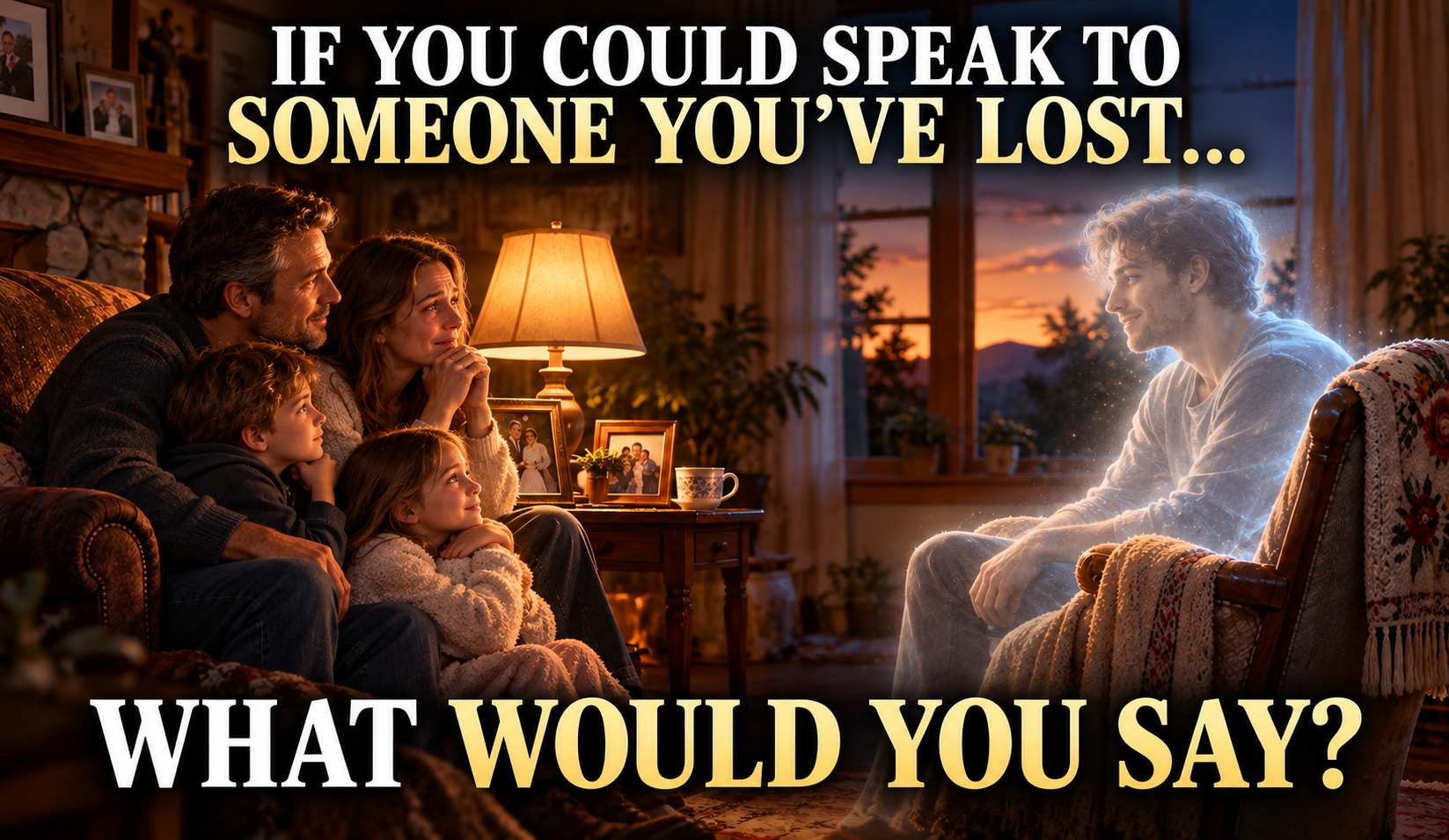
What if the greatest mystery surrounding death isn’t whether the dead can return, but what happens when the soul leaves the body?
Imagine waking in the middle of the night to the sound of footsteps in your hallway.
You know everyone in the house is asleep. Yet the footsteps sound familiar. They remind you of someone you loved, someone who passed away years ago.
You sit up, listening.
Then, just as suddenly as they began, the footsteps stop.
Was it your imagination? Something ordinary that you simply couldn’t explain? Or could it have been the presence of someone who has died?
Perhaps you’ve never experienced anything like this. But millions of Americans believe that others have.
According to a June 12, 2026, YouGov survey, 44% of American adults say they definitely or probably believe in ghosts.
Nearly half the country believes there may be something beyond the physical world that occasionally makes itself known.
And as Halloween approaches, these questions become especially popular. Haunted houses, ghost tours, paranormal investigations, and horror movies invite us to imagine that the dead might still be walking among us.
But Christianity has been addressing questions about death, departed souls, and the unseen spiritual world for nearly two thousand years.
And the Orthodox Church offers an answer that is both more mysterious and more hopeful than anything Hollywood has imagined.
The question isn’t simply whether ghosts are real.
The deeper question is what happens to the human soul after death, and whether the things we believe are ghosts are really what they appear to be.
What Does the Orthodox Church Actually Believe About Ghosts?
First, we need to understand something important.
The Orthodox Church absolutely believes in the existence of the spiritual world.
We believe in angels. We believe in demons. We believe that the human soul continues to exist after physical death. We believe that the saints are alive in Christ and that the prayers of the faithful reach beyond the grave.
The Christian faith does not teach that the physical universe is all that exists.
But that doesn’t mean we accept every story about wandering spirits or haunted houses.
In fact, the Orthodox understanding of death is considerably different from what popular culture has taught us.
Movies frequently portray ghosts as the souls of people who died suddenly, tragically, or with unfinished business.
According to these stories, the deceased remain trapped between heaven and earth, unable to find peace until someone helps them resolve whatever is keeping them here.
But the Orthodox Church does not teach that the souls of the departed wander aimlessly through houses, cemeteries, or battlefields.
The Church teaches that when a person dies, the soul separates from the body and enters a new condition of existence, awaiting the resurrection and final judgment.
The departed are not abandoned to wander the earth.
They remain in the hands of God.
What Happens to the Soul When We Die?
To understand why the Church approaches ghost stories with caution, we must first understand what Christianity teaches about death itself.
Human beings were created as a union of body and soul.
We are not merely physical organisms, nor are we spirits temporarily imprisoned in bodies.
God created us as complete human persons.
Death is the separation of what God intended to remain united.
This is why Christianity considers death an enemy rather than a natural fulfillment of human existence.
The Apostle Paul writes:
“The last enemy that shall be destroyed is death.” (1 Corinthians 15:26)
When the body dies, the soul does not cease to exist.
Hebrews 9:27 tells us:
“And as it is appointed unto men once to die, but after this the judgment.”
Orthodox Christianity teaches that the soul experiences a particular judgment after death, while awaiting the final resurrection and judgment at Christ’s return.
The Church also maintains ancient traditions of praying for the departed, particularly on the third, ninth, and fortieth days following death.
These practices express the Church’s understanding that the soul’s passage after death is spiritually significant. Certain traditional accounts describe the soul’s experience during these days, although the precise details should not be treated as a universally defined dogma.
What matters is this:
Death does not leave the soul wandering through an abandoned house, desperately searching for someone who can help it cross over.
The soul belongs to God.
And its eternal destiny is not determined by a psychic, a paranormal investigator, or someone communicating through a spirit board.
But Doesn’t the Bible Describe Someone Returning from the Dead?
This is where the conversation becomes especially interesting.
One of the most mysterious accounts in the Old Testament appears in 1 Samuel 28.
King Saul, desperate for guidance because God was no longer answering him, sought out a woman known as the medium of Endor.
Saul wanted to communicate with the deceased prophet Samuel.
The woman performed her forbidden practice, and a figure identified as Samuel appeared and delivered a message of judgment to Saul.
How should Christians understand this?
The passage has been interpreted differently throughout Christian history.
Some Fathers understood the event as a demonic deception. Others believed that God permitted Samuel to appear, not because the medium possessed genuine authority over the departed, but because God intended to pronounce judgment against Saul.
Whatever interpretation one accepts, the passage is not an endorsement of communicating with the dead.
Quite the opposite.
Saul’s actions demonstrated his spiritual desperation and disobedience.
The Old Testament explicitly forbids necromancy, the attempt to consult the dead.
Deuteronomy 18:10-12 condemns those who practice divination, sorcery, or seek communication with departed spirits.
Why?
Because the unseen world is not something human beings can safely manipulate.
And not everything that claims to come from the spiritual world comes from God.
Could a Ghost Actually Be a Demon?
This is the part of the discussion that many people find unsettling.
The Church Fathers repeatedly warned that demons can disguise themselves.
St. Paul writes:
“For Satan himself is transformed into an angel of light.” (2 Corinthians 11:14)
If the enemy can present himself as something beautiful, holy, or trustworthy, should we assume that every spirit claiming to be a departed loved one is telling the truth?
Certainly not.
St. John Chrysostom addressed the ancient belief that people who died violently might become wandering spirits.
He rejected that idea.
In his teaching on the parable of Lazarus and the rich man, Chrysostom warned against assuming that the souls of the dead remain on earth or become demons.
His concern was that evil spirits could exploit precisely this belief to deceive people.
Centuries later, St. Ignatius Brianchaninov similarly warned Christians about apparent encounters with spirits, particularly those presenting themselves as deceased relatives.
The concern was not that every unexplained event must be demonic.
Rather, the Fathers understood something that modern culture frequently overlooks.
A spiritual experience is not automatically a holy experience.
And something that appears comforting may not necessarily be trustworthy.
This is why Orthodox Christianity emphasizes spiritual discernment rather than spiritual curiosity.
We are not encouraged to chase supernatural encounters.
We are encouraged to seek Christ.
What About the Saints Who Have Appeared to People?
At this point, someone might reasonably ask:
“If the dead cannot wander the earth, why does the Orthodox Church have so many accounts of saints appearing to people?”
This is an excellent question.
Throughout Orthodox history, there have been accounts of saints appearing to believers, offering encouragement, warning of danger, and sometimes becoming instruments of God’s healing.
The Church does not dismiss such possibilities.
Consider the Transfiguration of Christ.
In Matthew 17:1-3, Moses and Elijah appeared with Jesus in glory.
Moses had died centuries earlier, yet he appeared with Christ.
This reveals an important truth.
Those who have departed this life are not necessarily unconscious or nonexistent.
They are alive to God.
Jesus Himself declares:
“He is not the God of the dead, but of the living: for all live unto him.” (Luke 20:38)
But there is an essential distinction between the appearances of the saints and modern ghost hunting.
The saints do not appear because someone successfully summoned them. They appear, when God permits, according to His purposes.
Their presence directs attention toward God, repentance, healing, and holiness.
They do not encourage fascination with paranormal activity or create a dependency on supernatural encounters.
The difference is not merely whether something unusual occurred.
The difference concerns its origin, its purpose, and its spiritual fruit.
Are Ghosts, Angels, and Departed Souls the Same Thing?
No. This is another misunderstanding that deserves clarification.
Angels are spiritual beings created by God. They are not deceased human beings.
Human souls belong to human persons, who were created as a union of body and soul.
Demons are fallen angels who rebelled against God.
And the saints are human beings who have been glorified in Christ, not people who have somehow transformed into angels.
This matters because popular expressions such as “God needed another angel” may sound comforting at a funeral, but they do not reflect Orthodox theology.
The Christian hope is not that we will become angels.
It is that we will participate in the resurrection of Christ and receive glorified, resurrected bodies.
Our destiny is not to become less human.
It is to become fully alive in Christ.
Could There Be Natural Explanations for Ghostly Experiences?
Absolutely.
And I believe this point is especially important.
Christians should never feel obligated to choose between blindly accepting a supernatural explanation and dismissing someone’s experience entirely.
There is a difference between acknowledging that someone experienced something unusual and declaring that the event was caused by a spirit.
An unexplained noise may have a perfectly ordinary explanation.
A shadow moving across a wall may be a trick of light.
Sleep paralysis can produce frightening experiences involving the sensation of an unseen presence.
Grief can also powerfully influence our perceptions.
Someone who has lost a spouse after forty years of marriage may occasionally hear what seems like the familiar sound of that person’s voice or footsteps.
That experience does not make them foolish.
Nor does it prove that the deceased has returned.
The human mind is extraordinarily complex, particularly when love, memory, loss, and emotional suffering are involved.
And in situations involving unusual sounds, physical sensations, or frightening events in a home, practical explanations such as faulty electrical systems, environmental problems, or carbon monoxide exposure must be considered.
Discernment requires us to be spiritually attentive without becoming spiritually gullible.
Not everything unexplained is supernatural.
And not everything supernatural should be welcomed.
Why Are We So Fascinated with Ghosts?
I believe the answer goes much deeper than Halloween entertainment.
We are fascinated by ghosts because we are fascinated by death.
More specifically, we are frightened by the possibility that death might be the end of everything we know and love.
Think about someone who has lost a husband, wife, child, parent, or close friend.
Wouldn’t they give almost anything for one more conversation?
One more embrace?
One more opportunity to say, “I love you”?
This longing is profoundly human.
It helps explain why so many people are drawn to mediums, paranormal investigators, and stories about departed loved ones communicating from beyond the grave.
But here is where Christianity offers something extraordinary.
You do not need a ghost to prove that your loved one continues to exist.
Christ has already revealed that death is not the final word.
The Church does not tell grieving families to seek signs from the departed.
It teaches us to pray for them.
We remember their names during the Divine Liturgy.
We offer memorial prayers.
We give alms and perform acts of mercy in their memory.
We entrust them to the love and compassion of God.
St. John Chrysostom taught that the Church’s prayers and commemorations for the departed are not offered in vain.
This is one of the most beautiful dimensions of Orthodox Christianity.
Our love for those who have died does not have to become an obsession with trying to contact them.
Instead, our love becomes prayer.
And prayer places those we love into the hands of the One who conquered death.
What Should You Do If You Believe Your Home Is Haunted?
Let me offer some practical pastoral counsel.
First, do not panic.
Fear often causes people to make unwise decisions, particularly when they believe something supernatural may be happening.
Second, investigate ordinary explanations.
Check your home’s electrical systems, heating and cooling equipment, doors, windows, and environmental safety.
Third, do not attempt to communicate with whatever you believe may be present.
Avoid Ouija boards, séances, mediums, spirit boxes, and attempts to provoke a response from an unseen presence.
The Church has consistently warned against deliberately seeking contact with spirits.
Fourth, return your attention to Christ.
Pray.
Read the Scriptures.
Make the sign of the Cross.
Participate in the sacramental life of the Church.
If you are Orthodox, speak with your priest. If appropriate, invite him to bless your home.
And remember that genuine spiritual protection is not found in magical formulas or rituals performed out of fear.
It is found in a living relationship with Jesus Christ.
The goal is not to become an expert on demons.
The goal is to become holy.
The Greatest Mystery Isn’t Ghosts. It’s the Resurrection.
When we ask whether ghosts are real, we are often asking a much more personal question.
Is death really the end?
Will I ever see the people I love again?
What happens to me when my heart stops beating?
Will I simply disappear?
Christianity answers these questions not with ghost stories, but with an empty tomb.
Jesus Christ entered death willingly.
He descended into Hades.
And through His death and Resurrection, He shattered the power of the grave.
Hebrews 2:14-15 teaches that Christ shared in our humanity so that through death He might destroy the power of the devil and deliver those who lived in bondage through the fear of death.
Every Pascha, the Orthodox Church proclaims:
Christ is risen from the dead, trampling down death by death, and upon those in the tombs bestowing life!
That is the Christian answer to the darkness of death.
Not that our loved ones are wandering through empty hallways.
Not that they are trapped inside abandoned buildings.
Not that they are waiting for someone with a recording device to discover them.
But that death has been conquered by Jesus Christ.
There is a spiritual world beyond what our eyes can see.
There are mysteries we do not fully understand.
And yes, there are experiences that require humility, prayer, and discernment.
But as Christians, our greatest hope is not that the dead might somehow return to visit us.
Our greatest hope is that through Christ, death itself will one day be no more.
And that is far more extraordinary than any ghost story.
What If Everything You Thought You Knew About Ghosts Was Wrong?
Perhaps you’ve experienced something you cannot explain.
Maybe you have wondered whether a departed loved one is trying to communicate with you.
Or perhaps you’ve simply been fascinated by haunted houses, apparitions, demons, and what really happens to us after death.
But what if your curiosity is pointing toward something much more important than the existence of ghosts?
What if understanding the unseen world could completely change the way you understand death, eternity, and your relationship with God?
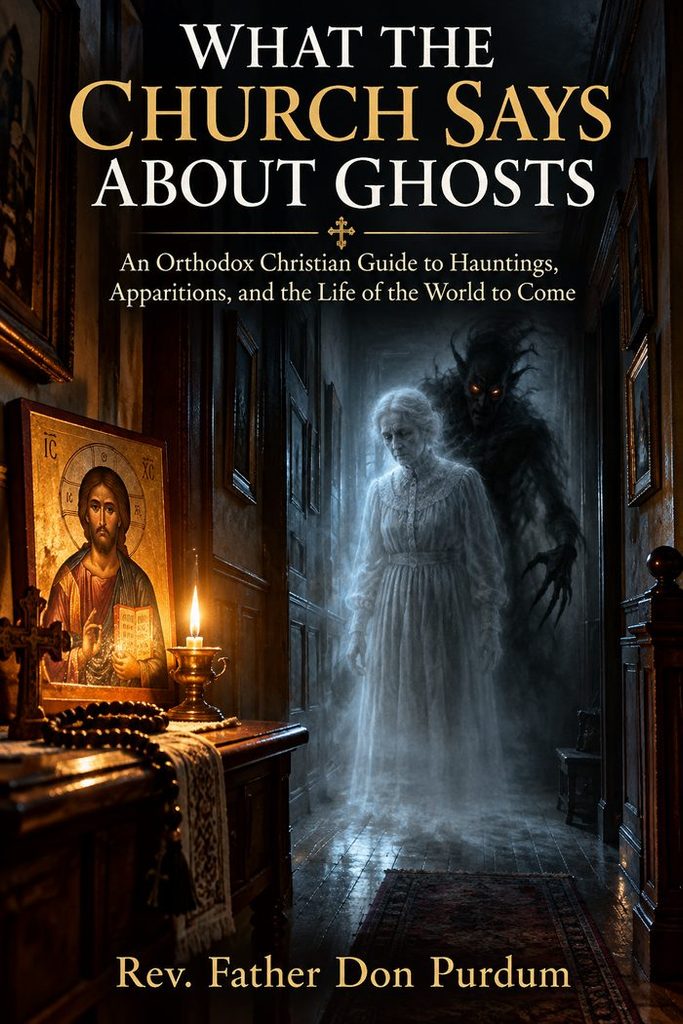
In my eBook, What the Church Says About Ghosts: An Orthodox Christian Guide to Hauntings, Apparitions, and the Life of the World to Come, I take you far deeper into these questions.
Drawing from Scripture, the Church Fathers, Orthodox theology, historical accounts, and the lives of the saints, we explore the mysteries that most Christians have never been taught.
You’ll discover why certain places are considered haunted, what the Bible actually teaches about contacting the dead, how demons can deceive the living, what the Church says happens to the soul after death, and how Christians should respond to frightening spiritual experiences.
Most importantly, you’ll discover why the Orthodox understanding of death is ultimately a message of hope rather than fear.
Don’t let Hollywood, ghost hunters, or paranormal television shows define what you believe about the spiritual world. Discover what Christians have taught for nearly two thousand years.
Because the greatest mystery isn’t whether ghosts are real. It’s what awaits each of us when we leave this world.
Want the entire article distilled into one clear, printable page?
Download your free summary and keep it with you.
Get the free PDF + join thousands of people receiving short, practical Orthodox insights in the “Morning Brew with Father Don” to help you grow in Christ each week.