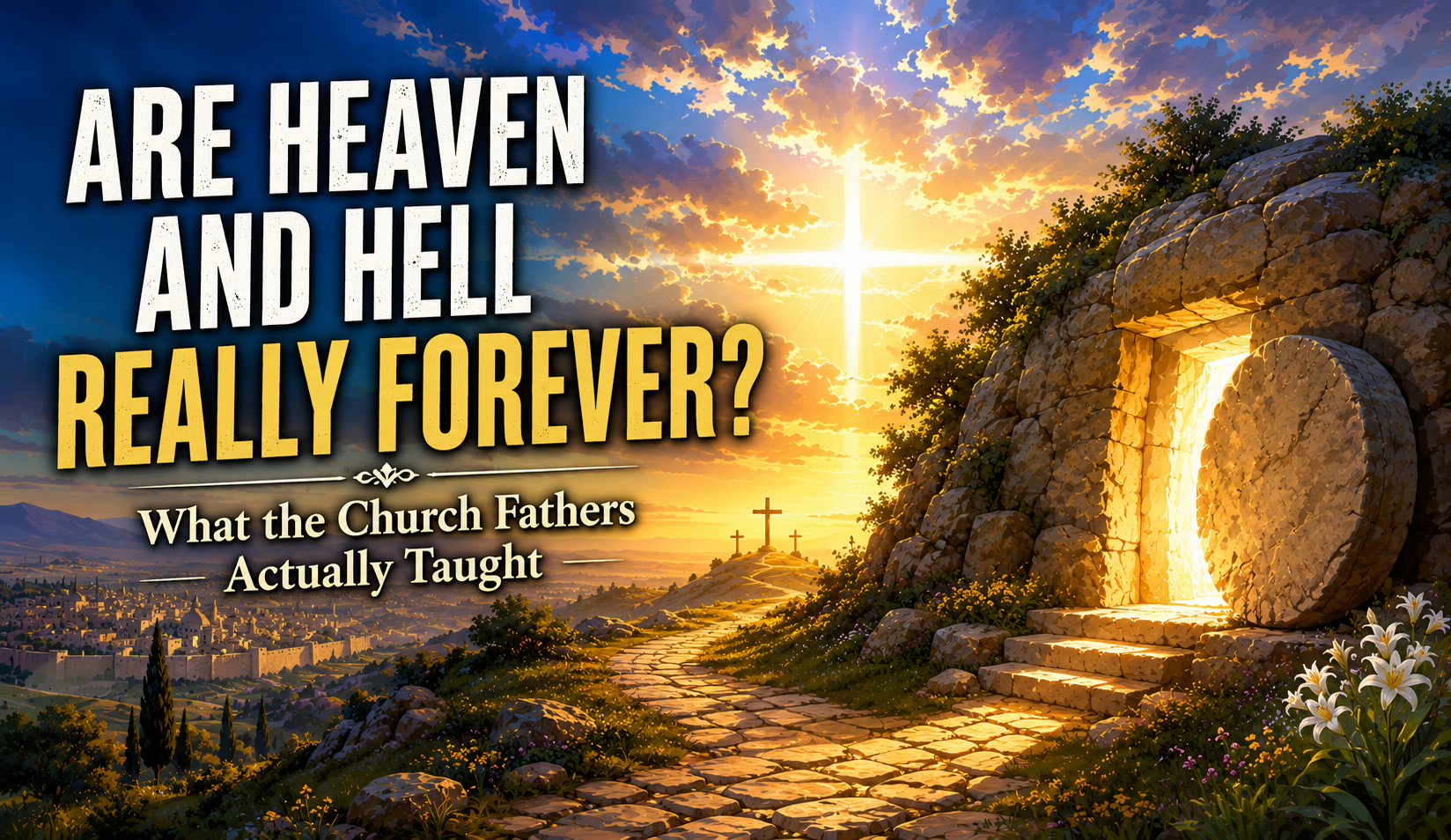
What if one of the most important words in your Bible doesn’t mean what you’ve always been told it means?
What if “eternal life” doesn’t actually mean everlasting life?
What if “eternal punishment” isn’t truly eternal?
What if heaven, hell, judgment, and even the age to come have been filtered through assumptions that neither the Apostles nor the early Church Fathers would have recognized?
Those are not small questions.
In fact, if you’ve spent any amount of time studying theology, especially outside the boundaries of historic Christianity, you’ve probably encountered someone who argues that the Greek and Hebrew words translated as “eternal” or “everlasting” don’t actually mean endless duration. Perhaps you’ve read the works of A.E. Knoch, Concordant Christianity, Christian Universalists, or certain Protestant teachers who divide the future into a series of successive ages, each with a beginning and an end.
The argument sounds compelling at first.
After all, the Scriptures speak about “this age” and “the age to come.” The Bible talks about “the ages of ages.” The Greek word aion certainly can mean an age or a period of time. So the question naturally arises: If the word means an age, then does “eternal life” simply mean life for an age?
Does “eternal punishment” merely mean punishment for an age?
Is hell temporary?
Will everyone eventually be restored?
Is there some final reality beyond all ages where everything is ultimately reconciled?
These are not merely academic questions.
They strike at the very heart of how we understand salvation, judgment, the Kingdom of God, and ultimately the character of God Himself.
But before we rush to dictionaries and word studies, I want to suggest something that modern Christians often forget.
One of the great weaknesses of modern Western Christianity is the assumption that if we can discover the “correct” meaning of a Greek word, then suddenly we have unlocked the mysteries of God. But the Orthodox Church has always approached theology differently.
Theology is not merely information about God.
Theology is the experience of God.
The earliest Christians were not called “the scholars” or “the academics.” They were called “The Way.”
Why?
Because Christianity was never intended to be merely a system of ideas. It is a path. A journey. A participation in the life of Christ Himself.
As I often say, there is a profound difference between someone who speaks about God and someone who knows God because God has revealed Himself to them. The Christian life is not simply learning doctrines; it is learning communion. It is becoming united to Christ through repentance, purification, and grace.
So when we ask questions about eternity, eternal life, eternal punishment, heaven, hell, and the ages to come, we must be careful not to impose modern assumptions onto an ancient faith.
The question is not simply, “What does this word mean?”
The deeper question is:
How did the Apostles understand it? How did the Church Fathers teach it? How has the Church prayed it, worshiped it, and lived it for two thousand years?
Only then can we begin to understand what Orthodox Christianity actually teaches about the ages, eternity, and the destiny of the human soul.
You can Now Listen to Each Article
The Linguistic Argument
The argument typically begins with the Greek word aion (αἰών), often translated as “age,” and its adjective aionios (αἰώνιος), often translated as “eternal” or “everlasting.”
There is no question that aion can mean an age, an era, or a period of time. Scripture regularly uses it this way.
For example:
- “This age” versus “the age to come”
- “The end of the age”
- “The ages of ages”
This is where advocates of Concordant Christianity and similar theological systems begin their argument. Since aion often refers to an age, they conclude that aionios must mean “age-lasting” rather than endless. Therefore, eternal life becomes life during an age, and eternal punishment becomes punishment for an age.
At first glance, that conclusion appears reasonable.
The problem is that language is rarely that simple.
Words develop. Meanings expand. Adjectives frequently take on meanings that go beyond the noun from which they originated. By the time of the New Testament, aionios was already being used in ways that pointed beyond merely temporary periods of time.
More importantly, the Orthodox Church has never determined doctrine through word studies alone.
The Church receives the Scriptures through the Apostles, the Fathers, the liturgical life of the Church, and the lived experience of the saints. The question is not merely what a word could mean in isolation, but how the Church has always understood it within the fullness of divine revelation.
And that is where the discussion becomes far more interesting.
What the Fathers Actually Wrestled With
One of the mistakes modern Christians often make is assuming that the questions surrounding eternity, judgment, and the age to come are new questions.
They are not.
The Fathers wrestled with these issues long before modern debates about universalism, Concordant theology, or dispensational timelines ever existed.
What is fascinating is that while the Fathers did not always emphasize the same aspects of the discussion, they consistently approached these questions from a very different angle than modern Christians.
They were less concerned with constructing prophetic charts and far more concerned with understanding what it means for a human being to encounter the living God.
St. Basil the Great: The Reality of the Age to Come
St. Basil the Great repeatedly spoke about the age to come as a genuine reality that transcends the present world. For Basil, eternal life was not merely endless existence but participation in the divine life.
The goal of salvation was not simply avoiding punishment.
The goal was communion with God.
This distinction is critical because many modern discussions about heaven and hell begin with punishment and reward. The Fathers began with God Himself.
The question was never merely, “How long does punishment last?”
The question was, “What happens when a sinful human being stands before the infinite holiness of God?”
St. Gregory of Nyssa: A Voice of Hope
Perhaps no Father is more frequently cited in modern discussions about universal salvation than St. Gregory of Nyssa.
Gregory occasionally used language that appears to suggest a universal restoration of all things. Because of this, many modern universalists claim him as an ally.
But Gregory’s vision was much deeper than a simplistic “everyone gets into heaven eventually.”
For Gregory, salvation was fundamentally transformative.
Human beings are not merely forgiven.
They are healed.
Purified.
Transformed.
Made capable of participating in God.
His emphasis was not on God lowering the standard of holiness but on God healing humanity so completely that every trace of corruption is ultimately destroyed.
Whether one agrees with every implication of Gregory’s thought or not, the important point is this: Gregory’s vision was centered on the triumph of God’s goodness, not on the denial of judgment.
Judgment itself was understood as part of God’s healing work.
St. Isaac the Syrian: Hell as the Experience of Divine Love
Among the Fathers, few have written more profoundly about God’s mercy than St. Isaac the Syrian.
St. Isaac makes a remarkable statement when he says that those who are punished in Gehenna are scourged by the scourge of love.
Think about that for a moment.
The punishment is not the absence of God.
The punishment is the experience of God’s love by a heart that has refused to be transformed by that love.
For Isaac, God’s love never ceases.
God does not become less loving on Judgment Day.
God does not stop being compassionate.
The tragedy is that some people spend their lives resisting the very love that could heal them.
When they finally stand before God unveiled, His love is experienced not as joy but as anguish.
This perspective has profoundly shaped Orthodox spirituality.
Heaven and hell are not primarily different locations.
They are different experiences of the same divine reality.
St. Maximus the Confessor: The Fulfillment of Creation
St. Maximus the Confessor offers perhaps one of the most comprehensive visions of the end of all things.
For Maximus, history is moving toward a great cosmic fulfillment in Christ.
Everything that was fractured by sin will ultimately be brought into proper relationship with God.
Creation itself is moving toward union with its Creator.
This does not eliminate human freedom.
Nor does it deny judgment.
Rather, it places judgment within the larger context of God’s purpose for creation.
The end of history is not destruction.
The end of history is transfiguration.
The Kingdom of God is the fulfillment of everything humanity was originally created to become.
What Does “For the Ages of Ages” Mean?
Orthodox Christians frequently hear the phrase in our liturgy:
“Now and ever, and unto the ages of ages.”
Some assume this phrase supports the idea that eternity is merely a collection of successive ages.
The Fathers understood it differently.
The phrase functions as a superlative.
Just as Christ is called the “King of kings” and the “Lord of lords,” so “ages of ages” points to the fullness and consummation of all ages.
It acknowledges that God works through ages and dispensations within history, but it simultaneously points beyond history toward the inexhaustible life of God Himself.
The Kingdom is not simply another age.
The Kingdom is the fulfillment of every age.
Orthodox Eschatology Is Not Primarily About Timelines
One of the striking differences between Orthodoxy and many Protestant traditions is our approach to the future.
The Orthodox Church certainly teaches:
- Christ will return.
- The dead will be raised.
- The Last Judgment will occur.
- Heaven and earth will be renewed.
- The Kingdom will be fully revealed.
But Orthodoxy has generally resisted elaborate prophetic systems.
The Fathers consistently redirect our attention away from speculative timelines and toward repentance, holiness, and communion with Christ.
The question is not:
“How many ages are left?”
The question is:
“Am I becoming the kind of person capable of dwelling in the presence of God?”
Eternal Life Is More Than Endless Existence
A crucial Orthodox insight is that eternal life is not merely life that lasts forever.
Everyone will exist forever.
The righteous.
The wicked.
The angels.
The demons.
Existence itself is not the issue.
The question is what kind of existence one experiences.
Christ defines eternal life in John 17:3:
“That they may know You, the only true God, and Jesus Christ whom You have sent.”
Eternal life is participation in the life of God.
It is communion.
It is union.
It is becoming by grace what Christ is by nature.
What About Eternal Punishment?
This is where the conversation becomes particularly challenging.
Orthodox Christianity has never dogmatically embraced universalism—the teaching that every rational being, including the devil and the demons, will ultimately be saved. At the same time, Orthodoxy has generally resisted the kind of rigid legal framework that often dominates Western discussions of heaven and hell.
The Fathers tended to approach these questions differently.
Rather than beginning with categories of reward and punishment, they began with God Himself.
God is love.
God is light.
God is goodness itself.
And perhaps the most important question is not whether God changes in eternity, but whether we do.
One of the most profound voices on this subject is St. Isaac the Syrian. He famously wrote that those who find themselves in Gehenna are “scourged by the scourge of love.”
That statement should stop us in our tracks.
Think about what he is saying.
The torment of hell is not that God ceases to love.
The torment is that the soul experiences God’s love while remaining unwilling to be healed by it.
God remains what He has always been.
Love.
Mercy.
Compassion.
The tragedy is that a person can spend a lifetime resisting the very grace that would have transformed them.
When such a soul stands before God unveiled, the experience of divine love becomes painful because the heart itself remains disordered.
This understanding helps explain why many Orthodox Fathers described heaven and hell less as separate geographical locations and more as different experiences of the same divine presence.
The saints experience God’s glory as joy.
The rebellious experience that same glory as anguish.
The difference is not God.
The difference is the condition of the human heart.
This is one reason why St. Gregory of Nyssa’s writings continue to generate discussion among theologians today. Gregory frequently emphasized the ultimate victory of God’s goodness and the healing purpose behind divine judgment. For Gregory, judgment was never merely punitive. It was revelatory and transformative. God’s goal was always the destruction of evil, not the destruction of the human person.
Yet even Gregory never reduced salvation to a simplistic formula or treated repentance as unnecessary. The human person must still be transformed. Sin must still be purged. The soul must still become capable of communion with God.
This is where modern debates often miss the point.
The Fathers were not primarily asking, “How long does punishment last?”
They were asking, “What must happen for a human being to become fully united with Christ?”
That is an entirely different question.
And it moves the conversation away from speculation and back toward repentance, healing, and theosis.
The Orthodox Church therefore leaves room for mystery where Scripture and Tradition leave room for mystery. The Church definitively teaches that judgment is real, hell is real, human freedom is real, and God’s mercy is beyond human comprehension.
What the Church refuses to do is reduce eternity to a mathematical equation.
The age to come is not merely about duration.
It is about encounter.
Every human being will encounter the living Christ.
The question is whether that encounter will be experienced as joy or as sorrow, as healing or as regret, as paradise or as torment.
For the Orthodox Christian, that question is not answered in some distant future.
It is being answered right now by how we respond to Christ today.
Time Itself May Not Exist as We Know It
Another point often overlooked is that eternity is not simply an infinite extension of time.
God does not merely possess more time than we do.
God transcends time.
The Fathers distinguished between created time, the ages through which creation unfolds, and the eternal life of God Himself.
When the resurrection occurs and creation is renewed, humanity enters a mode of existence that is difficult—even impossible—for us to fully comprehend from within our present experience.
This is why the Fathers frequently speak with reverence and mystery when discussing the age to come.
Not everything can be reduced to a chart.
Not everything can be reduced to a formula.
Some realities must be encountered.
Why This Question Matters
Ultimately, debates about aionios, eternal punishment, and future ages reveal a deeper question.
What is the destiny of the human person?
Orthodoxy answers that humanity was created for communion with God.
The purpose of the Christian life is not merely avoiding punishment.
It is becoming united to Christ.
It is healing.
Transformation.
Theosis.
The focus of Orthodox eschatology is therefore profoundly relational.
The end is not merely an event.
The end is a Person.
Jesus Christ.
The One who stands at both the beginning and the end of history.
The One who is Alpha and Omega.
The One in whom all ages find their fulfillment.
A Final Thought
Can the Greek word aionios sometimes carry the sense of an age?
Certainly.
Does that automatically mean eternal life and eternal punishment are temporary realities?
No.
The Orthodox Church approaches these questions through the fullness of Apostolic Tradition rather than through word studies alone.
The Fathers direct our attention away from speculative timelines and toward something far more important.
Not, “How long is eternity?”
But:
“Am I becoming united to Christ?”
Because in the end, eternity is not merely endless time.
Eternity is the experience of God Himself.
And the choices we make today are already preparing us for that encounter.
Want the entire article distilled into one clear, printable page?
Download your free summary and keep it with you.
Get the free PDF + join thousands receiving short, practical Orthodox insights in the “Morning Brew with Father Don” to help you grow in Christ each week.