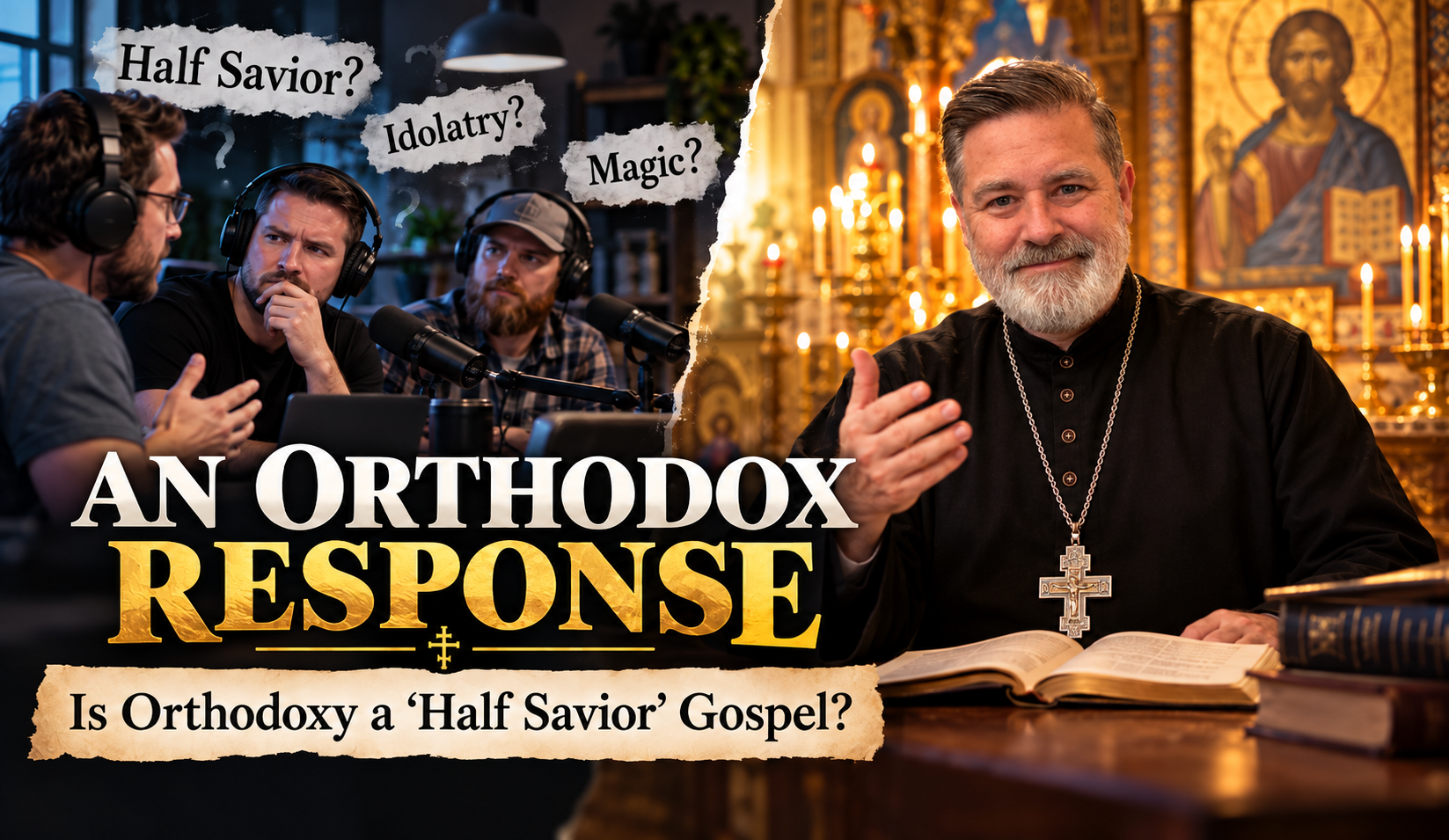
One of the most significant differences between Orthodox Christianity and much of modern Protestantism concerns the Lord’s Supper. Is Holy Communion merely a symbolic memorial of Christ’s sacrifice, or does the bread and wine truly become the Body and Blood of Christ?
This is one of the most significant theological disagreements in Christianity. It is not merely a debate over ritual or tradition, but a profound disagreement concerning the words of Christ Himself. The divide between a sacramental understanding of the Eucharist and a symbolic understanding of Communion has separated Christians for centuries and continues to impede meaningful theological dialogue today. At stake are fundamental questions: How should Scripture be interpreted? What did Christ mean when He commanded His followers to eat His flesh and drink His blood? How is God present in the life of the Church? Can God use material things to communicate divine grace? The answers to these questions shape not only how Christians worship, but how they understand salvation, the Incarnation, the Church, and their communion with Christ.
For Orthodox Christians, the Eucharist is not merely one aspect of worship; it is the very center of Christian life. Every Divine Liturgy culminates in the reception of Christ’s Body and Blood. The Eucharist is not an occasional remembrance but the continual participation in the life of God. From the earliest centuries of the Church, Christians gathered around the Eucharistic table because they believed they were encountering the living Christ Himself.
In many Protestant traditions, however, Communion is viewed primarily as a symbolic act of remembrance. As a result, it may be celebrated monthly, quarterly, or even only a few times per year. While these traditions rightly seek to honor Christ’s command to remember His sacrifice, they often arrive at very different conclusions regarding what occurs when believers partake of the bread and wine.
This raises an important question:
If Christ intended Communion to be merely symbolic, why did the earliest Christians treat it as the center of worship? Why did the Church celebrate the Eucharist whenever believers gathered? And why did Jesus speak about eating His flesh and drinking His blood in language that sounded anything but symbolic?
The answer begins in John 6.
You can Now Listen to Each Article
John 6: The Hard Saying
The sixth chapter of John’s Gospel contains one of the most controversial teachings Jesus ever gave.
After feeding the five thousand, Jesus redirects the crowd’s attention away from physical bread and toward something infinitely greater.
He declares:
“I am the bread of life.”
At first, the crowd assumes He is speaking metaphorically. They understand Him to be discussing faith, belief, and spiritual nourishment.
But then Jesus says something shocking:
“Unless you eat the flesh of the Son of Man and drink His blood, you have no life in you.” (John 6:53)
John 6: The Hard Saying
The sixth chapter of John’s Gospel contains one of the most controversial teachings Jesus ever gave.
After feeding the five thousand, Jesus redirects the crowd’s attention away from physical bread and toward something infinitely greater.
He declares:
“I am the bread of life.”
At first, the crowd assumes He is speaking metaphorically. They understand Him to be discussing faith, belief, and spiritual nourishment.
But then Jesus says something shocking:
“Unless you eat the flesh of the Son of Man and drink His blood, you have no life in you.” (John 6:53)
Notice what happens next.
The crowd does not respond by saying:
“Ah, we understand. He is speaking symbolically.”
Instead, they are horrified.
They ask:
“How can this man give us his flesh to eat?” (John 6:52)
This reaction is extremely important.
The people listening to Jesus were first-century Jews. They knew symbolism. They understood metaphors. The Old Testament is filled with symbolic language.
Yet they did not hear symbolism.
They heard exactly what Jesus said.
What Jesus Did Not Do
Throughout Scripture, when people misunderstand a metaphor, Jesus clarifies.
When Nicodemus thinks physical rebirth is required, Jesus explains spiritual rebirth.
When the disciples misunderstand the “leaven of the Pharisees,” Jesus explains that He is speaking of false teaching.
When the Samaritan woman misunderstands “living water,” Jesus clarifies His meaning.
But in John 6 something remarkable happens.
The crowd objects.
The crowd is offended.
The crowd begins leaving.
And Jesus does not soften His language.
He intensifies it.
In fact, the Greek language becomes even stronger.
Earlier, Jesus uses the ordinary word for “eat.”
Later, He switches to a more graphic term meaning “to chew” or “to gnaw.”
Rather than correcting a misunderstanding, He doubles down on it.
If His listeners were mistaken in taking Him literally, this would have been the perfect moment to clarify.
Instead, He repeats Himself repeatedly:
“My flesh is true food.”
“My blood is true drink.”
“Whoever eats My flesh and drinks My blood abides in Me.”
The teaching becomes more explicit, not less.
The Departure of the Disciples
The most revealing moment comes near the end of the chapter.
John writes:
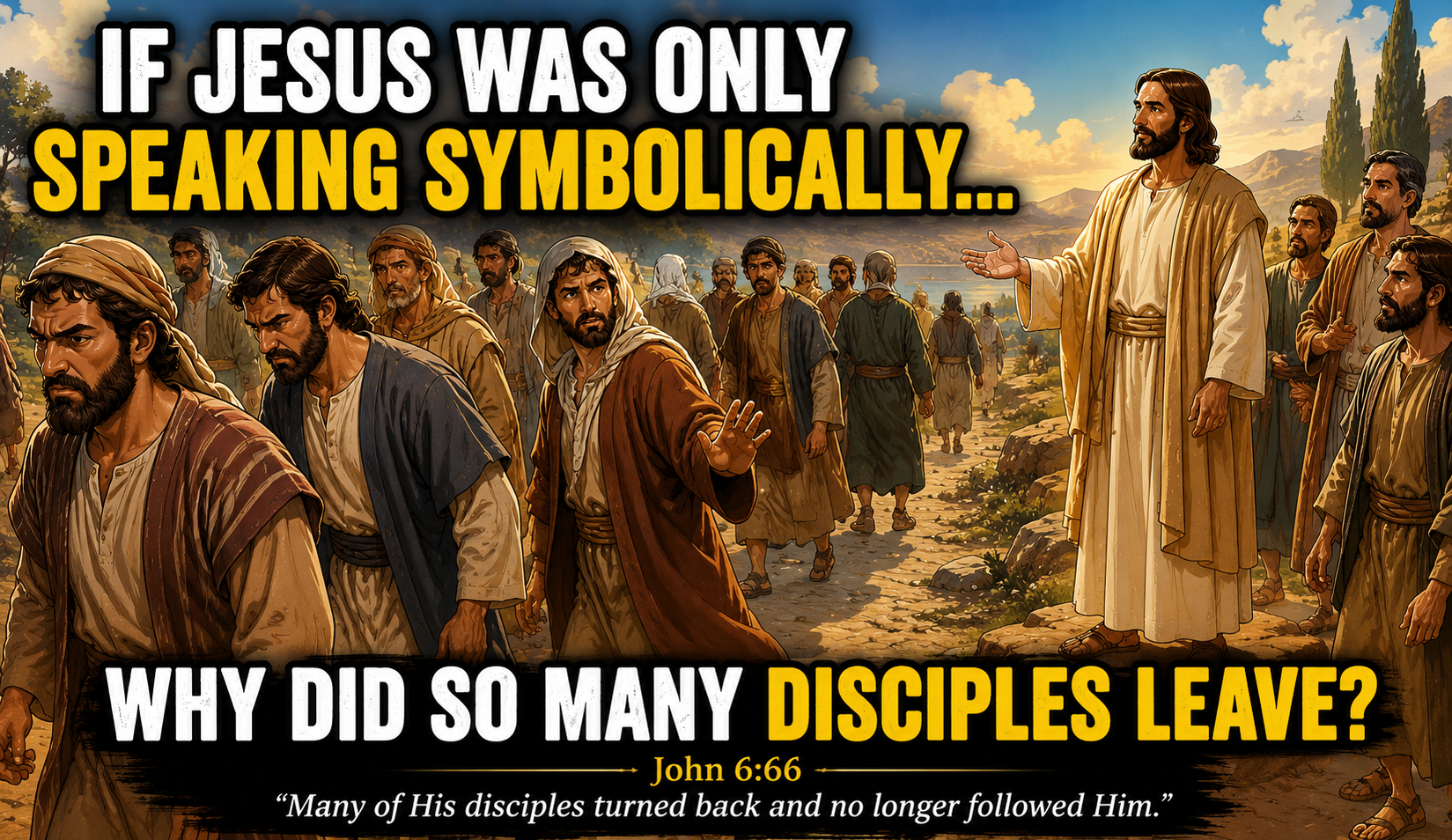
“After this many of His disciples turned back and no longer walked with Him.” (John 6:66)
This is one of the saddest verses in the New Testament.
People left Christ because of this teaching.
Think about that carefully.
If Jesus meant only:
“Remember Me symbolically.”
Then the departure of these disciples makes little sense.
No faithful Jew would abandon a rabbi merely because he used symbolic language.
The disciples left because they believed Jesus meant exactly what He said.
And Jesus let them leave.
He did not call them back.
He did not explain that they misunderstood.
He did not say:
“Wait! I was only speaking figuratively.”
Instead, He turns to the Twelve and asks:
“Do you also want to go away?”
The implication is unmistakable.
The teaching stands.
The Last Supper: The Fulfillment of John 6
The events of John 6 prepare us for what occurs at the Last Supper.
Nearly a year before His crucifixion, Jesus taught that His followers must eat His flesh and drink His blood. The crowd struggled to understand. Many rejected the teaching altogether. Yet at the Last Supper, Christ reveals how this mystery will be fulfilled.
When Jesus takes the bread, He does not say:
“This represents My body.”
Nor does He say:
“This symbolizes My body.”
He says:
“This is My Body.”
Likewise:
“This is My Blood.”
The language is direct.
The language is sacramental.
The language is covenantal.
The same Lord who commanded His followers to eat His flesh and drink His blood now places bread and wine before them and identifies them as His Body and Blood.
Just as God used material things throughout Scripture to communicate divine realities—water, oil, fire, temples, sacrifices, and altars—Christ now uses bread and wine as the means through which He gives Himself to His people.
The Orthodox Church has always understood these words in their plainest sense.
Not through philosophical speculation.
Not through scientific analysis.
But through mystery.
The bread and wine truly become the Body and Blood of Christ while retaining the outward appearance of bread and wine.
How?
The Church does not claim to know.
The transformation is a mystery accomplished by the Holy Spirit.
The Witness of the Early Church
Perhaps the strongest historical argument against the purely symbolic interpretation is the testimony of the earliest Christians.
Long before denominational divisions existed, Christians consistently described the Eucharist as the actual Body and Blood of Christ.
Around A.D. 107, St. Ignatius of Antioch wrote that certain heretics abstained from the Eucharist because they refused to confess that the Eucharist is the flesh of our Savior Jesus Christ.
This testimony is especially significant.
Ignatius was not writing centuries after the Apostles.
He was a disciple of the Apostle John himself.
He was preserving what he had received.
Not innovating.
Likewise, St. Justin Martyr, writing in the second century, explained that Christians did not receive the Eucharist as common bread or common drink, but as the flesh and blood of the incarnate Christ.
St. Irenaeus, St. Cyril of Jerusalem, St. John Chrysostom, and countless others spoke with one voice on this subject.
The consensus of the early Church is overwhelming.
For centuries, Christians throughout the world believed that Christ was truly present in the Eucharist.
The idea that Communion is merely symbolic appears much later in Christian history.
Why Frequency Matters
One practical consequence of these differing views is how often Communion is celebrated.
If Communion is merely symbolic, it can be observed occasionally without fundamentally affecting Christian life.
A quarterly memorial service makes sense if the primary purpose is remembrance.
But if the Eucharist is truly participation in Christ Himself, then the situation changes dramatically.
The Eucharist becomes spiritual nourishment.
It becomes communion with the living God.
It becomes what St. Ignatius called “the medicine of immortality.”
And because believers need Christ continually, the Church gathers continually around His table.
This is why Orthodox Christians celebrate the Eucharist at every Divine Liturgy.
The gathering of the Church culminates in union with Christ.
The sermon is important.
The hymns are important.
The prayers are important.
But everything moves toward the Eucharist.
The Eucharist is not an addition to worship.
It is the culmination of worship.
The Ancient Christian Understanding of Worship
Many Christians today think of worship primarily as singing, preaching, and prayer.
The earliest Christians understood worship differently.
For them, worship centered on thanksgiving and participation in Christ through the Eucharist.
This understanding is reflected in the very word Eucharist, which means “thanksgiving.”
The Church gathered not merely to hear about Christ but to receive Christ.
Not merely to remember Him intellectually but to participate in Him sacramentally.
This understanding explains why the Book of Acts repeatedly emphasizes “the breaking of bread.”
It explains why the earliest Christian liturgies center upon Communion.
And it explains why Christians throughout history risked imprisonment, persecution, and death in order to gather for the Eucharist.
People do not risk everything for a quarterly symbol.
They risk everything for what they believe is truly holy.
Symbol and Sacrament
A common modern assumption is that something must be either symbolic or real.
But this is a false distinction.
The Orthodox Church does not deny symbolism.
Rather, it understands symbols differently than the modern world does.
In Scripture, symbols often participate in the realities they reveal.
The Passover was not merely a reminder of deliverance; it was participation in God’s saving acts.
The Temple was not merely symbolic of God’s presence; it was the place where heaven and earth met.
Likewise, the Eucharist is a mystery in which the visible and invisible meet together.
The bread and wine remain visible signs.
Yet they communicate the reality they signify.
Thus, the Eucharist is both symbol and reality.
It is a sacramental mystery through which believers truly receive Christ.
Why This Matters Today
At its heart, the debate over Communion is not merely about bread and wine.
It is about the Incarnation.
Did God truly enter matter?
Can God use physical things to communicate spiritual life?
Can Christ unite heaven and earth through created realities?
Orthodoxy answers yes.
The same God who became flesh in Bethlehem continues to sanctify matter.
Water becomes the means of baptism.
Oil becomes the means of anointing.
Bread and wine become the means through which Christ gives Himself to His Church.
The Eucharist is the continuation of the Incarnation within the life of the Church.
It is the living testimony that God has not abandoned creation but has entered it, redeemed it, and continues to work through it.
Conclusion
John 6 remains one of the most challenging chapters in Scripture because it forces every Christian to answer a question.
When Jesus said:
“My flesh is true food and My blood is true drink,”
did He mean what He said?
Those who heard Him certainly thought He did.
Many walked away because of it.
Yet Jesus never corrected their understanding.
Instead, He reaffirmed it.
The Last Supper then provides the fulfillment of that teaching, as Christ offers His Body and Blood to His disciples and commands them to continue doing so in remembrance of Him.
The Orthodox Church continues to proclaim what Christians believed from the beginning: that the Eucharist is not merely a symbol of Christ’s presence but the mystery of His true presence among His people.
This is why the Eucharist stands at the center of every Divine Liturgy.
This is why Christians have treasured it for two thousand years.
And this is why the question of the Eucharist remains one of the most important questions any believer can ask.
For if Christ truly gives Himself in the Eucharist, then Holy Communion is not merely something we remember.
It is Someone we receive.
Want the entire article distilled into one clear, printable page?
Download your free summary and keep it with you.
Get the free PDF + join thousands receiving short, practical Orthodox insights in the “Morning Brew with Father Don” to help you grow in Christ each week.