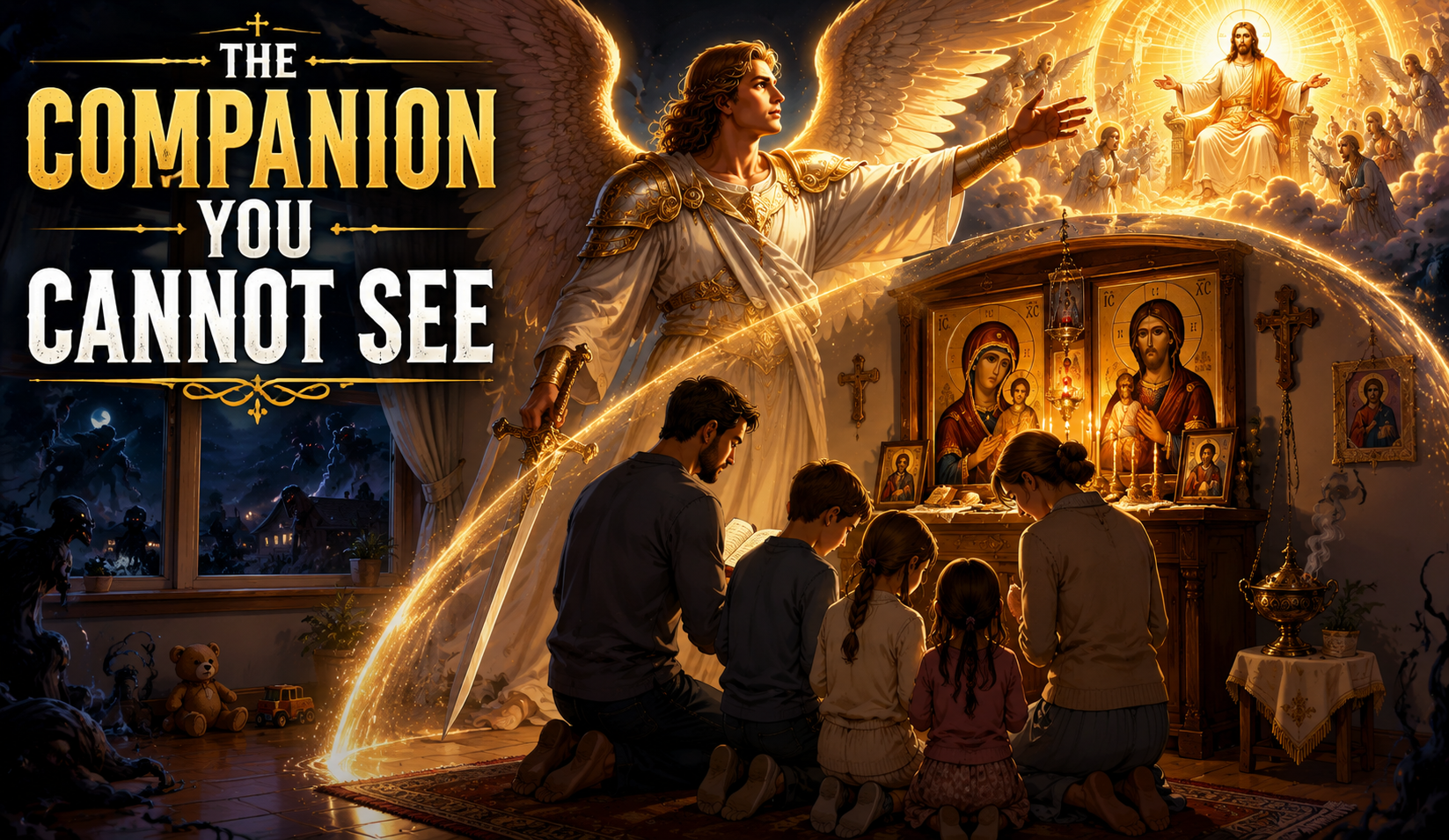
There are moments in life when the veil feels thin.
Perhaps it is standing beside the bed of a dying loved one as they take their final breath. Perhaps it is hearing a child sing “Holy God” for the first time during the Divine Liturgy. Perhaps it is those moments of prayer when the distractions of the world suddenly fall silent and you become profoundly aware that there is something more happening around you than what your eyes can see.
Most modern Christians have been taught to live almost entirely within the boundaries of the material world. We trust what can be measured, weighed, tested, and verified. We have become so conditioned to think scientifically that we often forget one of the most basic assumptions of biblical Christianity:
The universe is not merely physical.
It is spiritual.
The Scriptures do not present angels as poetic symbols, metaphors, or religious decorations. They are real beings, created by God, participating in His divine purposes, ministering to His people, and worshiping continually before His throne.
Yet for many Christians, angels occupy an uncomfortable place somewhere between children’s storybooks and Hollywood fantasy.
The Orthodox Church has never shared that uncertainty.
From Genesis to Revelation, from the writings of the Apostles to the teachings of the Desert Fathers, the Orthodox Christian understanding of reality has always included the angelic hosts as active participants in God’s creation. To ignore them is not merely to overlook an interesting theological topic. It is to misunderstand the nature of the world itself.
You can Now Listen to Each Article
The Invisible World Is Not Less Real
One of the great challenges of modern Christianity is that we often divide reality into separate compartments.
There is the “physical world” over here.
There is the “spiritual world” over there.
Then we live as though the physical world is what really matters while the spiritual world exists somewhere in the background.
Orthodoxy rejects that division.
In fact, every Orthodox Christian confesses this truth every time we recite the Nicene Creed:
“I believe in one God, the Father Almighty, Maker of heaven and earth, and of all things visible and invisible.”
Notice what the Creed does not say. It does not say that God created only the material universe. Nor does it imply that the invisible world is somehow secondary or less important than the visible one. Rather, the Creed affirms that both realms originate from God, exist under His authority, and are part of the same created order.
The Fathers consistently taught that creation consists of both visible and invisible realities. Saint Paul reminds us in Colossians 1:16:
“For by Him all things were created, in heaven and on earth, visible and invisible.”
The invisible world is not less real because we cannot see it.
In fact, many times it is more consequential than the things we can see.
The spiritual realities surrounding us shape the visible realities we experience. The decisions we make, the temptations we face, the battles we fight, and even the peace we experience often have dimensions that extend beyond what our senses can perceive.
This is one reason the ancient Church never reduced theology to merely intellectual concepts or philosophical systems. Theology was understood as participation in reality as it truly is. Christianity is not simply about knowing facts about God. It is about experiencing God and entering into communion with Him. The visible and invisible worlds are not competing spheres. They are interwoven dimensions of God’s creation. The Christian life is learning to live faithfully within both.
This is why the Church has always taken angels seriously.
To ignore the invisible world is to ignore part of the very creation we confess every Sunday. The angels, the saints, the heavenly hosts, and the spiritual realities described throughout Scripture are not additions to Christianity. They are part of the Christian worldview itself.
The more we recover this understanding, the more the Scriptures begin to make sense. Prayer becomes more than words. Worship becomes more than ritual. The Divine Liturgy becomes more than a gathering of believers. We begin to recognize that we are participating in a reality far larger than ourselves, one that encompasses both heaven and earth, things visible and invisible.
This is why the Orthodox Church has never viewed angels as theological curiosities or symbolic figures. They are part of the living reality of God’s creation. To understand the role of angels is to better understand the nature of the world itself, the nature of worship, and ultimately our place within God’s eternal purposes.
What Are Angels?
Angels are created spiritual beings.
They are neither eternal nor divine. They are not gods. They are not independent powers competing with God. They are creatures who exist because God willed them into existence.
The word “angel” comes from the Greek word angelos, meaning messenger.
Yet describing angels merely as messengers would be like describing human beings merely as biological organisms. It is technically true, but it fails to capture the fullness of who they are.
The Fathers describe angels as intelligent, personal, spiritual beings who possess will, reason, and the ability to act according to God’s purposes. Saint John of Damascus writes that angels are spiritual substances possessing intellect and free will.
One of the most fascinating differences between angels and humanity concerns the nature of knowledge itself.
According to the Fathers, angels were created with a fullness of knowledge appropriate to their nature. They did not need to learn language. They did not need to discover mathematics. They did not need to develop philosophy or acquire wisdom through centuries of experience. God infused them with knowledge at the moment of their creation. They immediately understood their place within the created order and their role within God’s divine purposes.
Humanity, however, was created differently.
Adam and Eve were not created with exhaustive knowledge. They were innocent, pure, and without sin, but they were not omniscient. In fact, the very existence of the Tree of the Knowledge of Good and Evil demonstrates that humanity was intended to grow in wisdom through communion with God rather than possess all knowledge instantaneously.
This distinction is critically important.
The angels were created complete according to their nature.
Humanity was created with the capacity for growth.
The Fathers often speak of man as a creature who stands between the material and spiritual worlds. Unlike the angels, who are purely spiritual, mankind was created as both body and soul. Unlike the animals, mankind was created in the image and likeness of God.
Notice the language of Genesis carefully.
God created humanity in His image and likeness.
The Fathers frequently distinguished between these two concepts. The image refers to those gifts that belong to us by creation: reason, freedom, self-awareness, creativity, and the ability to enter into relationship with God. The likeness, however, is something dynamic. It is something toward which humanity grows.
Saint Irenaeus and many of the later Fathers taught that Adam and Eve were created in the image of God, but they were intended to mature into His likeness through faithful obedience and communion with Him.
In other words, humanity was never meant to remain as it was in Eden.
Human beings were created for transformation.
The tragedy of the Fall was not simply that mankind became sinful. It was that mankind attempted to seize wisdom apart from God rather than receive it through relationship with Him.
The angels knew who they were from the moment they were created.
Humanity must discover who we are through our journey with God.
The angels glorify God according to the nature they were given.
Human beings are invited into something even more astonishing. We are called to participate in the divine life itself. As Saint Peter writes, we are called to become “partakers of the divine nature.”
This is why Orthodox theology speaks so often about theosis.
The ultimate destiny of mankind is not merely moral improvement or escaping judgment. It is union with God by grace. We were created to grow continually into His likeness, reflecting His glory more fully with each step of our journey toward Him.
Unlike the angels, who were created with immediate knowledge of their purpose, humanity’s path is one of discovery, growth, struggle, repentance, and transformation. In that sense, the human story is uniquely beautiful because it reveals not merely God’s power, but His desire to draw His children freely into communion with Himself.
Like humanity, the angels were created to participate in the life of God.
Unlike humanity, they do not possess physical bodies.
Their existence reminds us that materiality is not a prerequisite for personhood. Yet their existence also reminds us that humanity occupies a unique place within creation, standing between heaven and earth, called to unite both in worship before the throne of God.
The Nine Orders of Angels
Orthodox theology has traditionally recognized nine angelic ranks organized into three triads.
These include:
- Seraphim
- Cherubim
- Thrones
- Dominions
- Virtues
- Powers
- Principalities
- Archangels
- Angels
This hierarchy is drawn primarily from Scripture and developed through the theological reflections of Saint Dionysius the Areopagite.
While some modern readers become fascinated with classifications and rankings, the Fathers were interested in something deeper.
The hierarchy reveals that God’s creation is ordered.
The universe is not chaotic.
It is structured, purposeful, and directed toward communion with God.
Every angelic rank fulfills a unique role within God’s providential governance of creation.
Angels and Worship
One of the most profound themes in Orthodox theology is that angels are not merely workers.
They are worshipers.
Isaiah’s vision reveals the Seraphim crying out:
“Holy, Holy, Holy is the Lord of Hosts.”
The Book of Revelation presents the heavenly liturgy where angels and saints together glorify God before His throne.
This is one reason Orthodox worship is so rich and deeply symbolic.
The Divine Liturgy is not merely an earthly gathering.
It is participation in heavenly worship.
When the Church gathers around the Holy Table, we are not engaging in a symbolic reenactment.
We are entering into the worship already taking place in heaven.
This is why the priest proclaims:
“We who mystically represent the Cherubim.”
Orthodox worship is cosmic worship.
The angels are not spectators.
They are participants.
Guardian Angels and the Christian Life
Among the Church’s most beloved teachings is the belief that God assigns guardian angels to His people.
Christ Himself speaks of children whose angels continually behold the face of the Father.
The Orthodox prayer tradition regularly acknowledges the presence of one’s guardian angel.
Yet we must be careful not to think of guardian angels in sentimental or superstitious ways.
They are not lucky charms.
They are not celestial bodyguards whose purpose is merely to prevent inconvenience.
The role of a guardian angel is fundamentally spiritual.
They aid, protect, guide, and strengthen us in our journey toward salvation.
Their ministry always points us toward Christ.
Never toward themselves.
The closer an angel brings us to Christ, the more faithfully that angel fulfills his purpose.
Angels and Spiritual Warfare
Modern Christianity often speaks of spiritual warfare while possessing very little understanding of the spiritual world itself.
The Orthodox tradition has never made that mistake.
The Church recognizes that human beings live within a spiritual conflict that began before humanity’s creation.
Some angels remained faithful to God.
Others rebelled.
Those fallen angels became what Scripture identifies as demons.
This reality should not produce fear.
It should produce vigilance.
Many Christians become fascinated with demonic activity while neglecting the far greater reality of God’s power and the ministry of His holy angels.
The Orthodox approach is balanced.
We acknowledge evil.
We recognize temptation.
We understand spiritual warfare.
But our focus remains fixed on Christ.
The angels teach us this lesson.
The holy angels do not draw attention to themselves.
They continually direct attention toward God.
What Angels Teach Us About Ourselves
Perhaps the most important question is not what angels do.
Perhaps the more important question is what angels reveal about us.
The angels remind us that humanity was created for communion with God.
They remind us that worship is our highest calling.
They remind us that reality is larger than what appears on a screen, in a news feed, or in a bank account.
They remind us that every decision carries eternal significance.
Most importantly, they remind us that heaven is not merely a destination.
It is a reality breaking into the present moment.
Every prayer.
Every act of repentance.
Every Divine Liturgy.
Every confession.
Every Eucharist.
These are moments where heaven and earth intersect.
The angels stand as witnesses to that truth.
Conclusion
The tragedy of modern Christianity is not that we deny angels.
It is that we have forgotten the world they inhabit.
We have become so focused on the visible that we have neglected the invisible.
So focused on information that we have forgotten mystery.
So focused on earthly concerns that we have forgotten heavenly realities.
Orthodoxy calls us back to a fuller vision.
A vision in which heaven and earth are intertwined.
A vision in which angels worship before the throne of God even now.
A vision in which our lives are part of a story much larger than ourselves.
The angels are not the center of that story.
Christ is.
Yet the angels help us remember something essential.
The world is far more spiritual than we realize.
And the God who created both angels and men is continually inviting us into deeper communion with Him.
May we have eyes to see, ears to hear, and hearts prepared to enter more fully into that heavenly reality.
Want the entire article distilled into one clear, printable page?
Download your free summary and keep it with you.
Get the free PDF + join thousands receiving short, practical Orthodox insights in the “Morning Brew with Father Don” to help you grow in Christ each week.