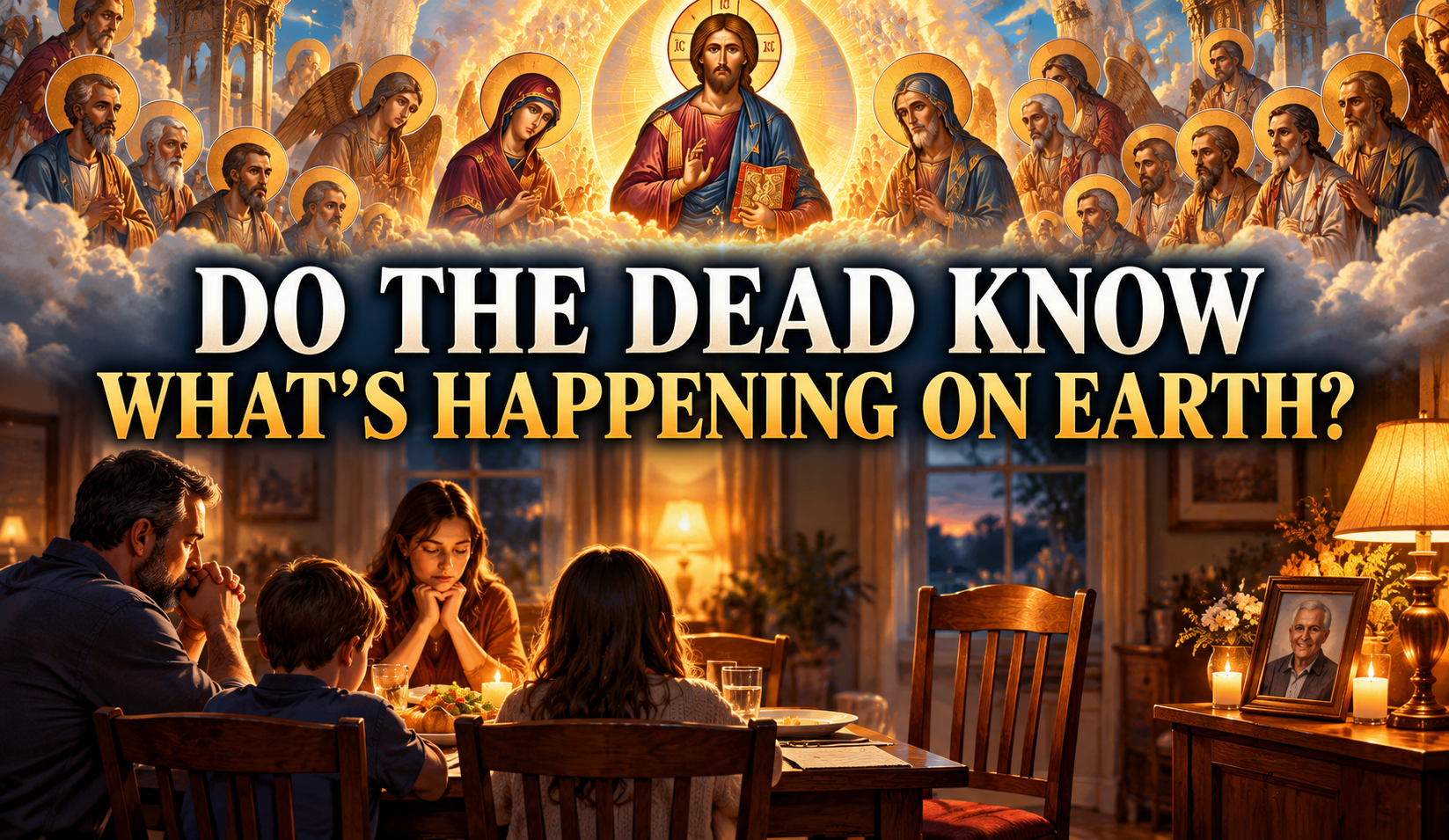
Do our departed loved ones know that we still love them? Can the saints in heaven hear our prayers? And what did the earliest Christians believe about the mysterious relationship between the living and the dead?
When someone you love dies, one question can haunt your heart:
Do they know how much I still love them?
Perhaps it is your mother, whose voice you would give anything to hear one more time.
Perhaps it is your father, whose wisdom you desperately need as you face a difficult decision.
Maybe it is your spouse, the person with whom you shared your entire life. You still catch yourself reaching for the phone to tell them something, only to remember that they are no longer there.
Or perhaps it is a child, whose absence has left an emptiness that words cannot begin to describe.
You visit the cemetery. You stand beside the grave. You whisper, “I miss you. I love you.”
And somewhere deep inside, you wonder:
Can they hear me? Do they see what is happening in my life? Are they watching over me?
These are not merely theological questions. They are deeply human questions, born out of love, grief, and the hope that death has not destroyed the relationship we once shared.
Interestingly, Americans remain remarkably interested in these questions.
According to a December 2023 report from the Pew Research Center, 50% of American adults believe spirits or spiritual energies can inhabit burial places. Another 38% report having experienced a feeling that someone who died was communicating with them from beyond this world. These findings describe Americans’ beliefs and experiences, not evidence that such communication actually occurred.
But here is something that may surprise you.
The earliest Christians believed that death did not end our communion with those who belonged to Jesus Christ.
They prayed for departed Christians. They asked the saints for their intercessions. They gathered around the Eucharist believing that the Church was far greater than the people physically standing inside the building.
Yet they also recognized important boundaries between Christian prayer and attempts to communicate with the dead.
So what did they actually believe? And what does the Orthodox Church teach about these matters today?
The answer is far more beautiful, and more mysterious, than many people realize.
1. Death Is Real, but It Is Not the End
We need to begin with something foundational.
Christianity does not teach that death is simply an illusion or that our loved ones become invisible spirits floating around us.
Death is a terrible consequence of humanity’s fallen condition. It separates the soul from the body, something God never intended to be humanity’s permanent state.
That is why the Orthodox Church does not speak of death casually.
We grieve. We weep. We bury our loved ones with reverence.
Even Jesus wept at the tomb of His friend Lazarus (John 11:35).
But Christianity also makes a remarkable proclamation:
Death has been conquered through the death and Resurrection of Jesus Christ.
Jesus told Martha:
“I am the resurrection and the life. He who believes in Me, though he may die, he shall live.” (John 11:25)
Notice that Jesus did not simply promise that someday He would give us life.
He declared that He Himself is the Resurrection and the Life.
This changes everything about how Christians understand death.
When an Orthodox Christian dies, we frequently say that the person has fallen asleep in the Lord.
This language comes directly from the New Testament.
St. Paul writes:
“But I do not want you to be ignorant, brethren, concerning those who have fallen asleep, lest you sorrow as others who have no hope.” (1 Thessalonians 4:13)
Paul is not telling us that grief is wrong. He is telling us that Christian grief must be shaped by the Resurrection.
The person we love has truly died. Their bodily presence is gone, and we cannot pretend otherwise.
But their existence has not ended.
And in Christ, our hope of reunion is not an empty wish.
It rests upon His victory over death and His promise of the resurrection of the body.
2. Jesus Said Something Extraordinary About Those Who Have Died
One of the clearest passages on this subject comes from an encounter between Jesus and the Sadducees.
The Sadducees rejected the resurrection of the dead. They attempted to challenge Jesus with a question about marriage in the resurrection.
Jesus responded by referring to God’s words to Moses at the burning bush:
“I am the God of Abraham, the God of Isaac, and the God of Jacob.”
Then He made this remarkable declaration:
“For He is not the God of the dead but of the living, for all live to Him.” (Luke 20:38)
Consider what Jesus is saying.
Abraham had been dead for centuries.
Isaac had been dead for centuries.
Jacob had been dead for centuries.
Yet Jesus spoke of them as living before God.
Their physical bodies had died, but their existence before God had not ceased.
This is an essential part of the Orthodox understanding of the communion of saints.
Those who have departed this earthly life in Christ are not simply erased from the Church until the final resurrection.
They remain alive to God.
St. Paul reinforces this when he writes:
“For I am persuaded that neither death nor life … shall be able to separate us from the love of God which is in Christ Jesus our Lord.” (Romans 8:38-39)
If death cannot separate us from the love of God in Christ, why should we assume that it automatically destroys every spiritual bond between members of His Body?
The Church is not simply a gathering of people who happen to be alive on earth.
It is the Body of Christ, united to the One who has conquered death.
And this brings us to a truth that has been preserved in Orthodox Christianity for nearly two thousand years.
3. The Communion of Saints: One Church, Not Two
Many Christians imagine heaven and earth as two entirely disconnected realities.
The living are here. The departed are there. There is an enormous wall between us.
But that is not how the ancient Church understood itself.
The Church has always confessed that there is one Body of Christ.
St. Paul writes:
“So we, being many, are one body in Christ, and individually members of one another.” (Romans 12:5)
Our membership in that Body does not depend upon geography.
Nor is the Church limited to those whom we can physically see.
The Epistle to the Hebrews gives us a remarkable glimpse of this reality.
After recounting the lives of the Old Testament faithful in Hebrews 11, the author declares:
“Therefore we also, since we are surrounded by so great a cloud of witnesses, let us lay aside every weight, and the sin which so easily ensnares us.” (Hebrews 12:1)
Who are these witnesses?
They are the faithful who have gone before us.
Abraham. Moses. The prophets. The martyrs. Those who lived by faith and whose lives testified to God’s promises.
The passage presents them as witnesses surrounding the Christian life, although it does not specify precisely how much they observe of our earthly activities.
A little later, Hebrews describes Christians as having approached the heavenly Jerusalem, the angels, and:
“The spirits of just men made perfect.” (Hebrews 12:23)
Do you see the picture?
Earthly worship is connected to heavenly reality.
The Church is not divided into two unrelated communities, one alive and one dead.
There is one Lord, one faith, one baptism, and one Body.
This is why Orthodox Christians speak of the communion of saints.
We remain united in Christ, even when physical death separates us.
But an important question remains.
Does this mean those who have departed can actually see what is happening here on earth?
4. Can Our Departed Loved Ones Actually See Us?
Here we must be careful.
The Orthodox Church believes that the saints are alive in Christ and that they intercede for us.
But that does not mean every departed person possesses unlimited knowledge of everything happening on earth.
The departed do not become omniscient.
They do not become gods.
They do not suddenly possess all the knowledge and power that belong to God alone.
Only God knows all things.
Scripture does, however, provide some fascinating glimpses of heavenly awareness.
In Revelation 6:9-10, St. John sees the souls of martyrs beneath the heavenly altar crying out to God:
“How long, O Lord, holy and true, until You judge and avenge our blood on those who dwell on the earth?”
These martyrs are conscious.
They remember their suffering.
They pray to God concerning events on earth.
That is significant.
It shows that at least some of those who have departed in faith remain aware of earthly matters and continue to pray.
In Revelation 5:8, the twenty-four elders are pictured holding golden bowls filled with incense, which represent the prayers of the saints.
And in Revelation 8:3-4, an angel offers incense together with the prayers of the saints before God.
These passages reveal a heavenly reality in which prayer, worship, and the life of the Church are connected.
However, we should not take these images and claim more than Scripture actually says.
They do not prove that your departed grandmother watches you every morning as you make coffee.
They do not establish that your father knows every decision you make.
And they certainly do not mean that departed souls continually wander through our homes.
Even among the Church Fathers, there was recognition that the precise extent of the departed’s knowledge remains mysterious.
St. Augustine, writing in On the Care to Be Had for the Dead, considered reports of deceased loved ones appearing in dreams. He cautioned against immediately assuming that such dreams were actual visits from departed souls.
He recognized that an experience which feels profoundly real does not necessarily tell us exactly what occurred spiritually.
That is an important distinction.
The Orthodox Christian does not need to deny every mysterious experience.
But neither should we immediately assign supernatural explanations to things we do not understand.
Our hope is not that our loved ones have become invisible observers of our daily lives. Our hope is that they remain within the knowledge, mercy, and love of God.
And what God knows, He can make known according to His wisdom.
That is enough for us to trust Him.
5. What the Church Fathers Actually Taught
Some Christians assume that asking saints to pray for us or offering prayers for the departed were practices invented centuries after the apostles.
But when we examine the writings of the early Church, we discover something quite different.
By the fourth century, both practices were clearly present in the Church’s worship.
St. Cyril of Jerusalem: The departed remain part of our prayers
St. Cyril of Jerusalem, writing in the fourth century, described what Christians did during the Divine Liturgy.
In his Mystagogical Catechesis 5, he explains that the Church commemorated the patriarchs, prophets, apostles, and martyrs:
“That at their prayers and intercessions God would receive our petition.”
He then described the prayers offered for other Christians who had departed, believing that these prayers brought spiritual benefit to their souls.
Think about what this means.
Here we have a bishop of the ancient Church explaining that Christians both sought the intercessions of the saints and prayed for those who had fallen asleep.
These were not presented as unusual innovations.
They were part of the Church’s liturgical life.
And they remain part of Orthodox worship today.
St. John Chrysostom: Our prayers for the departed matter
St. John Chrysostom, one of the greatest preachers in Christian history, was equally explicit.
In his third homily on Philippians, he wrote:
“Not in vain did the Apostles order that remembrance should be made of the dead in the dreadful Mysteries.”
He went on to explain that the prayers of the gathered Church brought benefit to those who had departed in faith.
Notice the connection to the Eucharist.
For Chrysostom, prayer for the departed was not simply a private expression of grief.
It was an act of the Church, gathered before God in worship.
We do not pray because we believe we can control the spiritual condition of the departed.
We pray because God’s mercy is greater than our understanding.
St. Jerome: Do the saints stop praying when they enter heaven?
Another fascinating witness comes from St. Jerome.
In the early fifth century, Jerome responded to Vigilantius, who objected to certain practices involving the martyrs and their intercessions.
Jerome asked:
“If Apostles and martyrs while still in the body can pray for others … how much more must they do so when once they have won their crowns, overcome, and triumphed?”
His argument was straightforward.
If Christians can pray for one another while living on earth, why should death render the saints incapable of praying?
Has union with Christ somehow diminished their love?
Have they become less concerned about the Church?
Jerome believed precisely the opposite.
The saints are more fully united to Christ, not less.
Their love has not been extinguished by death.
It has been purified by the presence of God.
However, Jerome’s argument for heavenly intercession does not imply that every departed Christian has equal knowledge or spiritual authority. The Church particularly recognizes the intercessory role of those glorified as saints.
Together, these early witnesses reveal something important.
The ancient Church did not understand death as severing all relationships within the Body of Christ.
And the Orthodox Church continues to preserve that understanding.
6. Why Orthodox Christians Ask the Saints to Pray for Them
This is an area where many Protestant Christians have sincere questions.
They ask, “Why would you pray to a saint when you can pray directly to Jesus?”
It is a reasonable question, especially if someone has never encountered the Orthodox understanding of prayer.
First, Orthodox Christians absolutely pray directly to God.
We pray to the Father, through the Son, in the Holy Spirit.
Our entire liturgical and sacramental life is centered upon the Holy Trinity.
But we also ask other Christians to pray for us.
If you are facing surgery, you might ask your pastor to pray.
If your marriage is struggling, you might ask trusted Christian friends to pray.
If your child is suffering, you might ask the entire congregation to intercede.
Why?
Because Scripture encourages believers to pray for one another.
St. James writes:
“The effective, fervent prayer of a righteous man avails much.” (James 5:16)
Here is the Orthodox question:
If we can ask Christians on earth to pray for us, why would we assume that Christians who are alive in Christ can no longer intercede?
When Orthodox Christians say, “Most holy Theotokos, pray for us,” or “St. Nicholas, pray for us,” they are not worshiping Mary or Nicholas.
They are requesting their prayers.
There is a fundamental distinction between worship, which belongs to God alone, and honor given to His saints.
Of course, St. Paul tells us:
“For there is one God and one Mediator between God and men, the Man Christ Jesus.” (1 Timothy 2:5)
Orthodox Christians wholeheartedly affirm this.
Jesus Christ is the unique Mediator of our salvation.
No saint replaces Him.
No saint redeems us.
No saint possesses an independent source of grace apart from God.
But the intercessory prayers of Christians do not compete with Christ’s mediation. They participate in the life of His Body.
After all, the same apostle who declared Christ to be the one Mediator instructed Christians to offer prayers, intercessions, and thanksgivings for all people in 1 Timothy 2:1.
The difference is not between praying to Christ and asking others to pray.
It is between recognizing Christ as the source of all salvation and recognizing that His people share in a life of mutual prayer.
7. Why Orthodox Christians Pray for the Dead
Let me ask you something.
If your mother were seriously ill, would you pray for her?
Of course you would.
If your father were suffering, would you ask God to comfort him?
Absolutely.
But what happens when they die?
Does love suddenly become meaningless?
Does prayer no longer have any place?
The ancient Christians did not think so.
They continued to commend their departed loved ones to the mercy of God.
And Orthodox Christians continue to do exactly that.
During the Divine Liturgy, the Church remembers the faithful departed.
Orthodox Christians also offer memorial services, often called Panikhida or Mnemosyno, depending on the tradition.
In many Orthodox communities, prayers are offered especially on the third, ninth, and fortieth days after death, as well as on anniversaries and appointed days of remembrance.
But why do we pray for those who have already died?
Because we believe that God’s mercy is not limited by our understanding of time.
We do not presume to know the eternal condition of every departed soul.
We do not claim that our prayers automatically change God’s judgment.
And we do not believe that prayer is a way of purchasing salvation for someone who has died.
Instead, we entrust them to the loving mercy of Christ.
An ancient Orthodox prayer begins:
“O God of spirits and of all flesh, Who hast trampled down death and overthrown the Devil, and given life to Thy world…”
It then asks God to grant rest to His departed servants, to forgive their sins, and to receive them into His peace.
There is something profoundly beautiful about this.
We do not stop loving because someone dies.
And because we do not stop loving, we do not stop praying.
When I stand at the altar and commemorate those who have fallen asleep, I am reminded that the Church is much larger than the congregation gathered before me.
We are worshiping the same Christ who reigns over both the living and the departed.
Our prayers rise before the throne of the One who has conquered the grave.
And that is where our hope rests.
8. What About Roman Catholics and Protestants?
Here we need to make several important distinctions.
Orthodox Christians, Roman Catholics, and Protestants generally agree that human beings do not cease to exist at death and that our ultimate Christian hope is the resurrection.
But there are significant differences concerning the communion of saints, prayers for the dead, and what happens after death.
The Roman Catholic understanding
Roman Catholicism shares substantial common ground with Orthodoxy on these questions.
Roman Catholics also believe in the communion of saints.
They ask saints to intercede.
They pray for the departed.
They believe that the faithful remain spiritually united through Christ.
These are meaningful similarities rooted in the ancient Christian tradition.
However, an important difference concerns the doctrine of purgatory.
The Roman Catholic Catechism describes purgatory as the final purification of those who die in God’s grace but are not yet completely purified.
It also connects prayers for the dead with this process of purification.
The Orthodox Church does not accept the Roman Catholic dogmatic formulation of purgatory.
This does not mean that Orthodoxy rejects the possibility of spiritual purification or growth in God’s mercy after death.
Rather, Orthodoxy is more reserved about defining the precise condition and experience of souls awaiting the final resurrection.
We pray for the departed because we trust God’s mercy, without claiming to understand all the mysteries of the intermediate state.
This is an important distinction.
Orthodoxy does not attempt to construct a detailed map of the afterlife.
We know that Christ has conquered death.
We know that He is merciful and just.
We know that the Church has always prayed for those who have fallen asleep.
Beyond that, we must approach the mystery with humility.
The Protestant understanding
Protestant Christianity is diverse, and we should be careful not to treat every Protestant tradition as though it teaches exactly the same thing.
Many evangelical, Baptist, and Reformed Christians reject asking departed saints for their intercessions.
They often argue that Christians should direct their prayers exclusively to God and that Scripture does not explicitly command believers to address departed saints.
Many also reject prayers for the dead, reasoning that the eternal destiny of a person is settled at death.
Other Protestant traditions, particularly Anglican and Lutheran communities, retain language concerning the communion of saints, although their approaches to invocation and prayers for the departed vary considerably.
Here is something worth considering, especially for Protestant readers.
If a practice was already part of Christian worship in the fourth century, should we dismiss it without first examining why the Church practiced it?
This does not mean that every fourth-century custom is automatically apostolic.
Historical evidence must be evaluated carefully.
But the writings of St. Cyril, St. John Chrysostom, and St. Jerome demonstrate that intercession by the saints and prayers for the departed were well established in ancient Christianity.
The question is not simply what modern Christians are accustomed to doing.
It is what the ancient Church believed, how those beliefs developed, and whether they faithfully express the life of the Church described in Scripture.
For Orthodox Christians, Scripture is not separated from the worship and living Tradition of the Church that preserved and proclaimed it.
That is why these ancient witnesses matter.
They help us understand how Christians interpreted the apostolic faith long before the divisions that shaped modern Christianity.
9. If the Departed Are Alive in Christ, Can We Try to Contact Them?
This is perhaps the most important distinction in the entire discussion.
There is a tremendous difference between the communion of saints and attempting to communicate with the dead through occult practices.
Orthodox Christianity affirms one and rejects the other.
Scripture explicitly condemns attempts to summon or consult the dead.
Deuteronomy 18:10-12 warns against divination, sorcery, and those who seek information from the dead.
In 1 Samuel 28, King Saul consults a medium at Endor in an effort to communicate with the prophet Samuel.
This was an act of disobedience and spiritual desperation.
Saul had turned away from trusting God and sought forbidden supernatural guidance.
The Orthodox Church takes these warnings seriously.
Christian communion with the saints is not spiritualism.
It is not necromancy.
It is not an attempt to summon spirits, uncover secret information, predict the future, or control the supernatural world.
Asking St. Nicholas to pray for you is fundamentally different from visiting a medium who promises to bring your deceased father into the room.
One is a request for intercession within the Body of Christ.
The other is an attempt to initiate contact with the dead through practices forbidden by Scripture.
This distinction is especially important today.
We live in a culture fascinated with the supernatural.
People visit psychics hoping to speak to departed family members.
They attend séances.
They experiment with spirit boards and paranormal practices.
Sometimes they do these things out of curiosity.
But often, they do them because they are grieving.
They desperately want one more conversation.
One more opportunity to say, “I love you.”
One more assurance that the person they lost is at peace.
As a priest, I understand how powerful that longing can be.
But we must never allow grief to lead us into spiritually dangerous territory.
Orthodox spirituality teaches us to seek God, not forbidden supernatural experiences.
When we miss someone who has died, we should pray for them.
When we long for reassurance, we should turn toward Christ.
And when grief becomes overwhelming, we should seek comfort through the prayers, sacraments, and fellowship of the Church.
You do not need a medium to bring your loved one closer to you. You need the hope of the Resurrection.
10. What About Dreams, Signs, and Feeling a Loved One’s Presence?
This is another question I hear frequently.
Someone dreams about a departed parent.
Another person smells a familiar perfume associated with a grandmother who died years earlier.
Someone else feels an extraordinary sense of peace while standing beside a grave.
They wonder whether their loved one is trying to communicate.
How should an Orthodox Christian respond?
First, we should not mock or dismiss someone’s experience.
Grief is complicated.
Memory is powerful.
Love leaves deep impressions upon the human heart.
Sometimes dreams are simply dreams.
Sometimes familiar smells, sounds, or circumstances awaken intense memories.
And sometimes people experience things they genuinely cannot explain.
But here is where Orthodox spiritual discernment becomes essential.
Not every mysterious experience is a message from heaven.
The Fathers repeatedly warn Christians against placing excessive trust in visions, dreams, and extraordinary spiritual experiences.
Why?
Because human beings are capable of misunderstanding their experiences.
And because spiritual deception is a real concern within Orthodox ascetical teaching.
Not everything supernatural should be assumed to come from God.
Yet we should also avoid the opposite error of claiming that God could never comfort someone through an unexpected experience.
God is free to act according to His wisdom.
Our responsibility is not to chase signs, demand messages, or attempt to reproduce supernatural encounters.
Our responsibility is to remain rooted in Christ.
If you dream about someone you love who has departed, you do not need to be frightened.
Neither do you need to assume that the dream was an actual visitation.
Instead, allow it to become an occasion for prayer.
Say:
“Lord Jesus Christ, have mercy upon Your servant. Grant them rest in Your presence, and comfort those of us who remain.”
Then entrust the experience to God.
This is a much healthier spiritual response than becoming consumed with trying to decipher hidden messages.
And it is far more consistent with the wisdom of the Orthodox spiritual tradition.
11. When We Gather for the Divine Liturgy, Heaven and Earth Meet
There is one final truth I want to share.
And for me, this may be the most beautiful part of the entire discussion.
In Orthodox Christianity, the Divine Liturgy is not simply a religious meeting.
It is our participation in heavenly worship.
We gather before the throne of God.
We join our voices with the angels.
We commemorate the Most Holy Theotokos, the apostles, martyrs, confessors, and all the saints.
And we remember those who have fallen asleep in the hope of the Resurrection.
The Book of Revelation provides us with glimpses of heaven filled with worship.
Angels praise God.
The saints worship before His throne.
Prayers rise like incense.
The Lamb stands at the center of everything.
And when we gather for the Eucharist, we are participating in the worship of this same Lord.
Think about that for a moment.
The most meaningful connection we can have with our departed loved ones is not found in trying to summon their presence.
It is found in the One who conquered death.
I think of someone standing in church after losing a beloved spouse.
Perhaps they spent decades worshiping together.
For years, they stood side by side.
They prayed together.
They approached the chalice together.
And now one of them stands alone.
The absence is painful.
But the Orthodox understanding of worship reminds us that the Church remains united in Christ.
The departed faithful are not lost to Him.
Their names have not disappeared from His knowledge.
Their lives are not forgotten.
The same Lord who receives our worship is the Lord in whose hands we entrust them.
That does not eliminate grief.
But it gives grief a place to rest.
And it reminds us that the story has not ended.
12. Do They Know How Much We Still Love Them?
Let us return to the question with which we began.
When someone you love dies, do they know how much you still love them?
I wish I could give you a simple answer.
I wish I could point to a verse that explicitly declares that every departed person hears every word spoken by those left behind.
But Scripture does not say that.
And the Orthodox Church does not require us to pretend we know what God has not revealed.
What we can say is that God knows our love.
He knows every tear.
He hears every prayer.
He understands the grief that sometimes leaves us unable to speak.
Psalm 56:8 speaks beautifully of God remembering our tears.
Not one moment of sorrow is hidden from Him.
And the One who holds our departed loved ones in His care is the same One who holds us.
We are separated by death.
But we are not beyond the reach of His love.
That is why I would encourage you to do something simple.
The next time you find yourself missing someone who has died, do not become consumed with wondering whether they can see you.
Instead, pray.
Give thanks to God for their life.
Ask Him to forgive their sins.
Ask Him to grant them rest.
And ask Him to prepare your own heart for the day when you too will stand before Him.
Because the Christian hope is not that we will spend eternity communicating with invisible spirits.
Our hope is the resurrection of the dead and the life of the world to come.
St. Paul declares:
“For as in Adam all die, even so in Christ all shall be made alive.” (1 Corinthians 15:22)
The Christian story does not end at the cemetery.
It ends with the restoration of creation, the resurrection of the body, and the triumph of Jesus Christ.
And that brings me to a final thought.
Death Does Not Get the Last Word
One day, every one of us will experience the loss of someone we love.
And one day, unless Christ returns first, those who love us will experience that same grief.
Death is a reality none of us can escape through our own strength.
But death is not greater than Jesus Christ.
This is why the Orthodox Church sings at Pascha:
“Christ is risen from the dead, trampling down death by death, and upon those in the tombs bestowing life!”
That is not just beautiful poetry.
It is the proclamation at the very center of our faith.
Christ entered death.
He shattered its power.
And He opened the way to everlasting life.
So when you stand beside the grave of someone you love, remember this:
You are not standing at the place where God’s power ends.
You are standing at a place where the promise of the Resurrection matters most.
You may not know whether your loved one can see you.
You may not know whether they hear the words you whisper.
But you can know that God hears you.
You can know that Christ has conquered death.
And you can entrust the person you love to the mercy of the One whose love is infinitely greater than your own.
Perhaps the most important question is not whether the dead can see us.
Perhaps the greater question is whether we can see beyond death to the One who has destroyed its power.
Because in the end, Christian hope is not built upon the possibility of receiving messages from those who have departed.
It is built upon the certainty that Jesus Christ is risen.
And because He lives, death will not have the final word.
Christ is risen! Truly He is risen!
Want the entire article distilled into one clear, printable page?
Download your free summary and keep it with you.
Get the free PDF + join thousands of people receiving short, practical Orthodox insights in the “Morning Brew with Father Don” to help you grow in Christ each week.