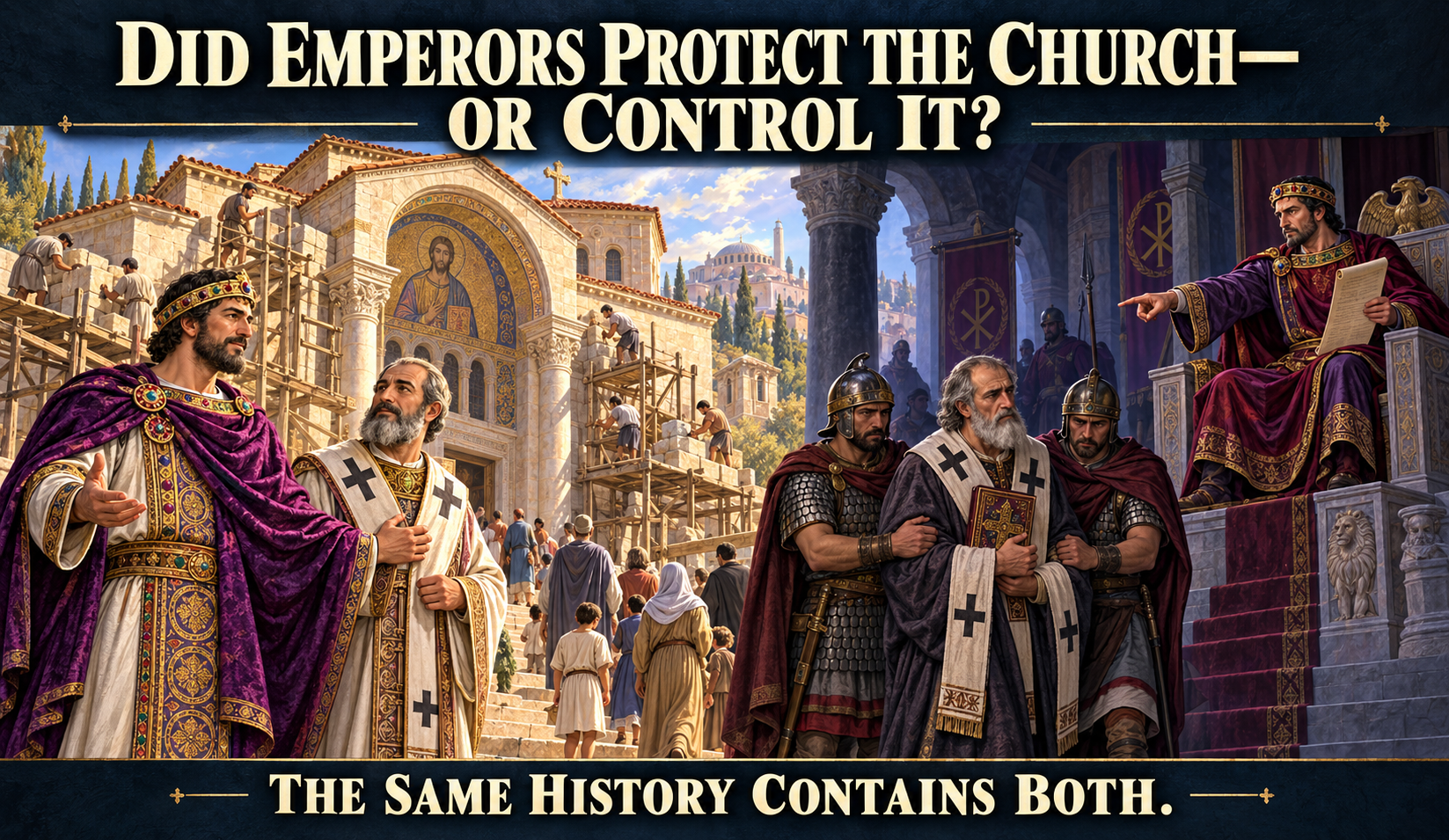
Some people argue that the Christianity we practice today is no longer the faith of the apostles. Somewhere along the way, they say, the Church of Jesus Christ became the church of the Roman emperors. Rulers took charge of doctrine, bishops learned to obey, and political convenience replaced apostolic truth.
In this telling, Christians who recite the Nicene Creed on Sunday are repeating the decisions of an imperial government.
This argument takes several forms. Jehovah’s Witness publications portray Constantine’s alliance with the bishops as producing a religion that mixed Christianity with paganism. A different claim appears in the World History Encyclopedia, which describes Constantine as becoming the head of the Christian Church upon his conversion. These accounts are not identical, but both encourage readers to associate the development of historic Christianity with imperial control.
The conclusion some draw is serious: if emperors ran the Church and determined its beliefs, why should anyone receive those beliefs as the faith handed down by the apostles? Others question if the Church is even legitmate after the 3rd Century because of a belief it was no longer the faith of the Apostles.
It’s true that emperors did exercise enormous power over the Church’s outward life. They favored bishops, financed councils, removed opponents, and sent churchmen into exile. Some bishops cooperated willingly. Others surrendered under pressure. An Orthodox Christian does not need to hide any of this.
Yet the same history presents a problem for the claim that the bishops simply believed whatever the emperor commanded. Emperors condemned men whom the Church now venerates as saints. Imperial governments supported teachings that the Church eventually rejected. Bishops and monks suffered imprisonment, exile, and mutilation rather than accept the religious policies of Christian rulers.
If the emperor’s word settled the faith, why did the Church preserve the teaching of men he tried to silence?
To answer that question, we must distinguish the power to punish a bishop from the authority to determine what the Church believes. Across the centuries, the struggle between those two things reveals both the benefits of imperial protection and the terrible cost of imperial interference.
Before Constantine: persecution and periods of peace
The third-century Church knew what imperial hostility could mean. Under Decius and Valerian, Christians faced demands that violated their faith, and bishops suffered alongside their people. In the early fourth century, the persecution associated with Diocletian brought the destruction of churches and Scriptures, imprisonment, and martyrdom.
Yet persecution was not continuous. There were also periods of toleration. Eusebius preserves an order from Emperor Gallienus allowing bishops to resume their activities and recover places of worship.
He also records an extraordinary episode involving Paul of Samosata, whom a council deposed from the bishopric of Antioch. When Paul refused to surrender the church building, the dispute reached the pagan emperor Aurelian. The emperor directed that it be assigned to the party recognized by the bishops of Italy and Rome.
The sequence matters. Bishops had already made the ecclesiastical judgment. Imperial authority then intervened over possession of the building. Christians were appealing to civil power even before there was a Christian emperor.
That appeal could be useful. It could also become dangerous. Whoever asks the state to enforce an ecclesiastical judgment gives the state an opportunity to become involved in ecclesiastical life.
Constantine: a protector with considerable power
For Christians who had endured persecution, Constantine’s patronage was an immense relief. Churches could be restored, Christian worship could flourish openly, and bishops could gather with imperial assistance. Constantine supported church building and provided arrangements for the Council of Nicaea in 325.
We should understand why Christians welcomed this change. Freedom to worship, after the destruction of churches and the suffering of believers, was no small gift.
Nevertheless, Constantine was more than a generous host standing quietly outside the council chamber. His concern for religious unity brought him directly into theological disputes. Eusebius’s letter about Nicaea reports that the emperor supported the inclusion of homoousios, the confession that the Son is “of one essence” with the Father. Bishops discussed and accepted the language; imperial influence was also present.
An Orthodox account can acknowledge both facts.
The question is whether Constantine’s support made the teaching true. It did not. The Son is eternally divine because that is who He is, and because this is the faith handed down in the Church. An emperor’s approval could help a confession prevail publicly. It could not supply its truth.
Nor did Christians begin worshiping Christ as divine because Constantine instructed them to do so. Christian testimony to Christ’s divinity long preceded his reign. Nicaea addressed a dispute about how faithfully to confess the Son’s relationship to the Father. The emperor did not introduce Christians to a divine Christ they had never previously known.
When protection became coercion
The reign of Constantine’s son Constantius II exposes the danger.
Athanasius describes a campaign in which bishops opposed to him sought imperial intervention, and imperial authority supported their efforts against him. This was no simple contest between a unified Church and an interfering ruler. Churchmen themselves helped bring the machinery of government into the dispute.
That point deserves attention. Bishops were actors in this history. They could resist the palace, accommodate it, or seek its help against other bishops.
Athanasius also preserves the protest of the elderly Bishop Hosius of Cordoba. Hosius distinguished the emperor’s responsibility for government from the bishops’ responsibility for the Church, warning Constantius against intruding into ecclesiastical affairs. The same account describes the pressure eventually brought upon Hosius himself.
These are the writings of a participant defending his cause, and we should read them with that awareness. Nevertheless, they plainly show that imperial interference was contested from within the Church.
Were some bishops compliant? Certainly.
Were all bishops compliant? The exiles and protests answer that question.
Nor should we speak too casually about those who weakened. It is easy to admire courage from a comfortable distance. Threats, imprisonment, isolation, and the loss of one’s community were terrible pressures. The Church’s history includes steadfast confessors, ambitious collaborators, frightened shepherds, and people who faltered and repented.
That is a history of human beings.
An emperor still needed repentance
St. Ambrose of Milan expressed the proper relationship with unusual clarity:
“For the emperor is within the Church, not above the Church.”
He spoke during a conflict over the court’s demand for a basilica for Arian worship. Ambrose refused to surrender it, despite the threat of force.
His words have consequences beyond disputes about church buildings. A Christian ruler remains a Christian accountable to God.
After the massacre at Thessalonica in 390, Ambrose wrote to Theodosius and insisted upon repentance. He told the emperor that he could not offer the Eucharistic sacrifice if Theodosius intended to be present. The letter itself gives us sufficient evidence of episcopal resistance; we do not need to depend upon later dramatic descriptions of a confrontation at the church door.
Consider what that means pastorally. The emperor’s patronage could not purchase permission to shed innocent blood. His position did not place him beyond correction.
A bishop who truly loves a ruler must sometimes call him to repentance.
Symphonia: a Christian aspiration under strain
In the sixth century, Justinian described priesthood and imperial government as gifts from God, with distinct responsibilities and a shared concern for human flourishing. Their proper cooperation is associated with the Byzantine ideal of symphonia, or harmony.
Yet we must read the whole situation honestly. The very law whose preface describes this harmony proceeds to regulate matters of clerical life and ecclesiastical discipline. Justinian did not imagine the modern separation of Church and state. His government claimed extensive responsibilities within a Christian society.
Symphonia therefore names an aspiration that requires moral judgment. It does not establish that every imperial intervention was legitimate, or that the relationship consistently worked well.
Protection, patronage, and control could become entangled. A ruler might sincerely believe that religious coercion served both God and public peace. Sincerity did not make his judgment sound.
From an Orthodox perspective, cooperation with government must remain accountable to the Gospel. Otherwise, the desire for harmony can become an excuse for silence.
When emperors and church leaders were wrong together
The seventh-century controversy over Christ’s will makes the issue unmistakable.
Monothelitism taught that Christ has one will. St. Maximus the Confessor defended the fullness of Christ’s humanity, including His human will. This concerned our salvation: the humanity the Son assumed must be truly and fully human.
St. Martin of Rome and St. Maximus resisted the imperial religious policy. Imperial authorities arrested, tried, and exiled them. Maximus suffered the cutting out of his tongue and the severing of his right hand.
The Sixth Ecumenical Council, held in 680–681 under Constantine IV, confessed two natural wills in Christ. It condemned prominent ecclesiastical supporters of the opposing teaching, including former patriarchs of Constantinople and Pope Honorius.
Here we find imperial authority supporting a council that rejected the religious direction of earlier imperial governments.
We also find a necessary warning: holding high ecclesiastical office did not guarantee faithfulness. The crisis reached into the hierarchy itself.
The Orthodox Church remembers Maximus as a confessor. His punishment did not make his teaching false, and his opponents’ offices did not make theirs true.
Icons and the limits of imperial endorsement
The iconoclast controversy repeated this struggle.
Under Constantine V, the council at Hieria in 754 condemned icons. A large gathering of bishops supported the policy. We cannot explain that away by pretending that imperial interference always met immediate, united episcopal resistance. It did not.
Yet the Seventh Ecumenical Council at Nicaea in 787 defended the veneration of icons, distinguishing it from the worship due to God alone. Its definition appealed to the Church’s received tradition. Imperial sponsorship and episcopal signatures had not made Hieria’s teaching binding upon Orthodoxy.
Imperial support also mattered to the restoration. Irene supported the council of 787. Following renewed iconoclasm, Theodora’s regency helped bring about the restoration of icons in 843. The history includes rulers who persecuted the defenders of icons and rulers who helped restore their freedom.
Calling every emperor a persecutor would be as misleading as calling every emperor a faithful guardian.
What, then, should an Orthodox Christian say?
We should begin by clarifying what we mean by control.
If we mean the ability to remove bishops, influence appointments, shape councils, and punish opposition, emperors sometimes exercised substantial control. The later vindication of confessors does not undo their suffering or make that control imaginary.
If we mean a rightful authority to determine what Christians must believe simply by issuing an imperial command, Orthodoxy recognizes no such authority.
The claim that imperial involvement made Christianity false requires another step that the evidence does not supply. Political influence can explain why a council assembled, why a bishop lost his position, or why a teaching received government support. Those facts alone do not establish whether the teaching faithfully expresses the apostolic faith. That question requires examining the teaching itself and the Christian witness that preceded it.
We should also acknowledge that the restoration of Orthodox teaching often involved changes in imperial policy. History does not become less political because we believe God was at work within it.
The Orthodox conviction is that the Holy Spirit preserves the Church in the apostolic faith through these struggles. That conviction does not promise that every bishop will be courageous, every council faithful, or every generation spared confusion.
Neither does it make resistance itself a guarantee of holiness. A person is not right merely because he defies authority. The confessors matter because of the faith they confessed.
The Church’s reception of a council belongs to this same life of fidelity: its teaching is recognized and lived as the apostolic faith, in continuity with Scripture, the Fathers, worship, and earlier true councils. This recognition can unfold through painful controversy. It is neither an imperial decree nor a simple vote.
Were the emperors protectors? Some were, and sometimes generously so. Did they also seek control? Some did, with devastating consequences. Were bishops merely “yes” men? Some accommodated power; others suffered rather than surrender their confession.
For us, the lesson reaches beyond Byzantium. We may welcome a government’s protection and be grateful for a ruler’s generosity. We must also retain the freedom to call rulers, bishops, and ourselves to repentance.
The Church belongs to Christ. Every Christian exercise of authority must answer to Him.
Want the entire article distilled into one clear, printable page?
Download your free summary and keep it with you.
Get the free PDF + join thousands of people receiving short, practical Orthodox insights in the “Morning Brew with Father Don” to help you grow in Christ each week.