A Response From an Orthodox Priest Who Was Once Protestant
There are criticisms of Orthodoxy by some Protestants that deserve serious answers. I find that oftentimes most people are coming from a good place with well-meaning intentions and are curious about ancient Christianity in its expressions that greatly differ from modern Christianity post-Reformation.
And then there are criticisms that leave an Orthodox Christian wondering whether the person speaking has ever actually listened to what the Orthodox Church teaches.
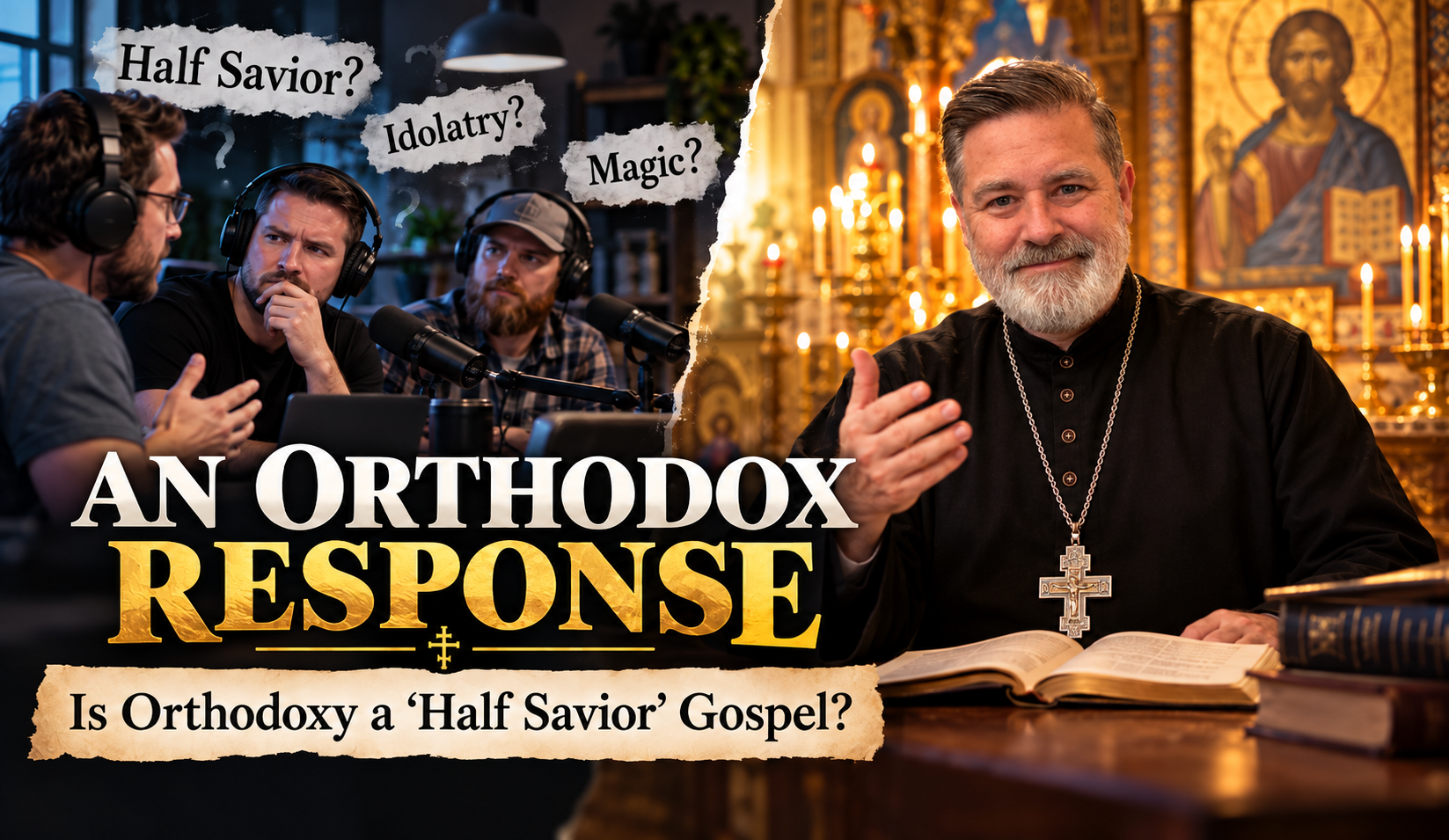
Recently, I listened to a Protestant discussion about Eastern Orthodoxy in a podcast titled The Sword & The Trowel. I did not listen looking for a fight. In fact, I understand many of the concerns being expressed better than some might expect.
I spent years in Protestant ministry as military Chaplain and pastor. I went to Lancaster Bible college and Dallas Theological Seminary in the mid-1990s to 2005. I preached from Protestant pulpits.
I loved Jesus Christ then, and I love Him now.
I did not become Orthodox because I stopped believing the Bible.
I became Orthodox because I became convinced that the faith I was discovering in the ancient Church was the faith into which the Scriptures themselves were born.
That is why several statements in this discussion caught my attention.
Orthodoxy was described as a religion that leaves us with a “half Savior.”
Its sacramental life was characterized as something approaching magic.
The veneration of icons was called “rank idolatry.”
Orthodox spirituality was described as “soul-crushing.”
And near the end of the conversation came perhaps the most striking description of all:
Orthodox Christians were characterized as something like “atheists who believe in magic.”
Those are extraordinary accusations.
And extraordinary accusations deserve more than sound bites.
So let us ask the question at the heart of this entire conversation:
Does the Orthodox Church lead people away from Jesus Christ, or does everything in Orthodoxy ultimately lead us toward deeper communion with Him?
Because if Orthodoxy gives us only half a Savior, I want nothing to do with it.
But if the criticism misunderstands what Orthodoxy actually teaches, then Christians deserve to know that too.
1. Is Jesus Christ Only a “Half Savior” in Orthodoxy?
Let us begin with the strongest accusation because everything else depends upon it.
The claim is essentially this: Protestant Christianity gives us a complete Savior, while Orthodoxy teaches that Jesus merely makes salvation possible and then leaves human beings to finish the work themselves.
I understand why that accusation sounds powerful.
There is only one problem.
That is not what Orthodoxy teaches.
Walk into an Orthodox Divine Liturgy and listen.
Listen carefully.
We do not gather to announce how wonderfully we have saved ourselves.
We gather crying:
“Lord, have mercy.”
Again.
And again.
And again.
Why?
Because our hope is the mercy of Jesus Christ.
The Orthodox Church proclaims that the eternal Son of God became man for our salvation, entered death, destroyed its power through His Resurrection, conquered the grave, ascended in glory, and gives eternal life to His people.
I cannot accomplish the Incarnation.
I cannot conquer death.
I cannot resurrect myself.
I cannot heal the corruption within my own soul.
I cannot make myself divine.
Jesus Christ does what I could never do.
So where does the confusion come from?
It comes largely from the Orthodox understanding of synergy.
And here is where we need to slow down, because this is one of those moments where two Christian traditions can use very different language and then assume the other side means something it does not.
Synergy does not mean God does 50 percent and I do the remaining 50 percent.
It means God acts, God calls, God gives grace, and human beings genuinely respond to that grace.
Saint Paul puts both realities together beautifully:
“Work out your own salvation with fear and trembling; for it is God who works in you both to will and to do for His good pleasure.”
Philippians 2:12-13
Notice what Saint Paul does not say.
He does not say, “God does everything, therefore your response is meaningless.”
Nor does he say, “You must save yourself.”
He says we work because God is at work within us.
Think about Saint Peter stepping out of the boat.
Peter really stepped.
Peter really walked.
But Peter was not keeping himself above the water.
Christ was.
And when Peter began to sink, he did not save himself by trying harder.
He cried, “Lord, save me!”
And Christ reached for him.
That is synergy.
Grace does not eliminate our response. Grace makes our response possible.
Here is the question I would ask my Protestant brothers:
If responding to grace somehow diminishes grace, why does Jesus repeatedly command us to repent, follow, endure, forgive, love, obey, watch, pray, and remain in Him?
Paul says:
“By grace you have been saved through faith.”
Amen.
Orthodox Christians believe that.
But only two verses later Paul says we have been created in Christ Jesus for good works.
James warns us about a faith that produces no life.
Christ describes the final judgment in Matthew 25 in terms of whether love for Him was manifested in love for the hungry, the stranger, the naked, the sick, and the imprisoned.
Our works do not purchase God’s love.
They do not place God in our debt.
They do not make the Cross effective.
They are the fruit of a life actually being transformed by grace.
Jesus Christ is not half a Savior.
He is the Savior who not only forgives us but begins healing everything sin has damaged within us.
And that brings us to one of the most beautiful teachings in all of Orthodoxy.
2. Theosis Is Not Becoming Another God
Here is another moment where words matter.
The podcast discusses the Orthodox doctrine of theosis, or deification, and understandably asks what Orthodox Christians mean when we speak about becoming “partakers of the divine nature.”
Some Christians hear that language and immediately become nervous.
I understand.
If Orthodoxy taught that human beings literally become God by nature, I would reject it too.
But it does not.
Here is the hook that changed the way I thought about salvation:
What if salvation is not merely God changing something written beside your name, but God actually changing you?
That question matters.
Because sometimes Western Christianity can reduce salvation almost entirely to a courtroom.
We are guilty.
Christ pays the penalty.
God declares us righteous.
There are biblical truths contained in that picture.
But Scripture gives us other pictures too.
Salvation is resurrection.
Salvation is healing.
Salvation is adoption.
Salvation is liberation.
Salvation is union with Christ.
Salvation is participation in divine life.
In 2 Peter 1:4, Saint Peter writes that we become:
“partakers of the divine nature.”
Saint Paul says we are being transformed into the image of Christ:
“from glory to glory.”
Jesus Himself prays that His disciples may participate in the communion of love revealed between the Father and the Son.
That is theosis.
We do not become God according to His essence.
We do not join the Holy Trinity.
We do not cease being creatures.
We become, by grace, what humanity was created to become all along.
Saint Athanasius expressed it in a famous way: the Son of God became man so that man might become god by grace.
The point is not that I become another deity.
The point is that through union with Christ I become truly alive with His life.
Think of iron placed into fire.
The iron remains iron.
But eventually it glows with the heat and light of the fire.
That is a helpful picture of theosis.
We remain human, yet through grace we increasingly participate in the life of God.
And that is why salvation in Orthodoxy is more than avoiding punishment.
Christ came not merely to change our destination.
He came to transform us.
3. Does the Essence-Energies Distinction Create “Two Gods”?
The discussion then moves into much deeper theological territory, specifically Saint Gregory Palamas and the distinction between God’s essence and His energies.
This is sometimes presented as though Orthodox Christians invented a second part of God so human beings could somehow absorb it.
But that caricature misses the point.
Here is the real question:
Can human beings genuinely experience God without comprehending or possessing everything God is?
Orthodoxy says yes.
God in His essence remains incomprehensible.
He is not an object we can examine, contain, dissect, or intellectually master.
And yet God genuinely gives Himself to us.
We know Him.
We experience His grace.
We encounter His presence.
We participate in His life.
The distinction between God’s essence and energies protects both truths.
God remains utterly transcendent.
Yet God is genuinely present and active.
His energies are not some created substance standing between God and humanity.
They are God’s real action, presence, and grace.
Saint Gregory Palamas did not invent the Christian idea that human beings participate in divine life. He gave careful theological language to a reality Christians had confessed long before him.
The God who is infinitely beyond me is also the God who comes near.
That is not a defect in Orthodox theology.
It is part of its beauty.
4. Does Orthodoxy Put Tradition Above the Bible?
This accusation is especially personal for me.
I came from Protestant Christianity.
I was trained to ask:
“Where is that in the Bible?”
And I still believe Christians ought to ask biblical questions.
But eventually I had to confront another question.
Where did the Bible come from?
Not who inspired it. God did.
I am asking something historical.
Who preserved these books?
Who read them in worship?
Who recognized them?
Who defended the apostolic faith against heresy?
Who handed the Scriptures from one Christian generation to another?
The answer is the Church.
Orthodoxy does not view Holy Tradition as a secret collection of doctrines sitting beside Scripture and competing with it.
Holy Tradition is the life of the Holy Spirit in the Church.
Scripture exists at the very heart of that Tradition.
Go to Divine Liturgy.
You will hear the Psalms.
You will hear the Epistles.
You will hear the Gospel.
You will hear biblical language woven through prayers from beginning to end.
Orthodox worship is saturated in Scripture.
And here is something worth considering:
Nobody reads Scripture without a tradition.
The question is not whether you have a tradition.
The question is which tradition is shaping the way you understand Scripture.
Reformed Christians interpret Scripture within a Reformed theological tradition.
Baptists interpret Scripture within Baptist assumptions.
Pentecostals bring their own interpretive inheritance.
Non-denominational Christians often inherit theological assumptions without even realizing where those assumptions originated.
So when someone says, “I just believe the Bible,” I understand what they mean.
But none of us approaches Scripture as a blank slate.
Orthodoxy asks us to read Scripture within the worshiping community that received it, preserved it, preached it, and defended its teaching for centuries.
That is very different from saying the Bible does not matter.
5. The Filioque Is Not Merely an Ancient Technicality
The podcast correctly acknowledges that the separation between East and West did not happen overnight in 1054.
There were centuries of cultural tensions, jurisdictional conflicts, political disputes, linguistic differences, and theological disagreements.
One of those theological disagreements involved the Filioque.
The original Nicene-Constantinopolitan Creed confesses of the Holy Spirit:
“Who proceeds from the Father.”
The Western Church eventually added:
“and the Son.”
Whatever theological arguments one wishes to make for or against the addition, something historically significant happened.
One part of the Church altered an ecumenical creed without an ecumenical council.
And here is the question that should concern every Christian who values the early Church:
Who has the authority to change the Creed of the universal Church?
That is not a minor question.
Orthodoxy continues to confess the Creed in the form received from the Ecumenical Councils.
So the East-West separation cannot simply be reduced to beards, politics, personalities, or cultural misunderstandings.
There were real theological questions beneath the division.
6. No, Orthodox Christians Do Not Worship Icons
Perhaps nowhere in the discussion does the rhetoric become stronger than when icons are called “rank idolatry.”
Let me be very clear.
I worship one God: Father, Son, and Holy Spirit.
I do not believe wood is God.
I do not believe paint is God.
I do not believe an icon possesses divine power independently of God.
I do not worship saints.
And if I believed Orthodox Christians were worshiping created things, I would oppose the practice myself.
But here is the question critics of icons must answer:
Is every act of bowing, kissing, or showing honor automatically worship?
If so, Scripture itself becomes difficult to explain.
Human beings bow before kings.
People show reverence to others.
Objects connected with holy things receive honor.
The biblical question is not merely whether the body bows.
The question is what kind of honor is being offered and to whom it is ultimately directed.
The Seventh Ecumenical Council made an important distinction between the worship that belongs to God alone and the veneration or honor shown toward icons.
And interestingly, the podcast itself reverses the Greek terminology at one point.
Latreia is worship properly offered to God alone.
Proskynesis can refer to reverence or veneration.
That distinction matters.
When I kiss an icon of Christ, I am not imagining that the wood is Jesus.
My love passes to the Person represented.
If someone kisses a photograph of a deceased parent, we do not accuse them of loving photographic paper.
Their affection is directed toward the person represented.
An icon operates similarly, though within a much richer theological framework.
And icons ultimately rest upon something profoundly Christian:
The Word became flesh.
Before the Incarnation, God had not been seen in human flesh.
Then Jesus Christ came.
The invisible God entered our visible world.
Saint John says:
“The Word became flesh and dwelt among us.”
The apostles saw Him.
Touched Him.
Ate with Him.
Walked beside Him.
Christian iconography is inseparable from that confession.
An icon of Christ says something magnificent:
God truly became man.
You may remain unconvinced about icon veneration.
I can respect that disagreement.
But please disagree with what we actually believe rather than calling us idolaters for a belief we explicitly reject.
7. But Didn’t the Old Testament Forbid Images?
This naturally raises the Second Commandment.
Critics say God commanded Israel not to make images.
True.
But read the remainder of the Old Testament.
God also commands Moses to make cherubim for the Ark of the Covenant.
Images appear in the Temple.
So the commandment cannot mean that creating any religious image under any circumstance constitutes idolatry.
The prohibition concerns idols.
Images that become false gods.
Things created and then worshiped as deity.
The distinction matters enormously.
The Christian defense of icons became even stronger because of the Incarnation.
Christ is not an imaginary representation of God.
He is God the Word who actually assumed visible human nature.
And once God has taken flesh, Christians must reckon seriously with what that means.
8. Are the Sacraments Just Christian Magic?
The podcast suggests that Orthodoxy’s sacramental worldview can amount to performing physical actions in order to obtain grace.
Do the ritual.
Get the grace.
Do the religious thing correctly.
Receive the spiritual benefit.
But that is not how I understand or experience the sacramental life.
Here is the question:
What if God actually chooses to meet human beings through physical creation?
That should not surprise Christians.
Christianity itself depends upon the greatest physical reality imaginable:
The Word became flesh.
Jesus touched lepers.
He used mud in healing.
People touched His garment.
He commanded baptism with water.
He took bread and said:
“This is My body.”
He took the cup and said:
“This is My blood.”
Christianity has never been a religion in which physical matter is irrelevant.
God created matter.
God entered matter.
And God uses His creation to communicate His grace.
Saint Paul says baptism unites us with Christ’s death and Resurrection.
He calls the Eucharistic cup a participation in the blood of Christ and the bread a participation in His body.
Orthodoxy simply takes those statements seriously.
The Eucharist is not magic.
Baptism is not magic.
Holy oil is not magic.
A priest does not control God through religious rituals.
In fact, Saint Paul warns Christians that it is possible to approach the Eucharist unworthily.
Sacraments are not mechanical transactions.
They are encounters with Christ.
9. “But Where Were the Seven Sacraments in the Early Church?”
The discussion raises a fair historical question about the familiar list of seven sacraments.
Here we should simply be accurate.
The earliest Christians did not walk around carrying a checklist labeled “The Seven Sacraments.”
The standardized enumeration developed later.
That does not mean the realities themselves suddenly appeared later.
Baptism existed.
The Eucharist existed.
Ordination existed.
Anointing of the sick existed.
Marriage existed.
Confession existed.
The laying on of hands and reception of the Holy Spirit existed.
Orthodoxy generally speaks of seven principal Mysteries, but Orthodox sacramental theology is actually broader than merely counting seven religious ceremonies.
The entire life of the Church is sacramental because the entire Christian life is participation in Christ.
And sometimes this exposes a weakness in the argument:
A later vocabulary does not automatically mean a later reality.
After all, Christians used the word “Trinity” to precisely describe a biblical reality even though that exact word does not appear in Scripture.
Development of terminology is not necessarily invention of doctrine.
10. Do Orthodox Christians Believe Demons Decide Who Goes to Hell?
The discussion of the afterlife was, for me, one of the most misleading portions of the conversation.
The impression given is that Orthodox Christians universally believe every soul embarks on a forty-day journey after death, moving through demonic “toll houses” where demons examine our sins and determine whether we have accumulated enough righteousness to proceed.
That is not an accurate presentation of universal Orthodox dogma.
Some Orthodox saints and writers have used toll-house imagery.
Other Orthodox theologians dispute particular interpretations of it.
It is not a universally binding dogmatic map of the afterlife.
And here is something that needs to be said plainly:
Demons do not determine anyone’s eternal destiny.
God judges.
Christ is Lord.
The imagery of spiritual warfare after death should never be transformed into a doctrine in which demons somehow become independent judges standing between Christ and His people.
Still, Satan and his demons stand ready to accuse us of our sins before God. That does not mean they have any real authority to pronounce a judgment that they themselves have already received.
Whatever language Orthodox writers have used about the soul’s encounter with evil, everything remains under the judgment and mercy of God.
11. Why Would We Pray for Someone Who Has Died?
The podcast asks another important question.
Why pray for the departed?
If someone has died, is everything not already decided?
Orthodox Christians pray for the departed because Christians love beyond the grave.
We entrust those who have fallen asleep to the mercy of God.
Death does not suddenly make us stop loving someone.
If my brother dies, my love for him does not disappear.
If my mother dies, I do not stop placing her before God.
If a faithful Christian falls asleep in Christ, he or she has not vanished from the Body of Christ.
We pray because Christ has conquered death.
Our funeral prayers do not command God.
They do not purchase salvation.
They do not accumulate spiritual currency.
They are pleas for mercy.
Listen to Orthodox funeral services and you repeatedly hear prayers asking Christ to grant rest to His departed servant in a place of light, peace, and refreshment.
The entire prayer is directed toward God.
That is far removed from the caricature that Orthodox Christians are desperately trying to push someone past demonic checkpoints.
12. Why Ask Saints to Pray for Us if Christ Is Our Mediator?
This objection is closely related.
If Jesus is our one mediator, why ask saints to pray?
Because asking another Christian to pray does not replace Jesus Christ.
Every Protestant Christian already understands this instinctively.
Someone becomes sick and you call your pastor.
“Please pray for me.”
Your marriage is struggling and you call a friend.
“Please pray for us.”
Your child is hurting and you ask the church:
“Please pray.”
Nobody responds:
“How dare you ask me? Jesus is the only mediator!”
Why?
Because Christians understand that intercessory prayer does not compete with Christ.
It depends upon Christ.
Orthodoxy simply believes death does not destroy the communion Christ has created within His Body.
The saints are not rival saviors.
They have no grace apart from Christ.
They possess no holiness apart from Christ.
They perform no miracles apart from Christ.
Everything beautiful in a saint is evidence of what Jesus Christ has done in that human life.
13. Is Orthodoxy a “Soul-Crushing Religion”?
This description perhaps struck me most deeply.
Because my experience has been almost exactly the opposite.
Orthodoxy taught me that salvation is not about convincing myself that I prayed the correct prayer years ago.
It is about living every day in repentance, grace, communion, healing, and hope.
Someone might hear the Orthodox emphasis on repentance and conclude:
“That sounds exhausting.”
But repentance is not God standing over you waiting for an excuse to condemn you.
Repentance is the sick person continually returning to the Physician.
Preparing for eternity can appear as exhaustion to one who is more entertained by their passions than holiness. That is what the bondage of sin does to us. There is no denying that our passions have a strong hold over us and that it is a constant battle of denying ourselves, picking up our crosses, and following Christ.
The Church is not primarily a courtroom filled with defendants.
It is a hospital filled with patients.
Christ is the Physician.
Confession is medicine.
Prayer is medicine.
Fasting is medicine.
The Eucharist is medicine.
Repentance is medicine.
None of these replaces Jesus.
They are ways Jesus heals us.
There is an enormous difference between:
“I must become good enough so that God will finally love me”
and:
“God loves me, therefore I can finally surrender everything in me that needs to be healed.”
Orthodoxy teaches the second.
14. “Atheists Who Believe in Magic”?
Near the end of the conversation comes perhaps its most provocative characterization: Orthodox Christians are essentially “atheists who believe in magic.”
I realize the phrase was intended rhetorically.
But spend five minutes inside an Orthodox Divine Liturgy and the accusation becomes almost impossible to maintain.
Everything is directed toward God.
“Blessed is the Kingdom of the Father and of the Son and of the Holy Spirit.”
“Lord, have mercy.”
“Holy God, Holy Mighty, Holy Immortal, have mercy on us.”
“We praise You, we bless You, we give thanks to You, O Lord.”
“One is Holy, One is Lord, Jesus Christ.”
The criticism that Orthodox Christians somehow do not talk much about God bears little resemblance to actual Orthodox worship.
The entire Divine Liturgy is about God.
Father.
Son.
Holy Spirit.
Creation.
Incarnation.
Cross.
Resurrection.
Ascension.
Kingdom.
Mercy.
Holiness.
Communion.
Salvation.
And no, we do not believe in magic.
We believe in mystery.
Those are not the same thing.
Magic is man’s attempt to manipulate spiritual power.
Mystery is man’s humble recognition that the infinite God cannot be reduced to an equation.
There are things about God I cannot explain completely.
I am comfortable admitting that.
If I could completely explain God, the being I had explained would not be God.
15. Why Are Young Protestant Men Looking Toward Orthodoxy?
The podcast begins with an interesting observation.
Young Protestant men appear increasingly interested in Orthodoxy.
The speakers suggest several possible reasons: stability, masculinity, tradition, transcendence, historical rootedness, and dissatisfaction with shallow evangelicalism.
On this point, I think they are seeing something real.
But I would go one step further.
Maybe some young Christians are not leaving Protestant churches because Orthodoxy seduced them.
Maybe they began asking questions their churches were not prepared to answer.
Where was the Church before the Reformation?
How did the earliest Christians worship?
What did they believe about baptism?
What did they believe about the Eucharist?
What did they believe about bishops?
What did they believe about the saints?
What did they believe about salvation?
What did Christian worship look like in the second century?
These are legitimate questions.
And telling young people, “Don’t look over there,” will not make those questions disappear.
I know because eventually I began asking them myself.
My journey to Orthodoxy was not driven by beards, incense, masculinity, politics, or internet personalities.
It was driven by a deeper question:
What did the Church believe before Christianity fractured into thousands of competing interpretations?
Once I began following that question into history, I could no longer ignore what I found.
16. Come and See Before You Condemn
This brings me to where I wish the conversation had ended.
Not with mockery.
Not with “rank idolatry.”
Not with “soul-crushing religion.”
Not with “atheists who believe in magic.”
But with an invitation to investigate.
Because I understand Protestant concerns.
I lived them.
I preached many of them.
And I do not question the sincerity of Christians who hold them.
But I would ask for the same courtesy in return.
Do not tell Orthodox Christians what we believe without listening when we tell you what we believe.
Do not assume kissing an icon means worshiping wood.
Do not assume synergy means earning salvation.
Do not assume sacraments are magic.
Do not assume theosis means becoming another God.
Do not assume asking saints to pray means replacing Jesus.
Do not assume praying for the departed means demons determine our destiny.
And above all, do not assume Orthodoxy possesses only half a Savior.
Come and see.
Come to Divine Liturgy.
Sit or stand quietly in the back if you wish.
Listen.
Listen to the Scriptures.
Listen to the prayers.
Listen to the hymns.
Listen to the Gospel.
Listen to the name spoken again and again and again.
Jesus Christ.
You will hear us call Him Lord.
You will hear us confess His Incarnation.
You will hear us proclaim His Cross.
You will hear us celebrate His Resurrection.
You will hear us await His coming Kingdom.
And perhaps most frequently of all, you will hear us say:
“Lord, have mercy.”
We say it because we know we need mercy.
We say it because we cannot save ourselves.
We say it because salvation is not a human accomplishment.
We say it because our confidence is not in our righteousness.
Our confidence is in Jesus Christ.
He became man.
He entered death.
He shattered the gates of Hades.
He rose from the dead.
He gives life to the world.
And He invites us not merely to agree with facts about Him, but to enter into communion with Him.
That is the Gospel I preach.
That is the Gospel I encounter every time I stand before the altar.
That is the Christ I have come to know more deeply through Orthodoxy.
And He is not half a Savior.
He is the crucified, risen, reigning Lord Jesus Christ, and our salvation is entirely impossible without Him.
Want the entire article distilled into one clear, printable page?
Download your free summary and keep it with you.
Get the free PDF + join thousands of people receiving short, practical Orthodox insights in the “Morning Brew with Father Don” to help you grow in Christ each week.