One of the questions I hear with surprising regularity goes something like this:
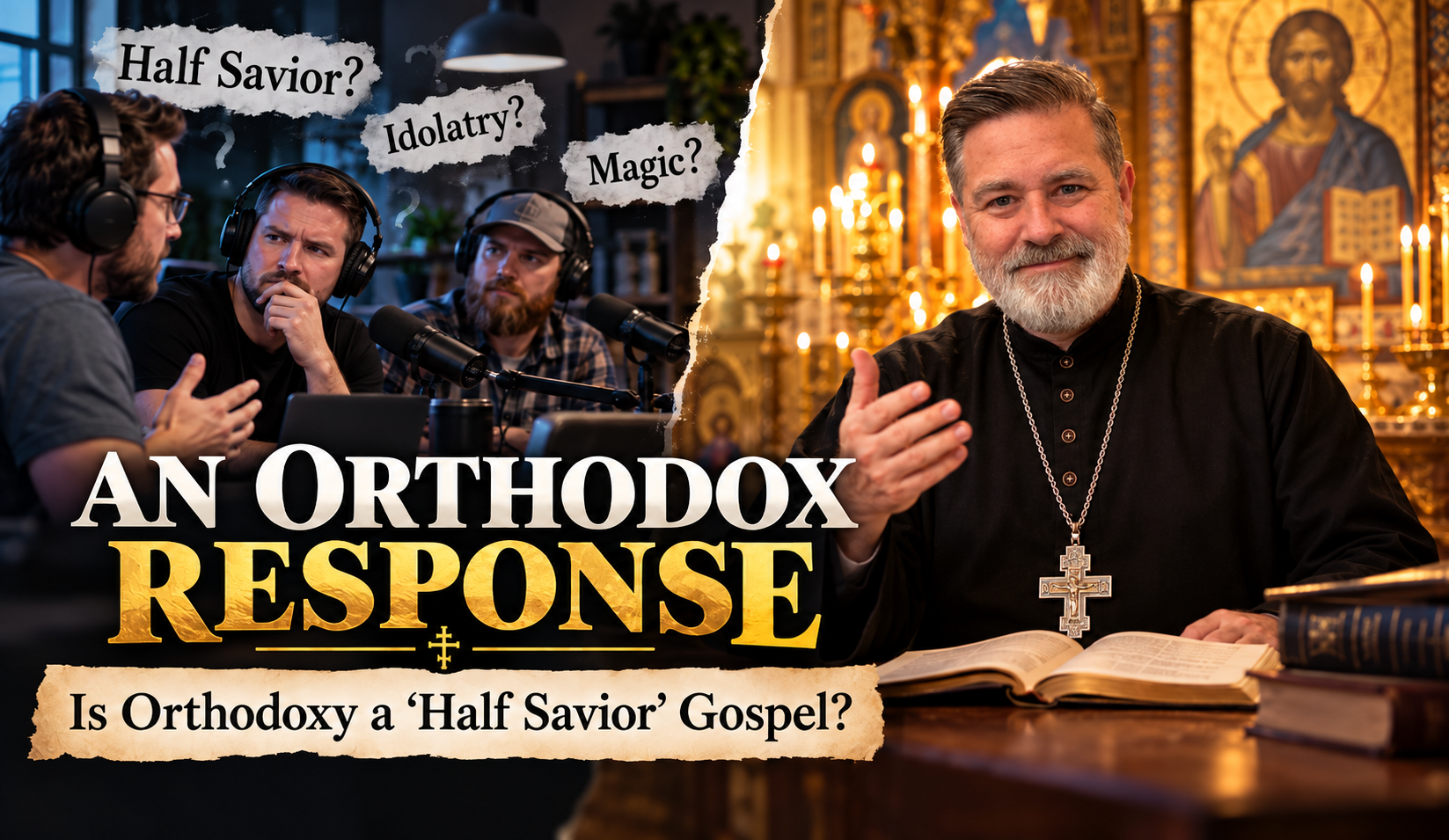
“Father Don, I visited an Orthodox Church with my family. They wouldn’t let me receive Communion because I’m not Orthodox. People kissed the priest’s hand. They called him ‘Father.’ They prayed before icons and honored the saints. It honestly felt legalistic and even idolatrous. Is the Orthodox Church really biblical?”
First, let me thank you for asking.
Questions like this are important because they reveal that someone genuinely desires to know the truth. God has never been threatened by honest questions. In fact, throughout the Scriptures we see men and women wrestling with God, seeking understanding, and being drawn deeper into communion with Him.
The problem is not asking questions.
The problem is assuming we already know the answers.
The Wrong Question
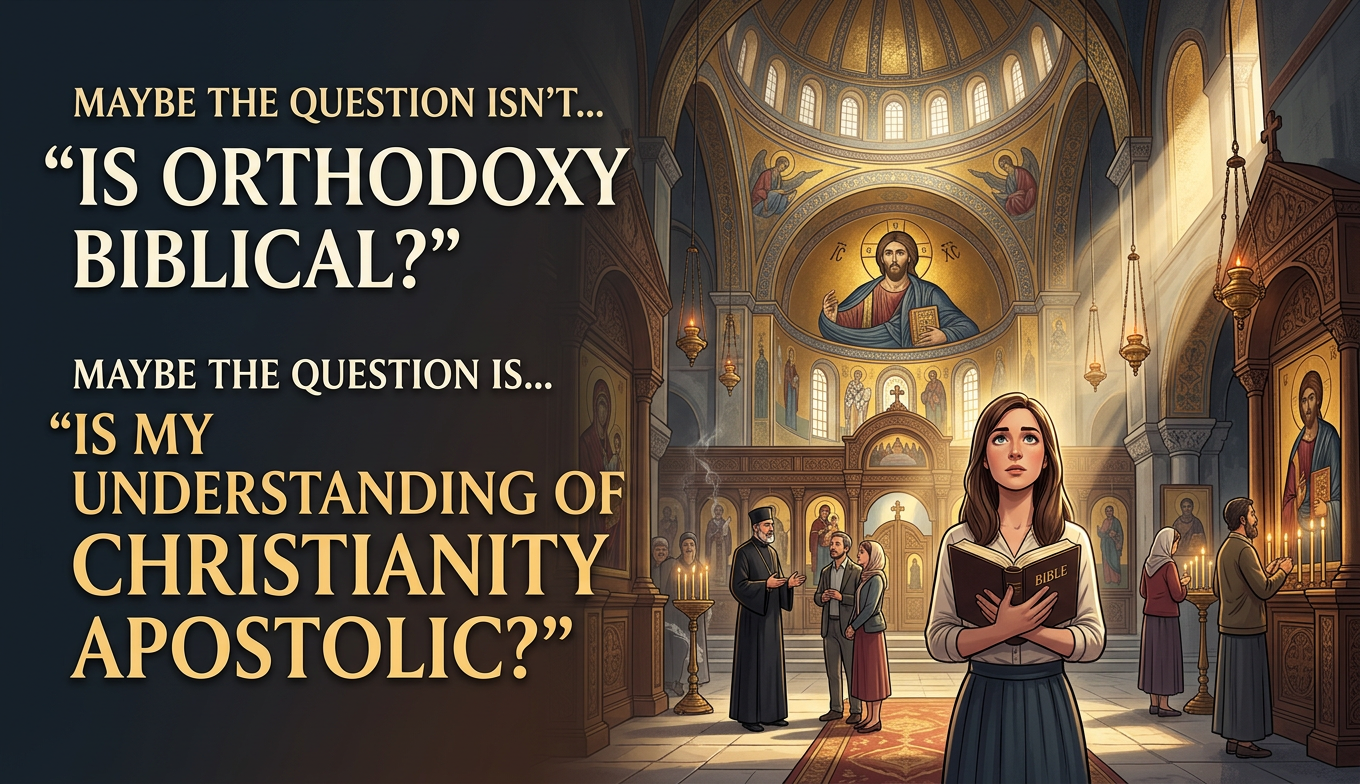
When most Protestants ask whether Orthodoxy is biblical, they are usually asking whether Orthodox worship looks like the style of Christianity they have always known.
Those are not the same thing.
The real question is this:
Did the Orthodox Church preserve the faith once delivered to the saints?
As St. Jude writes:
“Beloved… contend earnestly for the faith which was once for all delivered to the saints.” (Jude 3)
Notice something remarkable.
Jude does not say that the faith was once delivered as a completed New Testament.
He says it was delivered to the saints.
Christianity was lived before it was written.
The Church existed before the New Testament existed.
That single historical fact changes the entire conversation.
The Church Came Before the New Testament
Jesus never handed His Apostles a leather-bound Bible.
The Apostles preached.
They baptized.
They celebrated the Eucharist.
They ordained bishops.
They planted churches.
Years later they wrote letters to churches that already existed.
Even after every New Testament book had been written, Christians still did not possess a complete New Testament. Different churches possessed different apostolic writings.
It was the Church, guided by the Holy Spirit, that eventually recognized which books belonged to Scripture.
St. Paul even calls the Church:
“The pillar and ground of the truth.” (1 Timothy 3:15)
Notice what Paul does not say.
He does not call the Bible the pillar of truth.
He calls the Church the pillar of truth.
That does not diminish Scripture.
It explains who preserved it.
Scripture Never Teaches Scripture Alone
Many sincere Christians believe in sola Scriptura, the idea that Scripture alone is the Christian’s authority.
The difficulty is that Scripture never teaches that doctrine.
Instead, Paul writes:
“Stand fast and hold the traditions which you were taught, whether by word or our epistle.” (2 Thessalonians 2:15)
Notice the two sources.
Written tradition.
Oral tradition.
Both come from the Apostles.
Likewise, St. John concludes his Gospel by saying:
“There are also many other things that Jesus did, which if they were written one by one, I suppose that even the world itself could not contain the books.” (John 21:25)
The Apostolic Faith was never reduced to a book alone.
It was a living life in Christ.
Why Can’t Everyone Receive Communion?
Perhaps nothing surprises visitors more than being asked not to receive Holy Communion.
Many interpret this as exclusion.
Orthodoxy understands it as protection.
St. Paul warns:
“Whoever eats this bread or drinks this cup of the Lord in an unworthy manner will be guilty of the Body and Blood of the Lord… For he who eats and drinks unworthily eats and drinks judgment to himself.” (1 Corinthians 11:27-29)
If the Eucharist truly is the Body and Blood of Christ, then the Church has both the authority and the responsibility to guard it.
This practice is not new.
Around A.D. 155, St. Justin Martyr wrote:
“No one may share the Eucharist with us unless he believes our teachings are true, has been washed in baptism for the forgiveness of sins, and lives as Christ handed down.”
That was less than sixty years after the Apostle John died.
This was not a medieval invention.
It was Apostolic Christianity.
I would like to add that this is not unique.
The Roman Catholic Church practices closed Communion.
The Baptists withhold communion for those who are not Baptists. The Lutherans and Mennonites do the same.
Why Call a Priest “Father”?
Jesus said:
“Call no man your father on earth, for One is your Father, He who is in heaven.” (Matthew 23:9)
At first glance, this seems decisive.
Until we notice that Scripture itself repeatedly calls spiritual leaders fathers.
Paul tells the Corinthians:
“For though you might have ten thousand instructors in Christ, yet you do not have many fathers; for in Christ Jesus I have begotten you through the gospel.” (1 Corinthians 4:15)
Paul clearly saw himself as their spiritual father.
Jesus was condemning pride and religious hypocrisy, not abolishing spiritual fatherhood.
Otherwise we would also have to stop calling our biological fathers “father.”
Want to go deeper? Click Here to read my article titled, “Did Jesus Say Call No Man Father.”
What About Icons?
Perhaps no Orthodox practice is misunderstood more than icons.
The accusation is simple.
“Isn’t this idolatry?”
The answer is no.
In Exodus 20, God forbids the worship of idols.
Only a few chapters later, however, He commands Moses to place golden cherubim upon the Ark of the Covenant (Exodus 25:18-22).
Later, Solomon fills the Temple with carved angels, palm trees, oxen, lions, and pomegranates (1 Kings 6-7).
Images were never the problem.
The worship of representations of false gods was the problem.
The greatest defense of icons is actually the Incarnation.
“The Word became flesh and dwelt among us.” (John 1:14)
God, who was invisible, became visible.
Christ took on a human face.
As St. John of Damascus wrote:
“I do not worship matter. I worship the Creator of matter, who became matter for my sake.”
Icons proclaim that Christ truly became man.
Destroy the icon, and eventually you undermine the Incarnation.
Why Honor the Saints?
Many people fear that honoring saints somehow takes glory away from Christ.
The opposite is true.
Every saint is evidence that Christ’s grace transforms human beings.
Hebrews tells us:
“Therefore we also, since we are surrounded by so great a cloud of witnesses…” (Hebrews 12:1)
The saints are not dead.
Jesus Himself says:
“He is not the God of the dead but of the living.” (Matthew 22:32)
Death cannot separate members of Christ’s Body.
When Orthodox Christians ask a saint to pray for them, they are doing no more than asking another member of Christ’s Body to intercede before God.
The difference is simply that these members now stand before the throne of Christ.
What Did the Early Christians Believe?
One of the greatest surprises for many Protestants is reading the early Church Fathers.
St. Ignatius of Antioch, who learned directly from the Apostle John, wrote around A.D. 107:
“Where the bishop appears, there let the people be; just as wherever Jesus Christ is, there is the catholic Church.”
Notice what is already present.
The bishop.
The Church.
Unity.
Sacramental life.
Not individual interpretation.
St. Irenaeus, writing around A.D. 180, argued that true doctrine could be known because the Apostles had entrusted it to bishops who preserved it through succession.
His argument was not, “Read the Bible privately.”
His argument was, “Look to the Apostolic Churches.”
That is precisely what Orthodoxy still does.
The Bible Lives Best Inside the Church That Preserved It
The Orthodox Church does not stand above Scripture.
She stands beneath it.
She reads it.
Prays it.
Sings it.
Lives it.
The Divine Liturgy is saturated with Scripture from beginning to end.
Orthodoxy does not ask us to choose between Scripture and Tradition because such a choice would have made no sense to the Apostles.
Holy Tradition is simply the life of the Holy Spirit in the Church.
Scripture is its inspired heart.
A Final Thought
If you truly want to know whether Orthodoxy is biblical, then I encourage you to do something many people never do.
Read the Bible.
Read the Apostolic Fathers.
Read St. Ignatius.
Read St. Justin Martyr.
Read St. Irenaeus.
Read St. Athanasius.
Then ask yourself one simple question:
Which church today still believes, worships, and lives as these Christians did?
Truth has never been afraid of investigation.
Neither should we.
As our Lord Himself said:
“You shall know the truth, and the truth shall make you free.” (John 8:32)
Want the entire article distilled into one clear, printable page?
Download your free summary and keep it with you.
Get the free PDF + join thousands of people receiving short, practical Orthodox insights in the “Morning Brew with Father Don” to help you grow in Christ each week.