
How the Early Christians Understood Spiritual Warfare, Why American Christianity Has Lost Its Balance, and What Orthodoxy Still Teaches Us About the Invisible Battle
There is a war being fought for your soul right now.
You cannot see it. You cannot hear the enemy approaching. There are no explosions, no soldiers marching through the streets, and no warning sirens announcing that an attack is coming.
Yet the Church Fathers believed this battle was so real, so consequential, and so deeply woven into everyday Christian life that they devoted enormous portions of their teaching to understanding it.
And here is what should concern us.
The enemy does not need to convince you to worship Satan. He only needs to convince you that there is no spiritual battle worth fighting.
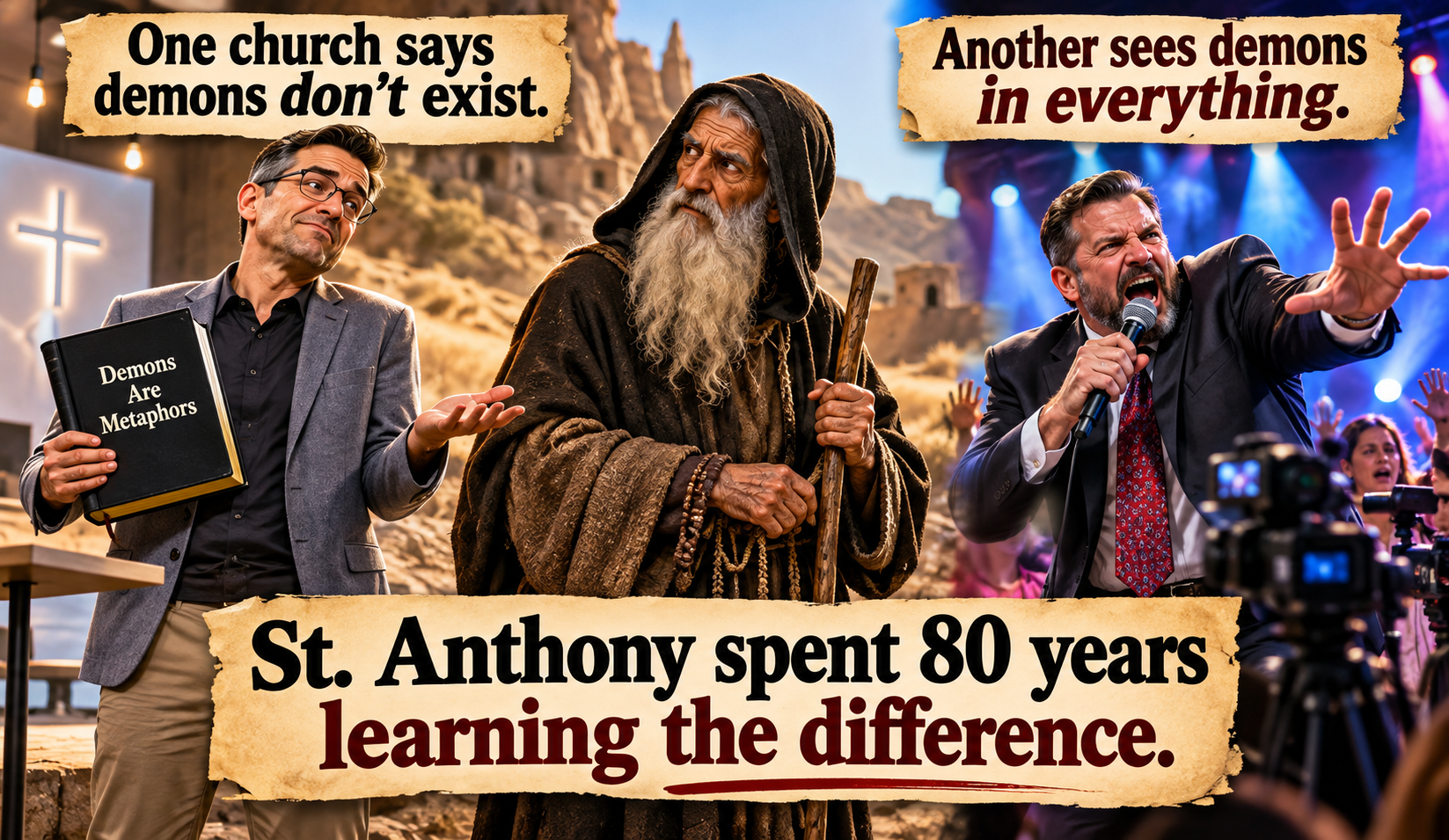
He can accomplish that by convincing you that demons are merely ancient superstitions. Or he can accomplish it by making you so obsessed with demons that you spend more time thinking about them than about Jesus Christ.
Either way, your attention has been diverted from the life of repentance, prayer, and holiness that actually defeats the enemy.
I spent many years in Protestant ministry before embracing the Orthodox Christian faith. One of the things that struck me as I began studying the early Church was just how seriously the Fathers understood spiritual warfare.
They were not embarrassed by the existence of demons. They did not explain away every encounter with evil as a psychological phenomenon. But neither did they turn spiritual warfare into a religious performance designed to attract crowds.
They understood something that much of modern American Christianity seems to have forgotten.
Spiritual warfare is not primarily about spectacular confrontations with demons. It is about the daily struggle for the human heart.
And as Halloween approaches, with images of demons, death, darkness, and occult power appearing everywhere around us, I believe this is a particularly important time to rediscover what the ancient Church actually taught.
The Early Church Did Not Consider Demons a Metaphor
When we read the New Testament, we encounter a spiritual world that is impossible to ignore.
Jesus Christ confronts demons repeatedly. He commands unclean spirits to depart, delivers people from bondage, and gives His apostles authority over the powers of darkness.
The Apostle Paul warns Christians:
“For we wrestle not against flesh and blood, but against principalities, against powers, against the rulers of the darkness of this world, against spiritual wickedness in high places.” (Ephesians 6:12)
Notice what Paul does not say.
He does not tell Christians that their struggle is simply against bad habits, difficult personalities, or unhealthy social structures.
Those things may certainly be involved in human suffering. But Paul identifies another dimension of our struggle. There are spiritual powers opposed to the purposes of God and to the salvation of humanity.
The Apostle Peter is equally direct:
“Be sober, be vigilant; because your adversary the devil, as a roaring lion, walketh about, seeking whom he may devour.” (1 Peter 5:8)
The early Christians took these warnings seriously.
They believed the devil and his demons were real created spiritual beings who had rebelled against God. They also understood that these beings were neither equal to God nor capable of overturning Christ’s victory.
They were dangerous, but they were defeated enemies.
That distinction is essential. We must never confuse recognizing the enemy’s activity with granting him authority he does not possess.
St. Anthony the Great: The Man Who Entered the Desert to Fight Demons
Few figures in Christian history illustrate the early Church’s understanding of spiritual warfare more powerfully than St. Anthony the Great (c. 251–356).
His life, recorded by St. Athanasius of Alexandria in The Life of Anthony, became one of the most influential works of early Christian spirituality.
Anthony withdrew into the Egyptian desert, not because he hated humanity, but because he wanted to devote himself completely to God.
What he encountered was not the peaceful retreat many of us might imagine.
According to St. Athanasius, Anthony endured severe demonic temptations, terrifying appearances, and even violent assaults. In one famous account, demons appeared to him in the forms of savage beasts, surrounding him with terrifying noises and threats.
Anthony was physically exhausted, yet he refused to surrender.
And when the demonic assault finally ended, he turned toward Christ.
Athanasius records a remarkable lesson from these experiences. Anthony taught that the demons sought to create fear precisely because they lacked the authority they pretended to possess.
He counseled Christians not to be intimidated by their appearances or threats.
His message was that the believer’s confidence must rest in Christ, not in his own courage.
What fascinates me most about Anthony is not the extraordinary nature of the encounters.
It is how he responded.
He did not become fascinated with demons. He did not build a ministry around describing supernatural encounters. He did not encourage people to chase spiritual manifestations.
He returned to prayer, fasting, watchfulness, and the pursuit of holiness.
Anthony understood that the purpose of spiritual warfare was not to become an expert on demons. It was to become more deeply united to Jesus Christ.
That is an important distinction, especially in a religious culture that often confuses supernatural excitement with spiritual maturity.
Evagrius Ponticus: The Most Dangerous Battles Begin in Your Thoughts
Another of the great early Christian spiritual teachers, Evagrius Ponticus (c. 345–399), helped develop one of the most detailed accounts of spiritual temptation in ancient Christianity.
Rather than concentrating primarily on frightening supernatural experiences, Evagrius examined how evil thoughts enter the mind and gradually influence the heart.
Evagrius identified eight principal categories of tempting thoughts: gluttony, lust, avarice, sadness, anger, acedia or spiritual listlessness, vainglory, and pride.
These categories later influenced the Western Christian tradition’s teaching about the seven deadly sins.
But Evagrius was examining something deeper than a list of moral failures.
He was describing how temptation develops.
Consider how this works in ordinary life.
Someone insults you. Initially, you experience a moment of irritation. That may pass quickly.
But instead of letting it go, you begin replaying the conversation.
You imagine what you should have said. You picture yourself confronting the person. You become increasingly angry.
Eventually, resentment takes root.
The original incident may have lasted thirty seconds, but you have allowed it to occupy your mind for hours.
Evagrius taught that spiritual warfare frequently begins in exactly this kind of interior struggle.
In The Praktikos, he writes:
“A wandering mind is stilled by reading and vigil and prayer.”
He also warns about the demon of pride, who persuades a person to attribute spiritual success to himself rather than to God’s help.
Think about the implications.
The enemy does not always need to tempt us with something spectacular.
Sometimes he simply encourages us to keep nurturing the resentment we already feel.
Sometimes he convinces us that our anger is righteous, our selfishness is justified, and our pride is spiritual maturity.
And sometimes the most effective temptation is to make us so distracted by the noise of everyday life that we never develop a meaningful life of prayer.
Evagrius understood that the mind is often where the battle begins, although he did not regard every unwanted thought as demonic.
Not every thought deserves your attention, and not every thought should be welcomed into your heart.
This is why the Orthodox tradition places such a strong emphasis on nepsis, or spiritual watchfulness.
We learn to observe our thoughts without automatically accepting them, consenting to them, or allowing them to shape our character.
Spiritual warfare often begins with a simple decision: Will I entertain this temptation, or will I turn my attention toward Christ?
St. John Cassian: Demons Can Tempt You, but They Cannot Make Your Choices
St. John Cassian (c. 360–435), who learned from the Egyptian desert monks, preserved much of their spiritual wisdom in his Conferences.
Cassian’s teaching is especially important because it protects Christians from another serious error: believing that demons can simply overpower human freedom.
In his seventh conference, Cassian records the teaching of Abba Serenus, who explains that the demonic powers may incite people toward evil, but they cannot ordinarily compel them to consent.
Serenus declares:
“For greater is He who is in us than he who is in this world.”
He explains that while demonic powers possess the ability to suggest evil, human beings retain the freedom to reject that suggestion, assisted by the grace of God.
Consider how liberating this teaching is.
You may experience temptation. You may struggle with destructive habits. You may encounter thoughts that frighten or disturb you.
But you are not helpless.
The enemy cannot simply erase your freedom.
God has not abandoned you to fight alone.
And the Christian response is not to surrender responsibility for our actions by blaming everything on demons.
We repent. We pray. We resist temptation. We seek help from the Church. We learn to cooperate with the grace of God.
This teaching is particularly relevant today because some forms of modern Christianity treat spiritual warfare as if the devil is responsible for nearly every personal failure.
Anger becomes a demon. Greed becomes a demon. A troubled marriage becomes a demon.
But the Fathers understood that we must also confront our own passions, habits, choices, and unwillingness to repent.
Sometimes the problem is not that a demon has taken control of our lives.
Sometimes the problem is that we simply refuse to surrender our lives to Christ.
And that is precisely where repentance must begin.
Two Extremes in American Christianity That Miss the Point
When I look at much of contemporary American Christianity, I see two opposite approaches to spiritual warfare.
One dismisses the reality of demons almost entirely.
The other seems to discover demons everywhere.
And I believe both approaches can leave Christians spiritually vulnerable, although for very different reasons.
The First Extreme: Christianity Without a Spiritual Enemy
In certain expressions of modern, progressive Christianity, Satan is no longer understood as a real spiritual being.
Instead, the devil becomes a metaphor for human evil, destructive social systems, or the darker tendencies of human nature.
We can find a clear example in the writings of progressive Christian author Bo McGuffee, who has described how progressive Christians often understand Satan symbolically rather than as a literal spiritual being responsible for evil.
This perspective does not necessarily deny that evil exists. It offers a different explanation for its nature and origins.
But that explanation creates a serious theological problem when measured against the witness of Scripture and the early Church.
If Satan is merely a symbol, what are we to make of Christ’s temptation in the wilderness?
Was Jesus simply confronting His own psychological weaknesses?
When Christ cast demons out of suffering people, was He merely dramatizing the healing of emotional problems?
And when St. Paul warned Christians about principalities and powers, was he simply using poetic language to describe difficult human relationships?
Certainly, Scripture contains figurative language, and not every passage should be interpreted with wooden literalism.
But the Church Fathers consistently understood the existence of fallen spiritual beings as part of the Christian understanding of creation and redemption.
Interestingly, contemporary American religious surveys demonstrate a significant difference between belief in God and belief in demonic powers.
For example, a 2026 American Bible Society survey reported that 68% of Americans believed in God, while 55% believed in Satan and 51% believed in demons.
That does not tell us how often pastors preach about spiritual warfare. But it does reveal that belief in the supernatural is far from uniform, even in a society where religious belief remains widespread.
I believe something important has been lost when Christianity becomes uncomfortable discussing the very spiritual realities that Jesus and His apostles addressed so frequently.
The problem is not that Christians should abandon reason, medical science, or psychology.
Those are important tools for understanding the human condition.
The problem arises when we assume that material explanations exhaust every dimension of human existence.
The Orthodox Church has never taught that every sickness, emotional struggle, or mental health condition is caused by demons.
But neither has she accepted the assumption that the spiritual realm ceases to exist simply because modern society finds it uncomfortable.
A Christianity that eliminates the spiritual enemy eventually struggles to explain why the New Testament speaks so seriously about spiritual warfare.
The Second Extreme: When Deliverance Becomes a Spectacle
At the opposite end of the Protestant spectrum, we find some charismatic and independent ministries where spiritual warfare becomes a central feature of public religious activity.
In these settings, demons are sometimes identified as the cause of nearly every personal struggle.
A person suffers from anxiety. Perhaps it is a demon.
A marriage is in trouble. Perhaps it is a demon.
Someone struggles financially. Perhaps a spirit of poverty needs to be expelled.
The problem with this approach is not belief in demonic activity.
The problem is the tendency to attribute too much to demons while turning deliverance into a public demonstration of spiritual authority.
And these concerns are not merely hypothetical.
For example, evangelist Isaiah Saldivar has promoted large-scale deliverance gatherings, including a Mass Deliverance service at V1 Church in Westbury, New York, in October 2021. His ministry has also advertised deliverance conferences involving other well-known ministers.
These gatherings illustrate how deliverance has become a prominent public ministry within certain contemporary Christian circles.
The existence of such events does not prove that they are fraudulent, and we should not presume to know the motives of those involved.
But they raise an important question.
When spiritual warfare becomes a public event, how do we distinguish genuine spiritual healing from emotional excitement, suggestion, or religious performance?
The early Church certainly believed in exorcism.
Jesus cast out demons. The apostles cast out demons. The Fathers recorded extraordinary encounters with the powers of darkness.
Orthodoxy has never denied that God can deliver people from demonic oppression.
But the Fathers consistently emphasized humility, discernment, and obedience.
They also understood that the ability to confront demons is not a reliable measurement of spiritual maturity.
Jesus Himself warned His disciples:
“Nevertheless do not rejoice in this, that the spirits are subject to you; but rejoice that your names are written in heaven.” (Luke 10:20)
Think about that for a moment.
The disciples had returned from an extraordinary mission. They had witnessed the powers of darkness submitting to the authority of Christ.
And Jesus redirected their attention away from the spectacular.
He told them that their greatest joy should not be their authority over demons, but their relationship with God.
That is an astonishing correction.
And I believe it is one that parts of modern American Christianity desperately need to hear.
The danger of sensationalized deliverance is that people may begin seeking supernatural experiences rather than spiritual transformation.
They may become dependent upon powerful personalities rather than developing a life of prayer.
They may look for a dramatic moment of deliverance while neglecting the ongoing repentance necessary for spiritual healing.
Worst of all, vulnerable individuals may be encouraged to interpret legitimate medical or psychological conditions as evidence of demonic possession, delaying the care they genuinely need.
The Fathers would have recognized the danger of pride in this.
And they would have reminded us that the Christian life is not measured by how loudly we confront demons, but by how faithfully we follow Christ.
We should also recognize that many Protestant and Pentecostal Christians approach prayer for deliverance with genuine reverence and pastoral responsibility. The excesses of certain ministries do not define everyone within those traditions.
Nevertheless, public spectacle should never replace spiritual discernment.
Orthodoxy Offers a Different Understanding of Spiritual Warfare
What I find so compelling about the Orthodox Church is that she has preserved a remarkably balanced understanding of the spiritual realm.
Orthodoxy does not pretend demons are imaginary.
But neither does she encourage Christians to become obsessed with them.
In fact, some of the clearest evidence of this balanced theology can be found in one of the Church’s most fundamental sacraments.
Baptism.
The Battle Begins With Renouncing Satan
Before a person is baptized in the Orthodox Church, the baptismal service includes prayers of exorcism and a formal renunciation of Satan.
The priest prays that the person preparing for baptism will be delivered from the powers of darkness.
The candidate is then asked to renounce Satan and his works before turning toward Christ.
This is not a modern invention or an unusual ceremony performed only when someone is believed to be possessed.
It is part of the Church’s ordinary preparation for baptism.
Think about the theological significance.
The Church recognizes that becoming a Christian involves a change of allegiance.
We are turning away from the dominion of sin and death and entering into the life of Christ.
Baptism is not simply a public announcement of our religious beliefs.
It is participation in Christ’s death and resurrection.
We are united to the One who has conquered death, defeated the devil, and opened the way to eternal life.
This is why the Orthodox Church takes the spiritual world seriously without making demons the center of our worship.
Christ is the center. The defeat of Satan is a consequence of Christ’s victory.
The Ordinary Christian Life Is Spiritual Warfare
When we examine the lives of the saints, we discover that spiritual warfare was not limited to extraordinary encounters.
It was woven into the ordinary disciplines of Christian living.
Prayer was spiritual warfare because it directed the heart toward God.
Fasting was spiritual warfare because it trained the passions rather than allowing them to rule us.
Confession was spiritual warfare because it brought hidden sins into the light of repentance.
Forgiveness was spiritual warfare because it denied resentment the opportunity to poison the soul.
The Eucharist was central because the Christian life is not merely an attempt to avoid evil. It is communion with the living Christ.
This is especially important.
The Orthodox understanding of salvation is not simply about being declared innocent before God.
It is about being healed and transformed through participation in His divine life.
We call this theosis.
The aim is not to become someone who knows everything about demons.
The aim is to become someone whose heart is increasingly purified by the grace of God.
St. Evagrius expressed this relationship between the spiritual struggle and its purpose with remarkable clarity:
“Love is the offspring of dispassion.”
In The Praktikos, he describes spiritual discipline, watchfulness, and growth in virtue as part of the journey toward love and true knowledge of God.
That is where spiritual warfare must lead.
Not fear.
Not obsession.
Not spiritual pride.
Love.
Love for God and love for our neighbor.
If someone’s understanding of spiritual warfare makes them increasingly suspicious, fearful, arrogant, or preoccupied with demons, something has gone wrong.
The fruit of genuine Christian spiritual struggle should be deeper repentance, humility, peace, and communion with Christ.
Halloween Reveals How Confused We Have Become About Darkness
As we approach Halloween, we encounter another fascinating contradiction in American culture.
Millions of people who would laugh at the suggestion that demons are real will spend an evening decorating their homes with images of demons, displaying symbols of occult power, and celebrating frightening portrayals of the supernatural.
And Christians often find themselves divided over how to respond.
Some dismiss the entire discussion.
“It’s just harmless fun,” they say.
Others respond as if every plastic skeleton, carved pumpkin, or child wearing a costume represents a direct invitation to demonic activity.
Once again, we encounter the two extremes.
And once again, the Orthodox tradition gives us a better way to think about the issue.
First, we should be careful not to confuse every cultural Halloween custom with occult participation.
A child dressing up as a firefighter or a princess and collecting candy is not necessarily engaging in anything spiritually dangerous.
Nor should we pretend that every Halloween decoration possesses some supernatural power.
Christians should not be governed by superstition.
But we should also ask a deeper question.
Why has our culture become so fascinated with making evil entertaining?
Why do we enjoy watching human suffering presented as amusement?
Why do we voluntarily immerse ourselves in stories and imagery designed to cultivate terror, cruelty, and despair?
Why have demonic images become fashionable decorations while serious conversations about the existence of demons are often considered embarrassing?
Those questions deserve more than a dismissive response.
The Orthodox Fathers understood that what we repeatedly expose ourselves to influences our inner life.
What we watch, imagine, contemplate, and celebrate can shape our thoughts and desires.
This does not mean that watching a horror movie automatically results in demonic oppression.
It means that Christians should exercise discernment concerning the things they willingly invite into their imaginations.
The Apostle Paul gives us a principle worth remembering:
“Whatsoever things are true, whatsoever things are honest, whatsoever things are just, whatsoever things are pure, whatsoever things are lovely, whatsoever things are of good report; if there be any virtue, and if there be any praise, think on these things.” (Philippians 4:8)
Notice that Paul directs our attention toward the formation of the mind.
He understood that our thoughts matter.
And the Fathers developed an entire spiritual discipline around that understanding.
We Should Not Celebrate What Christ Came to Defeat
I am not interested in turning Halloween into an occasion for condemning parents or frightening children.
But I do believe Christians should consider the spiritual messages communicated by the things they celebrate.
Death is not simply a source of entertainment within the Christian understanding of the world.
Death is an enemy Christ came to conquer.
Evil is not something Christians should admire.
It is a corruption of God’s good creation.
And demons are not merely amusing supernatural characters invented to give us a seasonal thrill.
The Orthodox Church teaches that they are real spiritual beings who seek to lead humanity away from God.
That does not mean we must spend October living in fear.
Quite the opposite.
It means we should remember that Christ has already defeated the powers of darkness.
The most appropriate Christian response to a culture fascinated by death is to proclaim the Resurrection.
The most appropriate response to a culture entertained by evil is to pursue holiness.
And the most appropriate response to a culture increasingly confused about spiritual reality is to recover the ancient Christian life of prayer.
The Greatest Victory of the Enemy May Be Our Distraction
There is something particularly revealing about the temptations described by the Desert Fathers.
Their writings do not suggest that the enemy always needs to destroy our faith through some dramatic supernatural confrontation.
Sometimes all he needs to do is make prayer seem unimportant.
Sometimes he simply encourages us to remain angry.
Sometimes he convinces us that we can postpone repentance until tomorrow.
Sometimes he makes us too busy to examine our souls.
Or he keeps us so occupied with religious controversies that we neglect our actual relationship with God.
St. John Cassian, Evagrius Ponticus, and St. Anthony all understood that the Christian life requires vigilance because temptation frequently arrives through ordinary experiences.
And that brings us to a question worth asking.
When was the last time you thought seriously about the condition of your soul?
Not the condition of the world.
Not the behavior of politicians.
Not the failures of other Christians.
Your soul.
Are you becoming more patient?
Are you growing in humility?
Are you learning to forgive?
Are you developing a consistent life of prayer?
Are you participating faithfully in the sacramental life of the Church?
Are you learning to recognize temptation before you give it a place in your heart?
These questions may not produce exciting social media videos.
They may not attract thousands of people to a deliverance conference.
But they represent the kind of spiritual warfare that occupied the attention of the greatest saints in Christian history.
Five Ways to Recover the Ancient Christian Understanding of Spiritual Warfare
If we want to recover the spiritual wisdom of the early Church, we must begin by practicing it.
- Establish a daily rule of prayer. Begin and end your day by turning toward Christ. Even a modest, consistent prayer rule is spiritually valuable. The Jesus Prayer, “Lord Jesus Christ, Son of God, have mercy on me, a sinner,” is a particularly important part of the Orthodox tradition.
- Learn to recognize and resist tempting thoughts. You do not need to examine every troubling thought or assign it a supernatural origin. When a thought invites anger, pride, despair, or another passion, refuse to nurture it. Redirect your attention toward Christ.
- Practice confession and repentance. Spiritual healing requires honesty. Instead of continually blaming outside forces for our problems, we must acknowledge our own sins and seek the grace of God to change.
- Participate in the sacramental life of the Church. The Divine Liturgy, the Eucharist, confession, fasting, and the Church’s common prayer are not optional decorations added to Christianity. They are part of the life through which we grow in communion with Christ.
- Seek discernment rather than supernatural excitement. Do not become preoccupied with identifying demons or chasing extraordinary experiences. If you believe you are experiencing serious spiritual distress, speak with a trusted priest. Where medical or mental health concerns are involved, seek appropriate professional care as well.
None of these practices is particularly glamorous.
None requires a stage, television cameras, or an emotional public demonstration.
But these are precisely the practices through which Christians have pursued holiness for centuries.
And that should tell us something.
Conclusion: The Church Fathers Feared Sin More Than Demons
I want to leave you with one final thought.
The Church Fathers spoke extensively about demons because they understood the seriousness of spiritual warfare.
But they did not teach Christians to live in terror.
They taught them to live in Christ.
St. Anthony confronted terrifying demonic appearances, yet his confidence was in the Lord.
Evagrius examined the thoughts and passions because he understood that the heart must be purified.
St. John Cassian taught that demons can tempt us, but they cannot simply force us to surrender our freedom.
And all of them understood that spiritual warfare was ultimately inseparable from the Christian journey toward union with God.
This is the understanding we desperately need to recover.
American Christianity does not need another generation of believers who pretend that the spiritual world does not exist.
Nor does it need another generation obsessed with discovering demons behind every personal difficulty.
We need Christians who know how to pray, how to repent, how to resist temptation, and how to live in the presence of God.
And as Halloween approaches, I want you to consider something.
Our culture is preparing to celebrate an evening filled with images of demons, ghosts, witches, death, and darkness.
Yet many of the people participating have never seriously considered what Christianity actually teaches about any of these things.
Are demons real?
What happens to the soul after death?
Are ghosts the spirits of those who have departed, or could something else be involved?
Why did the early Christians warn so strongly about occult practices?
And how should Christians respond to a culture that increasingly treats spiritual darkness as entertainment?
These are not questions we should answer with superstition, fear, or sensationalism.
They deserve thoughtful, historically grounded answers rooted in Scripture, the Church Fathers, and the spiritual wisdom of Orthodox Christianity.
Because the ultimate purpose of understanding spiritual warfare is not to become fascinated with darkness.
It is to learn how to live in the light of Jesus Christ.
The greatest victory we can experience over the powers of darkness is not a spectacular confrontation with a demon. It is a life increasingly surrendered to Christ.
And that is precisely the kind of faith the early Church sought to cultivate.
Go Deeper: Explore My Halloween Series on the Unseen Spiritual World
What if everything you thought you knew about ghosts, demons, death, and the supernatural was shaped more by Hollywood than by historic Christianity?
As Halloween approaches, I want to invite you to go beyond the costumes, frightening movies, and cultural fascination with darkness to discover what the ancient Christian Church actually believed.
I have put together a special Halloween series exploring the spiritual realities that our modern world either dismisses entirely or sensationalizes beyond recognition.
Through this series, we explore the reality of demons, the ancient Christian understanding of spiritual warfare, the mystery of death and the departed, and why the Church Fathers took the unseen world so seriously.
But this is not about creating fear.
It is about replacing fear with understanding, superstition with truth, and fascination with darkness with a deeper relationship with Jesus Christ.
You do not need to be afraid of the spiritual world. But you do need to understand it.
If you have been curious about what the early Church believed, or if you want to develop a deeper understanding of the spiritual battle taking place around us, I invite you to explore this special Halloween series.
Discover the ancient Christian understanding of the unseen world and the victory we have in Jesus Christ.
Click Here To Learn More, Explore the Halloween Series or Get Your Copies Today
Want the entire article distilled into one clear, printable page?
Download your free summary and keep it with you.
Get the free PDF + join thousands of people receiving short, practical Orthodox insights in the “Morning Brew with Father Don” to help you grow in Christ each week.